 DriveHub
Country guide · Ireland · 6 min
Mileage allowance in Ireland for your own car: what the civil service rates cover
You use your own car for work in Ireland and want the mileage allowance. The civil service motor travel rates are what your employer may pay tax-free, with records, and they are not a rate you can apply to yourself.

The short answer
- Which rates? The civil service motor travel rates, in force from 1 September 2022 (Circular 16/2022, Revised Motor Travel Rates).
- Who pays them? Your employer. They are an employer's rates: the employer reimburses, and keeps the records.
- How are they built? Per kilometre, in four cumulative distance bands, by engine-capacity class. The band follows your cumulative business kilometres for the year.
- What must be kept? A record of each journey, listed below, under Revenue's Tax and Duty Manual Part 05-01-06, section 1.3.
- For how long? Six years.
- Sole trader? No. Revenue won't accept a deduction based on the civil service rates.
- Employee nobody reimburses? No. You can't apply the rates to yourself.
Who sets the rates, and who they are for
The rates are set by the Department of Public Expenditure, Infrastructure, Public Service Reform and Digitalisation, by circular. The rates in force from 1 September 2022 come from Circular 16/2022, Revised Motor Travel Rates, dated 27 July 2022. The tax authority is the Office of the Revenue Commissioners, known as Revenue.
The word that matters is reimburse. These are rates an employer pays. They are not a deduction you pick up on your tax return.
How the figure works: four bands, three engine classes
The payment is per kilometre, and the rate changes as the year's business kilometres add up. There are four cumulative distance bands:
| Band | Business kilometres in the year |
|---|---|
| 1 | 0 to 1 500 |
| 2 | 1 501 to 5 500 |
| 3 | 5 501 to 25 000 |
| 4 | 25 001 and over |
Within each band the rate depends on the engine-capacity class of the car, and there are three classes. The circular carries the actual rates for each combination. Check them there, or ask your payroll team which rate sheet applies to you.
Two points trip people up:
- The band follows the year, not the trip. A kilometre belongs to a band by where it falls in your cumulative business kilometres for the year. The 1 501st kilometre is the first of band 2, whichever journey it is on.
- Motorcycles and bicycles are separate. Motorcycles have their own bands, and the bicycle rate is 8 cent.
So the band can only be right if the year's kilometres are right. A journey missing from the log lowers the total and can leave later kilometres in an earlier band than the one they belong to.
What the employer must keep
For a flat-rate reimbursement, Revenue's Tax and Duty Manual Part 05-01-06, section 1.3, says "the employer must retain a record of":
- the employee's name and address,
- "The date of the journey",
- "The reason for the journey",
- "The kilometres travelled",
- "The starting point, destination and finishing point of the journey",
- and the basis of the reimbursement.
The record sits with the employer, not with you. In practice the employer can only keep it if you hand over the details of each journey, so it pays to hold them yourself as you go.
The record is kept for six years.
Can a sole trader use the civil service rates?
No. The Tax and Duty Manual Part 04-10-01 is direct: "Revenue will not accept deductions for travel or subsistence expenses of sole traders based on the civil service rates".
If you are self-employed, these rates give you no per-kilometre figure to deduct. This guide doesn't set out another figure for sole traders, because the Irish rules it follows don't give one.
What if my employer doesn't reimburse me?
Then the rates don't apply to you either. Tax and Duty Manual Part 05-01-06, section 1: "There are no circumstances where it would be appropriate for a taxpayer to apply the civil service rates of travel and subsistence to themselves".
An employee nobody reimburses has no figure in these rules. If your employer pays nothing, or pays less than the rates, the rates are not a number you can claim against. Ask your payroll team or your accountant what applies to your case, and keep the journey records anyway.
A worked example of the bands
You drive 6 000 business kilometres in a year in your own car, all paid by your employer.
- The first 1 500 km are paid in band 1.
- The next 4 000 km (1 501 to 5 500) are paid in band 2.
- The last 500 km (5 501 to 6 000) are paid in band 3.
That is the same 6 000 kilometres, in three bands. The rate in each is the rate for your car's engine-capacity class in the circular. If one 40 km journey is missing from the log, the total is 5 960 km, and the figure the employer pays and records changes with it.
Before your employer pays you mileage
- Every business journey has its date, the reason, the kilometres and the start, destination and finish.
- The year's kilometres are added up in order, so each one lands in the right band.
- Your employer has your name and address and knows the basis of the reimbursement.
- The record is kept for six years.
- If you are a sole trader, you are not using these rates at all.
How DriveHub makes this easier
What goes missing from a mileage record is the short journey nobody wrote down. With the bands, a gap also moves the kilometres after it.
With location access set to Always, DriveHub records trips in the background. It checks for possible missed drives when iPhone motion history is available. It keeps the date, both ends and the distance. DriveHub files most trips as Business or Personal by your places, past routes and working hours, and asks you about the rest. Add the reason in your own words.
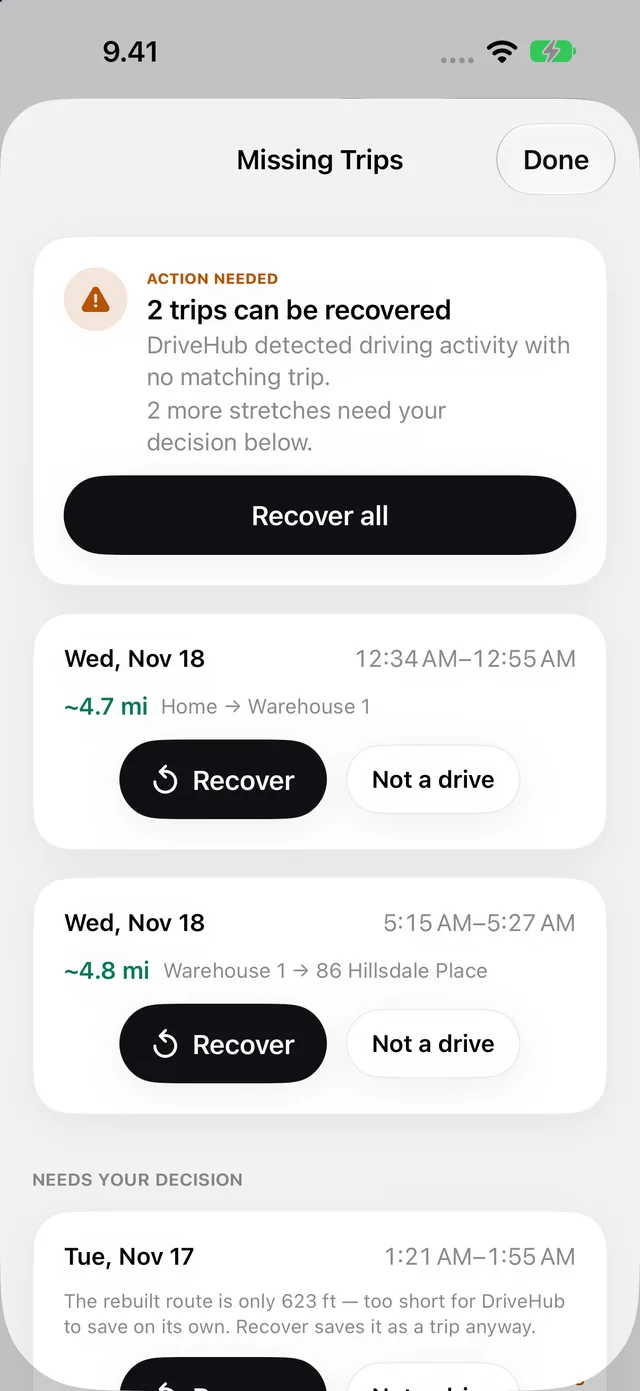
If your iPhone logged driving with no matching trip, a missed-trip item appears under Needs you on Trips. It opens Missing Trips, where each drive has Recover, so a journey can be put back before the figures go to your employer.
For Ireland, the report prints the date, the purpose, the kilometres and both ends of each journey. Each journey is priced at the civil service rate for its band and your car's engine size: a fully electric car uses the 1201–1500 cc column, and a car with no engine size entered uses the lowest column. Your name and address, and the basis of the reimbursement, are your employer's payroll record, so DriveHub doesn't print them, and it files nothing with Revenue.
DriveHub is on the App Store for iPhone. The Irish rules it follows are on the Ireland page, and setting up automatic tracking takes a few minutes, once. For ways to keep the record, see four ways to keep a mileage log.
This page states what Revenue and the circular say, and cites them so you can check. It is not tax advice. It can't account for your circumstances. Where money is involved, ask your employer's payroll team or your accountant — and bring the log.
Official sources
- Revenue: civil service rates — Motoring reimbursement rate bands.
Do it in DriveHub
Employment dates, different rates and trips for more than one job.
The full rule for Ireland, with the instruments it comes from: mileage log requirements in Ireland.