 DriveHub
How-to · 9 min
How to keep a mileage log: four ways, checked against what tax offices ask for
Tax authorities from the IRS to the ATO accept more than one way of keeping a mileage log. What differs is which method keeps the record the rules actually ask for — made at the time, complete, and still readable years later — and which one quietly loses it.

The short answer
None of the authorities quoted below prescribes a medium. Paper, a spreadsheet, a device in the car and an app on your phone can all produce an acceptable log. What they do not produce equally is the record the rules turn on: an entry made at or near the time of the drive, with every field your country lists, a total for the year that includes private driving, and a file you can still hand over years later.
- Paper meets every rule on the day it is filled in, and fails on the days it is not.
- A spreadsheet is easy to total and easy to change without a trace, and it is usually filled in from memory.
- A GPS device fitted to the car records the car, not the driver, and still leaves the reason for each trip to you.
- An automatic phone app records the driver wherever they drive, and is sound only if it notices when it missed a drive.
| Paper | Spreadsheet | GPS device | Phone app | |
|---|---|---|---|---|
| Made at the time | Only if you write at the end of each drive | Usually filled in afterwards | Yes, by itself | Yes, by itself |
| Every field | If you remember each one | If you type each one | Times and places; the reason is yours | Start, end, times, distance; the reason is yours |
| Year total, private included | Private trips are the first skipped | A formula, if every trip is in | That car only | You, in any car |
| Change history | A crossed-out line stays visible | None; any cell can change | — | — |
| Kept readable for years | If the book survives the drawer | Easy to copy and back up | — | If it exports a readable file |
A dash means the answer depends on the product rather than the method; the questions to ask of it are under How to choose one.
The rest of this page is the evidence for each of those lines, from the authorities' own texts, and a way to decide.
What does a tax office actually ask of a log?
Four requirements come up in almost every country, in different words.
1. Made at the time, not reconstructed. The IRS does not demand a same-day entry — 26 CFR § 1.274-5T says "a contemporaneous log is not required", and a weekly log counts as a record made "at or near the time". But it also says such a record "has a high degree of credibility", which is the point: a log written in March about last August has far less.
Other authorities say the same in their own terms. HMRC says a log must be kept in a timely way and that estimating is not accepted. Australia wants each log book entry made at the end of the journey or as soon as possible afterwards. Germany wants the Fahrtenbuch kept "zeitnah und in geschlossener Form" — promptly, and as one closed sequence.
2. The same fields for every trip. Almost everywhere: the date, where you started and ended, the distance, and the reason. Then each country adds its own. The UK wants the postcode at both ends of every journey. Germany wants the odometer at the start and end of each business trip and the business partner visited (Germany). For a company car, the Netherlands wants the odometer and both addresses for private trips too. An electronic Swedish körjournal must hold every heading in Skatteverket's example list (Sweden).
3. A figure for the whole year, not only the business part. The IRS asks for "the total miles for the year" as well as the business miles (United States); Australia asks for odometer readings on 1 July and 30 June; Canada at the start and end of the fiscal period. The business share is business kilometres over total kilometres, and a log of business trips supplies only one half of that fraction.
4. Kept, and readable, for years. Ten years for a German Fahrtenbuch. Seven for a Dutch business's records, counted from when a record stops being current. In Canada, six years from the end of the last tax year a base-year log is used for, which can mean eleven. In the UK, five years after the 31 January filing deadline for the self-employed. Canada adds, in s. 230 of its Income Tax Act, that a record kept electronically must be kept in an electronically readable format for that whole period, even if you also have printouts.
Two more rules decide how a correction has to look, and they separate the methods more than any field does. Germany's Federal Fiscal Court held in 2024 that an electronic logbook file whose entries can still be changed is acceptable only if the extent of the changes is documented in the file itself. Denmark's bookkeeping act, bogføringsloven § 9 stk. 3, requires any correction to leave both the original content and the change visible, and it draws no line between paper and electronic records.
Paper logbook
A paper logbook is accepted by every authority quoted on this page. Germany's courts accept one; Skatteverket accepts paper; the ATO names "a paper logbook" in so many words; the CRA accepts records in "paper format". If you fill it in at the end of every drive, with every field your country lists, it is as good a record as any.
What it gets right. It is made at the time, by definition, if you make it at the time. A crossed-out line stays on the page, so the original and the correction both remain visible: what Denmark asks of every record, paper or electronic, and what Germany asks of an electronic one. It needs no battery and no permission.
What it gets wrong. Everything that depends on you remembering, every time. The distance is rarely what goes missing. What goes missing is the start of a trip — the postcode you set off from, the odometer before you turned the key — because at the time you had no reason to write it down. Private trips are the first to be skipped, and they are the ones the year's total needs; a German logbook with a gap is invalid for the whole year, not only for the missing trips.
The arithmetic — the year's total, the business percentage — is left for a busy evening in March. And the book itself has to survive ten years in a drawer.
When it is the right choice. A short, bounded period with few trips: Australia's twelve-week logbook, or Canada's three-month sample period after a full base year. Few drives, a fixed window, and one person who is disciplined about it.
Spreadsheet
A spreadsheet is a computer record, and computer records are accepted: the IRS says that "if you prepare a record on a computer, it is considered an adequate record", and the CRA only asks that computerised records be clear and easy to read.
What it gets right. Totals and percentages are a formula rather than a chore. It can be copied, backed up and emailed to an accountant. It is free.
What it gets wrong. A spreadsheet is almost always filled in afterwards — from a calendar, a route planner or memory — which makes it a reconstruction rather than a record made at the time. Distances typed from a map are the planned route, not the drive. And a plain spreadsheet keeps no history: any cell can be changed and nothing shows that it was. That is what the German court rejects for an electronic logbook, and what the Danish act rejects for any record. A spreadsheet kept faithfully every day is sound; the difficulty is that the medium invites catching up at the end of the month.
When it is the right choice. Few trips, typed in the same day, in a country with no rule on how corrections are shown — and ideally checked against odometer readings at the start and end of the year.
GPS device or OBD dongle in the car
A tracker fitted to the car — plugged into the diagnostic port or wired in — records every movement of that vehicle. Some authorities describe exactly this. Skatteverket defines an electronic körjournal as "en enhet som kopplas in i bilen", a unit connected to the car that records all driving, private and business. Norway's regulation names a "GPS-basert elektronisk kjørebok", and Skatteetaten's guidance says it must not allow the recorded distance, date and time to be corrected or deleted — and that for an employee it is acquired and administered by the employer.
What it gets right. It needs nothing from the driver to start: every drive of that car is captured, with times and places, whoever is driving. For a company car that stays with one driver, that is the whole year's driving, which is what a German closed chain or the Dutch per-trip list for private driving needs.
What it gets wrong. It records the car, not the person. Drive your own car one day and a rental or a colleague's car the next, and the log has a hole. There is hardware to buy and fit, one unit per vehicle. And it still cannot know why you drove: the reason for the trip — Kundenbesuch Müller GmbH, not "business" — remains yours to add, and Germany's tax administration gives an automatic logbook seven calendar days for it. A device leaves you with the same classification work as any automatic method.
When it is the right choice. A fleet, an employer-issued car, or an employer that runs an electronic kjørebok, as Norway allows for employees — one that may not allow a correction or deletion.
Automatic mileage log app
A phone app runs on the device you carry, so it records you in whatever car you drive. Some start by themselves when you drive, with nothing to open and nothing to press.
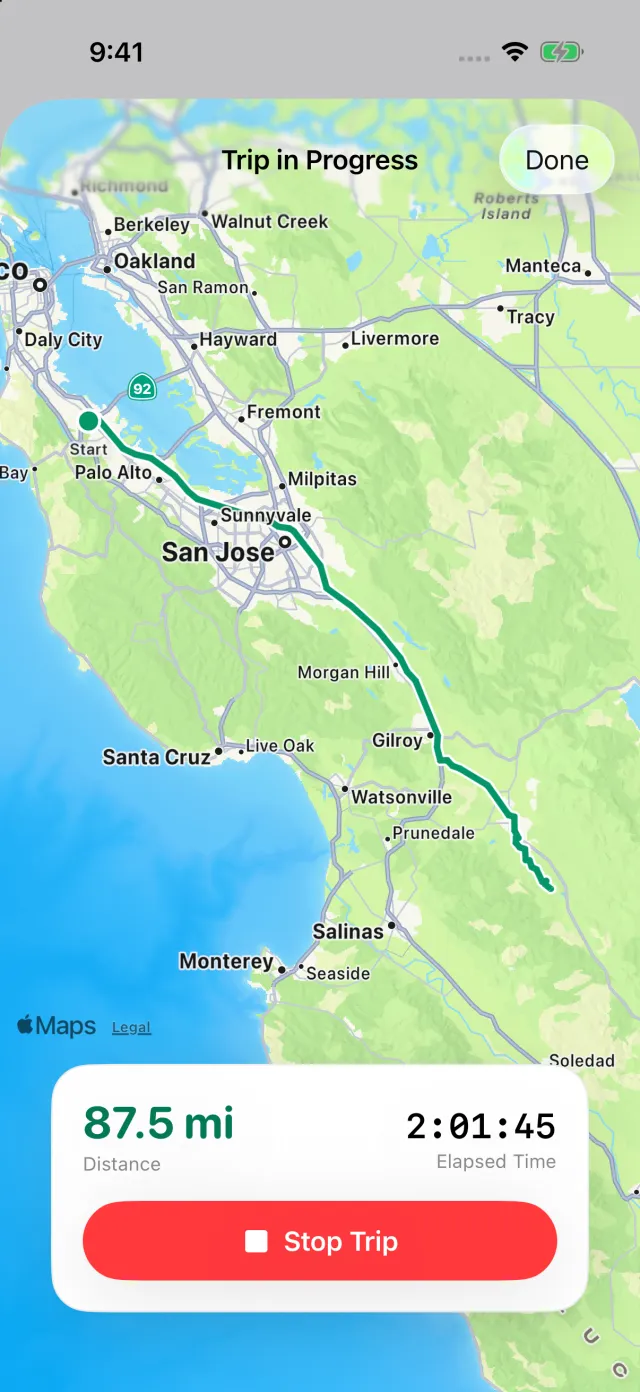
What it gets right. The record is made at the time, by the phone, without anyone having to remember: start, end, times and distance for every drive, business and private. That is the part of every log that people fail to write down, and the part that makes the year's total a measurement rather than an estimate. Classification becomes a review — a place you visit often can be filed once, and the rest waits for a tap on Business or Personal. The file for the tax office is generated rather than typed, and can be kept in a readable format for as long as your country requires.
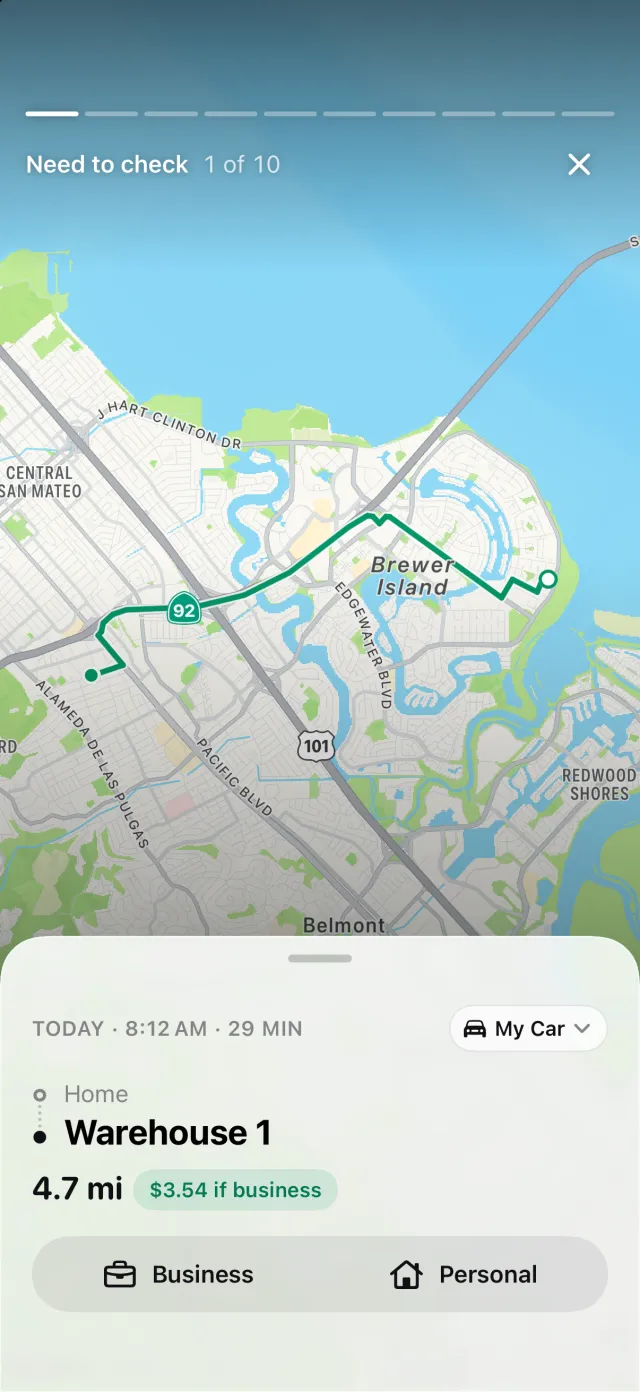
What it gets wrong. A phone is not a car. It can be flat, off, left at home or put in Low Power Mode, and iOS can stop any app working in the background. An automatic app that misses a drive and says nothing produces the worst kind of log: one that looks complete. It also cannot write your reasons for you — a trip marked "business" is a category, and Germany, Norway and the UK want a reason.
How to choose one. Ask of any app the same questions a tax office asks: does it record private drives too, so the year's total is real? Does it print every field your country lists? Does it show you when it may have missed a drive, rather than leaving you to find the gap at filing time? Does a later change to a trip show on the exported record? And can you export the whole record in a readable format and keep it for your country's retention period, whether or not you keep paying?
How DriveHub handles the four requirements
DriveHub is an automatic app for iPhone, built around that third question.
At the time. It records in the background with the phone in your pocket, business and private alike, and asks afterwards which trips were which. Trips it cannot file on its own wait under Need to check at the top of the Trips tab, one per page.
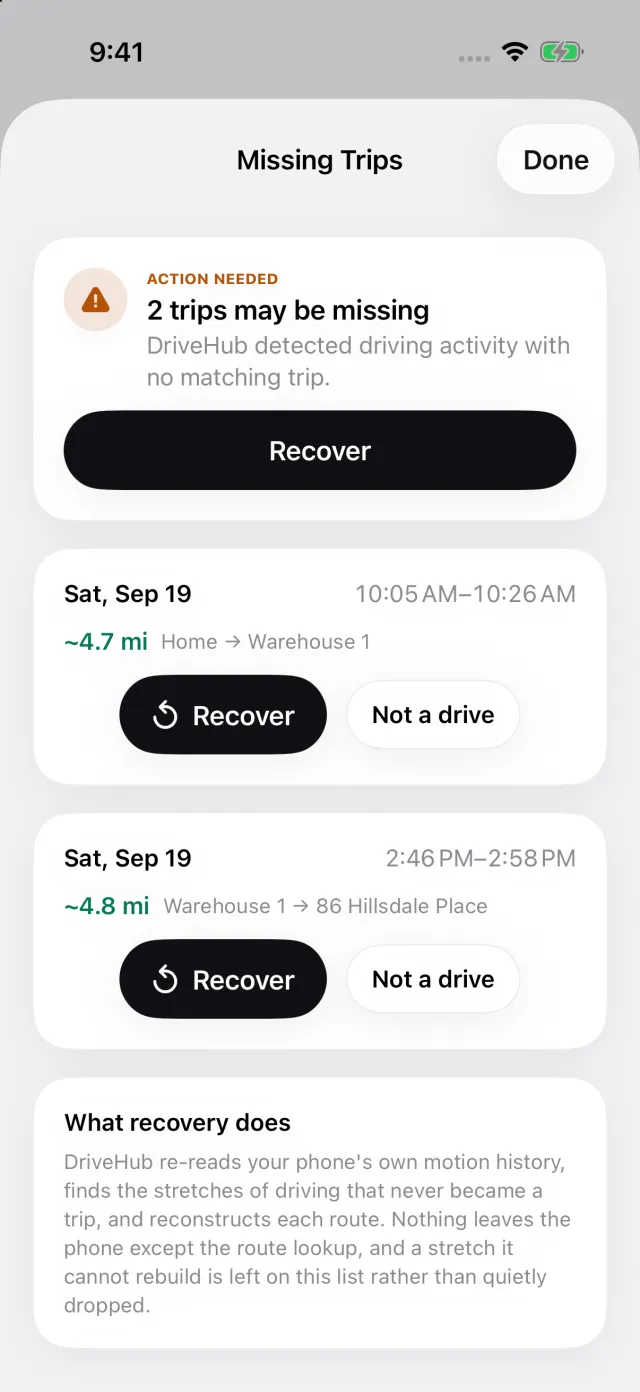
Nothing missing without a word. If the iPhone logged driving that has no matching trip, it appears as Missed drives on the Trips tab, and Recover rebuilds the route. A drive while the phone was off cannot be rebuilt — there is nothing to read — so you add it yourself, and it counts in reports like any other trip.
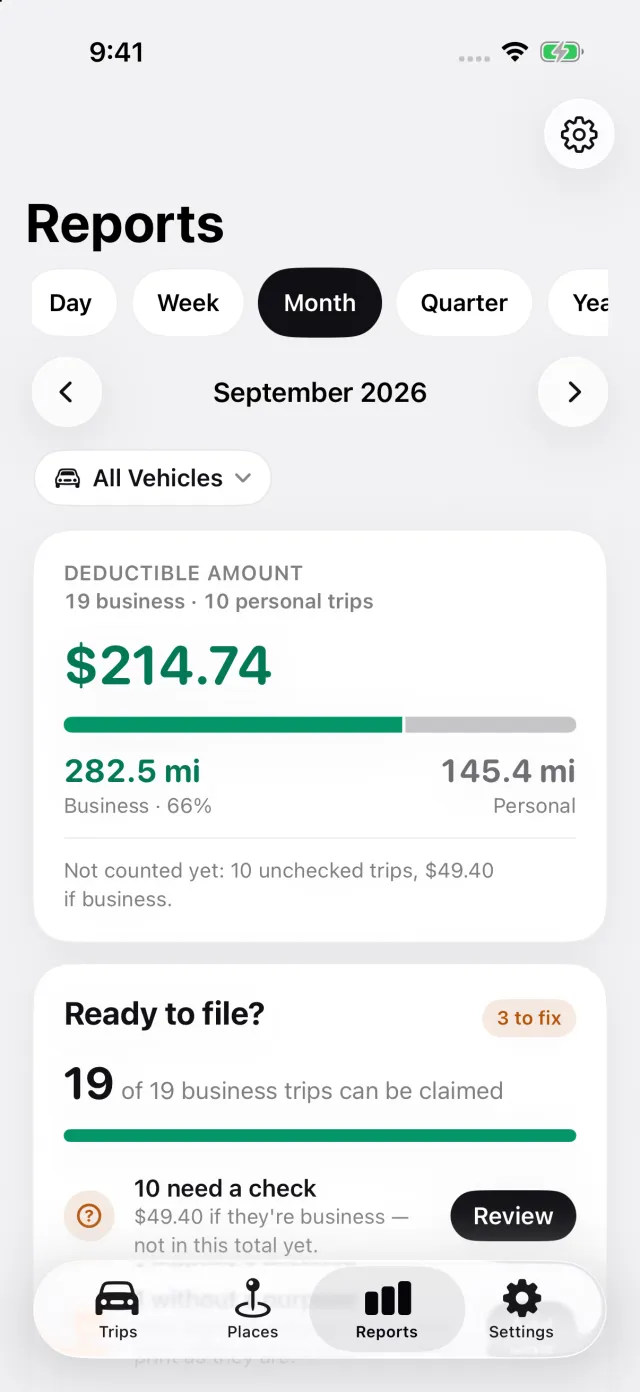
Every field, and the year. Reports carry your country's official rate, dated, so each trip is priced at the rate in force on its day. Before you export, the report shows what still stands between you and a claim — trips not yet checked are kept out of the total and listed with what they would add — and compares your odometer readings with the recorded distance. The Reports tab keeps a What your logbook needs page beside the export.
Kept for years. Your trips stay on your iPhone and in your own iCloud, with no account. Reports export as PDF for filing and Excel or CSV for an accountant, and as DATEV, SIE or Procountor files that accounting software imports. Recording, the missing-drive check and your full history are free; the exports are DriveHub Pro, and if you stop paying nothing is deleted.
To make the automatic part as reliable as it can be, give it the permissions it needs once: set up automatic tracking so nothing goes missing.
Which one to use
- Few trips, one short window — Australia's twelve weeks, Canada's sample period — and you are disciplined: paper or a same-day spreadsheet is enough.
- One car, one driver, or an employer that runs an in-car system: a fitted GPS device.
- Many trips, several cars, or private driving that has to be in the log — a German Fahrtenbuch, a Dutch rittenregistratie, a US total-miles figure: an automatic phone app, provided it tells you when it missed a drive.
Whichever you choose, the reason for each business trip is yours to write, and the odometer at the start and end of the year is worth reading off the car yourself: it is the one figure every method can be checked against.
What your own country asks, field by field and with the retention period, is on its page in the Journal — for example the United States, the United Kingdom, Germany and Australia.
This page states what the tax authorities' own guidance and legislation say, and cites them so you can check. It is not tax advice. It can't account for your circumstances. Where money is involved, ask your accountant or tax adviser — and bring the log.