 DriveHub
Country guide · New Zealand · 7 min
The IRD vehicle logbook is 90 days, reusable for three years, and the kilometre-rate election is permanent
You are a sole trader or contractor in New Zealand and use your own car for work. Inland Revenue (IRD) asks two things of the claim: the business share of the car's use, which a 90-day IRD vehicle logbook sets, and how the costs are worked out, at the kilometre rates or at actual cost. Here is what the logbook records, how long it lasts, and what the rate election locks in.

The short answer
For a car you own and use for business, two separate things decide the claim.
- The business share, from a vehicle logbook kept for at least 90 days. That share can then be used for up to three years.
- The cost method: the kilometre rates or actual costs. Using the kilometre rates is an election you make once per vehicle, and it is irrevocable.
With neither a logbook nor records of actual costs, the business share is capped at 25%. The rest of this page takes each part in turn, with IRD's own words, so you can check it against the source.
What the 90-day logbook records
IRD's Use a logbook page says to keep a logbook for at least 90 days that records:
"the start date and the vehicle's odometer reading on that day; the date, distance and reason for each business journey; the end date of the 90-day period, and the vehicle's odometer reading on that day; any other information we may require."
So three kinds of entry:
- The start of the period: the date and the odometer reading that day.
- Each business journey: its date, its distance and the reason for it.
- The end of the period: the end date and the odometer reading that day.
The logbook rules are in sections DE 6 to DE 11 of the Income Tax Act 2007. The business share from this test period is the number the rest of the claim rests on, so a period that is missing journeys understates it.
Three years from one logbook, and the 20% change rule
Once you have a test period, you can use its business share for up to three years. IRD's condition is that it holds "if the proportion of business use doesn't change by more than 20%".
So the reuse depends on the proportion of business use staying within that 20%. If your use of the car changes by more than that, the old test period no longer supports the claim.
No logbook: the 25% cap
If you keep neither a logbook nor records of actual costs, section DE 4(2) of the Act caps the business share at 25%. At the kilometre rates, that corresponds to Tier 1 for the first 3,500 business kilometres (Commissioner's operational statement OS 19/04a, paragraph 20).
The cap is a ceiling, not a shortcut. A driver whose real business use is higher loses the difference.
Kilometre rates or actual costs
Section DE 12 sets the kilometre rates. The Commissioner publishes them each year in an instrument, and they are not repeated here because they change. Check the current figures on IRD's site before you file.
What stays the same from year to year is how the choice works. Per OS 19/04a, paragraphs 3 and 4:
- It is an election, per vehicle. You make it by using the method in the return for the year the vehicle is acquired or first used for business.
- It is irrevocable. The alternative is the actual costs method, and you stay on whichever you chose for as long as you own that vehicle.
- No depreciation is claimed on a vehicle on the kilometre rates (paragraph 12).
- Which vehicles qualify. Cars, vans and tray-back utes, in four types: petrol, diesel, petrol hybrid and electric. Not motorcycles or scooters. IRD's own wording: "If your vehicle isn't petrol, diesel, hybrid or electric then you must use the actual costs method".
Because the election is permanent, it is worth choosing deliberately in the first year, with a logbook in hand to show how much of the car's use is business.
The odometer reading at balance date
The kilometre rates are tiered, and Tier 1 stops at 14,000 km of the vehicle's total travel for the year, business and private together. That is why OS 19/04a, paragraph 21, says a person on the kilometre rates "must record their odometer reading every balance date for each vehicle".
Paragraph 10 adds: "although not all travel … needs to be recorded, a person who uses the kilometre rate method will need to be able to show whether, and when, the vehicle exceeds the 14,000 annual kilometres."
So whatever the logbook shows, each vehicle on the kilometre rates needs its odometer reading recorded at balance date.
If you are an employee instead
The self-employed deduction is not the only situation, and the answer differs by who pays.
- Employed, and reimbursed. Section CW 17(3) exempts a reasonable estimate of your costs. OS 19/04b accepts the kilometre rates as one such estimate. The employer does not have to pay at them: "the Commissioner is not determining or suggesting what amount an employer must pay".
- Employed, and your employer pays nothing. There is no deduction, because of the employment limitation in section DA 2(4).
- Your employer's car. It is a fringe benefit, on which the employer pays fringe benefit tax. There is no per-kilometre figure for you to work out.
A reimbursed employee is also asked to record the odometer reading at balance date (OS 19/04b, paragraph 13, "should").
Before you file
- Keep the 90-day logbook, with its start and end dates and odometer readings, and every business journey in between.
- Note the date from which you rely on it, and re-check the business share against the 20% rule.
- Record the odometer for each vehicle at your balance date.
- Check the kilometre-rate election you made for each vehicle in its first year. It cannot be undone.
Four ways to keep a mileage log compares paper, spreadsheets, devices and apps, and cents per km or logbook in Australia shows the same decision across the Tasman.
How DriveHub makes this easier
The logbook runs for at least 90 days, and the entries people lose are the small ones: a reason for one visit among many, the odometer on the first day.
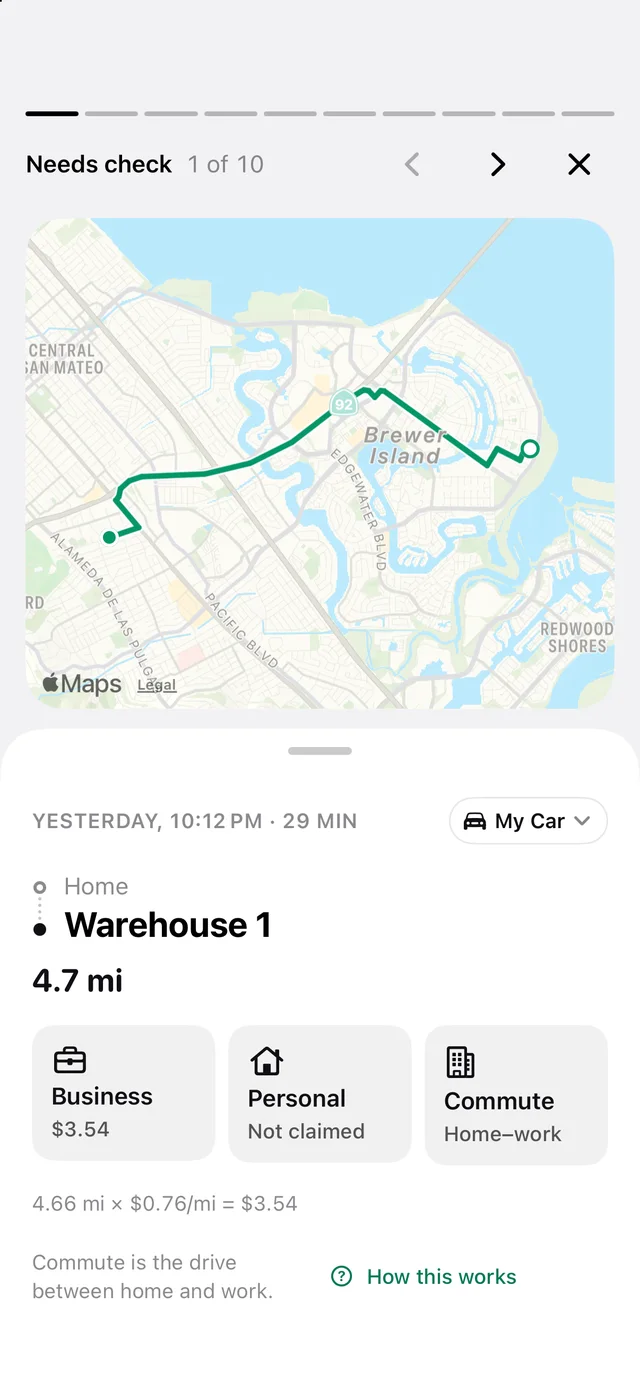
With location access set to Always, DriveHub records trips in the background. It checks for possible missed drives when iPhone motion history is available. It keeps the date, both ends and the distance. DriveHub files most trips as Business or Personal by your places, past routes and working hours, and asks you about the rest. Add the reason in your own words.
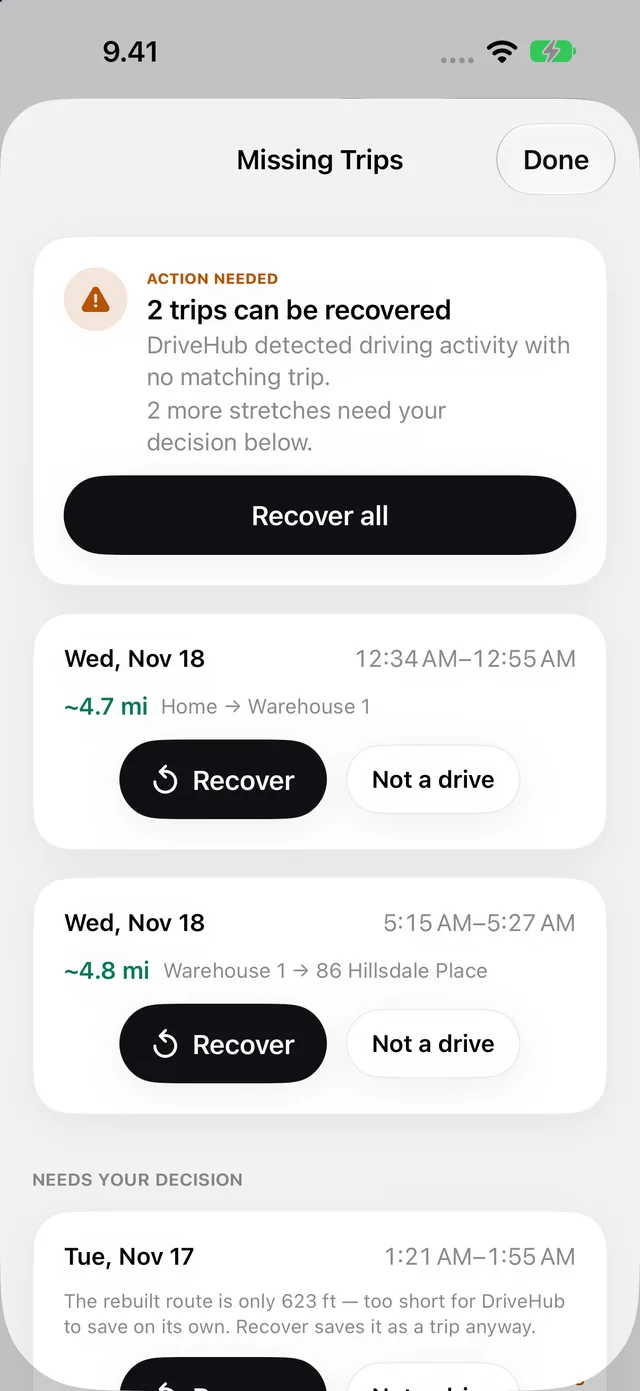
If your iPhone logged driving with no matching trip, a missed-trip item appears under Needs you on Trips. It opens Missing Trips, the drives that may be missing, each with Recover, which rebuilds the route. So you can catch a gap in the 90 days while you still remember the journey.
For a New Zealand logbook, the report prints each journey's date, distance and reason. The 90-day window is a period preset, so you do not count it out on a calendar. The year's first and last odometer readings print too, and the figure is computed per vehicle.
Where DriveHub stops: it records and prints the logbook. It does not choose between the kilometre rates and actual costs for you. That election is yours, and your accountant's.
DriveHub is on the App Store for iPhone. The New Zealand rules it follows are on the New Zealand page, and setting up automatic tracking takes a few minutes, once.
This page states what the Income Tax Act 2007, Inland Revenue and its operational statements say, and cites them so you can check. It is not tax advice. It can't account for your circumstances. Where money is involved, ask your accountant — and bring the logbook.
Official sources
- Inland Revenue: use a logbook — 90-day logbook and three-year business-use percentage.
Do it in DriveHub
Add and check odometer readings →
Enter dated readings and investigate a difference from the recorded log.
The full rule for New Zealand, with the instruments it comes from: mileage log requirements in New Zealand.