 DriveHub
Country guide · Australia · 8 min
Cents per km or logbook: which pays more for your car in Australia
You drive your own car for work, as an employee or a sole trader, and the return asks how you want to claim it. There are two methods: cents per kilometre, which needs almost no paperwork and stops counting at 5,000 kilometres, and the logbook method, which needs a log book and receipts and counts everything.

The short answer
The Income Tax Assessment Act 1997 gives you two ways to claim a car you own or lease, and you pick one per car, per year.
- Cents per kilometre. 91 cents for each business kilometre in 2026-27, for at most 5,000 business kilometres per car. No receipts and no log book; you need to show that you own the car and how you worked out the kilometres.
- The logbook method. Your actual car expenses, multiplied by the car's business-use percentage. It needs a twelve-week log book, odometer readings, receipts for the expenses, and a written estimate recorded before you lodge.
If your business kilometres stay under 5,000, the cents-per-kilometre method is the simpler one, and it counts every kilometre you drove for work. Above 5,000, every extra kilometre is lost under that method, so the logbook is the only way to claim for it.
To compare, work out both: 91 cents times your business kilometres, up to 5,000, against your business-use percentage times the car's running costs for the year. The larger one is the better claim, if you have the records it needs.
And the choice is not final. s 28-20(2): "you can change your choice for the income year", and the Act's own example is a change made after an audit.
Two methods, and who may use them
s 28-12(1): "If you owned or leased a car, you can deduct for the car's expenses an amount or amounts worked out using one of 2 methods." Section 28-15(2) says why there are two: "one method may involve more paperwork than the other, but could give you bigger deductions."
The Division applies to individuals and to partnerships that include at least one individual; "It does not apply to any other entity" (s 28-10). So an employee and a sole trader use the same two methods on identical terms. A company is outside the Division.
So is a car you neither own nor lease yourself. The ATO's example is a car your employer provides, or one you salary sacrifice through a novated lease. You "aren't entitled to claim work-related car expenses using the logbook or cents per kilometre method. This is because they don't own the car."
Neither method is available for a vehicle designed to carry a load of a tonne or more, because the Act does not treat it as a car. That case is in does a one-tonne ute need a logbook.
Cents per kilometre: 91 cents, 5,000 km per car
The rate. The 2026 Determination, F2026L00785, s 6: "the rate of cents per kilometre for cars for the income year commencing on 1 July 2026 is 91 cents per kilometre." Its explanatory statement calls it a base of 89 cents "with a temporary one-off uplift of 2 cents per kilometre for the 2026-27 income year". The 91 cents "will be in effect for the 2026–27 income year only." For 2024-25 and 2025-26 the rate was 88 cents.
The cap. s 28-25(2): "If the car travelled more than 5,000 business kilometres, you must discard the kilometres in excess of 5,000." The Act's example: "If the car travelled 5,085 business kilometres, you could claim for 5,000, and would lose the extra 85." The cap is per car, not per person. Joint owners who use the car for separate income-producing purposes each have their own cap. In the ATO's words, "you can each claim up to 5,000 work-related kilometres."
What the rate covers. Everything. The ATO's cents per kilometre page says it "covers all of your car expenses including decline in value, registration and insurance, maintenance, repairs and fuel costs. You can't add these, or any other car expenses, on top of the rate".
What you need to keep. Not receipts. Section 28-35, in full: "To use this method, you do not need to substantiate the car expenses for the car." But the kilometres are still yours to justify. Business kilometres are those travelled "producing your assessable income" or in "travel between workplaces", and you calculate them "by making a reasonable estimate" (s 28-25(3)). The ATO: "You do need to be able to show that you own the car and how you work out your work-related kilometres. For example, you could record your work-related trips: in a diary; using the myDeductions tool in the ATO app."
The logbook method: expenses times business use
The calculation. s 28-90(1): "you multiply the amount of each car expense by the business use percentage". The percentage is the business kilometres in the period you held the car, divided by the total kilometres it travelled in that period (s 28-90(3)). Under s 28-95 you can use this method only if you "held the car for some or all of the income year".
The log book. At least twelve continuous weeks, representative of the year's travel, with each work journey's dates, odometer readings, kilometres and purpose. Each journey is recorded at its end or as soon as possible afterwards (s 28-125(2)), and every entry must be in English (s 28-125(5)). The field-by-field detail is in the logbook method: twelve weeks, five years, English.
Odometer readings every year. At 1 July and 30 June, or for the part of the year you held the car. The log book gives the percentage; the year's readings give the total it applies to.
The written estimate. s 28-100(4): "You must record the following information, in writing, before you lodge your income tax return: (a) your estimate of the number of business kilometres; and (b) the business use percentage." The Commissioner may allow it later, but the Act expects it before you lodge.
Receipts, with one exception. s 28-100(1): "To use this method, you must substantiate the car expenses under Subdivision 900-C." For fuel and oil there is an alternative. The ATO's logbook method page accepts "receipts for your fuel and oil expenses, or a record of your reasonable estimate of these expenses based on the odometer readings for the start and end of the period you owned the car, the fuel consumption for your car and the average price of fuel during the income year".
Five years from one log book. One log book covers its year and the next four (s 28-115(2)). You keep it for five years after the last return that relies on it (s 28-150). You need a new one if the Commissioner directs you to, or if you add a car you want to use the method for (s 28-115(3)–(4)). A car you nominate in writing as replacing the old one carries on the old one's log book (s 28-130). The ATO adds a third case: the old log book no longer represents how you use the car.
Charging an electric car at home
For the cost of charging at home, PCG 2024/2 gives a rate per kilometre, and it is a logbook-method figure only. For 2026-27, that is 5.47 cents per kilometre. You multiply the rate "by the total number of relevant kilometres travelled by the electric vehicle in the relevant income year" (para 16).
Older ATO pages show 4.2 cents, the rate from 2022-23 to 2025-26. And if you use the home charging rate, the ATO says you "can't claim any commercial charging costs" as well.
The rate has no place in the cents-per-kilometre method, because 91 cents already covers all of your car expenses.
Which method pays more? A worked comparison
Three drivers, all in 2026-27, each with one car. All figures are illustrative, not averages.
| Driver A | Driver B | Driver C | |
|---|---|---|---|
| Business kilometres | 3,000 | 8,000 | 8,000 |
| Total kilometres | 15,000 | 16,000 | 16,000 |
| Business-use percentage | 20% | 50% | 50% |
| Car expenses for the year | $9,000 | $12,000 | $8,000 |
| Cents per km | 3,000 × $0.91 = $2,730 | 5,000 × $0.91 = $4,550 | 5,000 × $0.91 = $4,550 |
| Logbook | 20% × $9,000 = $1,800 | 50% × $12,000 = $6,000 | 50% × $8,000 = $4,000 |
Driver A stays under the cap and uses the car mostly privately. The cents-per-kilometre method gives more, with less to keep.
Driver B loses 3,000 kilometres to the cap under the cents method. With $12,000 of running costs, half of them business, the logbook gives $1,450 more.
Driver C drives the same distances as B in a car that is cheaper to run. The cap still costs 3,000 kilometres, but with lower running costs the cents method wins, by $550.
The deciding numbers are the business kilometres, the business-use percentage and the car's real costs. You only know the first two if you have recorded your driving, and the log book is how you prove them.
You can change method, even after an audit
s 28-20(1): "You can choose only one method for all the car expenses for the car for the income year." Then s 28-20(2): "However, you can change your choice for the income year." The Act's example:
"You choose the "log book" method and deduct $1,000. On audit, the Commissioner finds that your claim is too high and should be reduced to $500. You would have been able to deduct $700 if you had chosen the "cents per kilometre" method. This rule lets you change your choice and deduct the $700."
And s 28-20(3): "You can also choose different methods for the same car for different income years and different methods for different cars for the same year."
This works in only one direction when the records are missing. Without a valid log book the logbook method is closed, and the ATO says "You may be able to use the cents per kilometre method instead", capped at 5,000 kilometres. If neither method can be used, s 28-12(2) applies: "you can't deduct anything for the car expenses." So a log book keeps both methods open. Without one, only the capped method remains.
Before you lodge
- Work out the business kilometres for each car, and keep the diary or record that shows how.
- If you are comparing methods, have the odometer readings for the year and the car's expenses to hand.
- For the logbook method, write down the business kilometres and the business-use percentage before you lodge, and keep the year's odometer readings.
- Keep the receipts for every car expense. For fuel and oil, an odometer-based estimate may replace them.
- Keep the log book for five years past the last return that relies on it.
A blank Australian mileage log (PDF) has the log book's columns. Four ways to keep a mileage log compares paper, spreadsheets, devices and apps.
How DriveHub makes this easier
Both methods start from the same number: your business kilometres for the year, car by car. The hard part is not the arithmetic. It is the drives nobody wrote down.
With location access set to Always, DriveHub records every drive in the background — and if it ever misses one, it tells you. Business and private drives are both recorded, with the phone in your pocket, and you mark each one Business or Personal afterwards.
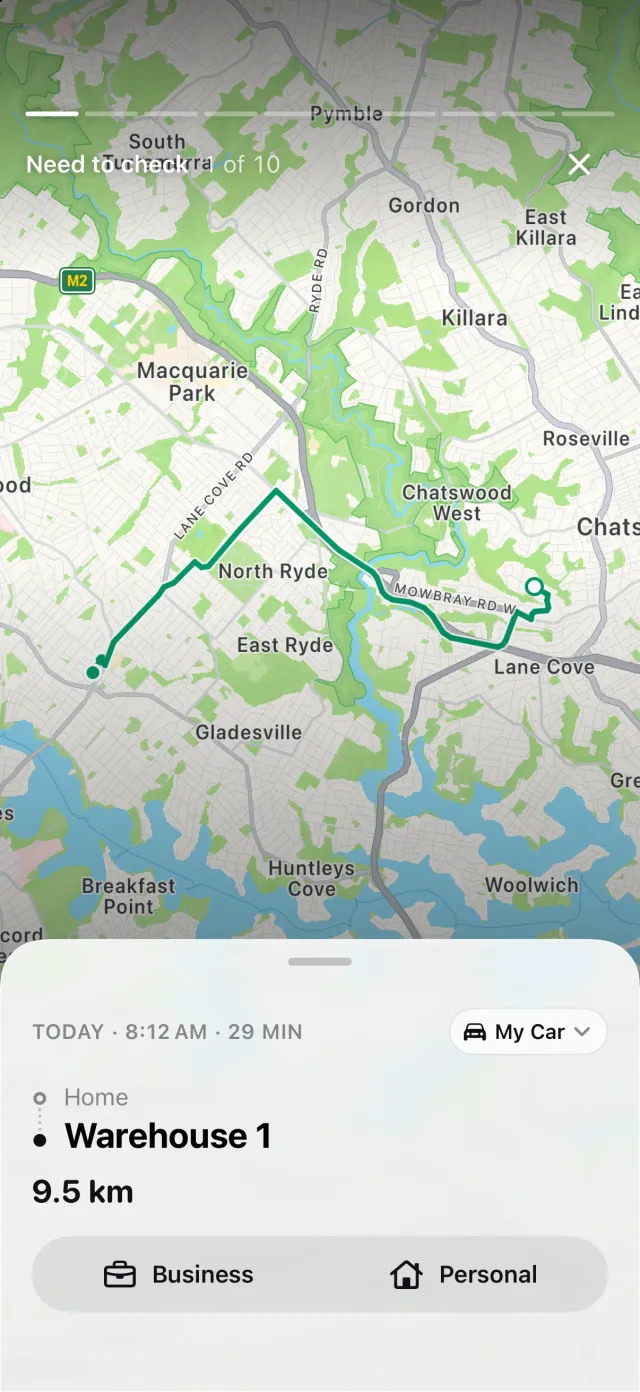
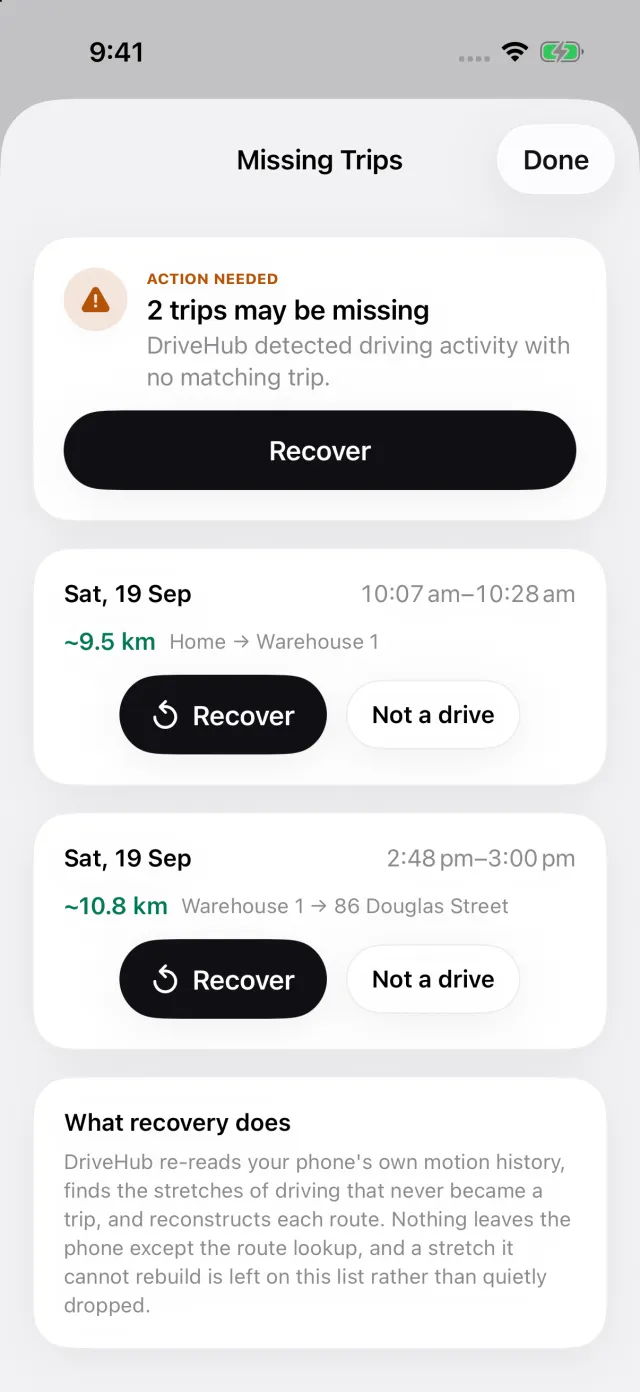
If your iPhone logged driving with no matching trip, a Missed drives story appears on the Trips tab. It opens Missing Trips, the drives that may be missing, each with Recover, which rebuilds the route. So you can catch a missed drive before you lodge, not after.
For Australia, "Year" means 1 July to 30 June, on the report and on the review screen. If the logbook method looks better, the twelve-week window is a period preset. Its report prints the period's totals, the business-use percentage and the car's make, model, registration and engine capacity, in English.
Where DriveHub stops: it records kilometres, not expenses. It does not total your fuel, insurance or servicing, or work out a logbook-method deduction. That part is your receipts and your tax agent's.
DriveHub is on the App Store for iPhone. The Australian rules it follows are on the Australia page, and setting up automatic tracking takes a few minutes, once.
This page states what Division 28 of the Income Tax Assessment Act 1997, the ATO and its published guidance say, and cites them so you can check. It is not tax advice. It can't account for your circumstances. Where money is involved, ask your tax agent — and bring the log book.
The full rule for Australia, with the instruments it comes from: mileage log requirements in Australia.