 DriveHub
Country guide · Canada · 8 min
Québec's registre des déplacements: the travel log Revenu Québec expects
You drive for work in Québec, in your own car or one your employer gave you, and you want to know which mileage log Revenu Québec expects. There are two, with different rules, and only one of them carries a deadline and a penalty.

The short answer
- Company car? Then you owe your employer a registre des déplacements. The Loi sur les impôts puts the duty on you, the employee, and you hand your employer a copy by 10 January of the following year. If you return the car earlier, the copy is due 10 days after.
- What if I'm late? The Act sets a penalty of $200 for an employee who doesn't hand over the copy in time.
- Own car? The registre does not apply. Revenu Québec's guide Les dépenses d'emploi (IN-118) still tells you to keep a record if you deduct car costs, and to keep it six years.
- What does each entry hold? The days the company car was made available to you, the kilometres, and for each work trip the start, the destination, the distance and what shows it was for work.
- No log? For a company car, a copy not handed over in time costs $200. For your own car IN-118 names no penalty, but without a record the business share of your costs is hard to support.
- Is there a form? Revenu Québec's page prescribes none.
- Is the commute a work trip? That is a separate question, covered in driving to work in Canada.
Two logs, two sets of rules
Québec people say "registre" for both, and the difference decides what you owe.
The registre des déplacements is a statutory duty about a car your employer provides. It sits in the Loi sur les impôts (RLRQ, c. I-3), art. 41.1.4 and 41.1.5, and its penalty in art. 1049.34.
The own-car record is guidance, not a statutory register. It belongs to the employee who drives a personal car for work and wants a deduction. It comes from IN-118, Revenu Québec's guide to employment expenses.
The statute is explicit about its trigger. Art. 41.1.4 starts: "Lorsqu'un employeur ou une personne à laquelle il est lié met dans une année d'imposition une automobile … à la disposition de son employé ou d'une personne liée à ce dernier". A car the employee owns doesn't fit that sentence.
| Company car | Your own car | |
|---|---|---|
| Source | Loi sur les impôts, art. 41.1.4–41.1.5 | Revenu Québec's guide IN-118 |
| Who keeps it | You, for your employer | You, if you deduct car costs |
| Each work trip | Start, destination, distance, what shows it was for work | Date, destination, purpose, distance |
| Deadline | Copy to your employer by 10 January (or 10 days after you return the car) | None; produce it on request |
| Penalty | $200 for a late copy (art. 1049.34) | None named |
| How long to keep it | Not stated | At least six years |
The company car: what the registre is
Revenu Québec's page says it from the employer's side: the employee "doit tenir un registre des déplacements effectués avec l'automobile et vous remettre une copie de ce registre". The car can also be made available to a person related to the employee, and the duty is the same.
Art. 41.1.4 covers "l'ensemble des jours de l'année" during which the car was made available. There is one exception, in art. 41.1.3. It covers a police officer or firefighter whose vehicle is "clairement identifié au nom de l'employeur" or specially equipped for public-safety emergencies, if a written directive limits personal use.
What each entry holds
Art. 41.1.5 sets the content. Revenu Québec's page repeats it in plain words.
For the year as a whole:
- "le nombre total de jours de l'année" the car was made available to you;
- "le nombre total de kilomètres parcourus", "sur une base quotidienne, hebdomadaire ou mensuelle", over those days.
For each trip made to do your job, daily:
- "le lieu de départ et le lieu de destination";
- "le nombre de kilomètres parcourus entre ces lieux";
- "toute information permettant d'établir que le déplacement a été fait pour remplir ses fonctions".
If the car is used only for personal purposes, the entries shrink. You record the days, and "le kilométrage indiqué à l'odomètre" at the start and end of each period the car was continuously available.
Two details are easy to miss. The trip entry is daily and per trip, not a monthly total. And the Act asks for something that shows the trip was for work, which is more than a note that it happened.
The deadline and the penalty
The statute says the copy goes to the employer "au plus tard le dixième jour suivant le dernier jour de l'année" in which the car was made available. Revenu Québec states that as two dates:
- 10 January of the year after the car was at your disposal;
- the 10th day after the car is returned to your employer (or to a person related to the employer).
Art. 1049.34: "Tout employé qui omet de remettre à son employeur une copie du registre visé à l'article 41.1.4 dans le délai prévu à cet article encourt une pénalité de 200 $."
Read it closely. The penalty is for not handing over the copy on time. It says nothing about how well the log was kept. Neither the Act nor the page says how long you keep the copy you gave away. For a penalty, art. 1050 puts the burden on the Minister. Where a challenge or an appeal concerns a penalty, proving the facts in art. 1049 to 1049.34 "incombe au ministre".
How it ties to the benefit your employer reports
The registre exists because a company car is a taxable benefit for the employee. How the reduced standby charge works, with the 50% and 1,667 km tests Revenu Québec applies, is in the company car standby charge in Canada.
Revenu Québec's pages on this carry a note that they don't reflect the measures in bulletin d'information 2023-4, so check the live page before relying on a detail.
Your own car: no registre, but a record
If you use your own car and your employer pays you per kilometre, Revenu Québec does not condition the allowance on a log. Its rule for an employer is that an allowance is taxable "sauf s'il s'agit d'une allocation raisonnable", meaning:
- "calculée uniquement en fonction du nombre de kilomètres réellement parcourus" for your duties;
- at a "raisonnable" rate per kilometre;
- without also reimbursing the costs of using the vehicle, apart from named exceptions.
Revenu Québec treats the per-km rate a taxable employer may deduct as reasonable. For 2026 its ceiling is $0.73 a kilometre for the first 5,000 km and $0.67 after, as announced on 6 February 2026. A flat monthly allowance isn't counted by kilometres, so it is taxable. If the allowance isn't reasonable, "la totalité de l'allocation" goes on your RL-1.
If your employer pays nothing, or pays an allowance that is taxed, you may deduct car costs. IN-118 sets the conditions:
- your contract says you must pay your own expenses, and you weren't reimbursed and have no right to be;
- you carry out some or all of your duties away from your employer's place of business, or in different places;
- your employer completes TP-64.3, which you attach with form TP-59.
Then comes the record. IN-118 § 9.2, Tenue de registres: "Vous devez tenir un registre pour chaque véhicule à moteur que vous utilisez pour gagner votre revenu d'emploi." It holds:
- the total kilometres for the year, and the kilometres used "exclusivement pour votre emploi";
- the odometer at the start and end of the year, or at purchase or sale;
- for each work trip, "la date, la destination et le but du voyage ainsi que le nombre de kilomètres parcourus".
You don't attach it to your return. IN-118 says to keep it so you can produce it on request, and "en règle générale" for at least six years after the end of the tax year. The guide names no penalty for a missing record. Without one, the business share of your costs is hard to support.
If you're self-employed in Québec
The statutory registre doesn't apply to you either. Revenu Québec's guide for the self-employed, IN-155 (version 2025-12), says "vous pouvez tenir un registre": it's optional. Its suggested content mirrors the employee's, and it offers a simplified register for a representative period of at least three continuous months after a full 12-month base year. Business use must stay within 10 percentage points of the base year. The home-to-work limits are in driving to work in Canada. The federal records for the self-employed are in Canada's motor vehicle records.
Before 10 January
- The car was your employer's? You hold a log covering every day it was available.
- Each work trip has a start, destination, distance and a reason, entered daily.
- The year's total kilometres are written down, by day, week or month.
- Your employer has a copy by 10 January, or by the 10th day after you returned the car.
- Your own car? You hold a record per vehicle, the odometer at each end of the year, and a line for each work trip. Keep it six years.
For the other side of the same question, see using your own car for work in Canada.
How DriveHub makes this easier
A Québec register is only as complete as the drives behind it, and the drive nobody wrote down is the one that leaves a day missing from it.
With location access set to Always, DriveHub records trips in the background. It checks for possible missed drives when iPhone motion history is available. It keeps the date, both ends, the distance and the vehicle. DriveHub files most trips as Business or Personal by your places, past routes and working hours, and asks you about the rest. Add the reason for a trip in your own words.
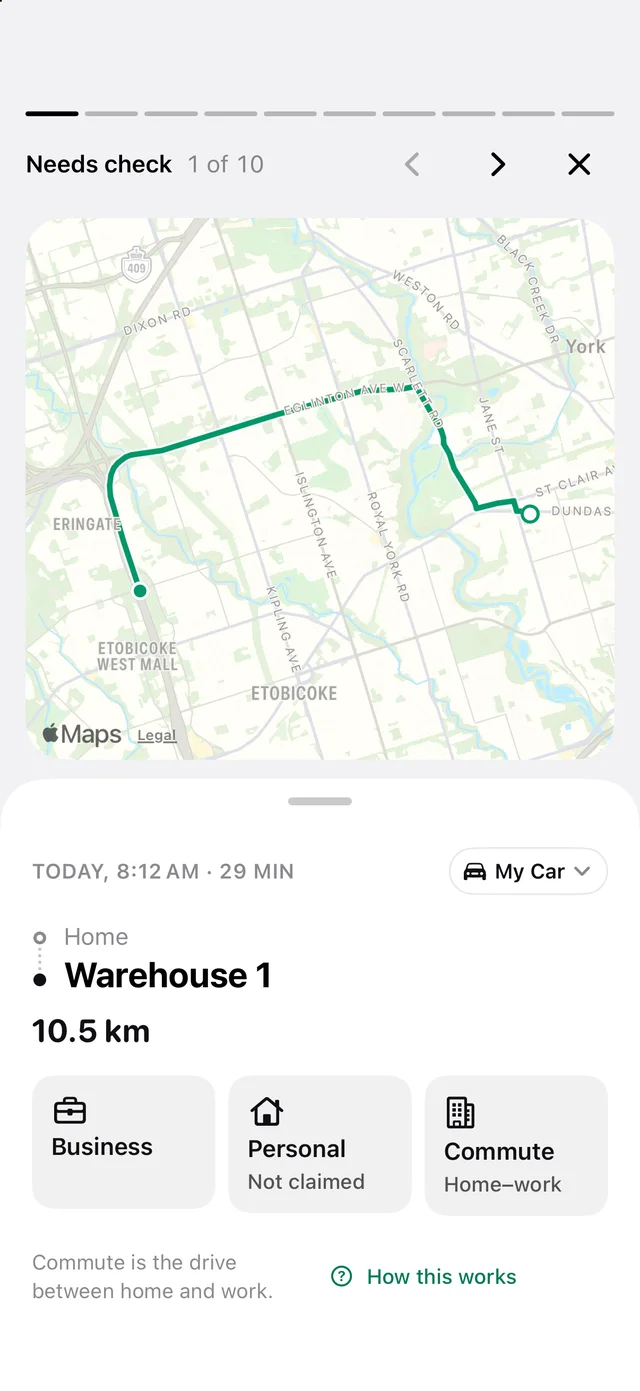
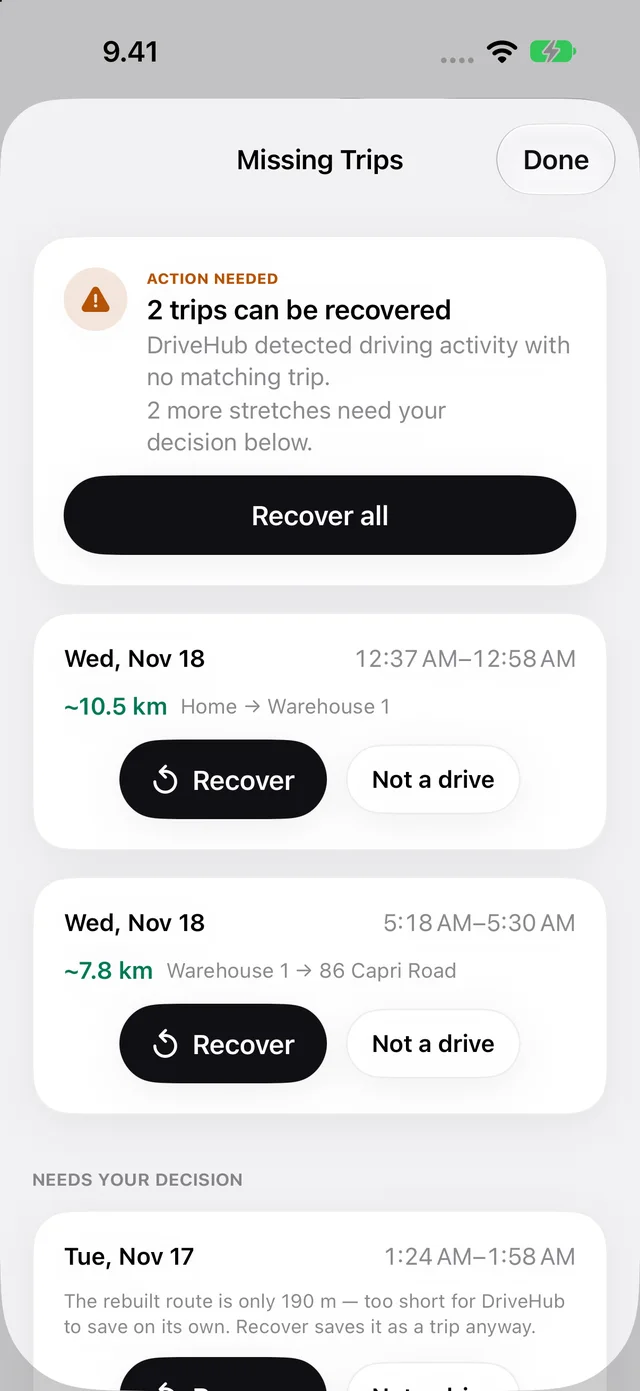
If your iPhone logged driving with no matching trip, the missed-trip item under Needs you on Trips opens Missing Trips, where Recover rebuilds the route. A gap in a daily register can then be closed before 10 January.
Reports shows business and personal kilometres for any day, week, month, quarter or year, for one vehicle or all, and prints the odometer readings for the year. With DriveHub Pro it exports as PDF, Excel or CSV, which you can send to your employer as the basis of your copy. Add the days the car was at your disposal.
Where DriveHub stops: it doesn't count the days a car was made available to you. It submits nothing to Revenu Québec and doesn't fill in TP-64.3 or TP-59. Your employer receives work trips only if you share them. It has no reminder for 10 January, so put the date in your own calendar. A drive it didn't record and can't recover stays out of the report until you add it by hand.
DriveHub is on the App Store for iPhone. The Canadian rules it follows are on the Canada page, and setting up automatic tracking takes a few minutes, once.
This page states what the Loi sur les impôts and Revenu Québec say, and cites them so you can check. It is not tax advice. It can't account for your circumstances. Where money is involved, ask your employer's payroll team or your accountant — and bring the log.
Do it in DriveHub
Canada: GST/HST on allowances →
Record the allowances a business paid and read the payer's GST/HST credit.
The full rule for Canada, with the instruments it comes from: mileage log requirements in Canada.