 DriveHub
Country guide · Canada · 8 min
In Canada the drive to work is personal — which place counts as work
Is driving to work tax deductible in Canada? The CRA's answer is no: driving between home and a regular place of employment is personal driving. What decides the rest of your day is which places count as regular, and what happens between them.

The short answer
No. The drive from home to work is personal. The CRA says so for an employee's own car and for a company car alike.
If you pay your own car costs as an employee, the CRA's line 22900 page and Guide T4044 say: "The CRA considers driving back and forth between home and work as personal use." For a car an employer provides, the CRA's page Automobile provided by the employer says: "Personal driving is any driving of an automobile that is done for purposes not related to the employee's employment. This includes driving between home to a regular place of employment."
What changes the answer is not the distance but the places at each end. The CRA spells out the rest in its rules for a car an employer provides:
- A regular place of employment need not be your employer's premises, and you can have several.
- Between regular places, driving is business. Only home to the first one and the last one to home stay personal.
- A point of call — somewhere you go to do your work that is not a regular place — can make the trip from home business.
Self-employed with a home office? Driving from home to where you work is deductible only if your home is the base of your business. The CRA says so in an archived bulletin; Revenu Québec says so in a current guide.
What counts as a regular place of employment
A regular place of employment is "any location where your employee regularly: reports for work [;] performs employment duties". The CRA wrote this for employers providing a car, and it defines the word that does the work:
"'Regularly' means there is some degree of frequency or repetition in your employee's reporting to that particular work location in a period (weekly, monthly, or yearly). This does not need to be your establishment. An employee can have multiple regular places of employment."
So a client's building can be a regular place of employment. The CRA's own examples include "a client's premises when your employee reports daily for a six-month project" and "a client's premises when your employee attends biweekly meetings". If you go there with that kind of frequency, the drive from home to it is personal, just like the drive to an office.
Several places in one day
When you work at more than one regular place in a day, only the two ends of the day are personal. Personal driving is the trip between "your employee's home and first work location" and between "the final work location and your employee's home".
The rest of the day is business: "Any other travel by your employee between regular places of employment is considered business (employment-related) driving."
A point of call can change the first trip
A point of call is "any location other than a regular place of employment where your employee goes to perform employment duties" — a customer you visit once, say, rather than the office you report to.
Driving from home straight to a point of call, or home from one, is business "if you need or allow your employee to travel directly from home to a point of call, or return home from that point". There is a condition attached: "it must be reasonable that your employee's travel to the point of call be made at that time and on the way to or from work. If the travel is not reasonable, it is considered personal driving."
Taking the car home does not make it business
Being told to drive the car home does not change the answer. Personal driving includes "Travel between home and a regular place of employment even if you insist your employee drives the vehicle home, such as when your employee is on call".
For a company car this matters in kilometres. The operating benefit is charged per personal kilometre, and the reduced standby charge depends on personal kilometres too — the commute counts in both. How the standby charge is worked out covers that side.
One day, worked through
Take an illustrative day for an employee with a company car: home to the office, 15 km; the office to a customer they visit once, 22 km; the customer back home, 19 km. That is 15 + 22 + 19 = 56 km. The office is a regular place of employment; the customer is a point of call.
| Situation | Home → office, 15 km | Office → customer, 22 km | Customer → home, 19 km | Personal | Business |
|---|---|---|---|---|---|
| Returning home straight from the customer is not allowed, or not reasonable | Personal | Business | Personal | 34 km | 22 km |
| The employer allows it, and it is reasonable on the way home | Personal | Business | Business | 15 km | 41 km |
In the first row, 15 + 19 = 34 km personal and 56 − 34 = 22 km business. In the second, 56 − 15 = 41 km business. The same drive gives 22 or 41 business kilometres, and nothing in the route itself tells you which. It depends on what your employer allows and whether the timing was reasonable.
If the customer were instead a regular place of employment — a client you report to every week — the day ends at the last work location. The trip home is then personal again, as in the first row.
You pay for your own car as an employee
The home-to-work trip is personal here too. An employee who pays their own car costs usually deducts them under ITA 8(1)(h.1), where they "(i) was ordinarily required to carry on the duties of the office or employment away from the employer's place of business or in different places, and (ii) was required under the contract of employment to pay motor vehicle expenses …". A commission salesperson may claim under 8(1)(f) instead; the two are alternatives.
Two further conditions narrow it:
- No tax-free allowance. The deduction is lost where the employee "(iii) received an allowance for motor vehicle expenses that was, because of paragraph 6(1)(b), not included in computing the taxpayer's income". T4044 also says you have not paid your own costs "if your employer reimburses you or you refuse a reimbursement or reasonable allowance from your employer".
- A T2200. Under 8(10), nothing is deductible "unless the taxpayer's employer confirms in prescribed form that the conditions set out in the applicable provision were met". T4044 asks that "You keep with your records a copy of Form T2200".
Where those conditions are met, what you deduct is the employment driving, not the commute. Using your own car for work in Canada covers the allowance side.
Self-employed with a home office
Here the CRA's current text is thin, and it is better to say so than to guess.
The CRA's current business page on motor vehicle expenses states no general home-to-work rule for the self-employed. It speaks to two trades only. "If you did not live on your farm, the travel between the farm and your home is not considered business travel." And for fishing, business use "also includes driving to and from the fishing boat if your home is your main place of business."
The general rule is in Interpretation Bulletin IT-521R, which the CRA has archived ("We have archived this page and will not be updating it"). Bulletins "do not have the force of law". Paragraph 24 reads:
"expenses incurred by the individual for the purpose of travelling between the individual's home and place of business are not [deductible], unless it is established that the home is the base of business operations. If the individual has an office or other fixed place of business located elsewhere, the home is normally regarded as not being the base of business operations."
It gives three examples of a home that is the base. One is an anaesthetist who does all office work at home and has no office at the hospital. Another is an independent real-estate agent whose only office is at home. The third is "a plumber, electrician or painter whose office is at home where all supplies are kept, who has no other place of business".
In Québec the same rule is current. Revenu Québec's guide IN-155 (version 2025-12), § 6.12.1: "vous ne pouvez pas déduire les frais engagés pour vous déplacer entre votre domicile et les différents lieux d'affaires de votre entreprise, à moins que votre principal lieu d'affaires soit votre domicile. Si vous avez un bureau ou un lieu d'affaires fixe ailleurs qu'à votre domicile, votre domicile n'est habituellement pas considéré comme votre principal lieu d'affaires". In English: you cannot deduct travel between home and your places of business unless home is your principal place of business. It gives the same three examples.
Working from home as an employee: one court case, and its limits
One Tax Court decision allowed the claim on its facts: Toutov v. The Queen, 2006 TCC 187. The Tax Court restated the rule first (¶ 2): "The general rule of course is that the cost of travelling from one's home to one's place of work is not a deductible expense. This has been settled law for many years".
It then allowed the appeals, because it regarded the taxpayer's home office "as an extension of Oracle's place of business and as his principal place of employment" (¶ 5). It relied on a test from an earlier case: travel between two places of work is deductible, but "not those of travelling from either place of work to his home or vice versa unless his home happens to be a place of work."
Two limits come with it. It was decided under the informal procedure, and by s. 18.28 of the Tax Court of Canada Act such a judgment "shall not be treated as a precedent for any other case". And it is an employee case, with an employer letter behind it. It does not change the CRA's rule for an ordinary commute.
What your log has to show
The commute belongs in the log as personal kilometres. A self-employed log lists, for each business trip, "date, destination, purpose, number of kilometres you drive", and the odometer at the start and end of the fiscal period. The business share is business kilometres over total kilometres, so the total includes the commute.
A company-car log needs the "Total number of kilometres travelled for business (employment-related) and personal driving" as well. Motor vehicle records in Canada covers the full record list, the base year and retention.
Where the rules above are involved, the purpose line does the work. "Customer visit, straight home after, allowed by employer" explains a business trip home. "Client office" does not say whether that office is a regular place or a point of call.
How DriveHub makes this easier
With location access set to Always, DriveHub records every drive in the background — and if it ever misses one, it tells you. The commute is included. DriveHub files each drive as Business or Personal by the rules you give it, and asks you about the rest under Need to check. The commute stays in the log as personal kilometres, which is where the year's total comes from.
A drive from home to a warehouse at eight in the morning is a trip only you can classify. It is Personal if the warehouse is a regular place of employment, and it can be Business if it is a point of call. Decide once, and a rule on the place files every later trip there.
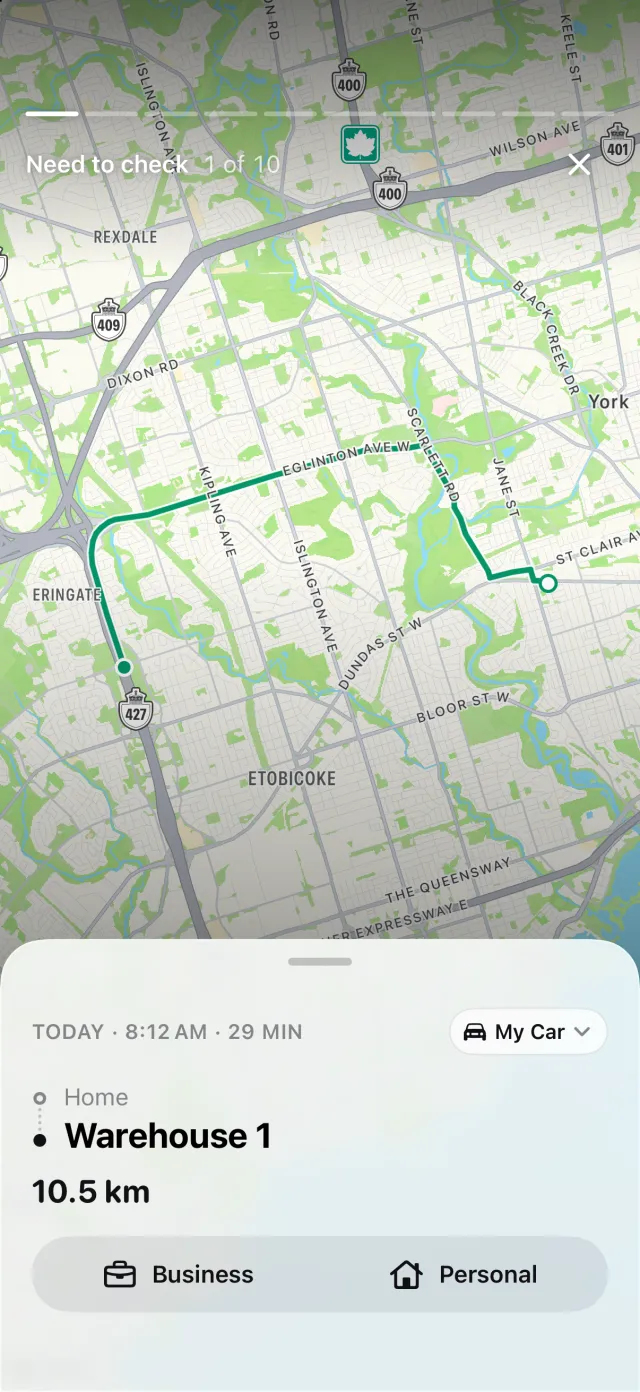
What DriveHub cannot do is decide which rule applies. Whether a place is regular, whether your employer allows a direct trip, and whether your home is the base of your business are facts about your work. DriveHub does not know them. You decide, and your rules carry the decision.
If your iPhone logged driving with no matching trip, a Missed drives story appears under For you on the Trips tab. The report prints the date, destination, purpose in your own words and kilometres for each trip, and the fiscal-year odometer readings. Ways to keep a mileage log compares this with paper and spreadsheets.
This page states what the Income Tax Act, the CRA's own guidance, Revenu Québec's guide IN-155 and the Tax Court say, and cites them so you can check. It is not tax advice. It can't account for your circumstances. Where money is involved, ask your accountant — and bring the logbook.
The full rule for Canada, with the instruments it comes from: mileage log requirements in Canada.