 DriveHub
Country guide · Canada · 8 min
Own car for work in Canada: the CRA per-km rate, tax and the T2200
You got a job in Canada and drive your own car for it. Your employer may pay you per kilometre, pay a flat amount, or pay nothing. Each of the three leads to a different tax answer, and the log you keep decides all of them.

The short answer
- What is the rate? For 2026, Finance Canada and the CRA publish 73 cents per kilometre for the first 5,000 km you drive in the year, and 67 cents after. In the territories it is 77 and 71 cents.
- Does my employer have to pay it? No. The rate caps what the employer may deduct. But the CRA generally treats it as the reasonable rate. Pay well above or below it and the allowance may not be reasonable, and then all of it is taxable.
- Is what I'm paid taxed? A reasonable allowance measured only by kilometres is not income, as long as you aren't also reimbursed for the same driving. A flat amount, or a flat amount paid for the same driving as a per-km rate, loses that exemption — for the whole allowance, not just a part.
- Can I deduct my car costs? Only if your contract makes you pay them and you ordinarily work away from the employer's place of business. You also need no tax-free allowance, and a signed Form T2200.
- Is the commute covered? No. The CRA treats driving between home and work as personal use.
- What do I keep? Receipts, and a log of every trip's date, destination, purpose and kilometres. Without a record, the CRA says an allowance is generally taxable. If you claim costs, add the odometer reading at the start and end of the year, and a copy of the T2200.
What 73 cents a kilometre actually governs
The per-kilometre rate lives in ITR 7306, which opens "For the purposes of paragraph 18(1)(r) of the Act…". ITA 18(1)(r) limits a deduction for "an amount paid or payable by the taxpayer as an allowance for the use by an individual of an automobile". The taxpayer in that sentence is the payer: your employer.
Your own side is ITA 6(1)(b)(vii.1), which exempts "reasonable allowances for the use of a motor vehicle". It never names the rate. The link is the CRA's: "Generally, the CRA considers an allowance based on the per-kilometre rates prescribed in section 7306 … to be reasonable."
A different rate isn't banned. The CRA's allowance page says one that is "lower or higher than the prescribed rate … may not be considered reasonable", and names the type of vehicle, the driving conditions and local fuel costs as facts that can justify it. If it isn't reasonable, "the allowance is taxable".
The 2026 figures are 73 cents for the first 5,000 kilometres you drive in the year and 67 cents after. The 5,000 km line is a lower band, not a cap. A territorial supplement of 4 cents gives 77 and 71 cents. The regulation's consolidated text still prints 2025's 72 and 66 cents; the figures in use are the ones Finance Canada and the CRA publish.
When the allowance is tax-free, and when it isn't
On top of "reasonable", two rules in the same paragraph of the Act deem an allowance not reasonable. Neither taxes only an excess. An allowance that fails is taxable whole: the CRA values the benefit at "the amount paid to your employee in the year".
- Not measured by kilometres alone. Under ITA 6(1)(b)(x), the allowance fails where "the measurement of the use of the vehicle…is not based solely on the number of kilometres". A flat monthly car allowance fails it. So does a flat amount paid on top of a per-km rate for the same driving.
- An allowance and a reimbursement together. Under ITA 6(1)(b)(xi), it fails where the employee "both receives an allowance in respect of that use and is reimbursed in whole or in part". Tolls, ferries and supplementary business insurance are excepted, if the allowance was set without counting them.
The "same driving" condition matters. The CRA's own example is a flat monthly amount for travel inside the employment district and a per-km rate outside it: "the allowances are considered separately". The flat part is taxable, and the per-km part "is not taxable".
So the question to ask payroll isn't only "how much?" It's "how is it counted, and for which driving?"
Paying your own costs: the T2200 route
Your employer may pay nothing for the car, or pay an allowance that is taxable. Then you may be able to deduct your actual car expenses on Form T777, at line 22900.
The deduction is ITA 8(1)(h.1). It applies where you "(i) was ordinarily required to carry on the duties of the office or employment away from the employer's place of business or in different places, and (ii) was required under the contract of employment to pay motor vehicle expenses".
It does not apply where you "(iii) received an allowance for motor vehicle expenses that was, because of paragraph 6(1)(b), not included in computing the taxpayer's income". A tax-free per-km allowance closes this route. A flat allowance that was taxed doesn't.
ITA 8(10) adds the form. Nothing is deductible under (h.1) "unless the taxpayer's employer confirms in prescribed form that the conditions set out in the applicable provision were met". That form is the T2200, and Guide T4044 asks you to keep a copy with your records.
Refusing an allowance doesn't open the deduction. T4044: "You are not considered to have paid your own motor vehicle expenses if your employer reimburses you or you refuse a reimbursement or reasonable allowance from your employer". If your costs run above a tax-free allowance, the way back is to "voluntarily include the amount of the allowance in your income".
Driving to work doesn't count
The CRA says it plainly, on the line 22900 page and in Guide T4044: "The CRA considers driving back and forth between home and work as personal use."
That matters twice. Commuting kilometres are not business kilometres in a per-km claim, and they count as personal use in the split behind a T777 claim. When a client's site becomes a regular place of work, and what happens with several stops in a day, is in is driving to work deductible in Canada.
A worked example
These figures are illustrative, not from the CRA. Say you drive 7,000 business kilometres in 2026 in your own car, outside the territories.
Paid at the published rate.
- First 5,000 km × 73 ¢ = $3,650
- Next 2,000 km × 67 ¢ = $1,340
- Total: $3,650 + $1,340 = $4,990
The allowance is counted by kilometres alone and paid at the prescribed rate, which the CRA generally treats as reasonable, so it isn't income. Because it is tax-free, 8(1)(h.1)(iii) rules out a T777 claim for the same car costs, unless you include the allowance in income as T4044 describes.
Paid a flat $400 a month instead.
- $400 × 12 = $4,800
It isn't measured solely by kilometres, so under 6(1)(b)(x) the whole $4,800 is taxable. Because it was included in your income, (iii) no longer blocks the deduction. If the other conditions hold and your employer signs a T2200, you can claim your actual costs on a T777.
What the log has to show
The CRA asks different things of each route.
Paid an allowance. Receipts, a log of all kilometres and, for each trip, "the date, destination and purpose". No odometer reading is asked for. And the CRA is blunt about the alternative: "If no record is kept, the allowance or reimbursement is generally taxable."
Claiming costs on a T777. For each trip, "the date, destination, purpose, and number of kilometres", and you must "Record the odometer reading of each vehicle at the beginning and again at the end of the year". The two readings give the year's total. The trips give the business part.
Keep the T2200 with it. Paper, a spreadsheet and an app can all produce this record; four ways to keep a mileage log compares them. The self-employed side, where the per-km rate does not apply at all, is in Canada's motor vehicle records. If your employer gives you a car instead, see the company car standby charge.
How DriveHub makes this easier
A claim rests on the drives in the log. The one that goes wrong is the drive nobody wrote down.
With location access set to Always, DriveHub records every drive in the background — and if it ever misses one, it tells you. It keeps the date, both ends and the distance. Afterwards you mark each trip Business or Personal, and add the purpose in your own words.
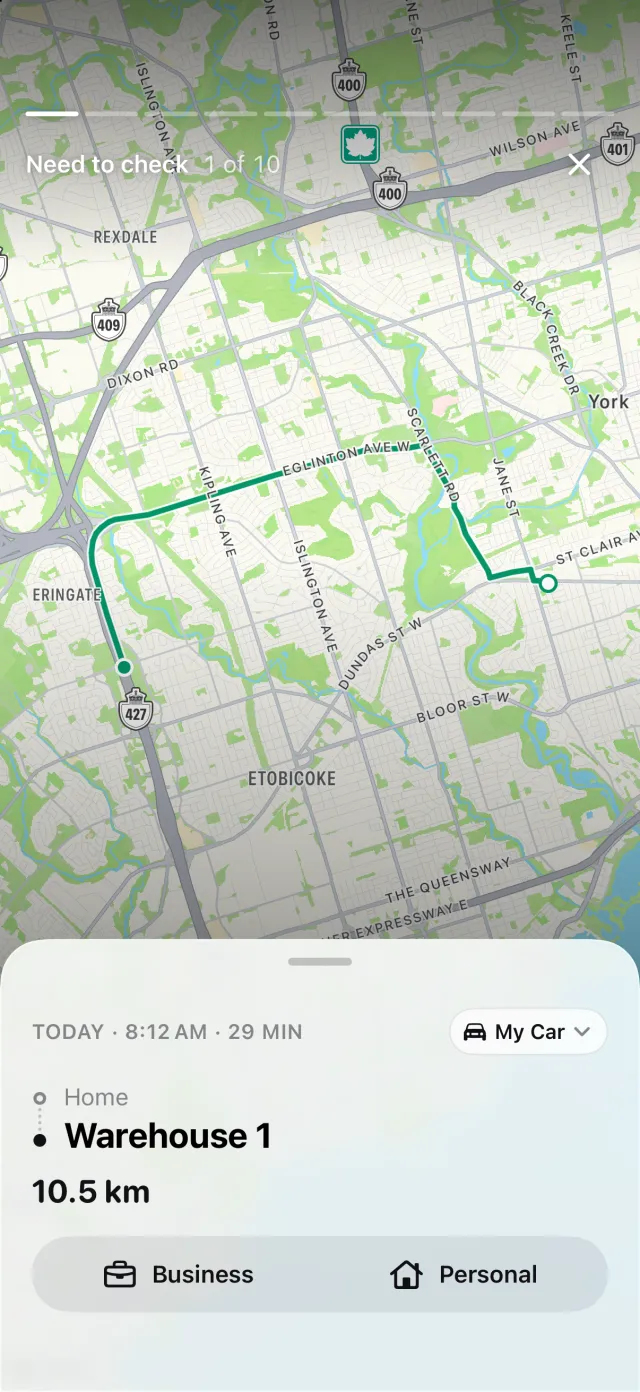
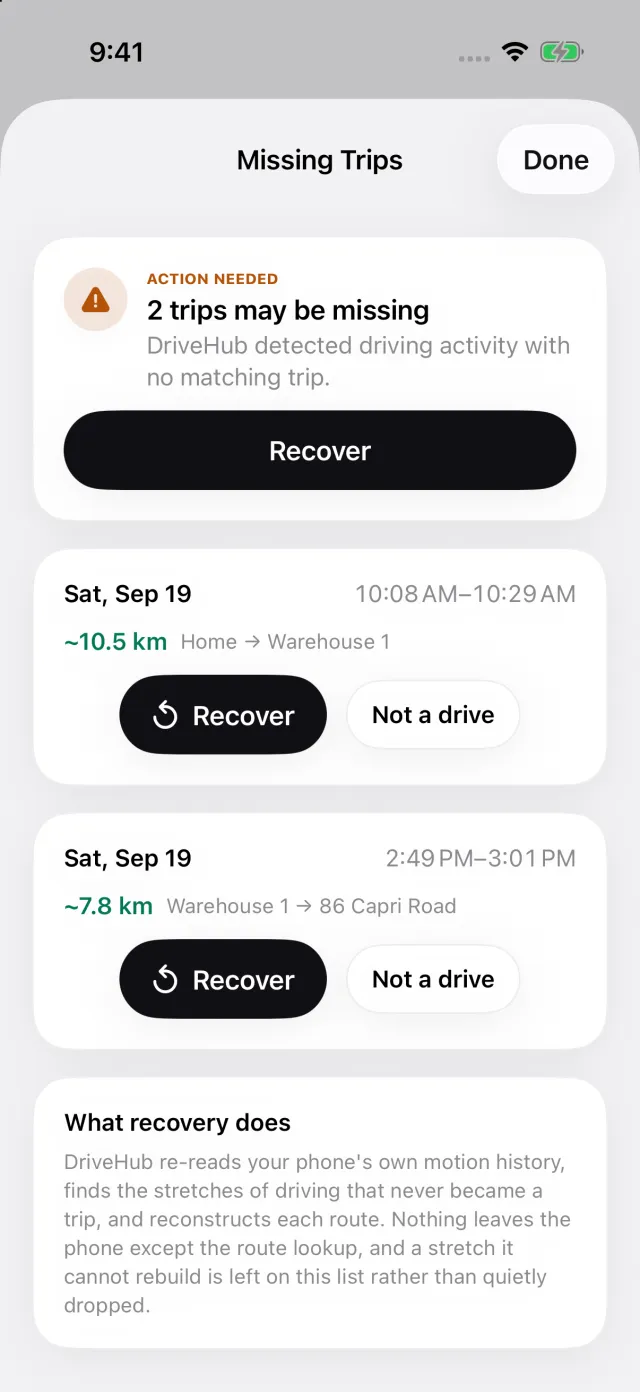
If your iPhone logged driving with no matching trip, a Missed drives story appears on the Trips tab. It opens Missing Trips, where Recover rebuilds the route, so a gap can be closed before the year ends.
Canada's rate is one of the official rates DriveHub carries, dated to its source, so each trip is valued at the rate in force on its day. The report prints the date, destination, purpose and kilometres of each trip, and the odometer readings for the year as their own block.
Where DriveHub stops: it files nothing with the CRA and doesn't fill in a T2200 or a T777. It can't tell you whether your allowance is reasonable or how your employer measures it. A drive it didn't record and can't recover, because the phone was off or flat, stays out of the report until you add it by hand.
DriveHub is on the App Store for iPhone. The Canadian rules it follows are on the Canada page, and setting up automatic tracking takes a few minutes, once.
This page states what the Income Tax Act, the Regulations and the CRA's own guidance say, and cites them so you can check. It is not tax advice. It can't account for your circumstances. Where money is involved, ask your employer's payroll team or your accountant — and bring the log.
The full rule for Canada, with the instruments it comes from: mileage log requirements in Canada.