 DriveHub
Country guide · Canada · 8 min
Company car in Canada: a logbook can reduce the standby charge
Your employer gives you a car, and some of the driving is yours. Canada taxes that as a standby charge for having the car and, if your employer pays the running costs, 34 cents per personal kilometre. A logbook can bring the first down to the reduced standby charge, if your employer requires you to use the car for work and most of the driving was work.

The short answer
- How is a company car taxed? Two amounts go into your employment income: a standby charge for having the car available, and an operating benefit if your employer pays running costs for your personal driving.
- What is the standby charge? 2 % of the car's cost for every 30 days it was available, or two-thirds of the lease payments, less their insurance part, if it is leased.
- What is the operating benefit in 2026? 34 cents per personal kilometre, or 31 cents if you work mainly in selling or leasing cars.
- Can a logbook make it cheaper? Yes. The reduced standby charge scales the charge down by your personal kilometres. It needs three things: your employer requires you to use the car for work, more than half the distance is for work, and your personal and total kilometres are on record.
- Is the drive to the office business? No. Home to a regular place of work is personal driving, even when your employer insists you take the car home.
- What goes in the log? The days the car was available, and your business and personal kilometres, daily, weekly or monthly. Your employer gets a copy.
The standby charge: you pay for having the car
ITA s. 6(1)(e) adds to your income "an amount that is a reasonable standby charge for the automobile for the total number of days in the year during which it was made so available". It is reduced by what you paid for the car's use, "(other than an expense related to the operation of the automobile)".
"Available" is wider than "driven". The CRA's page Automobile provided by the employer: "An automobile is made available to your employee if your employee has access to or control over the automobile". That covers "The whole day, part of the day, or even if it just stays unused in your employee's garage, driveway, or parking spot".
The full charge, from ITA s. 6(2), is 2 % × the car's cost × the number of 30-day periods it was available when the employer owns it. For a leased car it is two-thirds of the lease payments, less the insurance part of them.
There is one way to have no car benefit at all. The CRA: "If your employee does not use the automobile for any personal driving, there is no taxable benefit, even if the automobile is available to your employee for the entire year." That holds only if every kilometre was driven for work "and the automobile is returned to your premises at the end of the employee's work day."
The reduced standby charge: where the log comes in
Section 6(2) multiplies the charge by a fraction, A ÷ B. B is 1,667 km for every 30 days the car was available. A is your personal kilometres in those days, capped at B.
The statute allows A to be lower than B only if two things hold. You must be "required by the employer to use the automobile in connection with or in the course of the office or employment". And the distance must be "primarily in connection with or in the course of the office or employment".
The Act says "primarily". The CRA reads that as more than 50 % of the distance. It sets the ceiling at 1,667 km per 30 days or 20,004 km a year of personal driving. Its three conditions:
"Condition 1: You required your employee to use the automobile in connection with or in the course of an office or employment" "Condition 2: Your employee used the automobile more than 50% of the distance driven for business (employment-related) driving" "Condition 3 … The number of kilometres travelled of personal driving must not be more than one of the following: 1,667 km per 30 day period [;] 20,004 km in the year"
Condition 2 is computed from the log: business kilometres divided by business plus personal kilometres. Without the two totals there is nothing to divide.
The CRA's worked example
The CRA's own example, checked line by line:
| Step | Figure |
|---|---|
| Days available | 150 |
| 30-day periods: 150 ÷ 30 | 5 |
| Full standby charge: $50,000 × 2 % × 5 | $5,000 |
| B: 5 × 1,667 km | 8,335 km |
| Personal driving | 5,500 km |
| A ÷ B: 5,500 ÷ 8,335 | 0.66 |
| Reduced charge: $5,000 × 0.66 | $3,300 |
| Less the employee's $500 reimbursement | $2,800 |
Without the reduction, the same year is $5,000 − $500 = $4,500. Here the log takes $1,700 off your taxable income.
Every input except the car's cost comes from the log: the days available, the personal kilometres and, for Condition 2, the total.
The operating benefit: 34 cents per personal kilometre
If your employer pays running costs for your personal driving, ITA s. 6(1)(k) adds an operating benefit. The default is the prescribed rate times your personal kilometres.
Finance Canada confirmed the rate on 14 January 2026. It "will remain at 34 cents per kilometre for 2026", and "at 31 cents per kilometre" for people "employed principally in selling or leasing automobiles". The CRA's table and ITR 7305.1 give the same figures. (Guide T4130 still shows the 2025 rate, which was also 34 cents.)
Two ways the operating benefit changes:
- Repay within 45 days. The CRA: "You do not have to calculate the operating expense benefit if your employee reimburses you for all operating expenses related to personal driving no later than 45 days after the end of the year." A partial repayment made "in the year or within 45 days after the end of the year" is deducted from the benefit.
- Elect half the standby charge. Under s. 6(1)(k)(iv), if the car is used primarily for work, the benefit can be half the standby charge instead. You must notify your employer "in writing before the end of the year". The CRA reads "primarily" as more than 50 % here too, and warns "the optional calculation may result in a higher benefit amount than the fixed rate calculation."
Either way, the CRA says "Your employee must keep the records of this benefit even if you are using the fixed rate calculation."
The simplified 24 % method
The CRA also allows a simpler standby charge: the cost of the car multiplied by 24 %. It is open only if the employer owns the car, you use the same car all year and you don't sell or lease cars. And "Your employee is not eligible for the reduced standby charge". So it applies only where the reduced charge does not.
What counts as personal driving
The CRA: "Personal driving is any driving of an automobile that is done for purposes not related to the employee's employment. This includes driving between home to a regular place of employment."
A regular place of employment is "any location where your employee regularly: reports for work [;] performs employment duties". It "does not need to be your establishment", and you can have several. A client's premises you report to daily for a six-month project is one.
With several places in a day, only the first and last legs are personal: home to the first work location, and the final one back home. "Any other travel by your employee between regular places of employment is considered business (employment-related) driving."
A point of call is any other place you go to do your job. Driving straight from home to it, or back, is business if your employer needs or allows it. The trip must be reasonable "at that time and on the way to or from work", or it is personal.
Taking the car home on call does not change the answer. Personal driving includes "Travel between home and a regular place of employment even if you insist your employee drives the vehicle home, such as when your employee is on call".
For how these rules sort each trip, see driving to work in Canada.
What your company car logbook must contain
The CRA puts the duty on the employee: "your employee must keep a logbook or daily record of the trips made with the automobile." And: "The employee must give you a copy."
What the CRA says to record:
- the "Total number of days that the automobile was made available to them during the year";
- the "Total number of kilometres travelled for business (employment-related) and personal driving (on a daily, weekly, or monthly basis)" in those days.
Guide T4130 adds what a business entry may carry: "the date, the name and address of the client, and the distance travelled between home and the client's place of business". The rest of the detail follows the CRA's motor vehicle records guidance.
At year end your employer recomputes with "the actual number of personal kilometres travelled during the year." If no log was kept, the employer "must be able to reasonably account for the number of personal and business (employment-related) kilometers" to use the reduced charge. The CRA pages set no federal deadline for handing over the copy and name no penalty.
In Québec, a deadline and a $200 penalty
Québec is stricter. Revenu Québec says the employee must give the employer a copy of the logbook by 10 January of the following year. If the car is returned earlier, the deadline is the 10th day after its return. An employee who misses it "encourt une pénalité de 200 $".
Québec's Act also requires, daily for each work trip, the departure, the destination, the distance and what shows the trip was for work. This follows the Loi sur les impôts, art. 41.1.4, 41.1.5 and 1049.34, as consolidated to 5 June 2025.
Before the year ends
- Your employer requires you to use the car for work, if you want the reduced charge.
- Your personal kilometres are no more than 1,667 per 30 days of availability, and under half the total.
- The log holds the days available and business and personal kilometres, daily, weekly or monthly.
- Home to your regular workplace is logged as personal.
- If you want the half-standby election, your written notice reaches your employer before the end of the year.
- Any repayment of personal running costs is made within 45 days after year end.
- Your employer has a copy of the log. In Québec, by 10 January.
- Paying for your own car instead? See using your own car for work in Canada.
How DriveHub makes this easier
The reduced standby charge and the operating benefit both turn on two figures: your personal kilometres and your total kilometres.
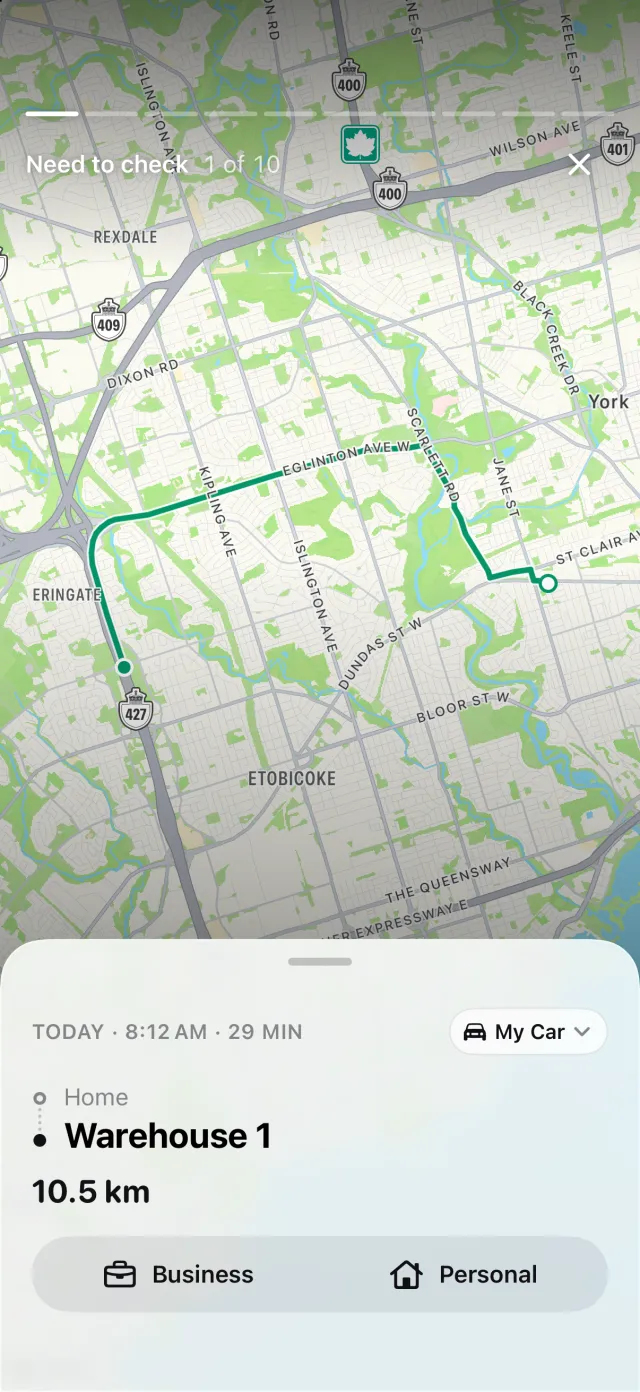
With location access set to Always, DriveHub records every drive in the background — and if it ever misses one, it tells you. A rule on a place, your past drives on the same route and your working hours file many trips as Business or Personal. The rest wait under Need to check. A Personal rule on your office files the commute as personal.
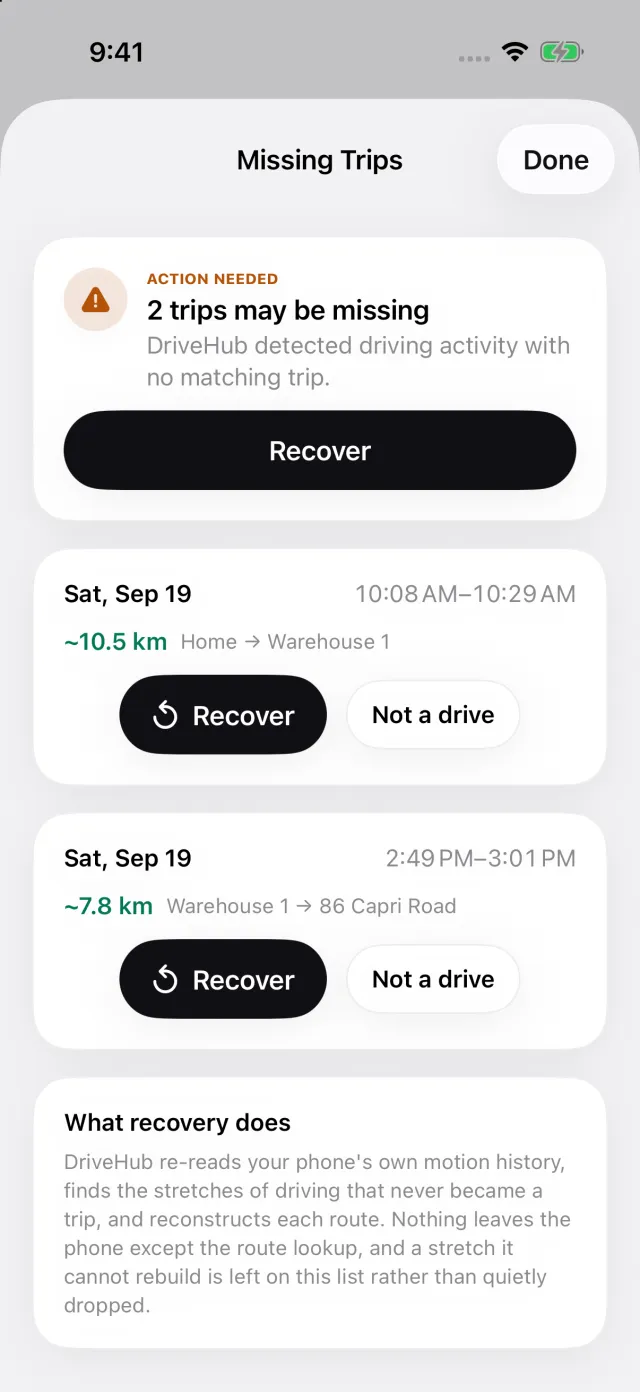
If your iPhone logged driving with no matching trip, Missed drives appears on the Trips tab and opens the Missing Trips list, where Recover rebuilds the route. An unrecorded personal trip would understate the figure the charge is built on.
Reports shows business and personal kilometres for any day, week, month, quarter or year, or a range you choose, for one vehicle or all. That is the daily, weekly or monthly split the CRA asks for. With DriveHub Pro it exports as PDF, Excel or CSV, as the copy for your employer.
Where DriveHub stops: it does not count the days the car was available, and it does not compute the standby charge or the operating benefit. It doesn't know whether your employer requires you to use the car, and it sends nothing to your employer.
DriveHub is on the App Store for iPhone. The Canadian rules are on the Canada page. Setting up automatic tracking takes a few minutes, once. For paper, spreadsheets and apps compared, see four ways to keep a mileage log.
This page states what the Income Tax Act, the Regulations, the CRA and Revenu Québec say, and cites them so you can check. It is not tax advice. It can't account for your circumstances. Where money is involved, ask your accountant or your employer's payroll team — and bring the logbook.
The full rule for Canada, with the instruments it comes from: mileage log requirements in Canada.