 DriveHub
Country guide · Croatia
Dnevnica for a službeno putovanje — €30 over 12 hours, €15 over 8, and what changes it

What the dnevnica is, and who this page is about
A dnevnica is the daily allowance an employer pays a worker on a business trip. The Pravilnik o porezu na dohodak, čl. 7 st. 2, sets the largest amount that is not taxed as salary. It is a ceiling: an employer may pay less. Whatever is paid above it is taxable pay.
This page covers the case DriveHub calculates: an employee on a domestic službeno putovanje (service trip) or on rad na terenu (field work). It does not cover the self-employed, trips with a part abroad, or trips before 2023. Those limits are listed near the end.
The figures
Rows 19 and 20 of the table in čl. 7 st. 2. The current amounts were set by NN 143/2023 and apply from 2 January 2024. NN 16/2025 re-enacted the table with the same figures.
| Time away | Tax-free dnevnica |
|---|---|
| More than 12 hours | €30.00 |
| More than 8 and less than 12 hours | €15.00 |
| 8 hours or less | nothing |
From 1 January 2023 to 1 January 2024 (NN 156/2022) the figures were €26.55 and €13.28. DriveHub uses the rate in force when each day or 24-hour period began. Earlier trips were paid in kuna, and DriveHub does not calculate them.
The 30 kilometre condition
Under čl. 7 st. 11 a dnevnica covers travel from the place of work, or from your place of residence, to another place at least 30 km away. A trip to the place where you live does not count, however far it is. A trip that stays within 30 km gets no dnevnica at all, however long it lasts. The total kilometres driven do not count.
DriveHub asks this as a plain yes or no. If the straight line from your log reaches 30 km, it fills in the answer for you. A shorter straight line proves nothing, because the road is always longer, so in that case it asks you about the road distance.
How long a trip counts
The Pravilnik says only "dnevno" (per day). For a trip over several days, DriveHub counts 24-hour periods from departure, as the Tax Administration does in its opinion 2413 of 26 August 2019. That opinion dealt with a trip that was partly abroad. Each full 24 hours earns €30. Whatever is left over is read against the table: over 12 hours earns €30, over 8 hours earns €15. The result shows the note "Multi-day trips are counted in 24-hour periods from departure."
Two edge cases:
- Exactly 12 hours. The table says "more than 12" and "more than 8 and less than 12", so exactly 12 hours is in neither row. DriveHub shows the lower €15 and prints "Exactly 12 hours is not covered by the rule; the lower amount is shown."
- Over 30 days. A continuous trip longer than 30 days is not a service trip under st. 8. DriveHub reports "Not a service trip under the rules (over 30 days)." and states no amount.
Field work is counted differently. Row 19 gives rad na terenu the over-12-hours rate per day, and st. 12 includes the days spent travelling there and back. You enter the number of field-work days, and DriveHub applies the full rate to each. Whether a job counts as field work at all is decided by st. 9: the employer's line of business must by its nature involve field work, and the site must be at least 30 km from the employer's seat and from your residence. DriveHub does not check that. The employer decides it.
Meals paid by your employer
If your employer provided a lunch or dinner, the tax-free dnevnica falls by 30% for one meal and by 60% for two (st. 13). Breakfast included in the room price does not count. A lunch or dinner included in a seminar or conference fee, in a ship ticket, or paid from the employer's entertainment budget counts as provided.
DriveHub asks this once for each per diem: each 24-hour period, the leftover part, or each field-work day. The amount is that per diem's rate × (1 − 0.30 × meals), rounded to the cent. So a €30 day is €21.00 with one meal and €12.00 with two.
If your employer paid more
You can enter the amount your employer actually paid. If it is higher than the tax-free figure, DriveHub prints "EUR … above the tax-free amount is taxable salary." It does not calculate the tax or contributions on that excess. That is payroll's job.
How to do it in DriveHub
- Open Reports, choose the period, and select all vehicles. On the Per diems · Croatia card, tap Set up per diems. Journeys are suggested only if you have marked a Home or Work site.
- Under Suggested from your log, tap Review journey, or tap Add a journey by hand. Not a business journey hides a suggestion.
- Check the Left and Back times. The log records when the car moved, so change them if you actually left or came back at a different time.
- Under Journey, set You are to Employed. DriveHub may have filled this in already.
- Answer the Distance question: "The destination was at least 30 km from my place of work or residence".
- Under Trip, pick the Kind: Service trip (službeno putovanje) or Field work (rad na terenu). Answer The trip had a part abroad and The destination is my place of residence. For field work, enter Field-work days, including travel days. Use … calendar days fills in the number of days the times cover.
- Under Meals at the employer's cost, choose No meal, One meal or Two meals for each per diem. Fill in Amount paid (optional) if you want the excess check.
- Switch on These times are right and this was a business journey. Until you do, no amount is stated.
- Read the Result, then tap Save. The amount is added to Total for this period on the setup screen.
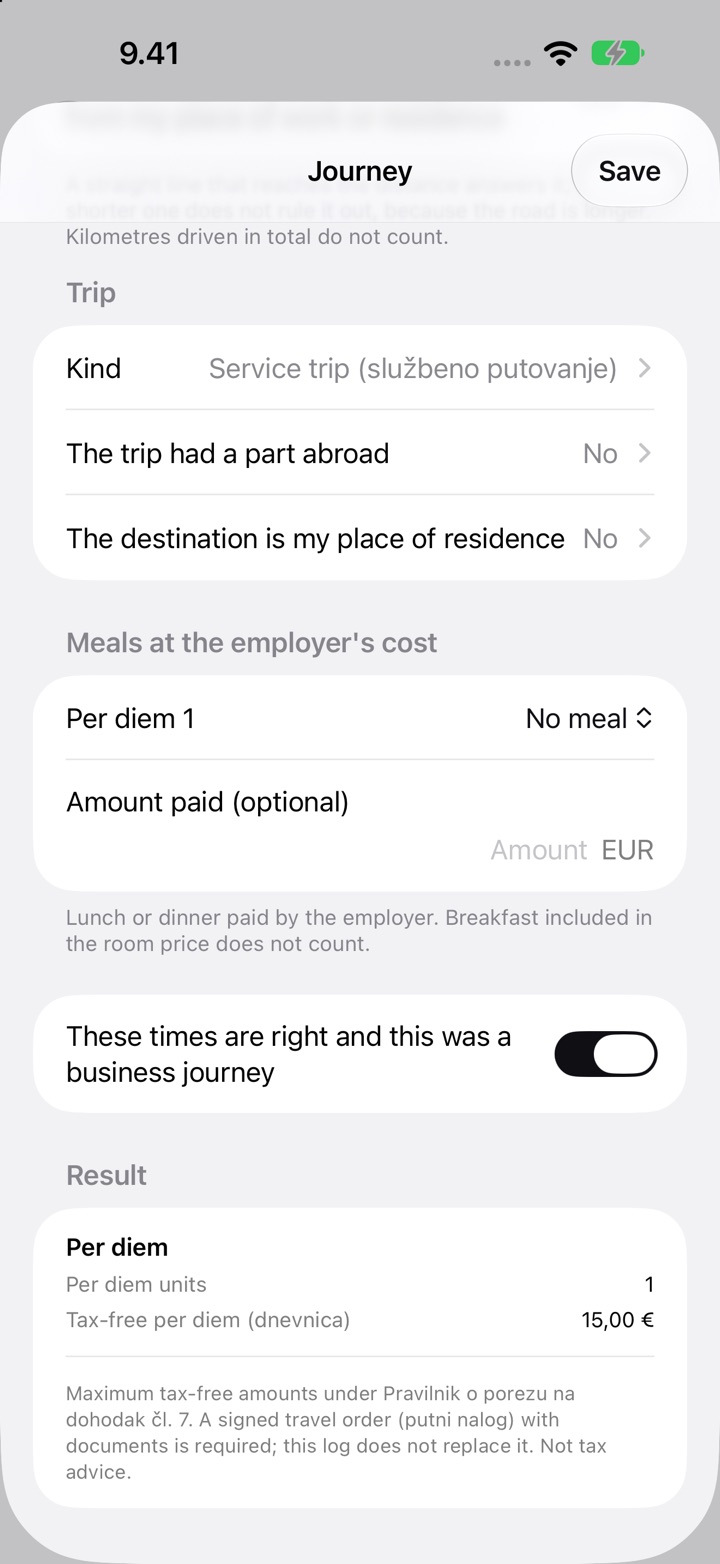
If an answer is missing, the result says Insufficient data — no amount is stated. and names what is missing.
When all vehicles are selected, the PDF and the workbook's tax calculations print a Per diems · Croatia block. It shows each journey with its Tax-free per diem (dnevnica) and a total for the period.
What DriveHub does not do
- The self-employed. For an obrtnik it says "Per diems for self-employed persons are not calculated." Čl. 7 st. 1 lists the dnevnica separately from "naknada, potpora, nagrada". Čl. 35 st. 1 t. 6, which extends čl. 7 to independent activity, names only "naknada, potpora i nagrada". DriveHub does not read that as covering a dnevnica. Your knjigovođa may read it differently.
- Trips with a part abroad. It reports "Trips with a foreign part are not supported."
- Trips before 2023, which were paid in kuna.
- Tax on any excess. It shows how much was paid above the limit, not what is due on it.
- The putni nalog itself. The per-diem block ends with this note: "A signed travel order (putni nalog) with documents is required; this log does not replace it." DriveHub gives you the times, the distance answer and the calculation to fill in the nalog. For what that document must contain, see Putni nalog or loko vožnja.
All Croatia pages are at /help/hr.
This page states what the Pravilnik o porezu na dohodak says, and names the articles so you can check. It is not tax advice. It can't account for your circumstances. Where money is involved, ask your knjigovođa, and bring the putni nalog.
The full rule for Croatia, with the instruments it comes from: mileage log requirements in Croatia.