 DriveHub
Country guide · Norway
Reisefradrag for the drive to work in Norway — how avstandsfradrag is calculated, and what DriveHub computes

What the deduction is
Reisefradrag, which Skatteetaten's handbook calls fradrag for arbeidsreiser and most people call avstandsfradrag, is the deduction for travelling between home and a regular workplace. It is a deduction in your own tax return. It is not the same thing as the kilometre allowance an employer pays you for a work trip, and the two should not be mixed up. For that one, see Reiseregning or elektronisk kjørebok in Norway.
The rules are in Skatte-ABC R-8, Skatteetaten's handbook (oppslag.rettskilder.skatteetaten.no). The figures below are for 2026.
The calculation
For one year, the deduction is:
- Count the days you travelled between home and the workplace.
- Multiply by two, because each day is a journey out and a journey back.
- Multiply by the shortest route between home and work, one way, in kilometres.
- Multiply by the rate: 1,90 kr per km for 2026.
- Add toll and ferry costs, if they count (see below). They are added before the floor is subtracted.
- Cap the total at 120 000 kr.
- Subtract the 12 000 kr floor (bunnfradrag).
R-8-2.1 puts the floor and the cap in these words: "Fradrag for arbeidsreiser gis bare med det beløpet som overstiger et bunnfradrag på kr 12 000 i året" and "Øvre grense for fradrag er kr 120 000." The 2026 rate is "kr 1,90 per kilometer". So the largest possible deduction is 108 000 kr, and a year with less than 12 000 kr of travel gives nothing.
Example. You travel 23,5 km one way and made the trip on 220 days, so 440 journeys. That is 10 340 km. At 1,90 kr that is 19 646 kr. After the floor, the deduction is 7 646 kr.
The rules around it
Shortest route, not the distance you drove. R-8-4.1.1: "Reiseavstanden beregnes som hovedregel etter den korteste strekningen av vei", and "Dette gjelder uavhengig av hvilken strekning som faktisk benyttes." If you take a longer, quicker or nicer road, you still count the shortest one. The same section rounds up: "Den samlede, daglige reiseavstanden avrundes opp til nærmeste kilometer."
At least 2,5 km each way. R-8-3.1: the journey qualifies "bare når beregnet reiseavstand er minst 2,5 km hver vei." Under that, there is no deduction.
Actual trips, with 230 days as the normal full-time count. R-8-5.1 starts from "det faktiske antallet arbeidsreiser", and adds: "Ved fulltidsarbeid regnes normalt med 230 arbeidsdager i året." Holiday beyond five weeks, sickness, time off in lieu, leave and work trips are deducted only "dersom fraværet utgjør mer enn 15 arbeidsdager i året". Once absence passes 15 days, all of it is deducted. Part-time workers and people with irregular hours count their actual trips. DriveHub does not use the 230-day count (see below).
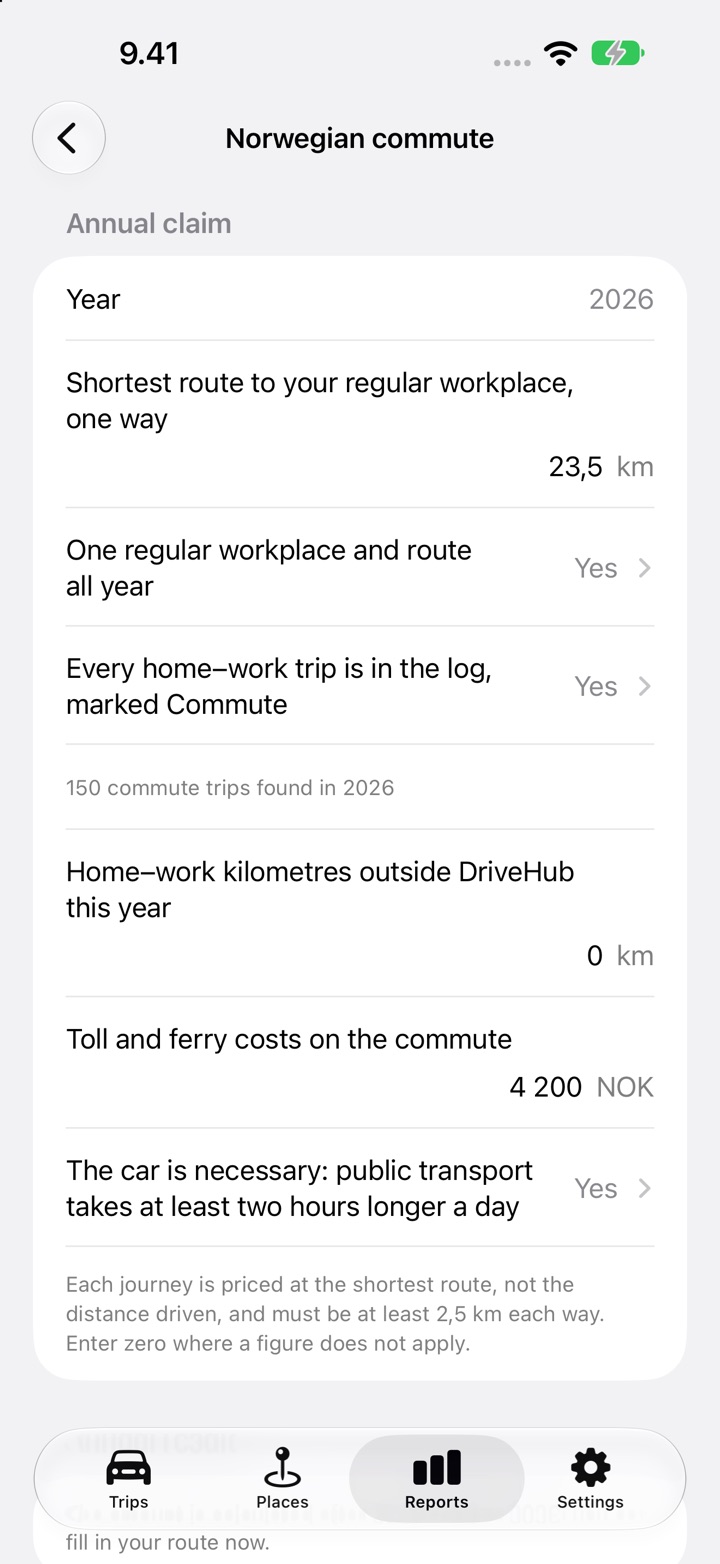
Toll and ferry costs. They count only if together they exceed "en minstegrense på kr 3 300 i året" (R-8-7.1), and then in full, not just the part above 3 300 kr. They also count only if the car is necessary. R-8-7.1 says that is the case only when public transport adds two hours or more of travel and waiting time, "til sammen for frem- og tilbakereisen", compared with the car.
One regular workplace. The model is a single workplace and a single route over the year. Split shifts, several workplaces and visits to customers are different situations.
What DriveHub does, and does not do
DriveHub calculates this for Norwegian vehicles and the 2026 tax year only. The rate for other years has not been checked against the source, so for any other year the card says only 2026 is calculated, and states no amount. It also waits for the year to end: the amount appears after 31 December 2026.
It does not use GPS distance. It takes the days from your trip log, and the distance from the one-way route you type in. Each date that has a reviewed trip marked Commute on a Norwegian vehicle counts as a day, with at most two journeys per day. Every journey is priced at your shortest route, not at what the trip meter recorded. If the route is under 2,5 km, the result is no deduction.
It does not round the daily distance up. R-8 rounds the day's total up to a whole kilometre; DriveHub multiplies your route as entered. If your route is 23,4 km, a day is 46,8 km in DriveHub and 47 km under the rule, so DriveHub's figure is slightly lower.
It does not apply the 230-day default or the 15-day absence rule. Only days found in your log count. If you drove to work on days the log does not have, the figure will be too low, which is why the setup asks you to confirm that every home–work trip is in the log.
It does not guess when it is unsure. Unanswered questions never become zero. If anything is missing, the card names what is missing and shows no amount. It does not model split shifts, several workplaces, visits to customers, or the exceptions for shorter distances on health grounds.
The setup also asks for home–work kilometres you travelled outside DriveHub (another car, public transport, a passenger seat). They are priced at 1,90 kr per km like the rest. Toll and ferry costs above 3 300 kr are counted only if you answer Yes to the question about the car being necessary; No leaves them out.
How to do it in DriveHub
- When you review a trip, mark a home–work trip Commute, the choice next to Business and Personal. Review every trip of the year on your Norwegian cars: one unreviewed trip stops the calculation.
- Open the Reports tab. The Norwegian commute deduction card shows a result only for the full calendar year with all vehicles selected. If you see Show 2026, tap it.
- On the card, tap Set up Norwegian commute (or Edit Norwegian commute if you have started). You can fill it in at any time during 2026.
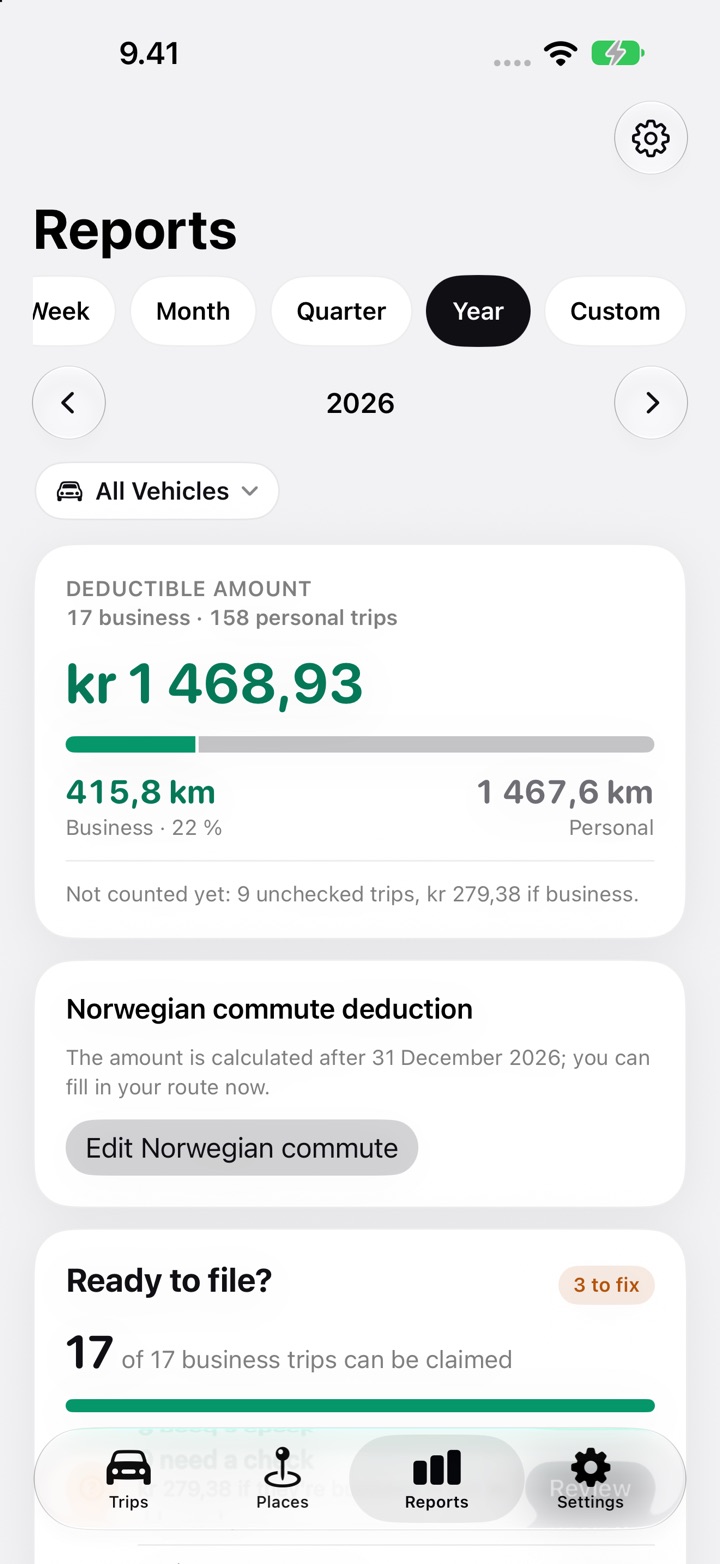
4. Enter Shortest route to your regular workplace, one way, in kilometres. 5. Answer One regular workplace and route all year and Every home–work trip is in the log, marked Commute. The screen shows how many commute trips it found, so you can check the answer against a number. 6. Enter Home–work kilometres outside DriveHub this year, or 0. 7. Enter Toll and ferry costs on the commute, or 0. If the total is above 3 300 kr, you are also asked whether the car is necessary: public transport takes at least two hours longer a day. Answer it against the rule above: two hours or more, there and back.
8. After 31 December 2026, the Annual result shows the commute days, journeys counted, the amount at 1,90 kr per km, toll and ferry costs counted, the total before the floor, and the Deduction after the 12 000 kr floor.
The same lines, plus the kilometres from the log and from outside it, are printed in the PDF and workbook report for the full 2026 calendar year with all vehicles.
More for Norway
The figure DriveHub prints is a calculation from your answers, so the route and the confirmations need to be right. Employer allowances, passengers and the kjørebok are separate subjects, covered in the Norway guide.
This page states what Skatte-ABC R-8 says, and names the section so you can check. It is not tax advice. It can't account for your circumstances. Where money is involved, ask your regnskapsfører — and bring your route and your log.
The full rule for Norway, with the instruments it comes from: mileage log requirements in Norway.