 DriveHub
Country guide · Germany · 6 min
Dienstwagen: 0.002% per commuting day instead of 0.03% a month (Einzelbewertung)

The short answer
If a company car is available to you privately in Germany and you value it with the list-price method, the drive between home and your first workplace is normally taxed, on top of the 1%, at 0.03% of the list price for every kilometre of the one-way distance, for every calendar month (§ 8 Abs. 2 Satz 3 EStG). The BMF letter says this monthly charge applies even in full months in which you did not drive to work at all, and when you work from home, part-time or travel (Rz. 12).
The tax administration allows an alternative, the Einzelbewertung (the letter also calls it the 0,002 %-Regelung): 0.002% of the list price for every kilometre of the one-way distance, for each day you actually drove to the first workplace, for at most 180 days a year. The source is the BMF letter of 3 March 2022, IV C 5 - S 2334/21/10004 :001 (reproduced as LStH 2026, Anhang 24 IV-1), Rz. 12 and 13. The cap is yearly, not monthly: "Eine monatliche Begrenzung auf 15 Fahrten ist ausgeschlossen."
Both methods use the same list price and distance, so you can compare them without either figure: the monthly method costs 0.03% times the months, the daily one 0.002% times the days. One month equals 15 days, so the daily method is cheaper whenever you drove to work on fewer than 15 days per month of availability on average. Over a full year at the 180-day cap the two are level (12 × 0.03% = 180 × 0.002% = 0.36%).
Who benefits
People who work from home part of the week, travel for clients, or are away for long stretches: over a full year, 90 commuting days is 0.18% against 0.36%. It does not help someone who commutes almost every working day, and it needs paperwork the monthly method does not.
What the rule requires
The same letter sets the conditions. They are the reason this is a record-keeping question rather than an arithmetic one.
- A dated list, per car and per month. You declare to your employer in writing, every calendar month and for each car, on which days (with the date) you drove it to the first workplace. Rz. 13 a: "die bloße Angabe der Anzahl der Tage reicht nicht aus". A total of 110 days is not accepted; the individual dates are. You do not have to say how you got to work on the other days.
- Actual days only, each once. A day counts if you drove the car to the first workplace that day. Driving there twice on one day still counts once.
- 180 days across all your cars in the year (Rz. 13 c).
- Your employer must use it if you ask, unless your employment contract or another legal basis says otherwise (Rz. 13 e).
- One method for the whole year. The employer fixes the method per calendar year for all your company cars and may not switch during the year. A switch for the whole year can still be made in payroll before the annual wage tax certificate is issued (Rz. 13 f). Otherwise you can switch to the daily method in your income tax return, for the whole year and all your cars, if you show the dated days per car (Rz. 13 g).
Which days DriveHub counts
DriveHub counts a day when a direct trip between your Home and your Work place was logged on this car that day. It recognises that trip in either of two ways:
- you answered Commute when reviewing the trip, or
- it is a Personal trip between a place you gave the role Home and a place you gave the role Work (in either direction).
Several trips on one day make one day. A trip classified as Business, such as a client visit on the way, does not make a commute day.
The page appears only for a car set as a company car, not for a car you own. It covers 1 January of the year in which the report period ends up to the end of the period, whatever start date the report has.
What the report prints
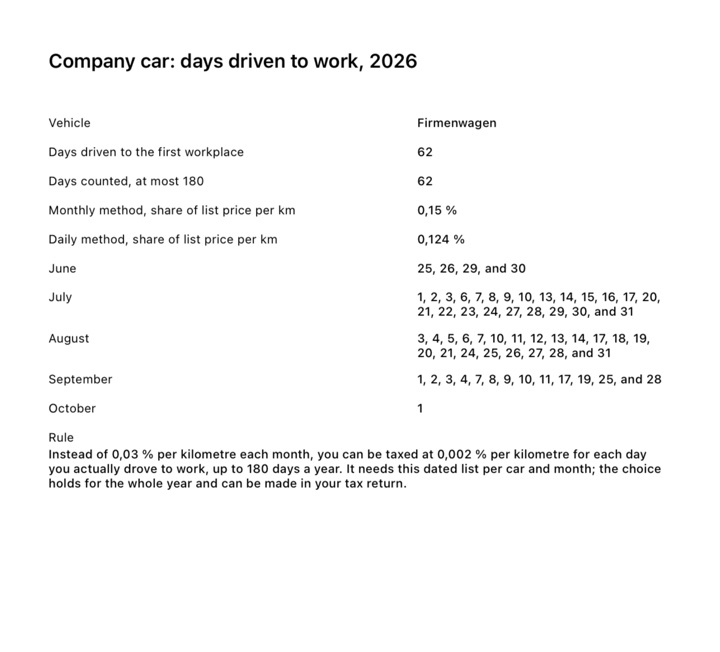
When you export a report for one German company car, the report gains a page titled "Company car: days driven to work, 2026" (with the year; in a PDF in another language the labels are translated). It contains:
- Days driven to the first workplace: the number of distinct days found
- Days counted, at most 180: the same number, capped at 180
- Monthly method, share of list price per km: 0.03% times the months counted this year, up to the end of the report or today, whichever is earlier
- Daily method, share of list price per km: 0.002% times the days counted
- one line per month with the dates of the days, for example "March: 3, 4, 10, 11"
- the rule, in a sentence
What it does not do
- It prints percentages, not euros. It does not ask for the list price or your one-way distance and does not calculate a tax amount. Multiply the percentages by your list price and distance yourself. An electric car or qualifying plug-in hybrid scales both methods alike, so the comparison holds.
- It counts one car. The 180-day limit applies across all your cars (Rz. 13). The page counts the days of the car the report is about.
- It only sees trips it recorded and classified. A commute that was never logged, or was logged as something else, is missing, so review your trips. It does not know what your employer applied in payroll.
- The months are an estimate. For Germany DriveHub does not ask when you got the car or gave it back, so months run from the car's first trip this year to the report's end or the current month. If you had the car before its first recorded trip, or returned it before the period ends, correct the monthly figure yourself.
- It does not make or file the choice. That is done in your tax return.
How to do it in DriveHub
- In Settings, open the car and choose Company car, I pay for fuel or Company car, fuel included, not My own car.
- In Places, open the place where you live and set its Role to Home, and the place of your first workplace to Work.
- Record your drives as usual with the company car set as the vehicle. When DriveHub asks about a trip, answer Commute for the home-to-work drive, Business for client visits and Personal for the rest. Trips between Home and Work are also recognised by their places.
- Open Reports and tap the vehicle filter (it shows All Vehicles until you choose one). Choose the company car: the page is only printed for a report about one car.
- Set the period so that it ends on the date you want counted up to, and tap the export button (with Year selected it reads Export Year report). Exporting needs DriveHub Pro.
- Open the PDF, find the page Company car: days driven to work and check the dates against your calendar.
Related
- If your car is on the 1% rule, see Fahrtenbuch or the 1% rule for the choice between the list-price method and a logbook, and switching from the 1% rule to a Fahrtenbuch for when you may change.
- Everything else DriveHub does for Germany is on the Germany page.
This page quotes the statute and the BMF letter by name and paragraph so that you can read them. It is not tax advice and cannot account for your circumstances. Where the money matters, ask your Steuerberater and bring the dated list.
The full rule for Germany, with the instruments it comes from: mileage log requirements in Germany.