 DriveHub
Country guide · Germany · 8 min
Switching from the 1% rule to a Fahrtenbuch starts on 1 January
Your company car is taxed under the 1% rule and you think a Fahrtenbuch would cost less. You can switch — but for the same car only for a whole year, so a logbook started in October counts from next January.

The short answer
Yes, you can switch — but not in the middle of a year for the same car. The method is fixed per calendar year and per vehicle. A Fahrtenbuch you start today cannot turn this year's 1% into the logbook method. If you want it for 2027, it has to run from 1 January 2027, private trips included.
- Payroll: your employer fixes the method with you for each calendar year and may not change it for the same car during the year (R 8.1 Abs. 9 Nr. 3 Satz 1 LStR).
- The courts agree: the logbook method applies only if the logbook covers the whole year in which you use that car (BFH, 20 March 2014 – VI R 35/12).
- Your tax return is not bound by payroll. You can still choose the logbook method there — if the logbook covers the whole year (Nr. 3 Satz 5).
- Self-employed: the choice is per Wirtschaftsjahr, and a change of vehicle does allow a switch mid-year (BMF, 18 November 2009, Rz. 8).
- New car? The ban covers the same car. A car you get mid-year can start on a logbook from its first day — agree it with payroll.
Whether the logbook actually costs less is a separate question, and Fahrtenbuch or the 1% rule covers it. This page is about when you can make the move.
Why a Fahrtenbuch started mid-year does not count
The guideline says it in one sentence. R 8.1 Abs. 9 Nr. 3 Satz 1 LStR: "Der Arbeitgeber muss in Abstimmung mit dem Arbeitnehmer die Anwendung eines der Verfahren nach den Nummern 1 und 2 für jedes Kj. festlegen; das Verfahren darf bei demselben Kfz während des Kj. nicht gewechselt werden."
The Bundesfinanzhof reached the same result. BFH, 20 March 2014 – VI R 35/12, Leitsatz 2: "Die Fahrtenbuchmethode ist nur dann zu Grunde zu legen, wenn der Arbeitnehmer das Fahrtenbuch für den gesamten Veranlagungszeitraum führt, in dem er das Fahrzeug nutzt; ein unterjähriger Wechsel von der 1 %-Regelung zur Fahrtenbuchmethode für dasselbe Fahrzeug ist nicht zulässig." The tax administration repeats it in BMF, 3 March 2022, Rz. 41.
A few good months do not help either. The guideline rules out a sample period outright, in R 8.1 Abs. 9 Nr. 2 Satz 5 LStR: "Die Führung des Fahrtenbuchs kann nicht auf einen repräsentativen Zeitraum beschränkt werden, selbst wenn die Nutzungsverhältnisse keinen größeren Schwankungen unterliegen."
The same decision also names the way out. You may choose the logbook method "von vornherein", or "für den folgenden Veranlagungszeitraum dazu überzugehen". That is the next calendar year.
Payroll and your tax return are two different decisions
For an employee, the method is decided twice, and the rules differ.
In payroll, the employer sets the method for the calendar year with you. It may not change mid-year for the same car. One door stays open, in Nr. 3 Satz 2: "Eine rückwirkende Änderung des Lohnsteuerabzugs (Wechsel von der pauschalen Nutzungswertmethode zur Fahrtenbuchmethode oder umgekehrt für das gesamte Kalenderjahr) ist vor Übermittlung oder Ausschreibung der Lohnsteuerbescheinigung jedoch im Rahmen des § 41c EStG möglich." The change is for the whole year, and it needs a whole-year logbook behind it.
In your income-tax assessment, payroll does not bind you. Nr. 3 Satz 5: "Bei der Veranlagung zur Einkommensteuer ist der Arbeitnehmer nicht an das für die Erhebung der Lohnsteuer gewählte Verfahren gebunden; Satz 1 zweiter Halbsatz gilt entsprechend." The last half-sentence matters. The no-mid-year-switch rule applies in the return as well. So payroll can run on 1% all year while you file with the logbook method, provided the logbook starts on 1 January.
If you are self-employed
The unit is the business year, not the calendar year, and the rule has an exit. BMF, 18 November 2009, Rz. 8, for a car used more than 50% for business: the choice is made "durch Einreichen der Steuererklärung beim Finanzamt" and "muss für das Wirtschaftsjahr einheitlich getroffen werden. Im Fall des Kraftfahrzeugwechsels (vgl. Randnummer 9) ist auch während eines Wirtschaftsjahres der Übergang zu einer anderen Ermittlungsmethode zulässig. Das Wahlrecht kann bis zur Bestandskraft der Steuerfestsetzung ausgeübt oder geändert werden."
With several business cars, each is valued on its own (Rz. 22). A car without a logbook stays on the 1% rule even if another car has one.
A new car, as an employee. Every text that bans the mid-year switch names the same car: "bei demselben Kfz" in the guideline, "für dasselbe Kraftfahrzeug" in BMF Rz. 41. The BFH asks for a logbook for the whole period "in dem er das Fahrzeug nutzt". So a new car mid-year is, by their wording, a new choice — with a logbook from its first day. No sentence says so outright for employees, as Rz. 8 does for the self-employed, so agree it with your payroll first.
A worked example: deciding in October
Illustrative figures, not taken from any rule. You have driven the same company car since 2025, and payroll taxes it under the 1% rule. On 1 October 2026 you start a Fahrtenbuch.
- 2026: payroll stays on 1% for the year, because the method may not change for the same car during the year. Your tax return cannot use the logbook method either, because the logbook does not cover January to September. Three months of logbook change nothing for 2026.
- 2027: if the logbook runs without a break from 1 January, you can agree the logbook method with your employer for 2027. Agreed late, payroll can still be changed for the whole year before the Lohnsteuerbescheinigung is transmitted (Nr. 3 Satz 2). If payroll stays on 1%, you can still choose the logbook method in your 2027 return.
What the logbook would save is your own arithmetic. Suppose your car's list price is €50,000, so your 2027 payslips show €6,000 of 1% benefit for the year. Suppose also the car costs €12,000 that year (your employer has the figure) and the logbook proves 6,000 private kilometres out of 30,000.
- Private share: 6,000 ÷ 30,000 = 20%
- Private use at actual cost: 20% × €12,000 = €2,400
- Difference in the taxable benefit: €6,000 − €2,400 = €3,600
That is a smaller taxable amount, not tax saved; the saving is that amount times your tax rate. How the cost items and the commute enter the actual calculation is for your payroll or Steuerberater. The example shows only why the logbook year has to be complete: without 1 January, the whole comparison is off the table.
What the logbook has to be, from the first day
The method is allowed only where "ein ordnungsgemäßes Fahrtenbuch" exists (§ 6 Abs. 1 Nr. 4 Satz 3 EStG). R 8.1 Abs. 9 Nr. 2 LStR sets out what that means.
- Business and private kept apart, continuously (Satz 2): "Dabei sind die dienstlich und privat zurückgelegten Fahrtstrecken gesondert und laufend im Fahrtenbuch nachzuweisen."
- Per business trip (Satz 3): "Datum und Kilometerstand zu Beginn und am Ende jeder einzelnen Auswärtstätigkeit, Reiseziel und bei Umwegen auch die Reiseroute, Reisezweck und aufgesuchte Geschäftspartner."
- Private trips and the commute (Satz 4): "Für Privatfahrten genügen jeweils Kilometerangaben; für Fahrten zwischen Wohnung und erster Tätigkeitsstätte genügt jeweils ein kurzer Vermerk im Fahrtenbuch."
- One unbroken chain. H 8.1 (9-10) LStH, citing BFH VI R 27/05: it "muss zeitnah und in geschlossener Form geführt werden" and show every trip with the odometer reading at its end.
- Electronic is allowed (Satz 6), "wenn sich daraus dieselben Erkenntnisse wie aus einem manuell geführten Fahrtenbuch gewinnen lassen und nachträgliche Veränderungen der aufgezeichneten Angaben technisch ausgeschlossen oder dokumentiert werden."
For an automatic logbook, the administration gives you time for the purpose. BMF, 3 March 2022, Rz. 29 accepts it as zeitnah at least where the driver enters Reisezweck and Geschäftspartner "innerhalb eines Zeitraums von bis zu sieben Kalendertagen nach Abschluss der jeweiligen Fahrt". Seven days is a safe harbour: the letter says "jedenfalls dann", not that the eighth day fails. What it does and does not let you add later is in filling in a Fahrtenbuch afterwards.
Minor defects alone do not sink a logbook (BFH, 10 April 2008 – VI R 38/06). A missing logbook cannot be replaced by other records, though. H 8.1 (9-10): "Eine Schätzung des Privatanteils anhand anderer Aufzeichnungen kommt nicht in Betracht." If the logbook is not accepted, the 1% method applies, for the entire year.
Before 1 January 2027
- Agree the method with your employer for 2027, or decide to claim it in your return.
- Note the real odometer reading on the first drive of the year. Every business trip needs a start and end reading.
- Record private drives too. A book of business trips only is not a closed chain.
- Write each business purpose promptly — for a logbook that records trips automatically, within seven days — as a reason and with the partner visited.
- Keep it all year. A gap in August costs the year, not the month.
- Keep it for ten years from the end of the year of its last entry; see Fahrtenbuch retention.
The cabinet's 2027 amendment to the Lohnsteuer-Richtlinien (Bundesrat-Drucksache 549/26 of 23 September 2026) leaves R 8.1 Abs. 9 unchanged.
How DriveHub helps you keep the whole year
A switch on 1 January stands or falls on a year with no gap. That is where software helps: not with the choice, but with the chain.
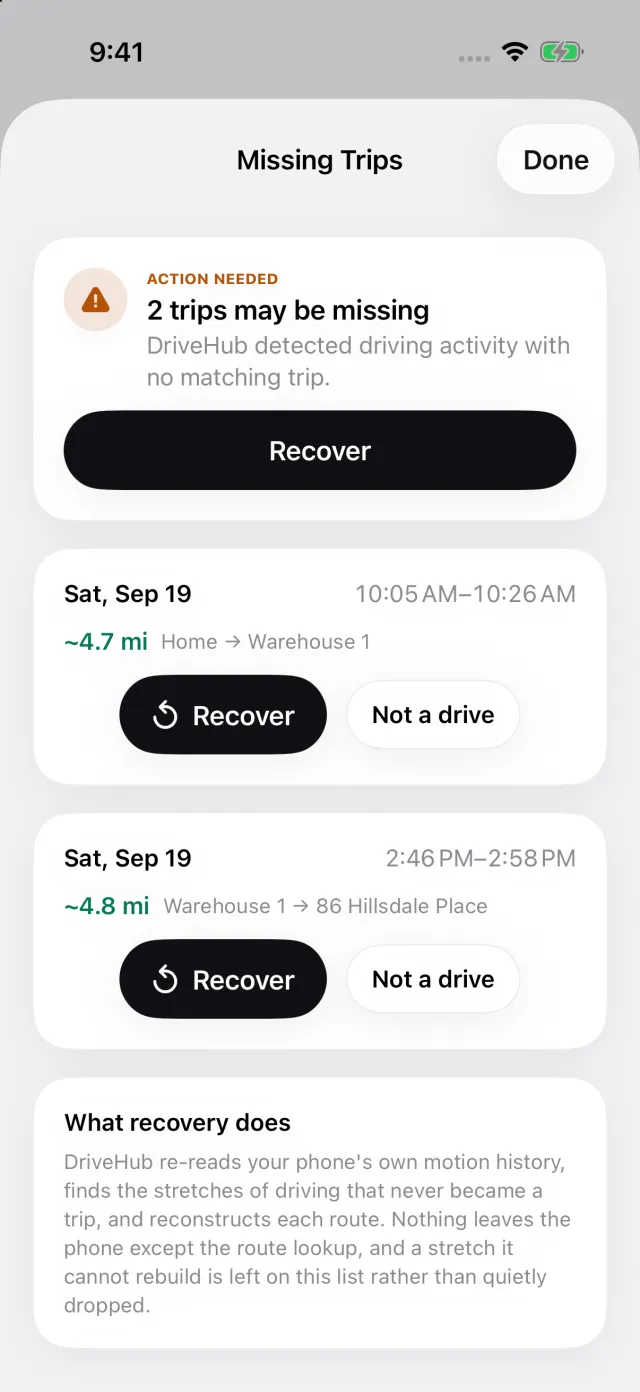
With location access set to Always, DriveHub records every drive in the background — and if it ever misses one, it tells you. It records business and private drives alike, and asks afterwards which were business. If your iPhone logged driving with no matching trip, Missing Trips lists it, and Recover rebuilds the route.
The report prints the odometer at the start and end of each trip, the business partner you visited, and every later change to a trip, on the report itself. DriveHub can remind you to enter an odometer reading. Reports covers a day, week, month, quarter or year; for the Finanzamt, pick Year. A one-month report is not a Fahrtenbuch.
Where DriveHub stops: it starts recording on the day you set it up, so it cannot fill in months before that. It does not compute your benefit, choose the method or deal with payroll. The purpose is still yours to write — "Angebot besprochen, Müller GmbH", not just "business" — within the seven days.
DriveHub is on the App Store for iPhone. Germany's other Fahrtenbuch rules are on the Germany page. Setting up automatic tracking takes a few minutes, once, and is worth doing before 1 January. For paper, spreadsheets and apps side by side, see four ways to keep a mileage log.
Sources
- § 6 Abs. 1 Nr. 4 Satz 3 EStG.
- R 8.1 Abs. 9 Nr. 2 Sätze 2–6 and Nr. 3 Sätze 1, 2 and 5 LStR; H 8.1 (9-10) LStH — Amtliches Lohnsteuer-Handbuch 2026.
- BMF-Schreiben vom 3. März 2022 – IV C 5 – S 2334/21/10004 :001, Rz. 29 and 41.
- BMF-Schreiben vom 18. November 2009 – IV C 6 – S 2177/07/10004, Rz. 8 and 22.
- BFH, 20 March 2014 – VI R 35/12; BFH, 10 April 2008 – VI R 38/06; BFH, 9 November 2005 – VI R 27/05.
- Bundesrat-Drucksache 549/26 (Lohnsteuer-Änderungsrichtlinie 2027), 23 September 2026.
This page states what the Lohnsteuer-Richtlinien, the BMF letters and the Bundesfinanzhof say, and cites them so you can check. It is not tax advice. It can't account for your circumstances. Where the money matters, ask your Steuerberater — and bring the records.
The full rule for Germany, with the instruments it comes from: mileage log requirements in Germany.