 DriveHub
Country guide · Germany · 7 min
Fahrtenbuch app vom Finanzamt anerkannt? None is — the log is judged
You want to keep your Fahrtenbuch in an app instead of a paper book, and every vendor calls its own "vom Finanzamt anerkannt". The tax administration approves no app. It examines your logbook — and the rules it applies are all about the record, not the product.

The short answer
No Fahrtenbuch app is approved by the Finanzamt in advance, because there is nothing to approve it through. The rules for a Fahrtenbuch set conditions on the logbook. None of them provides for an approval, a certificate, a register or a list of products.
The tax administration says so for software in general. It issues no Positivtestate, and a third party's certificate does not bind it (GoBD Rz. 180 and 181). So "anerkannt" on a product page is a vendor's claim, not a status.
What the Finanzamt accepts or rejects is your logbook, when it examines it. An electronic one has to meet at least these four conditions:
- It yields "dieselben Erkenntnisse wie aus einem manuell geführten Fahrtenbuch" — every field a paper book needs (R 8.1 Abs. 9 Nr. 2 Satz 6 LStR).
- Later changes are technically excluded, or documented in the file itself.
- The purpose and the business partner are entered promptly. For automatic capture, the administration treats up to seven calendar days after the trip as prompt.
- It is one closed chain for the whole year, private trips included.
One Finanzgericht also rejected a GPS logbook whose odometer readings were computed and never compared with the car's own. That is a single court's finding, not a rule the Finanzamt publishes, and it is covered below.
So choose an app by what its logbook will show, not by the badge on its store page. The sources below let you check any app, or a spreadsheet.
Why "anerkannt" is not a status
German practice rests on four texts: R 8.1 Abs. 9 Nr. 2 LStR, the hints to it in H 8.1 (9-10) LStH, and two BMF letters — 03.03.2022 for employees and 18.11.2009 for the self-employed. Together they set conditions on the record: its content, that it is zeitnah, that it is closed, and how changes are handled. None of them names an approval procedure. That is an absence in those texts, not a sentence they contain.
The positive statement sits in the GoBD, the administration's rules for electronic records. BMF 03.03.2022 Rz. 28 makes them apply to electronic logbooks: the GoBD "sind zu beachten". Its section on certification (version of 14 July 2025) opens by saying the variety of systems allows the administration no generally valid statement on whether hard- or software conforms (Rz. 179). Then:
- Rz. 180: "Positivtestate zur Ordnungsmäßigkeit der Buchführung - und damit zur Ordnungsmäßigkeit DV-gestützter Buchführungssysteme - werden weder im Rahmen einer steuerlichen Außenprüfung noch im Rahmen einer verbindlichen Auskunft erteilt."
- Rz. 181: "„Zertifikate" oder „Testate" Dritter können bei der Auswahl eines Softwareproduktes dem Unternehmen als Entscheidungskriterium dienen, entfalten jedoch aus den in Rz. 179 genannten Gründen gegenüber der Finanzbehörde keine Bindungswirkung."
A certificate may help you choose. It does not decide your case. The logbook does.
What an electronic Fahrtenbuch has to do
The same information as a paper book. R 8.1 Abs. 9 Nr. 2 Satz 6 LStR: "Das Fahrtenbuch kann auch elektronisch geführt werden, wenn sich daraus dieselben Erkenntnisse wie aus einem manuell geführten Fahrtenbuch gewinnen lassen und nachträgliche Veränderungen der aufgezeichneten Angaben technisch ausgeschlossen oder dokumentiert werden." BMF 18.11.2009 Rz. 23 says the same for the self-employed.
That brings in the field list of Satz 3: "Datum und Kilometerstand zu Beginn und am Ende jeder einzelnen Auswärtstätigkeit, Reiseziel und bei Umwegen auch die Reiseroute, Reisezweck und aufgesuchte Geschäftspartner." The rules for private trips and the commute are on the German logbook page.
Changes excluded, or visible in the file. BMF 03.03.2022 Rz. 28 puts it as "technisch ausgeschlossen, zumindest aber dokumentiert". The Federal Fiscal Court has said where the documentation belongs. In BFH 12.01.2024 – VI B 37/23, a file in which earlier entries can still be changed counts only if the extent of the changes is "in der Datei selbst dokumentiert und bei gewöhnlicher Einsichtnahme in die Datei offengelegt". The court did not prescribe how. It did reject changes that surface only through an extra enquiry to the system's administrator.
The purpose, promptly. BMF 03.03.2022 Rz. 29 is the passage every automatic logbook depends on: "Es bestehen keine Bedenken, ein elektronisches Fahrtenbuch, in dem alle Fahrten automatisch bei Beendigung jeder Fahrt mit Datum, Kilometerstand und Fahrtziel erfasst werden, jedenfalls dann als zeitnah geführt anzusehen, wenn der Fahrer den dienstlichen Fahrtanlass (Reisezweck und aufgesuchte Geschäftspartner) innerhalb eines Zeitraums von bis zu sieben Kalendertagen nach Abschluss der jeweiligen Fahrt in einem Webportal einträgt und die übrigen Fahrten dem privaten Bereich zugeordnet werden."
Two words in it matter. "Jedenfalls dann" makes seven days a safe harbour, not a rule that day eight fails. And it answers only whether the book is zeitnah; it replaces none of the other requirements. What can and cannot be added later is in what a Fahrtenbuch written afterwards can still fix.
In the logbook itself, as one chain. H 8.1 (9-10) LStH: "Ein ordnungsgemäßes Fahrtenbuch muss zeitnah und in geschlossener Form geführt werden und die zu erfassenden Fahrten einschl. des an ihrem Ende erreichten Gesamtkilometerstands vollständig und in ihrem fortlaufenden Zusammenhang wiedergeben." And: "Die erforderlichen Angaben müssen sich dem Fahrtenbuch selbst entnehmen lassen."
The BFH applied that in VI R 3/12 (13 November 2012). Trips were marked only "Außendienst", with the customers in a calendar printout. The court: "Dazu genügt nicht, wenn nur allgemein und pauschal die betreffenden Fahrten im Fahrtenbuch als "Dienstfahrten" bezeichnet werden." Filing a trip as "business" records a category. The reason is still yours to write.
Is an Excel Fahrtenbuch accepted?
Not as an ordinary spreadsheet. The Leitsatz of VI B 37/23 covers any file a program produces: it counts only if later changes are "technisch ausgeschlossen" or documented "in der Datei selbst". A spreadsheet in which any cell can be overwritten without a trace does neither.
GPS on its own is not a Fahrtenbuch
A Finanzgericht that examined a GPS logbook rejected it. FG Niedersachsen, 23 January 2019 – 3 K 107/18, concerned a plug-in device with GPS; the purposes were added in a portal. The official Leitsatz: "Die unmittelbare elektronische Erfassung der Fahrtwege eines betrieblichen Fahrzeugs durch ein technisches System reicht zur Führung eines Fahrtenbuches nicht aus. Neben dem Bewegungsprofil müssen die Fahrtanlässe ebenfalls zeitnah erfasst werden. Eine technische Lösung, die auch nach Jahren noch Änderungen zulässt, kann nicht als elektronisches Fahrtenbuch anerkannt werden."
The court found a second, separate defect in the odometer (Rn. 43): "Die vorgelegten Fahrtenbücher sind überdies insgesamt als nicht ordnungsgemäß zu verwerfen, weil der Kläger die tatsächlichen Kilometerstände nach den Tachos der Fahrzeuge niemals im Streitzeitraum den rechnerisch ermittelten Tachoständen in den Daten des elektronischen Fahrtenbuches gegenübergestellt hat." The readings had been computed from one starting figure plus the recorded trips (Rn. 47).
Read it for exactly what it says. A computed odometer that is never compared with the real one fails. The court set no tolerance, and no primary source says how close a compared reading must be. It is a Finanzgericht decision and binds no other court. The safer practice is still to put the car's real odometer reading in the log, set against what was recorded.
What it costs if the logbook fails
The Finanzamt does not strike out single trips. It reverts to the 1 % / 0.03 % method, which is usually far more expensive. And a break in the chain invalidates the logbook for the entire year. There is no middle way either. H 8.1 (9-10) LStH: "Eine Schätzung des Privatanteils anhand anderer Aufzeichnungen kommt nicht in Betracht."
Not every flaw is a break. The same hints say: "Kleinere Mängel führen nicht zur Verwerfung des Fahrtenbuchs, wenn die Angaben insgesamt plausibel sind." How the 1 % choice works, and why a gap costs more than the trips it swallows, is in Fahrtenbuch or the 1% rule.
An electronic logbook also has to survive: ten years, and machine-readable throughout. See why a Fahrtenbuch is kept for ten years, not eight.
Questions to ask of any app
No badge answers these. Ask them of any app, device or spreadsheet:
- Does the logbook print every field of R 8.1 Abs. 9 Nr. 2 Satz 3, including the business partner you visited?
- Does it record private trips too, so the year is one closed chain?
- Is a later change to a trip excluded, or shown in the exported file itself?
- Can you enter a real reason, not just "business", promptly after the trip?
- Does the real odometer reading enter the log, and is it compared with the recorded distance?
- Does it tell you when it may have missed a drive?
- Can you export the whole year in a machine-readable form and keep it for ten years?
The trade-offs between paper, spreadsheet, device and app are in how to keep a mileage log.
How DriveHub fits these rules
DriveHub is not approved or certified by the Finanzamt — no app is. What it does is capture the trips and print the fields those rules name; the reasons are yours to write. With location access set to Always, DriveHub records every drive in the background — and if it ever misses one, it tells you. Business and private trips are recorded alike, and you mark each one Business or Personal afterwards.
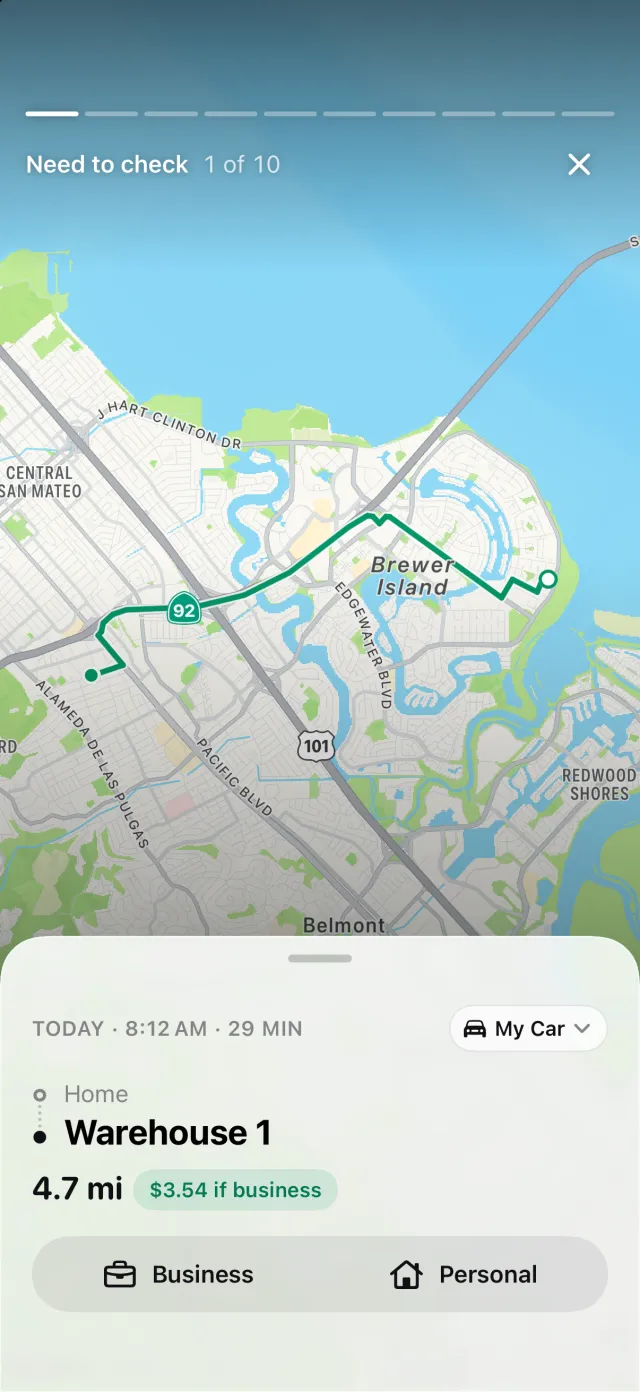
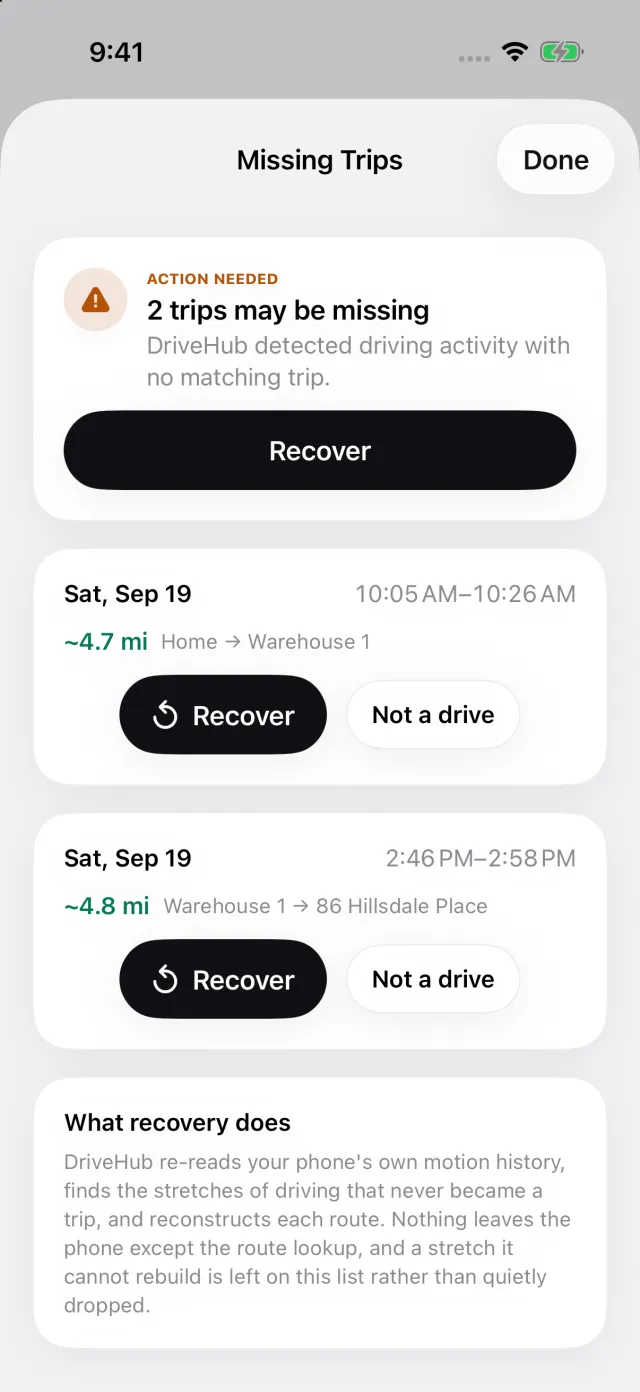
If your iPhone logged driving with no matching trip, a Missed drives story appears on the Trips tab and opens Missing Trips — the screen below. Tap Recover to rebuild the route, or add the trip yourself, so the year has no gap in it.
The report prints the odometer at the start and end of each trip and the business partner you visited. Every later change to a trip is printed on the report itself. Before you export, the report compares the odometer readings you entered with the recorded distance. Reports export as PDF, as Excel or CSV, and as a DATEV file; the exports are DriveHub Pro.
What stays yours. The purpose is a reason — "Angebot besprochen, Müller GmbH" — and only you can write it; within seven days is the safe side. The real odometer readings come from your dashboard. And whether the logbook is ordnungsgemäß is decided by the Finanzamt, for your logbook, not for DriveHub.
- DriveHub on the App Store
- German Fahrtenbuch requirements
- Set up automatic tracking, and know when a drive is missed
This page states what R 8.1 Abs. 9 LStR, H 8.1 (9-10) LStH, the BMF letters of 3 March 2022 and 18 November 2009, the GoBD and the decisions named above say, and cites them so you can check. It is not tax advice. It can't account for your circumstances. Where money is involved, ask your Steuerberater — and bring the logbook.
The full rule for Germany, with the instruments it comes from: mileage log requirements in Germany.