 DriveHub
Country guide · Denmark
Firmabil without private use in Denmark: 25 trips between home and work, and the 26th makes it a free car

The short answer
If your employer has banned private use of a company car, Skattestyrelsen still accepts that you drive it between the workplace and your home up to 25 times a year. This is 25-gange-reglen. It holds on three conditions: the car is used only for business the next day, you are otherwise barred from using it privately, and a kørselsregnskab (a driving log) is kept. The 26th trip inside a rolling 12 months makes it fri bil, a taxable free car under ligningsloven § 16, stk. 4, from the 30-day period in which that trip falls.
The rule is administrative practice. No tax act sets the number 25. It is stated in Skattestyrelsen's Den juridiske vejledning, afsnit C.A.5.14.1.5 (info.skat.dk), and Skatterådet confirmed how it is counted in SKM2016.508.SR.
What counts as one trip
The guidance counts every leg. In its words, hver kørsel mellem arbejdssted og bopæl og kørsel mellem bopæl og arbejdssted counts. So:
- Driving home from work is one trip, and driving to work the next morning is another.
- A day with both legs uses two of your 25.
- The rule counts trips, not kilometres. A short trip uses one of the 25, the same as a long one.
- The count is per person, across the employer's cars. If you pass 25 in different cars, the car you drive on the 26th trip is the one you are taxed on.
The count runs over a løbende 12-måneders periode. It is not a calendar year, and it does not reset on 1 January. A trip stops counting once it is more than twelve months old, so what matters is how many fall inside any twelve-month stretch.
Separately, driving the car for business for another firm counts as private use. The 25-trip tolerance does not cover that.
Why a calendar-year view is not enough
Take 26 trips between July and the following June. Neither calendar year holds more than 25, yet the 26th trip made the car taxable. A count that only looks at January to December reads "under 25" in the very year it went wrong. So the test has to slide.
What DriveHub counts
DriveHub looks at one car at a time and counts that car's trips you have marked Commute. Commute is the home–work answer on the trip page, next to Business and Personal. A Commute trip is stored as a personal trip, so your business totals do not change.
It then does two things:
- The last 12 months. It counts the Commute trips from the 12 months before the end of the report period (or before today, if the period ends in the future).
- The sliding window. It tests every twelve-month window up to that date. If any window holds more than 25 trips, it records the date of the 26th.
The count runs for a car whose country is Denmark and whose ownership is one of the two company-car options (Company car, I pay for fuel or Company car, fuel included). A car set to My own car is never counted.
How it warns you
The warning starts at 20 trips, not 25, so you have time to change how you drive. On the Reports screen, with that car selected, a red note appears once the 12-month count reaches 20, or once a 26th trip exists:
This company car has made N home–work journeys in the last 12 months. If your employer has banned private use of it, only 25 a year are tolerated before it is taxed as a free car.
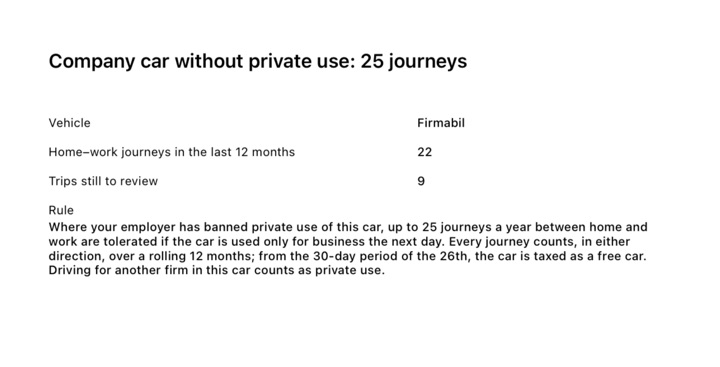
The exported PDF or workbook has a block titled Company car without private use: 25 journeys. It lists:
- the vehicle,
- Home–work journeys in the last 12 months,
- Trips still to review, only when there are some,
- 26th journey, with the date, only if a window went over,
- the rule in a sentence.
Exporting needs DriveHub Pro. The warning on screen does not.
What DriveHub does not do
- It cannot know your employer banned private use. It counts and states the rule. Whether the tolerance applies to you depends on that ban, and only your employment terms show it.
- It does not check "business the next day". Meeting that condition is up to you.
- It does not add up trips across cars. The count is per car. The rule counts per person. If you drive more than one of your employer's cars home, add the counts yourself.
- It does not work out the value of fri bil, or the tax on it. It prints the date of the 26th trip and the rule, nothing more.
- It counts a trip only after you mark it. A drive not yet marked Commute is not in the number. The block shows how many of that car's trips in the last 12 months are still to review, and any of them may be a home–work trip.
- It does not recognise a temporary workplace. Drives between home and a workplace that is temporary under the 60-day rule are counted if you mark them Commute. The guidance treats those drives as business. For a three-day course, it counts one trip when you take the car home and one when you drive back to the workplace afterwards. So for such a stay, DriveHub's number is higher than the real one, not lower.
- It counts drives, not outings. Each drive DriveHub recorded is one trip. If it recorded one outing as two drives, that is two trips in the count.
How to do it in DriveHub
- In Settings, open Vehicles and then the car. Under Whose car is this?, choose Company car, I pay for fuel or Company car, fuel included. If DriveHub's country in Settings is not Denmark, set the car's Rate country to Denmark.
- Let DriveHub record your drives, then open each trip after the drive. Choose Commute for home to work and work to home, and Business or Personal for everything else.
- Clear the review queue regularly. Trips still waiting for an answer are not counted.
- Open Reports, pick the car under Vehicle, and choose the period. Check for the red note.
- When you need it on paper, tap Export report. The block Company car without private use: 25 journeys is in the file.
Related
- Kørselsgodtgørelse: BEK 173 and BEK 1333 explains why a company car gets no tax-free kørselsgodtgørelse.
- Kørselsgodtgørelse: the voucher and the 60-day rule covers the voucher and when a workplace stops being temporary.
- Everything for Denmark is at /help/dk.
This page states what Skattestyrelsen's guidance says, and names it so you can check. It is not tax advice. It can't account for your circumstances. Where money is involved, ask your revisor — and bring the log.
The full rule for Denmark, with the instruments it comes from: mileage log requirements in Denmark.