 DriveHub
Country guide · Sweden
Your employer pays less than 25 kr per mil: the avdrag för mellanskillnad

The short answer
Skatteverket's schablon for business trips in your own car is 25 kronor per mil, and a mil is ten kilometres. If your employer pays you less than that, you may deduct the difference in your tax return. It is a deduction with no threshold: the 5 000 kr floor in the rules belongs to övriga utgifter, not to business trips (inkomstskattelagen 12 kap. 2 §, which deducts them "utan någon beloppsmässig begränsning"). The amount itself is set in 12 kap. 5 §: 2 kronor och 50 öre per kilometre, which is the same money as 25 kr per mil.
If your employer pays more than the schablon, the excess is taxable pay. DriveHub never shows a negative deduction.
How Skatteverket describes it
Skatteverket's answer for employees on business trips says it in one sentence: "Har du fått en lägre ersättning än schablonbeloppet ska du ta upp ersättningen du fått utbetalt i deklarationen och får sen göra avdrag med schablonbeloppet vid punkten för tjänsteresor."
So on the return you declare what you were actually paid, and you deduct the full schablon at the point for business trips (tjänsteresor). The net effect is the shortfall, and that shortfall is the number DriveHub prints. The same answer gives 25 kronor per mil for income years 2025 and 2026. It does not name a box on the form, so check the form guidance for your income year or ask your revisor.
Parking, road, bridge and ferry charges and congestion tax are not part of the schablon. Skatteverket allows them as a separate deduction.
The arithmetic
Take 400 mil (4 000 km) of business trips in your own car in the year.
- Schablon: 400 × 25 kr = 10 000 kr
- Your employer paid 18,50 kr per mil: 400 × 18,50 = 7 400 kr
- Difference: 2 600 kr
The unit is where people go wrong. Every Swedish source states the figure per mil, while the statute counts per kilometre. 18,50 kr per mil is 1,85 kr per kilometre. Mix them and the answer is out by a factor of ten.
What DriveHub asks you
DriveHub asks for the payment in kronor per mil, because that is how your employer and Skatteverket state it.
The field is called Your employer pays per mil, and the note under it reads: "In kronor per mil (10 km). Where it is less than Skatteverket's 25 kr per mil, your report shows the difference you can deduct."
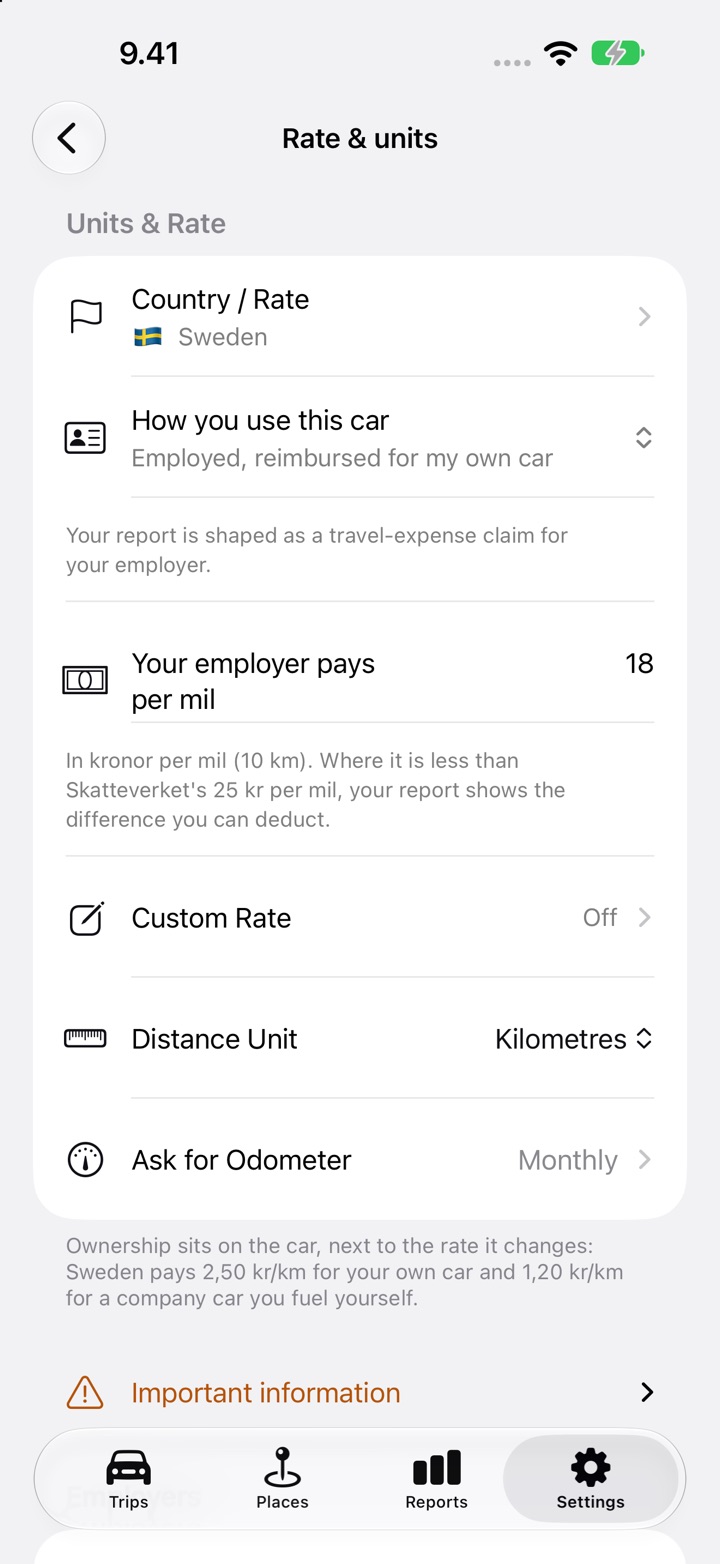
It appears only when the country is Sweden and the answer to "How you use this car" is Employed, reimbursed for my own car. If you have employers on file, the single field is hidden unless it already holds a figure; each employer then states its own.
If you have more than one employer
Under Settings → Rate & units → Employers, tap Add employer, give the name and dates, and fill in This employer pays. A trip counts toward the employer you worked for that day, unless its car or the trip names another.
Two things to know about that screen:
- Choose Kilometre under "Rate is per", not Mile. The editor's "Mile" is the English mile (1 609 metres), not the Swedish mil. For 18,50 kr per mil, enter 1,85 per Kilometre.
- The currency has to be SEK. A payment in another currency is not used, and the trip falls back to the single figure in Settings, if there is one.
What the report prints
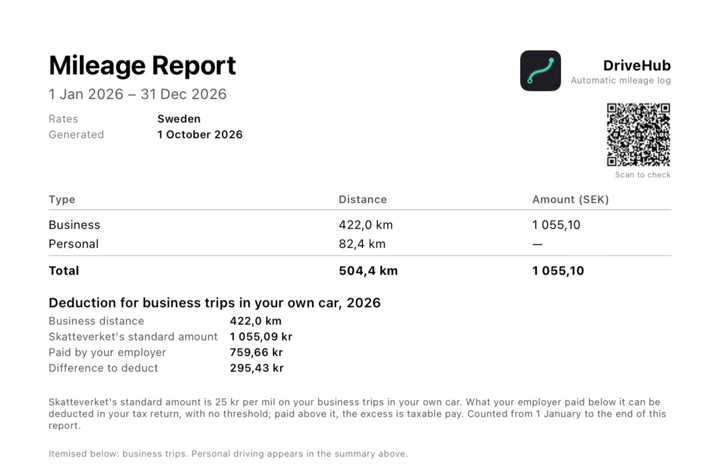
In the PDF, DriveHub prints a block headed Deduction for business trips in your own car, 2026 (the year changes with the report). It has these rows:
- Business distance
- Skatteverket's standard amount
- Paid by your employer
- Difference to deduct
A note beneath it repeats the rule: no threshold, and anything paid above the schablon is taxable pay.
What it counts, and what it leaves out
- Calendar year to date. It counts from 1 January up to the end of the report's period, over that year's business trips. A June report holds the first half of the year, not the whole year's deduction.
- All vehicles only. The deduction is yours, not a car's, so the block is printed only when the report covers All Vehicles. Filter to one car and it disappears.
- Trips with no stated payment are left out of both sides. If a trip has no payment from its employer and Settings holds no figure, it is not counted. The report then adds a row, Business distance with no stated payment, not counted, so the total is not read as the whole year's.
- Never negative. Paid above the schablon, the difference is zero.
- Only trips priced at Skatteverket's own-car figure. A trip you priced with a custom rate of your own is not in the block at all, and neither is a company car's.
- Tolls, parking and ferries are in neither figure. DriveHub holds no expense for them.
And what it does not do: it does not file anything, and it knows the figure you type, not your payslip. The block appears only for the regime above. A sole trader deducts under another rule (16 kap. 27 §), and an employee whose employer pays nothing already gets the full 2,50 per kilometre priced by the report.
How to do it in DriveHub
- Open Settings → Rate & units and check that the country is Sweden.
- Under How you use this car, choose Employed, reimbursed for my own car.
- Type your employer's payment in Your employer pays per mil, for example 18,50.
- If you have had more than one employer, tap Add employer under Employers instead, and fill in This employer pays per Kilometre (1,85 for 18,50 per mil), then tap Save.
- Open Reports, set the period, and leave the vehicle filter on All Vehicles.
- Tap Export report (with DriveHub Pro, which exporting needs, the button also names the period). The block is in the PDF.
- Carry the figures to your return as Skatteverket's guidance describes, or give the PDF to your revisor.
Your trips still need the evidence behind them. See what an electronic körjournal must hold, and the other Swedish pages under /help/se.
This page states what Skatteverket's own guidance and the inkomstskattelag say, and links the source so you can check it. It is not tax advice. It can't account for your circumstances. Where money is involved, ask your revisor.
The full rule for Sweden, with the instruments it comes from: mileage log requirements in Sweden.