 DriveHub
Country guide · Sweden
Leasingbil och moms in Sweden: half the VAT on the lease, all of it on running costs

The short answer
A VAT-registered Swedish business that rents a passenger car (personbil), or leases it on an operational lease, can deduct half of the VAT on the rent, never all of it. The car must be used more than 100 mil (1 000 km) a year in the VAT-liable business. The VAT on running costs (fuel, service, repairs, inspection) is deductible in full when the car is rented or is a fixed asset (inventarium) of the business. Buying a car gives no VAT deduction on the purchase.
The rules are in mervärdesskattelagen (2023:200), 13 kap. 20–23 §§. Skatteverket explains them on its page Bilar och moms.
What the law says, piece by piece
Buying. You may not deduct VAT on the purchase of a personbil or motorcycle (13 kap. 20 §). Business-only use doesn't change that. The exceptions are resale, renting cars out, taxi, funeral transport and driving schools.
Financial leasing counts as buying. Skatteverket treats a lease as a purchase when the contract clearly amounts to a sale: ownership passes to you at the end, or the buy-out price is low compared with the car's expected market value. Then the lease VAT is not deductible either. The 50 % rule below is for operational leasing (operationell leasing), which Skatteverket calls renting.
Renting or leasing. You may deduct half of the VAT on the rent (13 kap. 22 §). The law's condition is that the car is used "i mer än ringa omfattning" (more than to a minor extent) in the activity that gives the right to deduct. The section also says partial business use does not reduce the half. Skatteverket's page adds the figure: "mer än 100 mil per år". The statute has no number, so the 100 mil is Skatteverket's reading. Keep a complete logbook as evidence.
Running costs. For a car that belongs to the business's fixed assets, or is rented for use in it, you may deduct all the VAT on running costs (13 kap. 23 §), even if the car is only partly used in the business. Skatteverket names fuel, service, repairs, maintenance and inspection. Extras such as winter tyres or a tow bar follow the ordinary VAT rules.
A mileage allowance (milersättning) is not an invoice with VAT on it, so it gives nothing to enter here.
What DriveHub asks
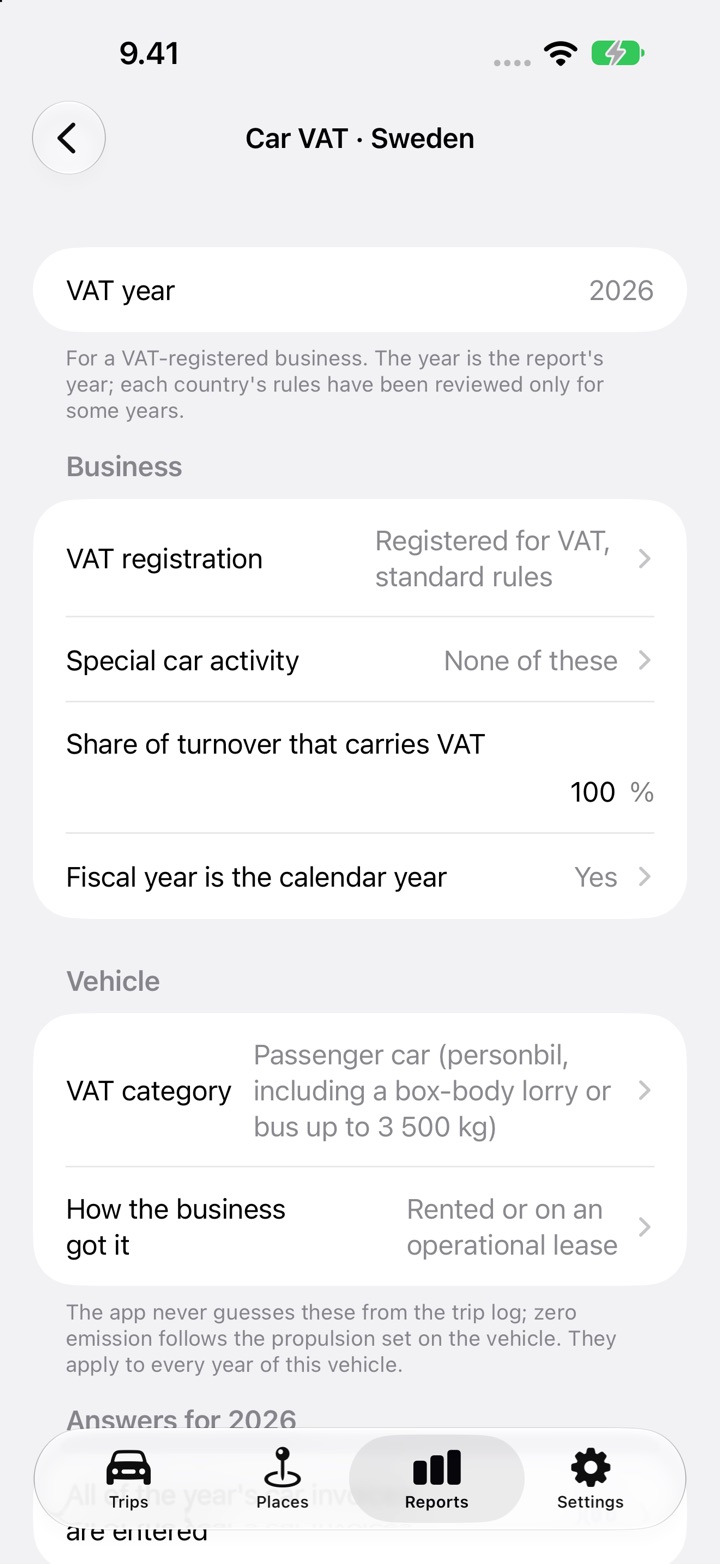
The car-VAT setup is for a business. It doesn't appear when your logbook is set up for an employee. For Sweden it asks:
- VAT registration, and Special car activity (carrying passengers for payment, renting cars out, resale, driving school, other special use, or none of these).
- Share of turnover that carries VAT, and whether the Fiscal year is the calendar year.
- VAT category: "Passenger car (personbil, including a box-body lorry or bus up to 3 500 kg)", "Motorcycle" or another commercial vehicle.
- How the business got it: "Owned by the business and booked as a fixed asset", "Bought without VAT (private seller, margin scheme)" or "Rented or on an operational lease".
- Whether All of the year's car invoices are entered.
You then add each invoice with the VAT printed on it. The type is "Lease or rent", "Lease down payment", "Running costs", "Vehicle purchase" or "No VAT". You enter the amount excluding VAT and the invoice VAT. Only a proper invoice in the business's name belongs here. Insurance and vehicle tax carry no VAT, so if you enter them, choose "No VAT".
What DriveHub computes
For a car that is rented or on an operational lease:
- It adds up the VAT on the year's "Lease or rent" and "Lease down payment" invoices.
- It adds up the car's business kilometres from your trips. Commuting and private trips do not count towards the 100 mil. Every trip of the year must be reviewed first.
- If business kilometres are more than 1 000 km, half of the lease VAT is deductible. At exactly 1 000 km or less, the deduction on the rent is zero.
- All the VAT on "Running costs" invoices is deductible.
- It shows the lease part, the running-cost part and the total as "Deductible input VAT".
For a car owned as a fixed asset, or bought without VAT, the deductible VAT on the purchase is shown as zero and the running-cost VAT in full. The kilometre test doesn't apply here.
The figure is shown only for a finished calendar year from 2024 to 2026, and only when at least one invoice with VAT is entered. Until then DriveHub says what is missing instead of a number.
What DriveHub does not do
In these cases DriveHub states "Insufficient data" or "Not applicable" and no amount:
- A mixed business. If only part of your turnover carries VAT, no figure is given, for an owned car or a leased one. Skatteverket says running-cost VAT is still deductible in full in a mixed business, but the 100-mil test counts only driving in the VAT-liable part, and DriveHub can't tell those kilometres apart. With no VAT-liable turnover at all, it reports no deduction.
- A fiscal year that is not the calendar year.
- A car rented for only part of the year. If the car stays under 1 000 business kilometres and was not available all year, the result is "Insufficient data".
- Special car activities such as renting cars out, taxi or a driving school, where the full-deduction exceptions apply.
- Other commercial vehicles, which follow the general input-VAT rules.
- A business not registered for VAT, or under the small-business exemption, which deducts no input VAT.
- Financial leasing. There is no choice for it. "Rented or on an operational lease" would apply the 50 % rule, which is wrong for a lease that counts as a purchase. Ask your accountant how the car is booked.
- A private car used in the business, which is neither a fixed asset nor rented. Here only the VAT on running costs from business driving may be deducted, and the setup doesn't cover that case.
DriveHub doesn't read your invoices. It uses the VAT amounts you type in. The result is an estimate, not a figure to copy into your momsdeklaration unchecked.
How to do it in DriveHub
- Open Reports and select a full calendar year. For a part of a year the card says "Select a full calendar year to see the car VAT estimate."
- With one car selected, find the Car VAT · Sweden card and tap Set up car VAT, or Edit car VAT if you've already started. With all vehicles shown, the Car VAT card lists your cars: tap the car.
- Under Business, answer VAT registration, Special car activity, Share of turnover that carries VAT and Fiscal year is the calendar year.
- Under Vehicle, set VAT category and How the business got it.
- Tap Add invoice for each lease and running-cost invoice, then tap Save.
- Once the year has ended and every trip is reviewed, turn on All of the year's car invoices are entered.
- Read the figure under Estimate. With one car selected and a full calendar year, it also prints in the PDF and the workbook, with the rule behind each line.
Related
- A complete logbook is your evidence for the 100 mil: see what an electronic körjournal must hold.
- Where to keep it: how long and where to keep a körjournal.
- More on Sweden: /help/se.
This page states what mervärdesskattelagen and Skatteverket's published guidance say, and links the source so you can check it. It is not tax advice. It can't account for your circumstances. Where money is involved, ask your revisor.
The full rule for Sweden, with the instruments it comes from: mileage log requirements in Sweden.