 DriveHub
Country guide · Austria
Tagesgeld for a business trip in Austria — over 3 hours, 25 km, and when the days run out

Four tests, in this order
Tagesgeld is a flat amount for the extra cost of meals on a business trip. You need no meal receipts, and receipts do not get you more than the flat rate (LStR Rz 299). For the self-employed it is a business expense (§ 4 Abs. 5 EStG); for an employee it is Werbungskosten (§ 16 Abs. 1 Z 9 EStG). The two use the same definition of a trip (LStR Rz 279), so both follow Lohnsteuerrichtlinien 2002 Rz 278 to 311. A journey has to pass all of these:
- Domestic. DriveHub does not calculate foreign trips.
- At least 25 km from your centre of activity (LStR Rz 278). Rz 280 measures it along the shortest reasonable route from your centre of activity to where you went. The kilometres you drove that day do not count: three 10 km hops around town are still under 25 km.
- More than 3 hours. Rz 311: a journey of up to three hours triggers no 24-hour period. Exactly 3 hours gives nothing.
- Not at a place where your days have run out. That is the rule below.
The rates, and the twelfths
From 1 January 2025 (BMF ABC der Werbungskosten; LStR Rz 311 and 315):
- 30,00 € for each full 24 hours
- 2,50 € for each started hour once the journey lasts more than 3 hours. That is one twelfth of the day rate, and the first 3 hours count too
- 17,00 € for each night away (Nächtigungsgeld), including breakfast, or the receipt for the room if you have one
A journey of 3 hours 10 minutes has 4 started hours, so it earns 10,00 €. Five and a half hours earns 15,00 €. More than 11 hours is a full day (Rz 311), because 12 started hours make 30 €. A 28-hour journey is one full day plus 4 started hours, so 30 € + 10 € = 40 €. Until 31 December 2024 the amounts were 26,40 € / 2,20 € / 15 €, and DriveHub uses the figure for the day each 24-hour block starts.
Two details DriveHub applies. On a journey over 24 hours, a tail of 3 hours or less counts for nothing, so a 26-hour journey earns 30 €. This is a conservative reading of Rz 311, and some advisers read it differently. Two journeys of more than 3 hours that start within the same 24 hours share one 30 € maximum. Rz 311 says each 24-hour period is started by a journey; the sharing is how DriveHub applies that.
The 5-day and 15-day rule
A town where you work often enough becomes a further centre of activity (LStR Rz 300 and 301). The count is per political municipality, not per client. All of Vienna is one place.
- You work there continuously, or at least once a week: Tagesgeld for the first 5 days. If you do not work there for six calendar months, the 5 days start again.
- You come now and then, not regularly: the first 15 days in each calendar year.
After that, Tagesgeld stops for journeys to that place. DriveHub counts every calendar day of a journey over 3 hours there.
The nights change too. Once the place is a centre of activity, you are no longer on a trip there. Rz 318 then allows a room only at its actual cost: no 17 € flat amount and no breakfast. DriveHub still prints a night amount for these journeys and its note says overnight costs remain deductible. For those nights, enter what the room cost without breakfast, from the receipt. Without a receipt DriveHub uses the 17 € flat amount, which Rz 318 does not allow there.
DriveHub keeps a list of places for this. If it sees that every day at a place was at most 7 days after the previous one, it suggests "Continuously or at least once a week". You confirm it.
Nights
Count only nights you were actually away. Without a receipt DriveHub uses 17 € per night; with one, the receipt amount, breakfast included. If the lodging was free, there is no flat amount (Rz 316). For an employee whose free room came without breakfast, DriveHub uses the 4,50 € breakfast estimate from the BMF ABC der Werbungskosten (Rz 317 describes the same estimate).
An employee also enters the tax-free daily and overnight allowance the employer paid, and DriveHub subtracts it from each item (LStR Rz 285).
How DriveHub suggests the journeys
You do not retype trips. DriveHub looks in your log for a chain: a trip leaving home or work, then trips ending away from both, closing at the first that gets back. A chain needs a business trip and must be longer than 3 hours. It is shown under "Suggested from your log", with "Probably N nights away" counted from the midnights inside it.
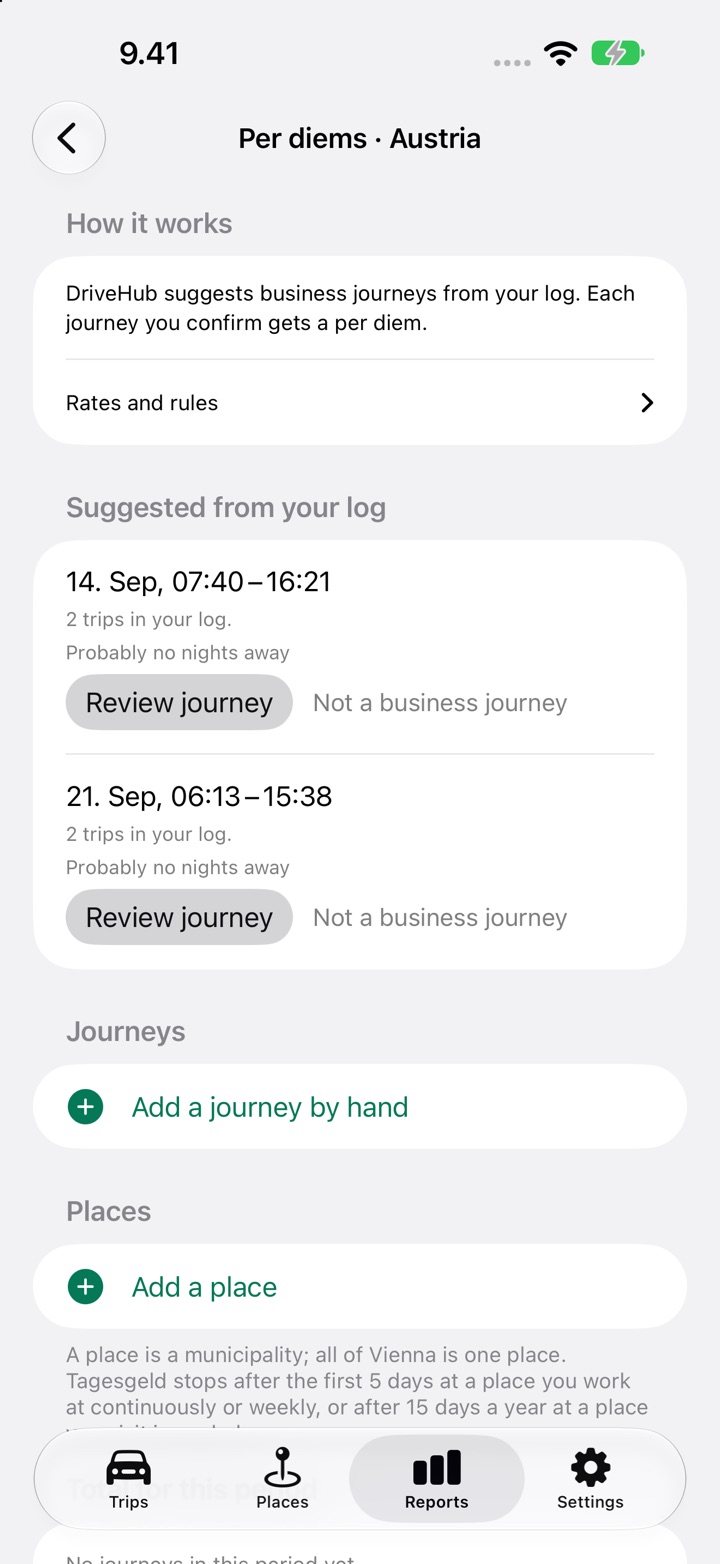
A suggestion is never money. The log records when the car moved, not when you left the house, so the times are yours to change, and nothing is counted until you confirm. If one trip ends more than 1 km from where the next starts, it warns you.
DriveHub answers the 25 km question from the log only when the farthest point of the journey is at least 25 km in a straight line from your Work site, because a road is never shorter than a straight line. If the line is shorter, it asks you about the road.
What DriveHub does not do
It will not calculate, and says so, in these cases:
- A trip abroad.
- A place that is part of a regularly travelled region or fixed route. Those have their own rules (Einsatzgebiet, LStR Rz 308, and Fahrtätigkeit, Rz 310), and DriveHub cannot tell which districts form your region.
- A journey where someone else paid for a meal. The reduction for that was not verified.
It does not compute what an employer may pay you tax-free under § 26 Z 4 EStG. It subtracts only the amounts you tell it your employer paid tax-free.
How to do it in DriveHub
- Open Reports and tap Set up per diems on the "Per diems · Austria" card. Trips need a Home or Work site, or nothing is suggested. If the card asks you to select all vehicles, do that first: a journey belongs to you, not to a car.
- Under Places, tap Add a place. Enter the municipality, answer "How often you work here", and answer "Part of a regularly travelled region or fixed route".
- Under "Suggested from your log", tap Review journey. Tap Not a business journey to hide one.
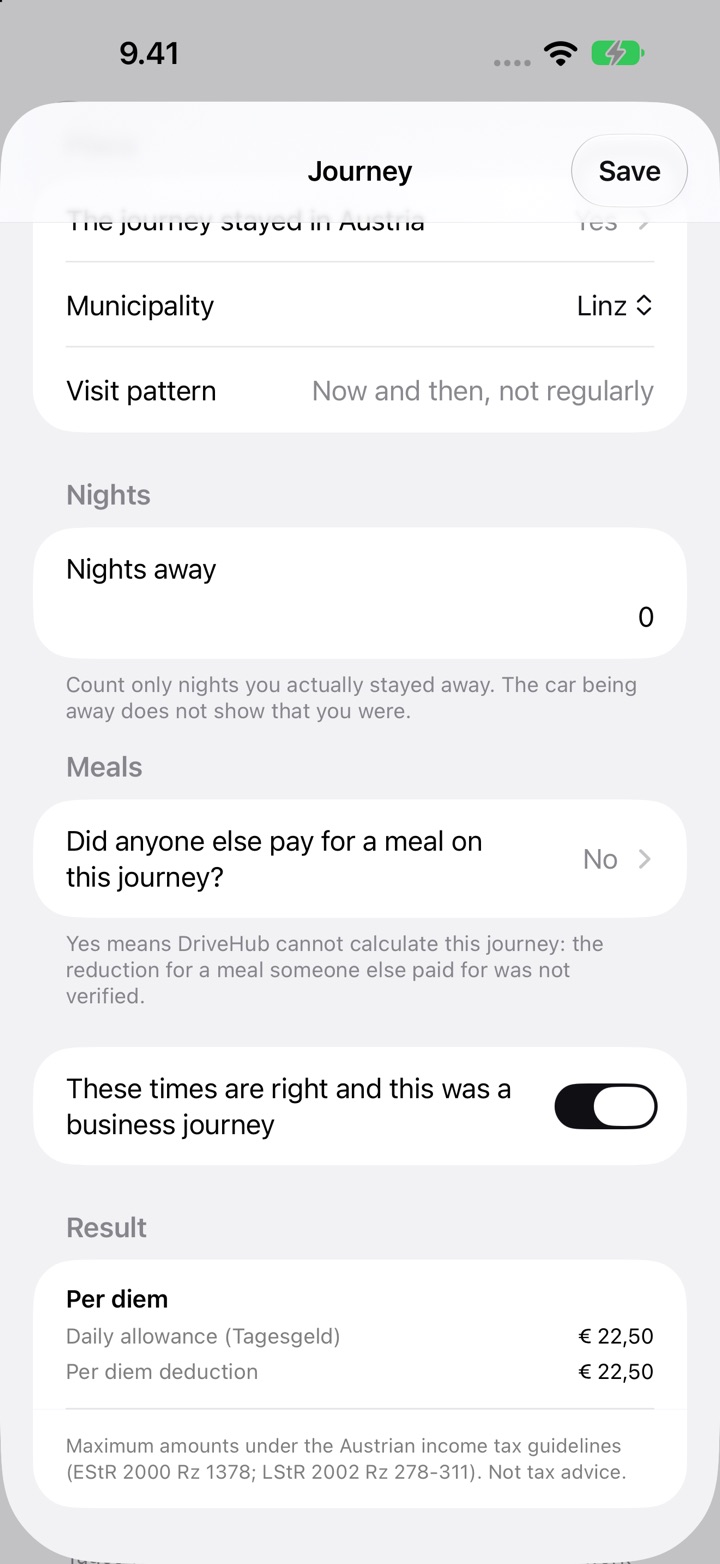
- Check the times. Choose Employed or Self-employed under "You are". Answer the distance question, "The journey stayed in Austria", the municipality, and "Did anyone else pay for a meal on this journey?".
- If you stayed away, check the nights and say whether the lodging was free or enter the receipt.
- Switch on "These times are right and this was a business journey", then Save. The journey shows its "Per diem deduction", and the screen adds the journeys up under "Total for this period".
The report prints each journey, the day amount and the night amount, and a note for each rule applied. For the kilometres themselves, see Austria's Kilometergeld record. More is on the Austria page.
This page states what the Lohnsteuerrichtlinien themselves say, and names the Randzahl so you can check. It is not tax advice. It can't account for your circumstances. Where money is involved, ask your Steuerberater — and bring the Aufzeichnungen.
The full rule for Austria, with the instruments it comes from: mileage log requirements in Austria.