 DriveHub
Country guide · Austria
Vorsteuerabzug for an Elektroauto in Austria — only zero-emission cars, the 40 000 € line, and nothing for petrol or diesel

The short answer
In Austria a business does not deduct input VAT (Vorsteuer) on a normal car, even if the car is used 100 % for the business. That is § 12 Abs. 2 Z 2 lit. b UStG 1994: Personenkraftwagen and Kombinationskraftwagen are not treated as used for the business for VAT purposes, so the VAT on buying, leasing and running them is not deductible. Motorcycles (Krafträder) are in the same group. The law excepts driving-school cars, demonstration cars, cars held for resale, and vehicles used at least 80 % for commercial passenger transport or rental.
The other exception is a car, estate car or motorcycle with zero CO2 emissions (§ 12 Abs. 2 Z 2a UStG 1994, in force since 2016). For it the Vorsteuer is deductible under the general rules, subject to two tests: a minimum business use, and a cost line at 40 000 € and 80 000 €. Z 2a says that Z 2 lit. a "bleibt unberührt", so the income-tax Angemessenheitsgrenze (the Luxustangente of 40 000 € in § 1 of the PKW-Angemessenheitsverordnung, BGBl. II Nr. 466/2004) still applies. The BMF sets out the tiers in UStR Rz 1984 and 1985.
Plug-in hybrids and ordinary hybrids do not qualify (UStR Rz 1984). Only a car that emits 0 g CO2/km, a battery or fuel-cell car, does.
What a zero-emission car gets
The deduction depends on the acquisition cost including VAT and NoVA. For a used car up to 5 years old, DriveHub asks you to use the new price less the usual discounts; for a lease, the lessor's cost basis.
| Acquisition cost | Input VAT |
|---|---|
| Up to 40 000 € | Deducted in full |
| Over 40 000 €, up to 80 000 € | Deducted in full, plus Eigenverbrauch (self-supply VAT) on the part above 40 000 € |
| Over 80 000 € | None |
The self-supply VAT on a purchased car is (acquisition cost − 40 000) ÷ 1,2 × 20 %. Take a 45 000 € car: (45 000 − 40 000) ÷ 1,2 × 20 % is 833,33 €. The Vorsteuer on the purchase stays deductible, and the 833,33 € is the VAT you then owe. In effect you keep the Vorsteuer on 40 000 € (6 666,67 €), which is how the Bundesfinanzgericht put it in RV/5101481/2019, a Tesla bought for 79 960 € with 6 660 € of self-supply VAT. DriveHub puts the self-supply in the year of the purchase invoice.
Two more points. A purchase subsidy (Förderung) does not lower the acquisition cost for the 40 000 € test. And the PKW-Angemessenheitsverordnung covers cars and estate cars only, so a zero-emission motorcycle is not tested against the 40 000 € line.
The 10 % business-use test
A vehicle counts as used for the business only if at least 10 % of its use is business (§ 12 Abs. 2 Z 1 lit. a UStG 1994). Below that, DriveHub shows "No deduction". It reads this from your recorded trips: business distance divided by all recorded distance.
Whether the drive between home and work counts toward the 10 % is not settled in DriveHub. If the business share is under 10 % but business plus commute reaches 10 %, it does not guess: it says "Insufficient data" and tells you to ask your adviser. It also will not calculate while any trip of the year is still unreviewed.
What DriveHub asks
The car's propulsion decides the zero-emission answer, because DriveHub never guesses it from the trip log.
- Electric: the question Emits 0 g CO2/km (battery or fuel cell) is asked and prefilled Yes.
- Plug-in hybrid: the screen says a plug-in hybrid never counts as zero emission, and nothing is asked.
- Petrol, diesel or a hybrid that cannot be plugged in: the screen says it never counts as zero emission and tells you to change the propulsion in the vehicle settings if the car is electric. The report says that cars give no input VAT in Austria, even at 100 % business use.
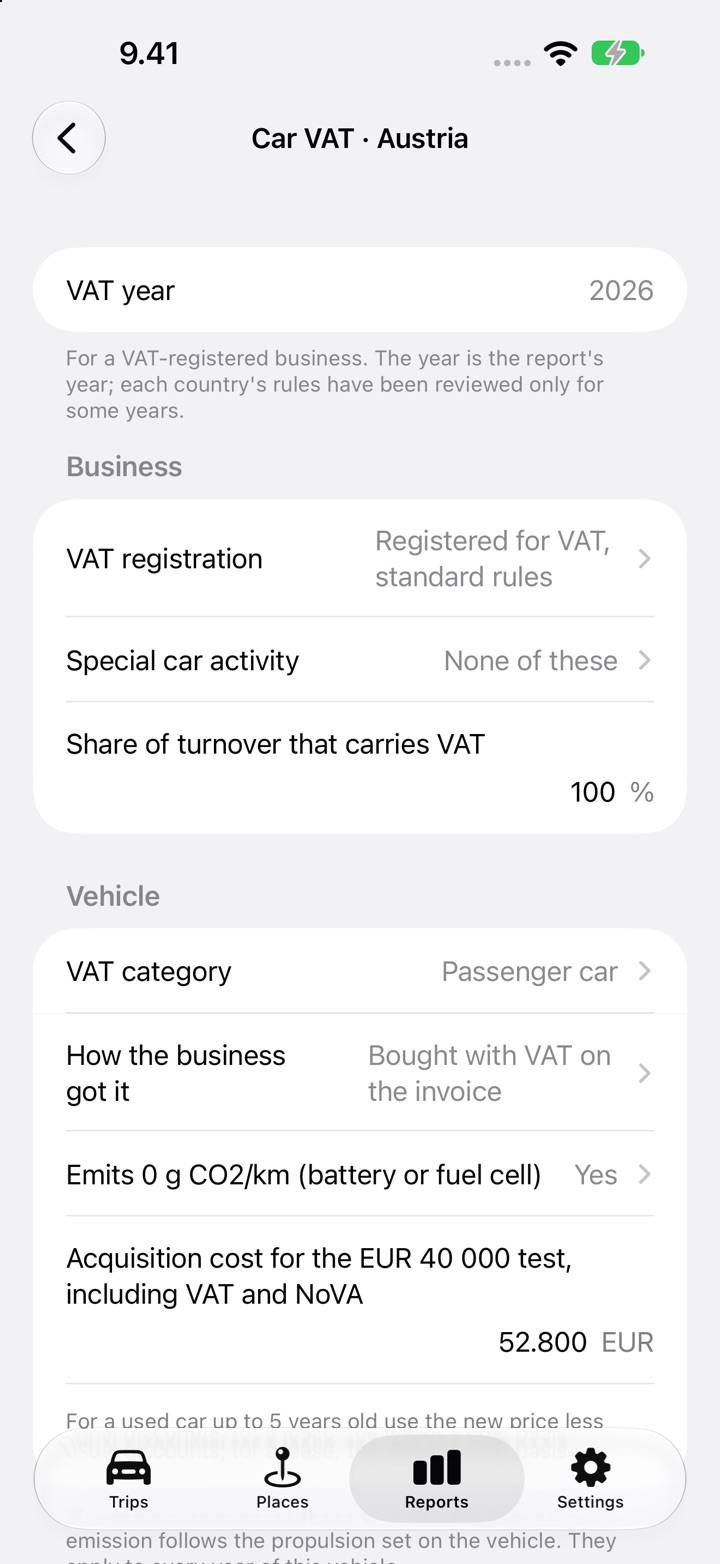
Beyond that it asks for the VAT category (Passenger car, Motorcycle, On the BMF Fiskal-Lkw list, Other commercial vehicle), the acquisition cost including VAT and NoVA, how the business got the car, and whether all of the year's car invoices are entered. Vehicles on the BMF Fiskal-Lkw list and other commercial vehicles follow the general Vorsteuer rules, which DriveHub does not calculate. Nor does it calculate the driving-school, resale, passenger-transport and rental exceptions: pick one under Special car activity and DriveHub says the business follows special rules.
What the figures cover
The estimate adds up the VAT you enter from car invoices: the purchase invoice (only if the car was "Bought with VAT on the invoice"), lease invoices and down payment, and running costs such as charging, service and tyres. It prints Deductible input VAT and Self-supply VAT on the part above EUR 40 000.
A purchase "Bought without VAT (private seller, margin scheme)" has no purchase VAT to deduct, so no self-supply arises either. A lease of a zero-emission car above 40 000 € is not calculated.
Only a business with 100 % taxed turnover gets a figure. If you answer a share of 0 %, it reports no deduction. If you answer between 0 and 100 %, it reports insufficient data and does not apportion. A business under the Kleinunternehmer exemption deducts no input VAT at all. The tax years it covers are 2025 and 2026.
What it does not do
- Private use. VAT on private use of the car (Eigenverbrauch) is not calculated. The report prints your private share of recorded distance and says so.
- Self-supply on running costs above 40 000 €. For a car over 40 000 €, the excess share of value-dependent running costs such as service, repairs and tyres is also self-supply VAT. DriveHub deducts running-cost VAT in full and leaves this out, so for such a car the deductible figure is too high by that amount. Electricity and charging are not affected.
- Income tax. The Car VAT screen calculates VAT only. The Luxustangente's income-tax side, the capped depreciation (AfA), is not in it.
- Employees. An employee has no input VAT on car costs, and DriveHub says so.
- Mixed turnover, such as a business with both taxed and exempt sales.
How to do it in DriveHub
- Check the car's propulsion in the vehicle settings. Set it to Electric if it is.
- Open Reports, choose the car and a full calendar year, and tap Set up car VAT (it reads Edit car VAT once you have answers).
- Under Business, set VAT registration and Share of turnover that carries VAT. Set Special car activity (usually None of these). Under Vehicle, set VAT category, How the business got it, and the acquisition cost.
- Under Car invoices, tap Add invoice for each car invoice with its VAT. Enter insurance, vehicle tax and fines as No VAT. Then turn on All of the year's car invoices are entered.
- Review every trip of the year, then read the Estimate at the bottom and take it to your Steuerberater.
For the mileage side, see Austria's Kilometergeld record and Tagesgeld. More is on the Austria page.
This page states what the Gesetz and the Richtlinien themselves say, and names the paragraph so you can check. It is not tax advice. It can't account for your circumstances. Where money is involved, ask your Steuerberater — and bring the Rechnungen.
The full rule for Austria, with the instruments it comes from: mileage log requirements in Austria.