 DriveHub
Country guide · Germany · 7 min
A Fahrtenbuch written afterwards is not a Fahrtenbuch
The year is ending, or the Finanzamt has asked for the logbook, and there are gaps. The obvious fix is to rebuild the missing weeks from a calendar — Fahrtenbuch nachträglich erstellen. German case law says that does not produce a Fahrtenbuch, and it says what does still count.

The short answer
No. A Fahrtenbuch reconstructed afterwards is not an ordnungsgemäßes Fahrtenbuch, however accurate it is. The Bundesfinanzhof requires it to be kept "zeitnah und in geschlossener Form", and that cannot be done in hindsight.
- One thing may be added later. Take an electronic logbook that captures every trip automatically. The tax administration treats it as kept on time if the purpose and business partner follow within up to seven calendar days.
- Other records do not fill the gap. Minimum details must be in the logbook itself; a calendar printout or a list made later cannot replace them.
- The price is the whole year. Without an ordnungsgemäßes Fahrtenbuch, a company car's private use is valued by the 1 % rule. The private share may not be estimated from other records.
So writing a Fahrtenbuch afterwards works for the purposes of recent, recorded trips, and for nothing else. What you can still do is further down.
Where "zeitnah" comes from
The requirement is not in the text of the Lohnsteuer-Richtlinien. It is case law, restated in the official hints to them, H 8.1 (9-10) LStH:
"Ein ordnungsgemäßes Fahrtenbuch muss zeitnah und in geschlossener Form geführt werden und die zu erfassenden Fahrten einschl. des an ihrem Ende erreichten Gesamtkilometerstands vollständig und in ihrem fortlaufenden Zusammenhang wiedergeben (>BFH vom 09.11.2005 – VI R 27/05, BStBl II 2006 S. 408)."
Three conditions sit in that sentence. The book is written close to the time of each trip. It is one closed record, not loose notes. And it reproduces every trip, private ones included, in an unbroken chain of odometer readings.
The guideline itself, R 8.1 Abs. 9 Nr. 2 LStR, adds that business and private kilometres are recorded "gesondert und laufend". It also rules out a shortcut: "Die Führung des Fahrtenbuchs kann nicht auf einen repräsentativen Zeitraum beschränkt werden, selbst wenn die Nutzungsverhältnisse keinen größeren Schwankungen unterliegen." A few sample months, written up later, are not a logbook either.
The seven days, and what they cover
The seven days come from the tax administration, not from a court. BMF-Schreiben vom 03.03.2022, Rz. 29 says:
"Es bestehen keine Bedenken, ein elektronisches Fahrtenbuch, in dem alle Fahrten automatisch bei Beendigung jeder Fahrt mit Datum, Kilometerstand und Fahrtziel erfasst werden, jedenfalls dann als zeitnah geführt anzusehen, wenn der Fahrer den dienstlichen Fahrtanlass (Reisezweck und aufgesuchte Geschäftspartner) innerhalb eines Zeitraums von bis zu sieben Kalendertagen nach Abschluss der jeweiligen Fahrt in einem Webportal einträgt und die übrigen Fahrten dem privaten Bereich zugeordnet werden."
Read it closely, because it is narrower than it is often quoted:
- It assumes every trip was already captured at the moment it ended, with date, odometer and destination. The seven days are for the purpose and the business partner, not for the trip.
- "Jedenfalls dann" makes it a safe harbour. Seven days is where the administration has no objection. It does not say that day eight fails, and it does not say it passes.
- It speaks only to zeitnah. Every other requirement still applies.
A worked date: a trip that ends on Monday 5 October 2026 is inside the safe harbour if its purpose is entered by Monday 12 October. That is 5 + 7 = 12, seven calendar days, weekend included.
Why a list made afterwards fails
Three decisions show where a reconstruction breaks.
Other lists cannot stand in for the logbook. In BFH 13.11.2012 – VI R 3/12, a handwritten logbook marked trips only as "Außendienst", with "siehe Anlage". The customers were in a printout of the employer's calendar. The Leitsatz:
"Die erforderlichen Mindestangaben können nicht durch anderweitige nicht im Fahrtenbuch selbst enthaltene Auflistungen ersetzt werden."
The reasons name the calendar directly: the details belong in the logbook, "nicht an anderer Stelle in einer weiteren und gegebenenfalls auch nachträglich vom Arbeitnehmer erstellten Auflistung. Entsprechendes gilt für vom Arbeitgeber erstellte Listen und Ausdrucke des Terminkalenders."
Lists compiled from a diary are not a Fahrtenbuch. In FG Münster 10.07.2019 – 7 K 2862/17 E, an assistant had compiled lists of business trips from a lawyer's diary. The court found they were "nicht zeitnah geführt" and had "keine Kilometerstände und keine Privatfahrten". The BFH set that judgment aside (BFH 16.03.2022 – VIII R 24/19), but on another point, and upheld the finding that the lists were no ordnungsgemäßes Fahrtenbuch. It was a § 7g EStG case, where other evidence of business use is allowed; for the 1 % choice it is not, as the next section shows.
GPS alone is not enough. In FG Niedersachsen 23.01.2019 – 3 K 107/18, a GPS device had recorded the routes. The court rejected the logbook. Its Leitsatz: "Neben dem Bewegungsprofil müssen die Fahrtanlässe ebenfalls zeitnah erfasst werden." It also rejected it because computed odometer readings were never compared with the cars' real ones (Rn. 43). That is a Finanzgericht decision, binding only in its case.
Can other records save the year?
Not for the company-car valuation. H 8.1 (9-10) LStH, entry "Schätzung des Privatanteils":
"Kann der Arbeitnehmer den ihm überlassenen Dienstwagen auch privat nutzen und wird über die Nutzung des Dienstwagens kein ordnungsgemäßes Fahrtenbuch geführt, ist der zu versteuernde geldwerte Vorteil nach der 1 %-Regelung zu bewerten. Eine Schätzung des Privatanteils anhand anderer Aufzeichnungen kommt nicht in Betracht (>BFH vom 16.11.2005 – VI R 64/04, BStBl II 2006 S. 410)."
Calendars, fuel receipts and emails therefore do not produce a lower figure than 1 %. Either the logbook is ordnungsgemäß, or the 1 % rule applies — for the whole year, as Fahrtenbuch or the 1% rule explains.
What you can still do
- Enter the purposes you still can. For trips an automatic logbook captured in the last seven days, write the Reisezweck and the business partner now. That is the Rz. 29 safe harbour.
- Correct in the open, never over the top. An electronic Fahrtenbuch must exclude later changes or document them (R 8.1 Abs. 9 Nr. 2 Satz 6 LStR). The BFH wants them "in der Datei selbst dokumentiert" (VI B 37/23, 12 January 2024).
- Know what minor gaps are. "Kleinere Mängel führen nicht zur Verwerfung des Fahrtenbuchs, wenn die Angaben insgesamt plausibel sind" (H 8.1 (9-10) LStH, citing BFH 10.04.2008 – VI R 38/06). Whether yours are minor is for your Steuerberater, not for a rebuilt month.
- Plan the next full year. The method is chosen per calendar year and per car. The BFH says you can move to the logbook "für den folgenden Veranlagungszeitraum" (VI R 35/12). A logbook for 2027 starts on 1 January 2027.
- As an employee, check the return. In your income-tax assessment you are not bound to the method payroll used (R 8.1 Abs. 9 Nr. 3 Satz 5 LStR). The logbook must still cover the whole year.
Whatever you keep, keep it for ten years: the retention rule.
How DriveHub makes this easier
The trouble with a Fahrtenbuch is rarely the rules. It is the Friday evening when nobody writes anything down.
With location access set to Always, DriveHub records every drive in the background — and if it ever misses one, it tells you. Business and private trips are recorded alike. If your iPhone logged driving with no matching trip, a Missed drives story leads to Missing Trips, where Recover rebuilds the route. That way a gap shows up this week, while it can still be closed, not at the audit. A recovered drive is still rebuilt afterwards; the warning is what matters.
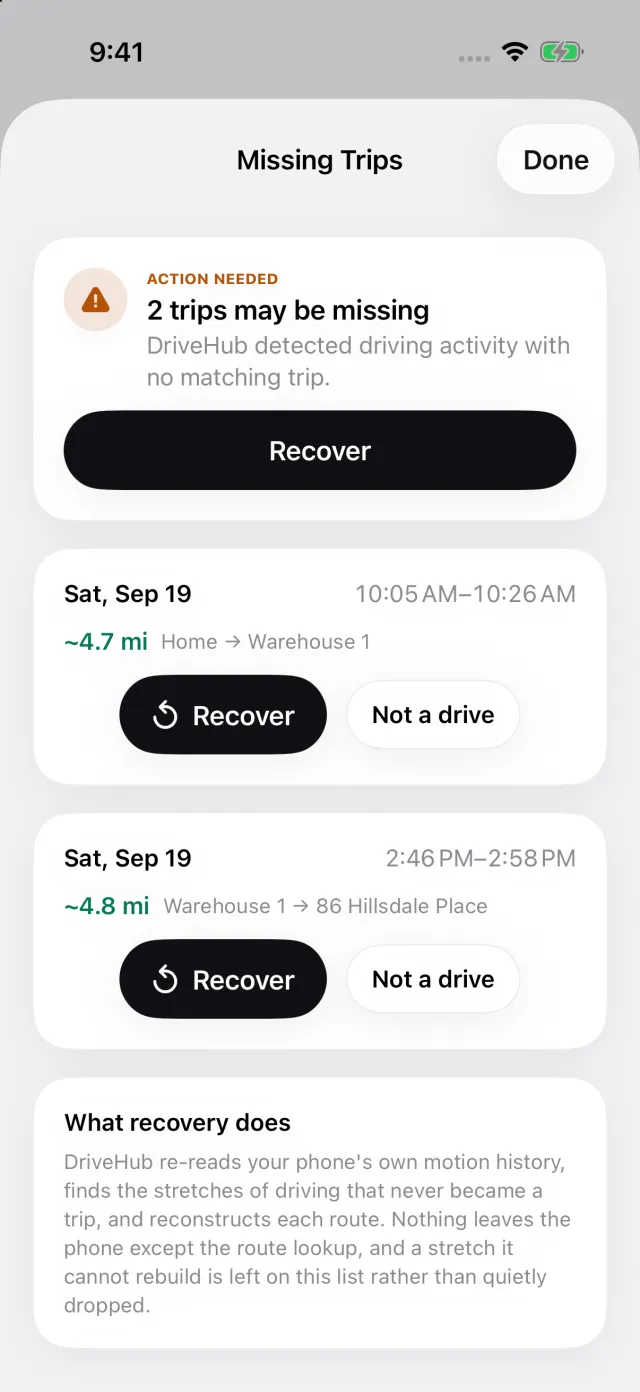
What is left for you is the purpose and the business partner. Enter them the same week — Rz. 29's seven days are the window the administration accepts. The report prints the odometer at the start and end of each trip, the business partner, and every later change to a trip, on the report itself.
DriveHub can also ask you for the car's real odometer reading on a schedule you set, and the report compares those readings with the recorded distance — the comparison missing in the FG Niedersachsen case.
Where DriveHub stops: it cannot write a purpose for you, and it cannot turn a month rebuilt from a calendar into a Fahrtenbuch. It does not judge whether your logbook is ordnungsgemäß — that is the Finanzamt's call. Nor does it calculate the 1 % value.
DriveHub is on the App Store for iPhone. The German requirements, field by field, are on the Germany page. Setting up automatic tracking takes a few minutes, once.
Sources
- R 8.1 Abs. 9 Nr. 2 and Nr. 3 LStR; H 8.1 (9-10) LStH — Amtliches Lohnsteuer-Handbuch 2026.
- BMF-Schreiben vom 03.03.2022 – IV C 5 - S 2334/21/10004 :001, Rz. 28–29 (LStH 2026 Anhang 24 IV.1).
- BFH 09.11.2005 – VI R 27/05; BFH 16.11.2005 – VI R 64/04; BFH 10.04.2008 – VI R 38/06; BFH 13.11.2012 – VI R 3/12; BFH 20.03.2014 – VI R 35/12; BFH 16.03.2022 – VIII R 24/19; BFH 12.01.2024 – VI B 37/23.
- FG Münster 10.07.2019 – 7 K 2862/17 E; FG Niedersachsen 23.01.2019 – 3 K 107/18.
This page states what the Lohnsteuer-Richtlinien, the BMF and the courts say, and cites them so you can check. It is not tax advice. It can't account for your circumstances. Where money is involved, ask your Steuerberater — and bring the logbook.
The full rule for Germany, with the instruments it comes from: mileage log requirements in Germany.