 DriveHub
Country guide · Croatia · 6 min
Driving to work is not loko vožnja: Croatia caps the tax-free commute at the ticket price
You drive your own car to work in Croatia and want to know what your employer may pay for it. The naknada za prijevoz na posao privatnim automobilom is tax-free up to the price of a public-transport ticket on your route — not per kilometre, and not as loko vožnja.

The short answer
- There is no per-kilometre commute rate in Croatian tax law. The commute is priced by the ticket: the monthly or single fare of public transport.
- Driving your own car changes nothing about that ceiling. The tax-free amount is the price of a ticket from any carrier serving the area, whatever the car's kilometres.
- A per-km payment above the ticket price is pay. A kolektivni ugovor may promise it; the part above the ticket price is taxable.
- No transport on your route? The ceiling is the fare for a roughly equal distance where transport does run.
- The commute is not loko vožnja. The 0,50 €/km and the loko record are for driving "u službene svrhe", and home to work is not that.
- Whether you get a commute payment at all comes from labour law, not tax law: your kolektivni ugovor, pravilnik o radu or ugovor o radu.
The rows that set the commute
The tax-free amounts are in the Pravilnik o porezu na dohodak, čl. 7 st. 2. The commute has two rows of its own, unchanged in substance since NN 10/17 and restated by NN 16/25.
Row 29 (r.br. 29), local public transport:
"29. Naknade troškova prijevoza na posao i s posla mjesnim javnim prijevozom — u visini stvarnih izdataka prema cijeni mjesečne odnosno pojedinačne prijevozne karte odnosno do visine cijene mjesečne odnosno pojedinačne prijevozne karte. Ako na određenom području odnosno udaljenosti nema organiziranog prijevoza, naknada troškova prijevoza na posao i s posla utvrđuje se u visini cijene prijevoza koja je utvrđena na približno jednakim udaljenostima na kojima je organiziran prijevoz …"
Row 30 (r.br. 30), intercity public transport:
"30. Naknade troškova prijevoza na posao i s posla međumjesnim javnim prijevozom — u visini stvarnih izdataka, prema cijeni mjesečne odnosno pojedinačne karte …"
Both rows measure the commute in tickets. Neither mentions a car, a kilometre or a rate per kilometre.
Your own car: still the ticket price
Porezna uprava answered the own-car question directly in mišljenje 2242 (25.01.2017.):
"Ako poslodavac radniku isplaćuje troškove prijevoza na posao i s posla, a isti umjesto javnog prijevoza koristi osobni automobil, isplaćena naknada ne smatra se oporezivim primitkom do visine cijene mjesečne odnosno pojedinačne prijevozne karte bilo kojeg prijevoznika koji prometuje na tom području."
So the tax-free amount is the ticket price, monthly or single, of any carrier serving that area. How far you drive does not change it. The opinion cites the 2017 Pravilnik that was repealed weeks later; its holding maps onto the current rows 29 and 30 and čl. 8 st. 3.
When there is no bus, or the bus is free
- No organised transport on your route. Row 29's second sentence applies: the ceiling is the fare set "na približno jednakim udaljenostima na kojima je organiziran prijevoz" — the price for a roughly equal distance where transport does run.
- Free municipal transport that cannot get you to work on time. Mišljenje 2601 (24.03.2025.) extends the ticket-price ceiling to this case, with a condition: "pritom je potrebno osigurati dokaze odnosno vjerodostojne isprave". The timetable problem has to be shown.
- Free transport that does get you there. Then nothing is tax-free. Mišljenje 2588 (24.02.2025.): the payment "nije moguće isplatiti bez oporezivanja budući da stvarnog troška radnika nema" — there is no real cost to reimburse.
A per-kilometre commute payment above the ticket is pay
The tax rules set no distance condition and no monthly cap. The ceiling is simply the ticket price, whatever it is. Who is entitled to a commute payment, and from what distance, is a separate question. Mišljenje 2601 puts it this way: the worker's right "uređena izvorima radnog prava (kolektivnim ugovorom, Pravilnikom o radu, ugovorom o radu …) dok je porezni tretman … uređen propisima o porezu na dohodak".
So a per-km commute figure in a kolektivni ugovor is an entitlement, not a tax-free rate. Up to the ticket price it is tax-free. Above it, it is taxable.
An example, with figures invented for illustration. Your agreement pays a per-km amount that comes to 90 € for the month. The monthly ticket on your route costs 60 €.
- Tax-free: 60 €, the ticket price
- Taxable: 90 € − 60 € = 30 €
The 30 € is taxed as pay. Your kilometres set only the 90 € your agreement promises; the 60 € comes from the carrier's price list.
What the employer keeps, and the months that do not count
The evidence for a commute payment is a price list, not a logbook. Čl. 8 st. 3: "vjerodostojnom ispravom smatraju se i javno objavljeni odnosno dostupni cjenici ovlaštenih prijevoznika koje su poslodavci radi priznavanja neoporezivih iznosa obvezni osigurati i čuvati". The employer must obtain and keep the carriers' published fares. No odometer reading or trip record is prescribed for the commute.
Some months carry no commute allowance at all. Under čl. 7 st. 33, none applies for a month in which the worker "cijeli mjesec nisu radili odnosno koji su cijeli mjesec proveli na bolovanju ili plaćenom odnosno neplaćenom dopustu … ili su cijeli mjesec radili na izdvojenom mjestu rada". In plain terms: a whole month not worked, on sick leave, on paid or unpaid leave, or working remotely. The remote-work limb was added by NN 1/23.
Why the commute is not loko vožnja
Loko vožnja is a record for one row of the table, r.br. 31: "Naknade za korištenje privatnog automobila u službene svrhe — do 0,50 po prijeđenom kilometru". It covers driving "u mjestu rada i/ili do 30 kilometara od mjesta rada" (čl. 7 st. 34). Both say u službene svrhe — for business purposes. A drive from home to work is not one, even when it is short and ends at the workplace.
Porezna uprava said so in mišljenje 1597 (20.03.2012.). An employee wanted a per-km payment for driving to work, backed by a log of arrivals and departures. The answer: "naknade za korištenje privatnog automobila u službene svrhe mogu se neoporezivo isplatiti samo pod propisanim uvjetima i samo za službena putovanja na temelju urednog i vjerodostojnog putnog naloga." The opinion construes the 2005 Pravilnik. The structure is unchanged: the commute has its own rows, 29 and 30, priced by ticket.
So putting home-to-work kilometres on the loko record does not turn them into 0,50 €/km. It puts kilometres that are not službena svrha on a record meant for those that are. What the business rate covers, and what goes on each record, is in the 0,50 €/km for your own car and Putni nalog or loko vožnja.
If you drive a company car privately, a commute allowance can still be paid, but it cannot be set against the benefit. That is covered in Službeni automobil u privatne svrhe.
How DriveHub makes this easier
DriveHub does not calculate the commute allowance. The amount turns on a carrier's fare and on your labour contract, and neither is in a mileage log.
What a log can get wrong is the reverse: home-to-work drives ending up among the business kilometres you claim at 0,50 €/km. With location access set to Always, DriveHub records every drive in the background — and if it ever misses one, it tells you. It files most trips as Business or Personal by your places, past routes and working hours, and asks you about the rest under Need to check, where a drive to work can be answered Commute.
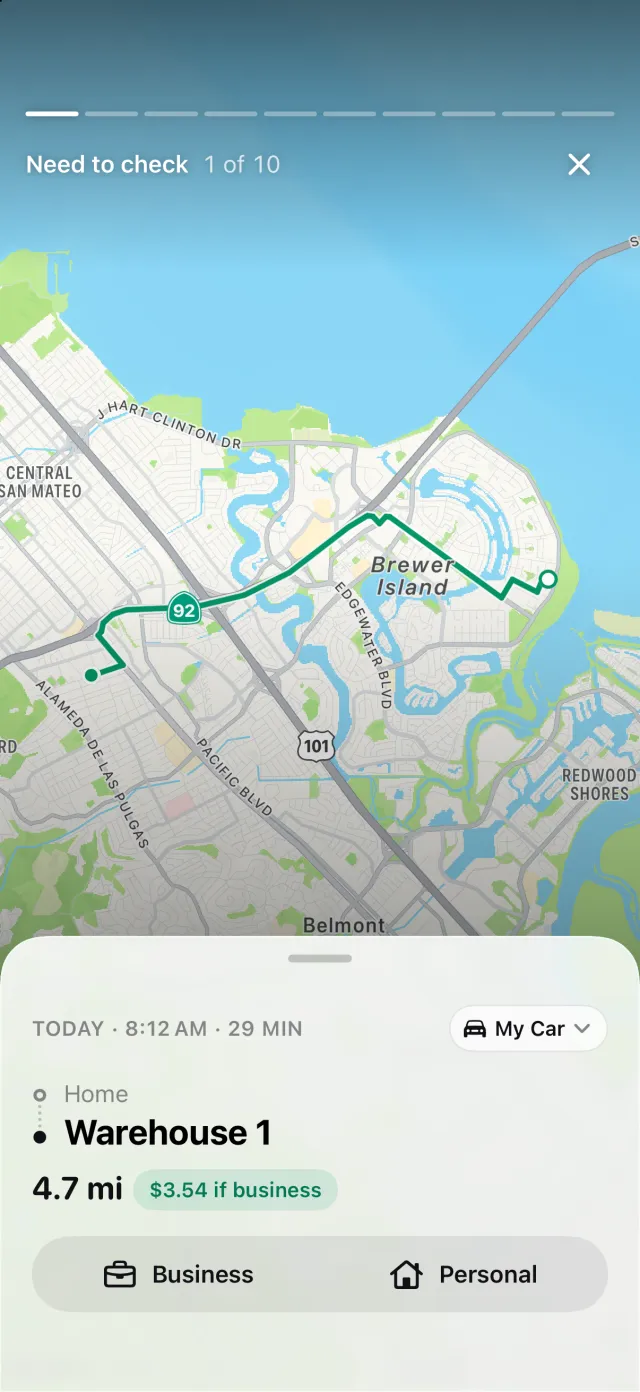
Commute sits next to Business and Personal. DriveHub counts a commute as personal driving, so it stays out of the business kilometres you would claim at 0,50 €/km, on the loko vožnja record or a putni nalog. Whether a particular drive is a commute is a fact about your work, and DriveHub leaves that decision to you.
DriveHub is on the App Store for iPhone. The Croatian rules are on the Croatia page. Setting up automatic tracking takes a few minutes, once.
This page quotes the Pravilnik o porezu na dohodak and Porezna uprava's opinions, and names them so you can check. It is not tax advice. It can't account for your circumstances. Where money is involved, ask your knjigovođa — and bring the carrier's price list.
Do it in DriveHub
Mark a drive to work as Commute →
Commute is a third answer beside Business and Personal. See where to give it and what it changes.
The full rule for Croatia, with the instruments it comes from: mileage log requirements in Croatia.