 DriveHub
Country guide · Croatia · 7 min
An obrtnik can claim 0,50 €/km for their own car — with the same record an employee keeps
You run an obrt and drive your own car for it. For loko vožnja and longer trips alike, the Pravilnik gives you the same 0,50 €/km an employer may pay a worker tax-free — and, in the same words, the same record duty.

The short answer
- Yes, an obrtnik gets it. Pravilnik o porezu na dohodak čl. 35 st. 1 t. 6 grants the self-employed the čl. 7 amounts "za njih osobno". That includes up to 0,50 €/km for a private car used for business.
- The record comes with the money. The same provision says "u visini i na način propisan člankom 7." — in the amount and in the manner. Inside 30 km of the place of work that means the loko vožnja record; beyond it, the putni nalog.
- It is booked in the KPI. Up to 0,50 €/km goes into the Knjiga primitaka i izdataka as a business expense. Anything above it is not deductible and may not be entered at all.
- 0,50 is a ceiling, and it is the same figure for loko vožnja and for a longer journey. The 0,40 still quoted for loko is the 2023 rate, replaced by 0,50 on 2 January 2024. There has never been a separate loko rate.
- It is for a private car. A car in the obrt's business assets is a different route: its costs are business expenses, with 50 % disallowed unless the private use is taxed as pay, and insurance fully deductible.
- A paušalni obrt has nothing to claim and keeps no record of this kind.
- Keep the record ten years from 31 December of the year the tax obligation arose.
Why a rule written for employees reaches you
Čl. 7 of the Pravilnik sets the tax-free amounts. By its own words it is confined to what "poslodavac ili isplatitelj plaće isplaćuje svojim radnicima" — what an employer pays its workers. Read alone, it leaves a self-employed person outside.
The bridge is čl. 35 st. 1 t. 6:
"iznosi naknada, potpora i nagrada poreznih obveznika koji obavljaju samostalne djelatnosti…za njih osobno, u visini i na način propisan člankom 7. ovoga Pravilnika"
So the figure an obrtnik may use for themselves is the employee's figure. For a private car on business that is čl. 7 st. 2 r.br. 31: "Naknade za korištenje privatnog automobila u službene svrhe — do 0,50 po prijeđenom kilometru". What the same 0,50 means for an employee, and what happens above it, is in Naknada for a private car.
The figure has moved. r.br. 31 read 3,00 kn from 1 October 2022 (NN 112/2022) and 0,40 € from 1 January 2023 (NN 156/2022). Since 2 January 2024 it reads 0,50 (NN 143/2023), and the table restated in NN 16/2025 kept it. A page quoting 0,40 is describing 2023.
How it is booked
Čl. 35 st. 1 opens "Poslovnim izdacima po osnovi samostalne djelatnosti, u smislu članka 32. Zakona, smatraju se i:" — so t. 6 makes the kilometre amount a poslovni izdatak, a business expense of the obrt. The Zakon o porezu na dohodak (ZPD; NN 115/16, 106/18, 121/19, 32/20, 138/20, 151/22, 114/23, 152/24) exempts the same amounts "do propisanih iznosa" in čl. 9 st. 1 t. 10.
The ceiling is a hard one:
- ZPD čl. 33 st. 1 t. 3 makes non-deductible the amounts "iznad propisanih iznosa" — above the prescribed amounts. T. 4 says the same of the entrepreneur's own travel costs.
- Pravilnik čl. 44 st. 6: "Izdaci iz članka 33. stavka 1. točaka 2., 3. i 4. Zakona ne mogu se iskazivati u Knjizi primitaka i izdataka."
So up to 0,50 €/km goes into the Knjiga primitaka i izdataka as an expense, and nothing above it may be entered. Porezna uprava read it the same way under the 2005 rules: a self-employed taxpayer may show in the KPI "naknade za korištenje privatnog automobila u službene svrhe" (mišljenje 867, 4 December 2006).
"Na način": the same record an employee keeps
The two words that matter are na način. They import the documentation along with the amount. An obrtnik claiming 0,50 €/km is under the same record duty as an employee being reimbursed it.
Which record depends on where you drive. Čl. 7 st. 34 covers driving "u mjestu rada i/ili do 30 kilometara od mjesta rada (locco vožnja)". Driving inside the place of work is loko vožnja at any distance, and the 30 km is measured from the place of work, not from your home. What the place of work is for an obrtnik, the Pravilnik does not say: it uses mjesto rada for workers and never defines it for the self-employed. Agree yours with your knjigovođa. Beyond the 30 km, the journey needs a putni nalog. The full split and the putni nalog's own fields are in Putni nalog or loko vožnja.
For loko vožnja, st. 34 says the costs "priznaju se temeljem evidencije" — they are recognised on the basis of a record that contains at least (naročito):
- General details of the employer and the worker: name and OIB
- The car's make
- Its registration plate
- The opening and closing odometer reading
- The relacija — the route
- The purpose of the drive
- Receipts for the actual costs, such as parking
No date is prescribed. The list is worded for two parties, a poslodavac and a radnik. In a one-person obrt you are on both sides of it, and the Pravilnik does not say how to fill them; no Porezna uprava mišljenje on it was found. The natural reading is the obrt's name and OIB as the payer and yours as the person. That may be the same OIB twice. It is a reading, not a requirement. Ask your knjigovođa how they want those lines filled.
The same 0,50 inside and outside 30 km
St. 34 refers back to st. 2 r.br. 31, and no separate loko row exists. So the rate does not change at the 30 km line; only the record does.
An example. In one year you drive 4 800 km for the obrt in your own car: 3 000 km of local driving and 1 800 km on longer journeys.
| Driving | km | × 0,50 € | Record |
|---|---|---|---|
| Loko vožnja | 3 000 | 1 500 € | loko evidencija |
| Longer journeys | 1 800 | 900 € | putni nalozi |
| Total | 4 800 | 2 400 € at most |
Each euro of it stands on a record. Without one, the amount is not recognised on these terms: st. 34 recognises loko costs "temeljem evidencije", and for a longer journey the putni nalog is the vjerodostojna isprava.
If the car is in the business assets
Kilometrina is the route for a private car — r.br. 31 says "privatnog automobila". A car entered in the obrt's Popis dugotrajne imovine earns its costs another way: amortisation under ZPD čl. 35 st. 4 and running costs under čl. 32. ZPD čl. 33 st. 1 t. 5 then disallows "50 % izdataka u svezi s vlastitim ili unajmljenim osobnim motornim vozilima … ako se po osnovi korištenja tih sredstava za osobni prijevoz ne utvrđuje plaća ili drugi dohodak". That is 50 % of the costs, unless the private use is already taxed as pay or other income. St. 2 keeps insurance fully deductible.
So the reading is one route or the other: the car in business assets with its costs, or the car kept private with 0,50 €/km. Be clear about what that rests on. It follows from the wording of r.br. 31. Porezna uprava drew the same line in mišljenje 845 of 29 June 2006, and mišljenje 867 of the same year confirmed that the private-car amount goes into the KPI. Both were written under the old law, when the disallowance was 30 % and the rate 2,00 kn. No current Porezna uprava text states the either/or.
Which side your car is on is a fact of your books, not of your log, and your knjigovođa is the one who knows it.
A paušalni obrt claims nothing
A paušalist is outside all of this. ZPD čl. 82 st. 4: "ne vodi poslovne knjige… osim evidencije o prometu". Expenses are fixed notionally at 85 %. There is no kilometrina to add to that, and no kilometre record to keep for it.
Ten years, not eleven
The record is kept for ten years from the start of the limitation period, under Opći porezni zakon čl. 66 st. 18. Assessment prescribes "istekom godine u kojoj je nastala porezna obveza", so the ten years run from 31 December of the year the obligation arose. The putni nalog and the loko record share that period.
The eleven years of the Zakon o računovodstvu bind a poduzetnik on double-entry books. An obrtnik on income tax sits on the OPZ's ten. The seven-year figure still quoted comes from the 2015 accounting act, which the 2024 act replaced.
Whether an obrtnik can also claim a dnevnica for themselves is a separate and less settled question: čl. 35 st. 1 t. 6 names only "naknada, potpora i nagrada". See Dnevnica for a službeno putovanje.
How DriveHub makes this easier
The record is simple to describe and easy to lose, and in a one-person obrt nobody else keeps it for you. What goes missing is rarely the kilometres; it is the odometer reading on the day and the route of a drive months ago.
With location access set to Always, DriveHub records every drive in the background — and if it ever misses one, it tells you. DriveHub files most trips as Business or Personal by your places, past routes and working hours, and asks you about the rest.
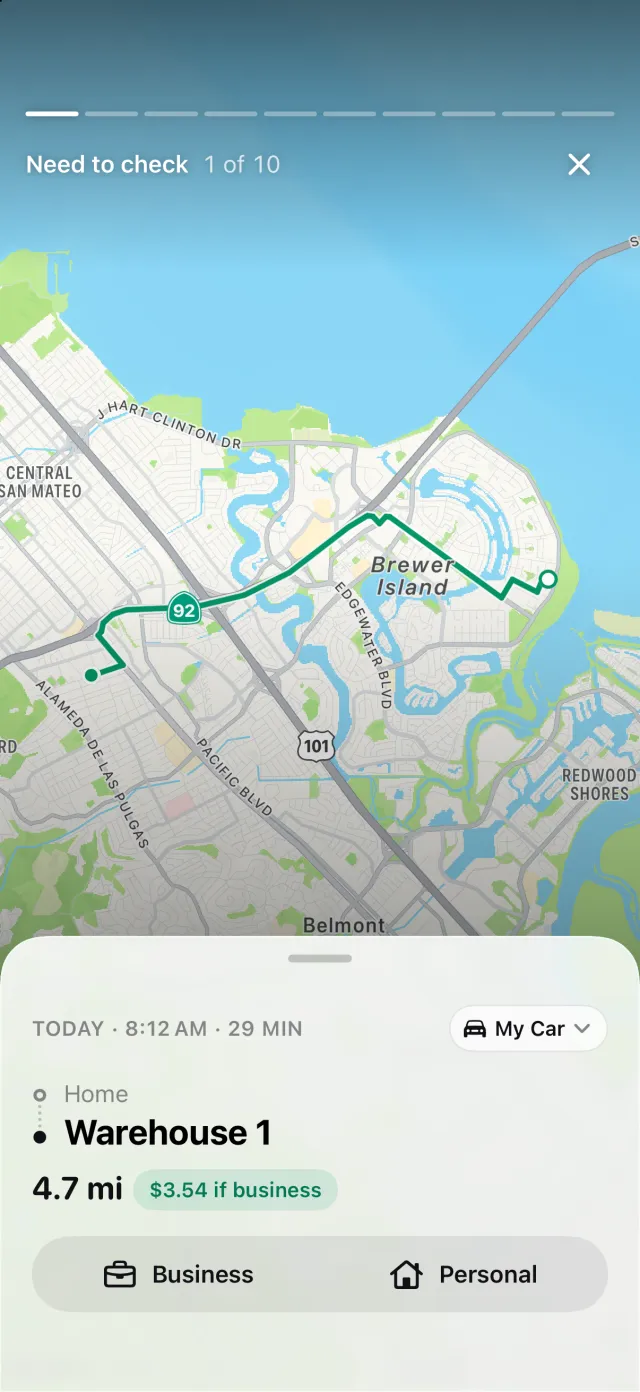
Where you have marked your workplace — for an obrtnik, the place of work you agreed with your knjigovođa — DriveHub measures both ends of a trip against it and files a drive that starts and ends within 30 km as loko vožnja. The PDF marks those rows, and the workbook gains a column an accountant can filter on. With no workplace marked, every row stays a putni nalog — the safer direction, because a putni nalog asks for more in every field except the two OIBs. Six of the loko record's seven items print. The receipts do not: DriveHub stores no attachments, and the report says on its face that they are yours to keep.
Reports shows business and personal distance for a month, a quarter or a year. Tracking is free; the PDF, Excel and CSV reports are part of DriveHub Pro. For a paušalni obrt there is nothing here to claim, so none of this applies.
DriveHub is on the App Store for iPhone. The Croatian rules are on the Croatia page. Setting up automatic tracking takes a few minutes, once.
This page quotes the Pravilnik o porezu na dohodak, the ZPD and the Opći porezni zakon, and names the articles so you can check. It is not tax advice. It can't account for your circumstances. Where money is involved, ask your knjigovođa — and bring the evidencija.
Do it in DriveHub
Country, official rates, your own rate and when a change applies.
The full rule for Croatia, with the instruments it comes from: mileage log requirements in Croatia.