 DriveHub
Country guide · Croatia · 6 min
Up to 0,50 €/km tax-free for your own car — loko vožnja included, not 0,40
You drive your own car for your employer in Croatia. The naknada za korištenje privatnog automobila u službene svrhe is up to 0,50 € per kilometre tax-free in 2026 — for local driving and for longer journeys alike.

The short answer
- Up to 0,50 €/km, tax-free. Pravilnik o porezu na dohodak čl. 7 st. 2 r.br. 31: "Naknade za korištenje privatnog automobila u službene svrhe — do 0,50 po prijeđenom kilometru". It is a ceiling on what your employer may pay you without tax.
- Loko vožnja gets the same 0,50. There has never been a separate loko rate. The 0,40 you still see was the 2023 figure, replaced on 2 January 2024.
- Above 0,50 is pay. Only the excess is taxed — as plaća for an employee, as drugi dohodak for someone who is not.
- Each kilometre stands on a record: the loko vožnja record in the place of work or within 30 km of it, a putni nalog beyond that.
- Tolls and parking come with receipts, which the record must carry.
- Driving to work is not službena svrha. The commute has its own rule, and it is priced by the ticket, not by the kilometre.
Where the 0,50 comes from
The figure sits in the table of tax-free amounts in čl. 7 st. 2 of the Pravilnik o porezu na dohodak, row 31. "Do" makes it a maximum. Your employer may pay less; what it pays up to 0,50 €/km is not income.
The current wording was set by NN 143/2023, in force from 2 January 2024. NN 16/2025 rewrote the whole table from 1 February 2025 and kept the row as it was: "31. Naknade za korištenje privatnog automobila u službene svrhe do 0,50 po prijeđenom kilometru".
The rate has no annual cap. There is no passenger supplement and no trailer supplement either.
Why so many pages still say 0,40
Because 0,40 was right, for one year. Row 31 has changed three times since October 2022:
| From | Rate | Instrument |
|---|---|---|
| Until 30 Sep 2022 | 2,00 kn/km | NN 10/17 (and the 2005 Pravilnik before it) |
| 1 Oct 2022 | 3,00 kn/km | NN 112/22 |
| 1 Jan 2023 | 0,40 €/km | NN 156/22 (the euro conversion) |
| 2 Jan 2024 | 0,50 €/km | NN 143/23 |
A page quoting 0,40 is describing 2023. A page quoting 2,00 kn is older still.
The loko version of the mistake is that 0,40 is the loko rate and 0,50 the rate for a longer journey. It is not. Čl. 7 st. 34, which governs loko vožnja, points back to r.br. 31 for its amount, and it has done so in every version. No separate loko row exists. The 30 km line changes the record you keep, not the rate.
Paid more than 0,50? The excess is pay
Čl. 7 st. 1 of the Pravilnik treats these payments as employment income "ako prelaze iznose iz stavka 2." — if they exceed the table. That rests on ZPD čl. 21 st. 1 t. 1 b), which counts as pay what an employer gives "iznad propisanih iznosa".
Porezna uprava spelled out how it is split, in mišljenje 2296 (14.07.2017.): "taj dio iznad neoporezivog iznosa smatra se oporezivim primitkom". So only the part above 0,50 is taxed. For an employee it is plaća. For a payee who is not an employee, it is drugi dohodak.
An example. In March you drive 1 200 km for work in your own car, and your employer pays 0,60 €/km.
- Paid: 1 200 km × 0,60 € = 720 €
- Tax-free: 1 200 km × 0,50 € = 600 €
- Taxable as plaća (only the excess): 720 € − 600 € = 120 €
Had the employer paid the stale 0,40, you would have received 1 200 × 0,40 = 480 €, which is 120 € less than the law allows tax-free.
What the 0,50 covers, and the receipts beside it
The Pravilnik does not list what row 31 covers. Two things in it settle the practical question.
For a journey beyond 30 km, čl. 8 st. 2 requires receipts with the putni nalog: "računi za cestarine, računi za parking, putne karate … računi za smještaj i drugo, bez obzira na način podmirenja izdataka". For loko vožnja, čl. 7 st. 34 makes "računi za stvarno nastale troškove vezane uz korištenje automobila (računi za parkiranje i slično)" part of the record itself.
Fuel receipts are not on either list. The 2005 Pravilnik did list "računi za utrošeno gorivo"; the current one does not. That fits the per-kilometre amount being the payment for fuel and running the car.
The receipts that are required support a reimbursement at actual cost, under r.br. 27 — "Naknade prijevoznih troškova na službenom putovanju — u visini stvarnih izdataka". No Porezna uprava text says in so many words that tolls and parking are paid on top of 0,50. That is what the instrument implies, not a quoted ruling.
One limit is written down. Čl. 7 st. 29 makes the transport, meals and accommodation rows "međusobno se isključuju", r.br. 27 and 31 among them. You cannot be paid actual transport cost and 0,50 €/km for the same transport.
Which record: putni nalog or loko vožnja
The 0,50 is tax-free only on a record. Which one depends on where you drive. Čl. 7 st. 34 covers driving "u mjestu rada i/ili do 30 kilometara od mjesta rada (locco vožnja)". Beyond that, the journey needs a putni nalog under čl. 8 st. 2.
Both ask for the car's make and registration plate, the opening and closing odometer reading, the purpose, and receipts. The loko record adds both parties' OIB. The putni nalog adds the date of issue, departure and return times, an authorised signature, a cost calculation and a trip report. Both lists, field by field, are in Putni nalog or loko vožnja. For the daily allowance on a longer journey, see Dnevnica for a službeno putovanje.
Without a compliant putni nalog, the payment is not a tax-free reimbursement. Keep the records ten years from 31 December of the year the tax obligation arose (Opći porezni zakon čl. 66 st. 18). The loko record has the same period.
Driving to work does not count
Row 31 is for "službene svrhe". The commute is not one. Porezna uprava, mišljenje 1597 (20.03.2012.), refused a per-kilometre payment for driving to work. Such an allowance may be paid tax-free "samo za službena putovanja na temelju urednog i vjerodostojnog putnog naloga". The opinion construes the 2005 Pravilnik, but the structure has not changed: the commute has its own rows, 29 and 30.
Under those rows, using your own car to get to work is tax-free only up to the price of a public-transport ticket (mišljenje 2242, 25.01.2017.). The kilometres do not matter, and a per-km commute payment above the ticket price is pay. The full rule is in Prijevoz na posao.
The same 0,50, the other way round
If your employer gives you a company car that you also drive privately, 0,50 €/km appears again — this time charged to you. By default čl. 22 st. 3 t. 5 values the private use at 1 % of the car's purchase value a month. Where the employer keeps a record of actual use, t. 5.5.1 values it at private kilometres × 0,50 instead. Same figure, opposite direction. See Company car for private use.
Self-employed? The same 0,50, the same record
An obrtnik on income tax gets the same amount for their own car, kept out of the obrt's dugotrajna imovina, through čl. 35 st. 1 t. 6, "u visini i na način propisan člankom 7." — so with the same record. The excess above 0,50 cannot be deducted. A paušalni obrt claims nothing. The details are in Loko vožnja for an obrtnik.
How DriveHub makes this easier
The rate is the easy part. What goes missing is the record behind it. It is the odometer reading on the day, the route of a drive three months ago, and whether it ended inside 30 km of the place of work.
With location access set to Always, DriveHub records every drive in the background — and if it ever misses one, it tells you. DriveHub files most trips as Business or Personal by your places, past routes and working hours, and asks you about the rest.
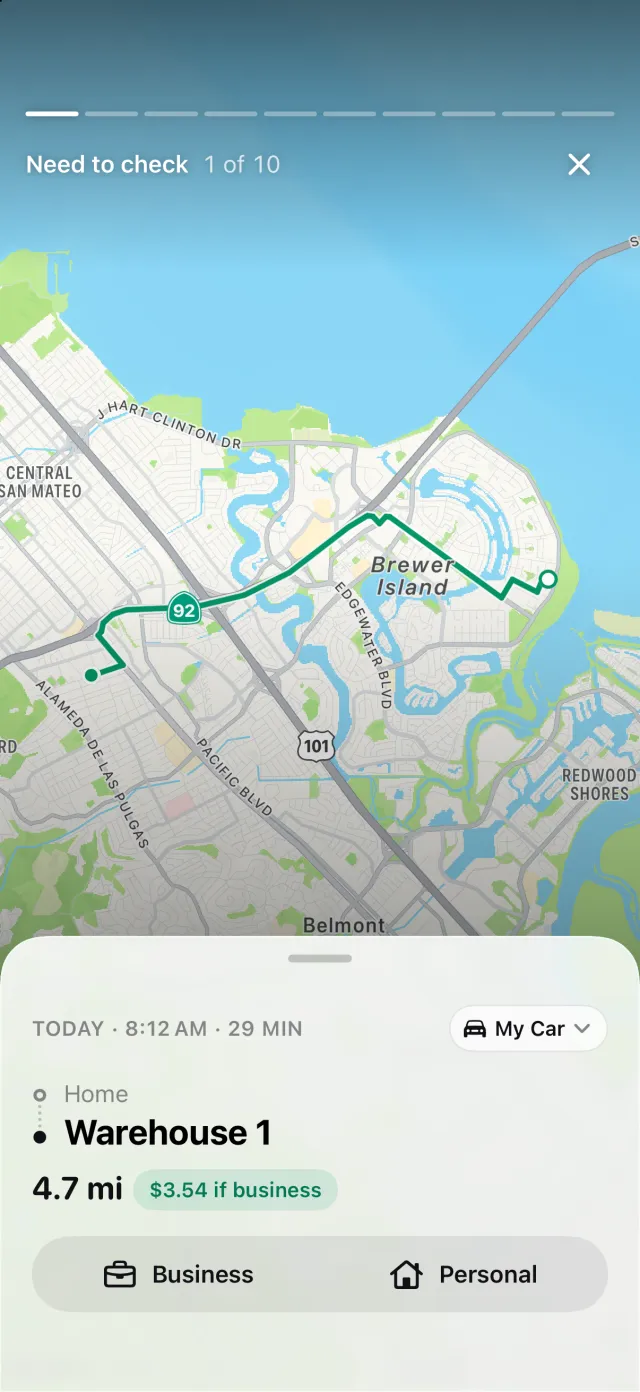
Where you have marked your workplace, DriveHub measures both ends of a trip against it and files anything inside 30 km as loko vožnja. The PDF marks those rows, and the workbook has a column an accountant can filter on. With no workplace marked, every row stays a putni nalog. Odometer figures come from your readings, and carried-forward ones are marked ≈. On a report for one car, the plate and the driver print once at the top. The receipts do not print: DriveHub stores no attachments, and the report says on its face that they are yours to keep. Whether a drive to work is a commute, DriveHub does not decide for you. When it asks about a drive from home to work, answer Commute — it stays out of the business and loko totals.
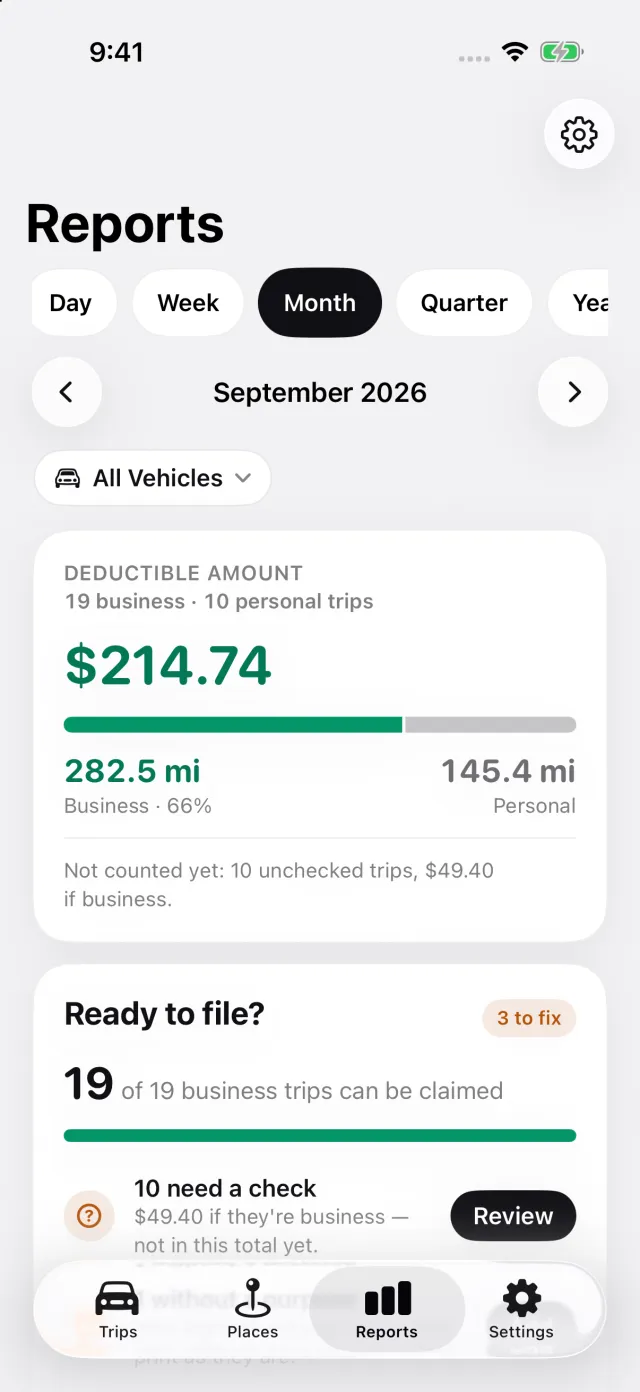
Reports shows business and personal distance for a month, a quarter or a year, with Croatia's rate built in. Tracking is free; the PDF, Excel and CSV reports are part of DriveHub Pro.
DriveHub is on the App Store for iPhone. The Croatian rules are on the Croatia page. Setting up automatic tracking takes a few minutes, once.
This page quotes the Pravilnik o porezu na dohodak, the ZPD, the Opći porezni zakon and Porezna uprava's opinions, and names them so you can check. It is not tax advice. It can't account for your circumstances. Where money is involved, ask your knjigovođa — and bring the putni nalog.
Do it in DriveHub
Employment dates, different rates and trips for more than one job.
The full rule for Croatia, with the instruments it comes from: mileage log requirements in Croatia.