 DriveHub
Country guide · Croatia · 7 min
A company car for private use in Croatia: 1 % a month, or 0,50 € per private kilometre with a record
Your employer, or your own d.o.o., gives you a službeni automobil and you also drive it u privatne svrhe. Croatia taxes that as a benefit in kind, priced one of two ways — and only one of them needs a record.

The short answer
- Private use of a company car is a benefit in kind. Pravilnik o porezu na dohodak čl. 22 st. 3 t. 5 prices it.
- The default is 1 % of the car's purchase value a month, "bez obzira na opseg korištenja" — however little you drive it privately. For an operating lease or long-term rental it is 20 % of the monthly instalment. Both are increased by PDV.
- The alternative is actual use: private kilometres × 0,50 €. It is allowed only if the employer keeps a record of private kilometres and time of private use.
- No record, no choice. Without that record the 1 % applies automatically (t. 5.3).
- The record is the employer's duty, and its form is set by the employer's own odluka. The 1 % route needs no record at all.
- The base for the 1 % is price + PDV + PPMV, whether or not the employer recovers the PDV.
- The 2,00 kn and 0,40 € per-kilometre figures still quoted online are stale. The figure since 2 January 2024 is 0,50.
What the Pravilnik says — čl. 22 st. 3 t. 5
The rule is one point with five sub-points. The operative text, NN 10/17 as amended by NN 112/22, 156/22 and 143/23:
"5. pri korištenju prijevoznih sredstava – primitak je iznos u visini od l% nabavne vrijednosti prijevoznih sredstava mjesečno (uvećano za porez na dodanu vrijednost) odnosno u visini 20% od mjesečne rate za operativni leasing ili dugotrajni najam (uvećano za porez na dodanu vrijednost), bez obzira na opseg korištenja prijevoznih sredstava u privatne svrhe. Primitak se može utvrđivati i prema opsegu stvarnog korištenja:"
Then the sub-points, in short:
- 5.1 — an employer that lets a car be used privately must adopt an odluka on the manner and conditions of that use, and on how the pay is determined.
- 5.2 — where the benefit is set by actual use, the employer "obvezan je voditi evidenciju o prijeđenoj kilometraži i vremenu korištenja u privatne svrhe", kept as the odluka from 5.1 says.
- 5.3 — if that record is not kept, the benefit is 1 % of the purchase value a month, or 20 % of the monthly instalment.
- 5.4 — if several workers use the same car during a month and the employer applies the 1 %, the corresponding amount is added to each of them.
- 5.5.1 — for road vehicles, actual use is priced as "ukupno prijeđena kilometraža u privatne svrhe pomnoži s 0,50 centi po prijeđenom kilometru".
"0,50 centi" is the gazette's wording
Read literally, "0,50 centi" is half a cent. It is how Narodne novine prints it, not a typo on this page. NN 156/22 replaced "3,00 kune" with "0,40 centi", and NN 143/23 čl. 10 replaced that with "0,50 centi". Everyone, Porezna uprava included, reads it as 0,50 € per private kilometre — the same figure that stands in čl. 7 st. 2 r.br. 31 for a private car on business.
The history explains the stale numbers in circulation:
| From | Per private kilometre | Instrument |
|---|---|---|
| Until 30 Sep 2022 | 2,00 kn | NN 10/17 |
| 1 Oct 2022 | 3,00 kn | NN 112/22 |
| 1 Jan 2023 | 0,40 | NN 156/22 (euro conversion) |
| 2 Jan 2024 | 0,50 | NN 143/23 čl. 10 |
A page quoting 2,00 kn predates October 2022. A page quoting 0,40 € describes 2023.
The record: two quantities, and the employer keeps it
For the per-kilometre method, t. 5.2 names exactly two things:
- private kilometres driven, and
- the time of private use.
Nothing else is prescribed. There is no field list like the putni nalog's. How the record is kept is for the employer's odluka under t. 5.1, and the duty sits with the employer.
The 1 % route needs no record. Porezna uprava, mišljenje 2334 (27.03.2018.): "Obveza vođenje evidencije o korištenju sredstava za osobni prijevoz, osim u navedenom slučaju stvarnog korištenja, za porezne svrhe, nije propisano ili obvezno." Mišljenje 2273 (13.04.2017.) says the same: "nije propisana obveza vođenja evidencije".
A business journey in the same car still has its own paperwork. Mišljenje 2273 adds that a putni nalog in a company car still needs the make, the plate and the odometer readings. The exception is where "ti podaci osigurani u drugim evidencijama poslodavca (internim evidencijama o korištenju službenih automobila)". What a putni nalog must contain, and when loko vožnja applies instead, is in Putni nalog or loko vožnja.
What the 1 % is 1 % of
The rule says "uvećano za porez na dodanu vrijednost". Mišljenje 2334 works an example from an invoice of "126.000,00 kuna (prodajna cijena 100.000,00 + 25.000,00 PDV + 1.000,00 PPMV)". The base it gives is "126.000,00 (101.000,00 + 25.000,00 PDV)".
So the base is the price, plus PDV, plus the special motor-vehicle tax (PPMV) — the full invoice. It does not matter whether the employer can recover the PDV: "bez obzira da li je istovremeno obveznik PDV-a ili nije".
For an operating lease paid with a down payment, the down payment is spread across the months: "potrebno je pribrojiti razmjerni iznos unaprijed plaćenog predujma (plaćeni predujam naknade/60)".
A worked example: 1 % against 0,50 € per kilometre
A company car's invoice totals 32 000 € — price, PDV and PPMV together.
The 1 % method. 32 000 € × 1 % = 320 € of benefit every month. It is the same in a month with 50 private kilometres and in a month with 1 500.
The per-kilometre method, with the record kept:
| Private km in the month | × 0,50 € | Benefit |
|---|---|---|
| 300 km | 300 × 0,50 | 150 € |
| 640 km | 640 × 0,50 | 320 € |
| 800 km | 800 × 0,50 | 400 € |
The two methods meet at 640 private kilometres a month (320 € ÷ 0,50 € = 640 km). Below that, the per-kilometre figure is lower than the 1 %. Above it, the per-kilometre figure is higher.
The employer's odluka sets how the benefit is determined (t. 5.1), and the per-kilometre method stands only where the record of t. 5.2 is kept. Without that record, t. 5.3 applies the 1 %.
Who is taxed, and as what
An employee, or a director paid a poduzetnička plaća: the benefit is income from nesamostalni rad — part of pay.
Anyone else given the car privately: it is drugi dohodak. Porezna uprava, mišljenje 2021 (26.05.2015.), under the older ZPD: "ukoliko isplatitelj omogući korištenje službenog automobila u privatne svrhe osobi koja kod toga poslodavca ne ostvaruje primitke od kojih se utvrđuje dohodak od nesamostalnog rada takvo korištenje predstavlja primitak od kojih se utvrđuje drugi dohodak". The current basis is Pravilnik čl. 54 st. 1, as cited in mišljenje 2334.
A commute allowance does not reduce the benefit
You can drive a company car privately and still be paid a tax-free commute allowance. What the employer cannot do is set one against the other. Mišljenje 815 (09.10.2006.), on a director with a company car: the allowance may be paid, but not netted against the benefit in kind, "jer se taj primitak može umanjiti samo za naknadu koju je radnik platio".
The opinion construes the 2005 Pravilnik. The rule it applies still holds: the benefit is reduced only by what the worker pays for the use. How the commute allowance itself is calculated is in Prijevoz na posao in Croatia.
Not the same 0,50 as kilometrina
The same 0,50 € appears in čl. 7 st. 2 r.br. 31, pointing the other way. There it is the most an employer may pay you, tax-free, for driving your own car on business. Here it is the price of a benefit charged to you for driving the company's car privately. Same figure, opposite directions. The own-car side is in Naknada for your own car on business.
How DriveHub makes this easier
The per-kilometre method lives or dies on two numbers per month: private kilometres and the time of private use. Both are easy to lose when they are written down from memory at the end of the month.
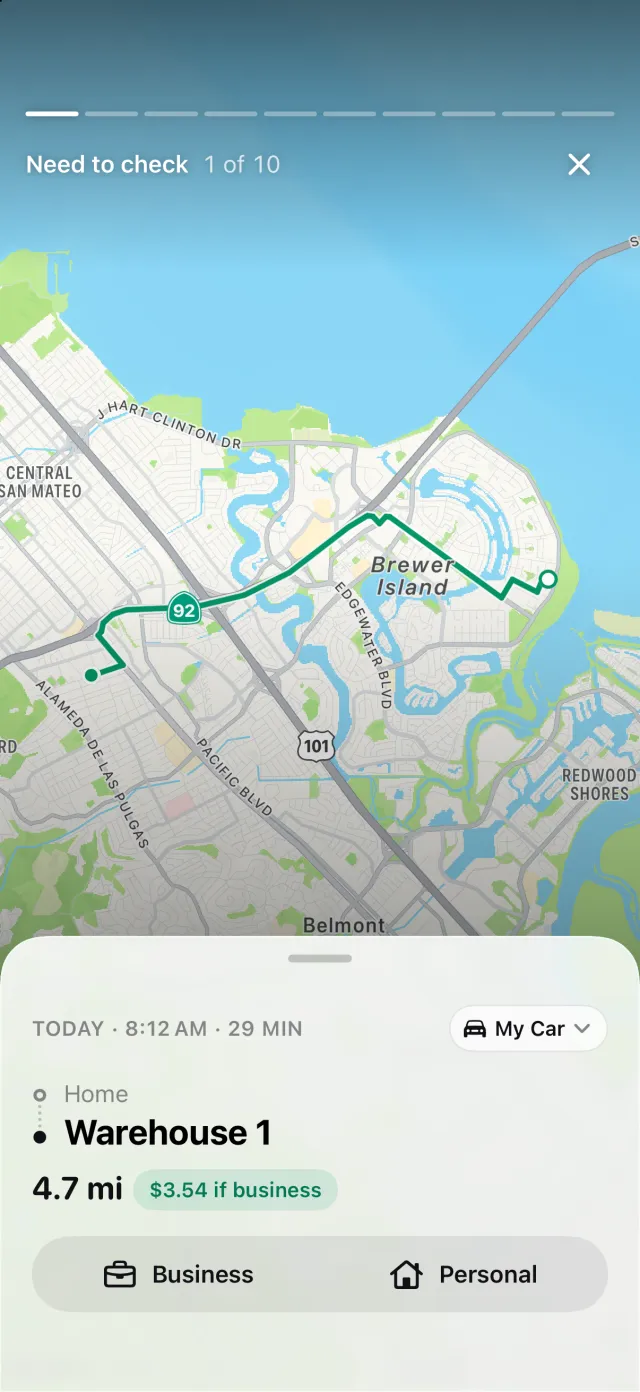
With location access set to Always, DriveHub records every drive in the background — and if it ever misses one, it tells you. Each trip keeps its start and end time, its places and its distance. DriveHub files most trips as Business or Personal by your places, past routes and working hours, and asks you about the rest.
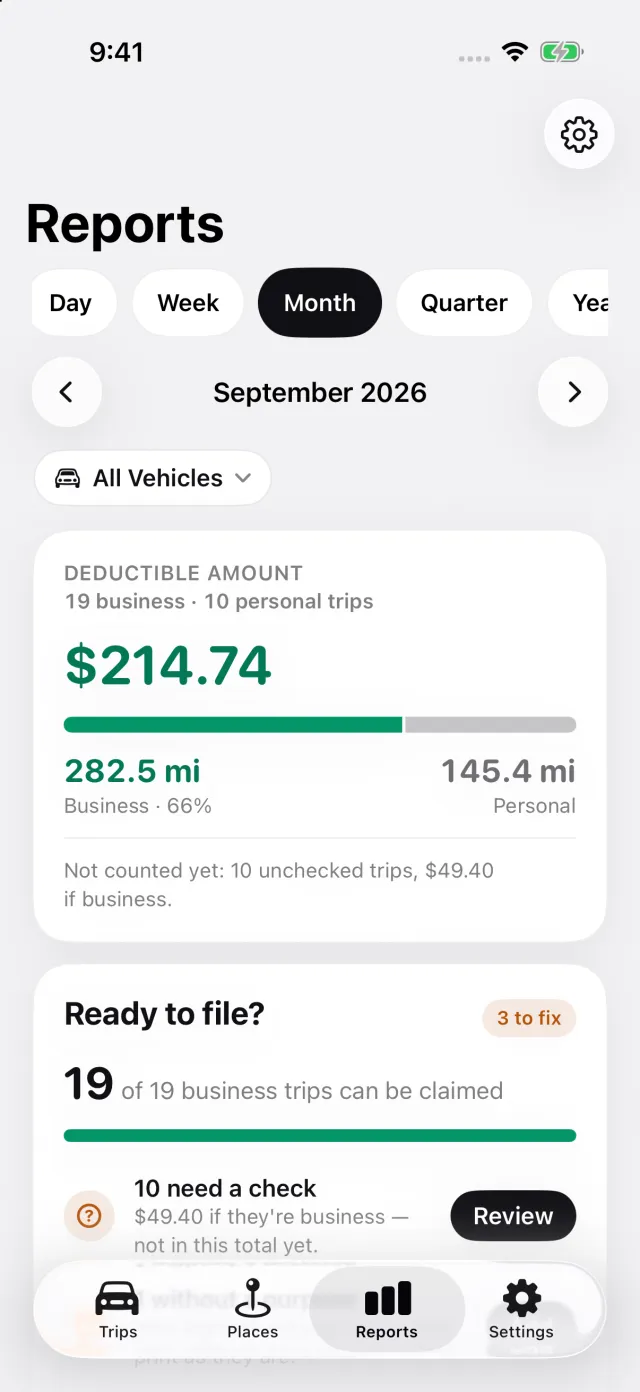
Reports shows business and personal distance for a month, a quarter or a year, and you can choose the company car on its own. That gives you the private kilometres and the times behind them to hand to your employer, in whatever form its odluka asks for. DriveHub does not keep the employer's record for it. Tracking is free; the PDF, Excel and CSV reports are part of DriveHub Pro.
DriveHub is on the App Store for iPhone. The Croatian rules are on the Croatia page. Setting up automatic tracking takes a few minutes, once.
This page quotes the Pravilnik o porezu na dohodak and Porezna uprava's opinions, and names them so you can check. It is not tax advice. It can't account for your circumstances. Where money is involved, ask your knjigovođa — and bring the evidencija.
Do it in DriveHub
File business and personal trips →
Review suggestions, set working hours and check place rules.
The full rule for Croatia, with the instruments it comes from: mileage log requirements in Croatia.