 DriveHub
Country guide · Poland
VAT on a car in Poland — when you deduct 50%, when you deduct 100%, and what the VAT-26 has to do with it

The short answer
In Poland the input VAT on a car's costs is 50% by default. It is 100% only if the car is used exclusively for the business. The 50% comes from ustawa o VAT art. 86a ust. 1 and covers every car cost listed in ust. 2: buying it, leasing or renting it, fuel, repairs and running costs.
Art. 86a ust. 3 pkt 1 lit. a switches the 50% off for a car "wykorzystywane wyłącznie do działalności gospodarczej podatnika", and ust. 4 pkt 1 says when a car counts as that: when the way you use it, "zwłaszcza określony w ustalonych przez niego zasadach ich używania", and a mileage register kept for the car, rule out any use outside the business.
In practice 100% needs three things: rules of use, the register, and a VAT-26 notice filed on time.
The three conditions for 100%
1. Rules of use. You set them yourself, and they must exclude private use. The act prescribes no form; write them down anyway. The register confirms the rules; it does not replace them.
2. The register. The ewidencja przebiegu pojazdu of art. 86a ust. 7, kept from the day exclusive use starts to the day it ends (ust. 6). Its contents are in Poland's two vehicle registers; how long to keep it is in keep it six years.
3. The VAT-26. Art. 86a ust. 12 requires a notice to your tax office about the car, due by the 25th day of the month after the month of the first expense on that car, and no later than the day you send the JPK for that period. Under ust. 13, a late notice does not void the 100%, but it moves the start: the car counts as exclusive only from the first day of the month in which you file. If the use changes later, ust. 14 requires an updated VAT-26 by the end of the month of the change.
Switching from 50% to 100% afterwards
If you bought the car under the 50% rule and later start using it exclusively, art. 90b ust. 1 pkt 2 lets you correct the VAT you deducted at purchase, within 60 months counted from the month the car was bought, imported or placed in use. The correction is made in the return for the period of the change, in proportion to the months left (ust. 4). Ust. 3 applies the same correction when a late VAT-26 pushed the start of exclusive use past the purchase. For a car with an initial value of up to 15 000 zł the window is 12 months (ust. 6). Going the other way is an obligation: a car deducted at 100% that starts being used privately needs a correction under pkt 1.
Vehicles that skip the 50%
Construction can exclude private use: vans meeting art. 86a ust. 9 pkt 1 and 2 (with the extra inspection and registration annotation of ust. 10), listed special-purpose vehicles, and vehicles built for ten or more people including the driver (ust. 3 pkt 1 lit. b). None of them needs the register or a VAT-26. Art. 86a covers only vehicles up to 3.5 tonnes (art. 2 pkt 34).
What DriveHub asks and computes
The Car VAT screen is for a VAT-registered business and works on whole calendar years, 2025 and 2026 for Poland. For a passenger car or motorcycle the key question is Used only for business: No gives 50%; Yes opens Written rules of use exclude private use, the exclusive-use dates and VAT-26 filed on.
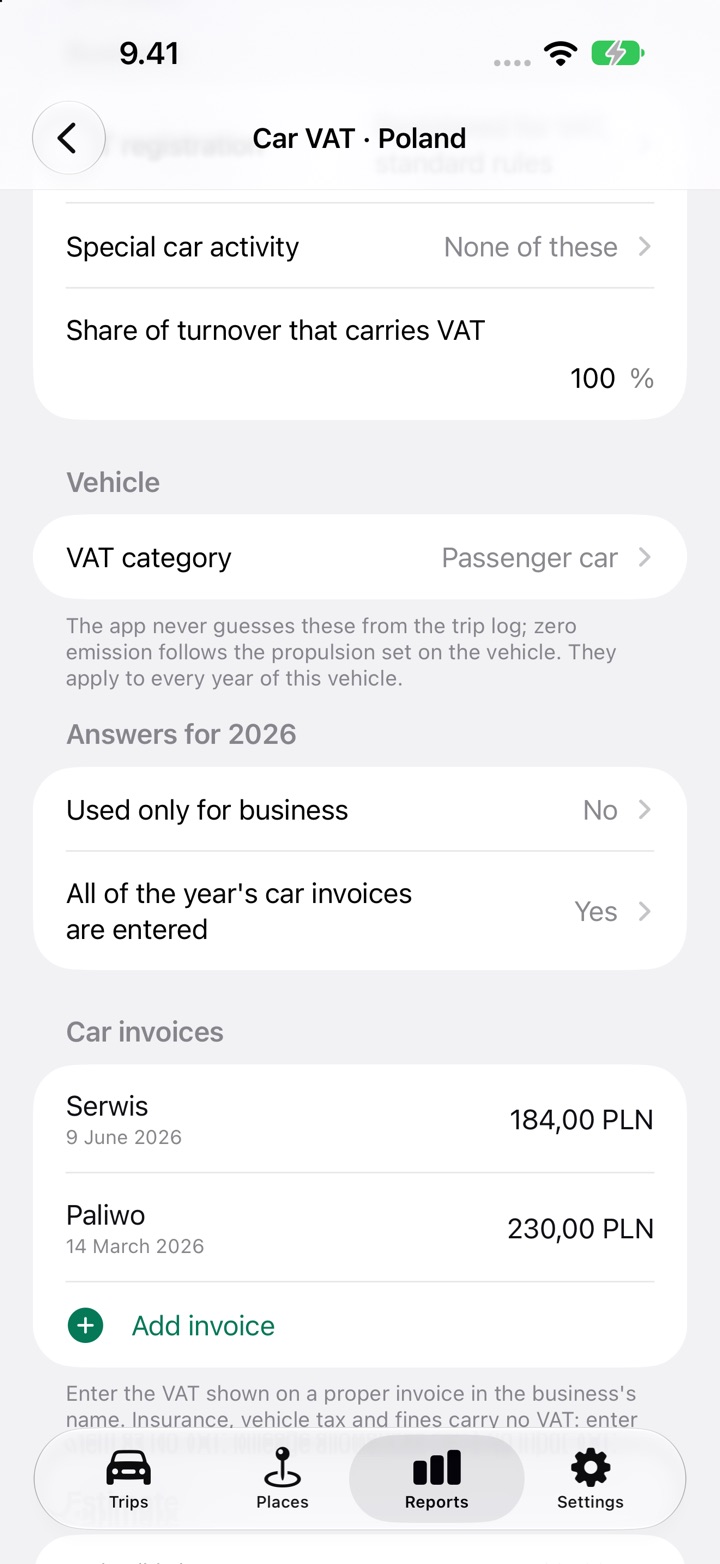
It then computes the deductible input VAT per invoice, with a figure per month. Invoices inside the exclusive period count at 100%, others at 50%. If the VAT-26 date is past the deadline, it moves the start to the first day of the filing month and says so. For the deadline it takes the earliest car invoice you have entered, in any year, as the first expense, so enter that first invoice even if it carries no VAT.
What it does not do:
- It gives no figure for a car used only for business if a trip inside the exclusive period is unreviewed, or if a trip you marked personal falls inside it. Commute trips do not stop it, but a note asks you to check them with your accountant.
- It gives no figure unless you confirm that all the year's invoices are entered, or if your turnover is only partly taxed, because the art. 90 proportion is not calculated.
- It does not file or generate the VAT-26. It trusts the date you enter.
- It cannot judge whether private use was possible. The law looks at possibility; the app sees only recorded trips.
- The art. 90b correction is only an estimate, shown as Correction estimate (art. 90b) when you have entered the purchase invoice and switch from 50% to 100% within 60 months of it. For a car bought for up to 15 000 zł net it says the correction is not calculated.
- It does not read the odometer at the end of each settlement period. You add that reading to the register yourself.
How to do it in DriveHub
- Open Reports, choose the car and a full calendar year, and tap Set up car VAT on the Car VAT card (it reads Edit car VAT once the year has a record). The card is there only when the log is kept for a business, not as an employee.
- Under Business, set VAT registration, Special car activity (usually None of these) and Share of turnover that carries VAT. Under Vehicle, choose the VAT category.
- Under Answers for 2026, set Used only for business. If yes, answer Written rules of use exclude private use and set Exclusive business use from, Exclusive business use until (leave it empty if the use continues) and VAT-26 filed on.
- Under Car invoices, tap Add invoice for each car invoice with its VAT, then set All of the year's car invoices are entered to Yes.
- Review every trip in the exclusive-use period, then read the Estimate at the bottom and take it to your księgowy.
Income tax is separate
For a sole trader, ustawa o PIT art. 23 ust. 1 pkt 46 and 46a limit the costs you can deduct to 20% for your own car that is not a business asset, and to 75% for a business car also used privately. The Car VAT screen does not calculate income tax.
Poland's other rules are on the Poland page.
This page states what the Polish VAT and PIT acts themselves say, and names the articles so you can check. It is not tax advice. It can't account for your circumstances. Where money is involved, ask your księgowy — and bring the register.
The full rule for Poland, with the instruments it comes from: mileage log requirements in Poland.