 DriveHub
Country guide · Switzerland · 8 min
Company car in Switzerland: 0,9 % a month, or only your private kilometres
Your employer lets you use the Geschäftsauto privately, and your Lohnausweis carries a flat 0,9 % of its price for every month. There is a second method: keep a Fahrtenbuch (in Switzerland, a Bordbuch), and only your private kilometres are taxed, at 75 Rappen each. The commute counts as private, and you get its deduction back.

The short answer
- The default is a flat rate. Each month, 0,9 % of the car's purchase price counts as income from private use (BKV Art. 5a Abs. 2). That is 10,8 % a year, with a minimum of CHF 150 a month (Wegleitung Rz 21).
- The alternative is the effective method. With a Bordbuch, the private kilometres, commute included, are multiplied by 75 Rappen (Wegleitung zum Lohnausweis 2026, Rz 23).
- The commute is private either way. Under the flat rate it is covered and you lose the commute deduction. Under the effective method it is taxed as private kilometres, and the deduction comes back.
- When does the Bordbuch pay? When private km × 0.75 is below 10,8 % of the price. For a CHF 50 000 car, that is under 7 200 private km a year, before the commute deduction (our arithmetic, below).
- What it must contain is listed in the FAQ zum Lohnausweis, Ziff. 2.2.8: odometer at 1 January and 31 December, and per trip the date, the kilometres and the person visited with the place. A day with no entry is private.
Method 1: 0,9 % of the price, every month
The ordinance gives the choice. Berufskostenverordnung (BKV, SR 642.118.1) Art. 5a Abs. 1 allows, "anstelle der Abrechnung über die tatsächlichen Kosten der privaten Nutzung und des Fahrkostenabzugs nach Artikel 5", a flat calculation. Abs. 2 sets it: "gelten 0,9 Prozent des Kaufpreises des Fahrzeugs als monatliches Einkommen aus dieser Nutzung".
The Wegleitung zum Lohnausweis 2026, Rz 21, fills in the detail: "0,9 % des Kaufpreises inkl. sämtlichen Sonderausstattungen (exkl. Mehrwertsteuer), mindestens aber CHF 150 pro Monat". The CHF 150 floor is in that guidance, not in the ordinance. For a leased car, the Barkaufpreis stated in the lease contract counts.
The Wegleitung's own example: a car costing CHF 43 000 gives CHF 4 644 a year. That is 43 000 × 0,9 % × 12.
What the flat rate includes, and what it costs you:
- It covers the commute. You declare nothing extra for the drive to work.
- You lose the commute deduction. FAQ 2.2.2 requires the cross in Feld F of the Lohnausweis under the flat rate: "Zusätzlich ist ein Kreuz in Feld «F» anzubringen". Feld F means free transport between home and work, so no Fahrkostenabzug for the trip.
- No Aussendienst share any more. Graubünden's Praxisfestlegung 031-01-a-01, Ziff. 5.2: "Dazu entfällt die Pflicht für Arbeitgeber, den Anteil Aussendienst auf dem Lohnausweis zu deklarieren." The Wegleitung 2026 no longer asks for an Aussendienst percentage for company cars.
- It ignores how much you drive. Ten private kilometres or twenty thousand, the figure is the same.
Method 2: private kilometres × 75 Rappen, with a Bordbuch
The Wegleitung, Rz 23, describes the second route:
"Neben der pauschalen Ermittlung des Privatanteils gemäss Rz 21 besteht die Möglichkeit der effektiven Erfassung der Privatnutzung. Voraussetzung dafür ist, dass ein Bordbuch geführt wird. Der im Lohnausweis zu deklarierende Anteil für die Privatnutzung wird so errechnet, dass die Anzahl der privat gefahrenen Kilometer (inklusive Arbeitsweg) mit dem entsprechenden Kilometeransatz multipliziert wird (z. B. 8'500 Privatkilometer x 75 Rappen = CHF 6'375)."
FAQ 2.2.2 repeats it. Three points follow from those words:
- It is kilometres times a rate, not a share of the car's costs. For an employee, nothing about fuel, insurance or depreciation enters the figure.
- The commute is private. "inklusive Arbeitsweg", and FAQ 2.2.8: "Der Arbeitsweg gilt als private Fahrt." A long daily commute can make this method the more expensive one.
- The commute deduction comes back. Bern's TaxInfo, 2.2: "In diesem Fall können die Fahrkosten für den Arbeitsweg steuerlich geltend gemacht werden". Graubünden, Ziff. 5.2, names "den (beschränkten) Fahrkostenabzug in der Höhe von Fr. 3'300.--".
That federal commute deduction is 75 Rappen a kilometre by car (BKV Anhang Ziff. 2), "sofern kein öffentliches Verkehrsmittel zur Verfügung steht oder dessen Benützung objektiv nicht zumutbar ist" (Art. 5 Abs. 2 Bst. b). DBG Art. 26 caps it at CHF 3 300 a year (Art. 5a Abs. 1 ties the effective route to the Fahrkostenabzug nach Artikel 5). How to tell that federal commute figure from the cantons' own 70 or 75 Rappen is in Bordbuch or flat rate in Switzerland.
Which one is cheaper? A worked example
This is arithmetic from Rz 21 and Rz 23, not a figure any authority publishes.
The break-even, on the Lohnausweis figure alone. The flat rate is 10,8 % of the price a year. The effective method is private km × 0.75. They are equal at 0.108 ÷ 0.75 = 0.144 × the price, in kilometres:
| Purchase price (excl. MWST) | Flat rate a year | Break-even private km |
|---|---|---|
| CHF 43 000 | CHF 4 644 | 6 192 km |
| CHF 50 000 | CHF 5 400 | 7 200 km |
| CHF 80 000 | CHF 8 640 | 11 520 km |
Check: 7 200 × 0.75 = 5 400, and 6 192 × 0.75 = 4 644. Below the break-even, the Bordbuch gives the lower figure. Above it, the flat rate does, before the commute deduction is counted.
Then add the commute deduction back. Take a CHF 50 000 car and two drivers, each working 200 days a year. Federal figures only; your canton's commute rules may differ.
| Driver A | Driver B | |
|---|---|---|
| Commute, one way | 5 km | 15 km |
| Commute km a year (× 2 × 200) | 2 000 | 6 000 |
| Other private km | 3 000 | 4 000 |
| Private km, commute included | 5 000 | 10 000 |
| Effective method (× 0.75) | CHF 3 750 | CHF 7 500 |
| Commute deduction (× 0.75, max. CHF 3 300) | − CHF 1 500 | − CHF 3 300 |
| Net, effective method | CHF 2 250 | CHF 4 200 |
| Flat rate (no commute deduction) | CHF 5 400 | CHF 5 400 |
Driver B is above the 7 200 km break-even, yet still ends lower with the Bordbuch. The 6 000 commute km × 0.75 = CHF 4 500 is capped at CHF 3 300, and that is still deducted. That only holds if the commute qualifies for the car rate: no public transport, or none that is reasonable to use. Without that deduction, Driver B's CHF 7 500 is higher than the flat CHF 5 400.
Feld F: the federal texts contradict each other
Under the effective method, should your employer cross Feld F? The answer decides whether you keep the commute deduction, and the two federal documents disagree.
- Wegleitung, Rz 25: "In allen Fällen ist im Lohnausweis grundsätzlich das Feld F (unentgeltliche Beförderung zwischen Wohn- und Arbeitsort) anzukreuzen (vgl. Rz 9)." Zürich's ZStB 17.1, B.I.3, copies this.
- FAQ zum Lohnausweis, same year, same authority, 2.2.2: "Im Fall der effektiven Ermittlung entfällt das Kreuz in Feld «F»". And 2.2.1: "Bei der effektiven Methode … ist der Arbeitsweg (Anzahl Kilometer multipliziert mit 75 Rappen) in Ziffer 2.2 aufzurechnen. In diesem Fall ist kein Kreuz in Feld F zu setzen."
- Bern's TaxInfo, 2.2, sides with the FAQ: "kreuzt der Arbeitgeber das Feld F … in diesen Fällen nicht an."
The FAQ reading is the one that fits the method. Your commute has already been taxed as private kilometres, so it has to stay deductible. If your Lohnausweis shows the effective amount in Ziffer 2.2 and a cross in Feld F, that is the Wegleitung wording at work. Raise it with your employer's payroll before you file.
What the Bordbuch must contain
The only published field list in Switzerland is the company-car one: FAQ zum Lohnausweis, Ziff. 2.2.8, marked "Zwingende Angaben".
- the driver, and the calendar year
- the odometer at 1.1. and at 31.12., and no per-trip reading
- per trip: the date, the number of kilometres, and "Angabe der besuchten Person, inkl. Ortsangabe"
The form is strict. The book is kept "täglich, vollständig und lückenlos", in "eine feste Form…keine Loseblatt-Ringbücher". An electronic Bordbuch must document later changes.
A gap counts against you: "da bei Fehlen einer Angabe eine Privatfahrt anzunehmen ist". Any trip without an entry is taken as private. And the purpose of the whole book, in 2.2.8: "Die Steuerbehörde muss anhand des Bordbuchs nachvollziehen können, wie viele Kilometer privat und wie viele geschäftlich gefahren wurden."
None of the DBG, the BKV, the OR, the MWSTG or the MWSTV mentions a Fahrtenbuch or Bordbuch. This list is guidance from the federal tax administration, not ordinance, and it is the only published field list there is.
Who keeps it, and can you switch?
Who keeps the Bordbuch is not settled. The declaration on the Lohnausweis is your employer's (Rz 23, "Der im Lohnausweis zu deklarierende Anteil"; Bern 2.2, "kann der Arbeitgeber … eintragen"). None of the texts cited here says whether you or your employer holds the book. The FAQ only asks that the tax authority can follow it.
Switching between methods. Neither the BKV, the Wegleitung 2026 nor the FAQ 2026 says anything about switching for an employee. A mid-year switch is simply not provided for. The "only at the turn of the year" rule that circulates online is not in any of those texts.
A lock does exist for owner-employees and the self-employed, and it runs per car, not per year. Bern's TaxInfo, 3.2 and 4.3: "Die gewählte Methode … ist grundsätzlich beizubehalten. Ein Wechsel ist lediglich bei einem Fahrzeugwechsel möglich." For them, "effective" also means something else: the car's actual costs split by kilometres, not km × 0.75. If the car belongs to your own company or business, the rules for business assets are in Bordbuch or flat rate in Switzerland.
Zürich. ZStB 17.1, B.I.1, headed "Grundsatz: Pauschale Berechnung", mentions only the flat rate for employees. The effective method comes from the federal Wegleitung, which governs the Lohnausweis in every canton.
How long to keep it. An employee has no statutory retention period. The practical horizon is the ten-year Nachsteuer window (DBG Art. 152 Abs. 1).
Before you choose
- Know the car's purchase price excl. MWST, with all Sonderausstattungen, or the Barkaufpreis for a lease.
- Estimate your private km for the year, commute included, and compare with 0.144 × the price.
- Check whether your commute qualifies for the car rate (no reasonable public transport), and your canton's own commute rules.
- Agree the method with payroll, and how the Bordbuch reaches them.
- Check the finished Lohnausweis: effective amount in Ziffer 2.2, and no cross in Feld F.
- Keep every day in the book. A missing day is a private day.
How DriveHub makes this easier
The effective method stands on one number, the private kilometres for the year, and on a book with no gaps in it.
With location access set to Always, DriveHub records every drive in the background — and if it ever misses one, it tells you. DriveHub files most trips as Business or Personal by your places, past routes and working hours, and asks you about the rest under Need to check, one trip at a time.
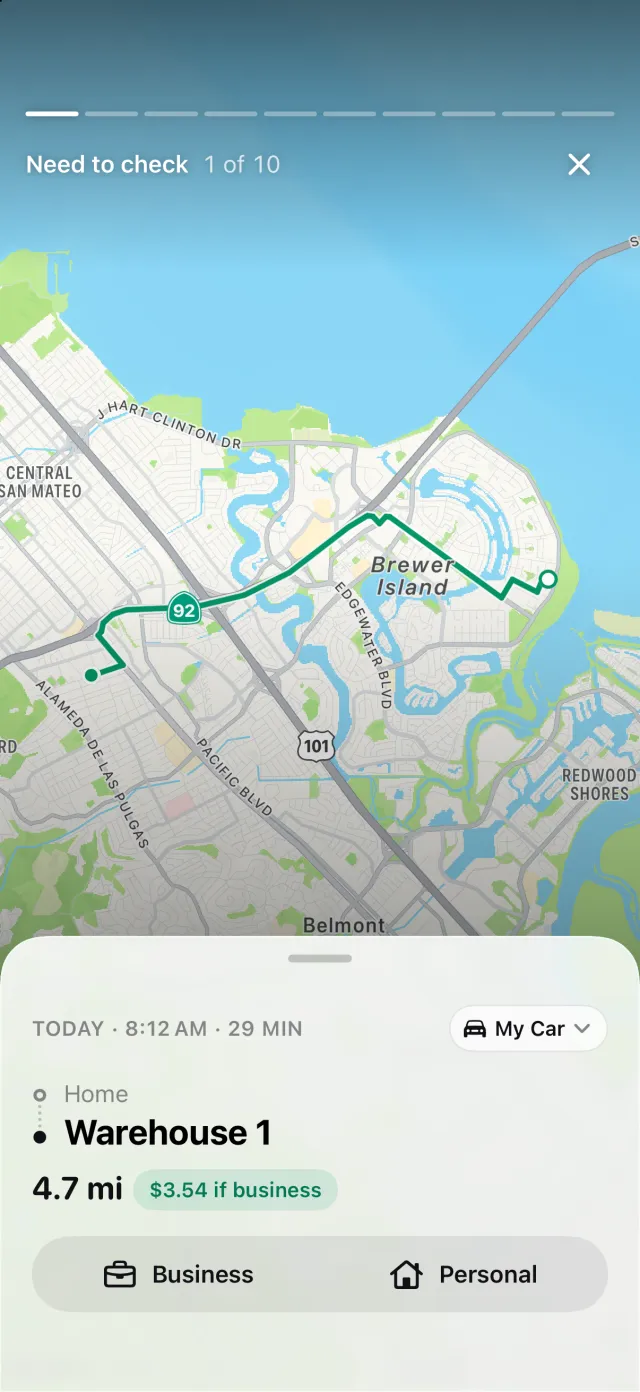
Answer Commute for the drive to work: DriveHub counts it with your Personal kilometres, and in Switzerland it is a private trip. A trip still under Need to check is not in either total, so clear the queue before you read the year.
Reports shows business and personal kilometres for any period, for one vehicle or all. Choose the company car and the year: the Personal figure is the one to multiply by 0.75.
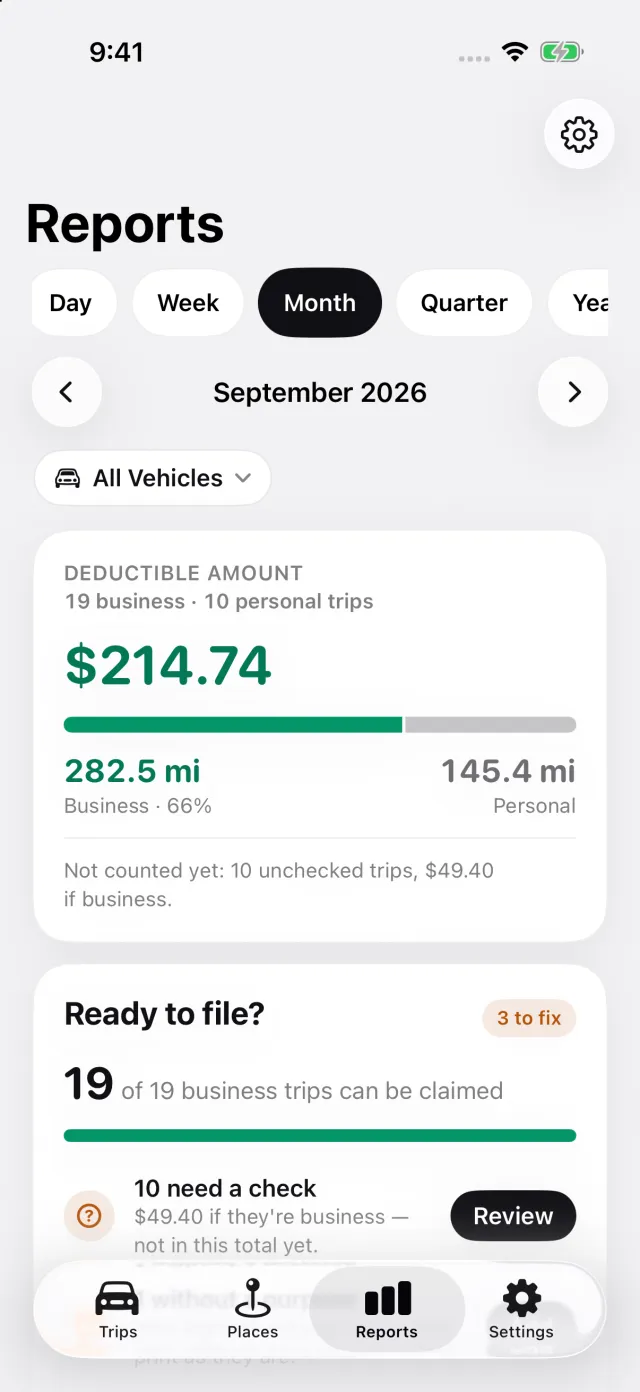
The report prints each trip's date, both addresses, its distance and, for a company car, the person you visited. With the car set up as a company or business-owned car, a report for that one car also prints the first and last odometer readings you entered in the year, each with the date you took it. Take one on 1 January and one on 31 December, the two FAQ 2.2.8 asks for.
Where DriveHub stops: it does not ask for the purchase price, does not compute the Privatanteil or the commute deduction, and fills in no Lohnausweis. If you use your own car for work instead, see your own car for work in Switzerland.
DriveHub is on the App Store for iPhone. The Swiss rules are on the Switzerland page. Setting up automatic tracking takes a few minutes, once.
This page states what the Berufskostenverordnung, the Wegleitung and FAQ zum Lohnausweis and the cantonal tax authorities say, and cites them so you can check. It is not tax advice. It can't account for your circumstances, and in Switzerland your canton is part of your circumstances. Where money is involved, ask your employer's payroll or your Treuhänder — and bring the Bordbuch.
Do it in DriveHub
File business and personal trips →
Review suggestions, set working hours and check place rules.
The full rule for Switzerland, with the instruments it comes from: mileage log requirements in Switzerland.