 DriveHub
Country guide · Switzerland · 7 min
Kilometerentschädigung 2026: 75 Rappen is a tax figure; your costs are the law
You drive your own car for your Swiss employer. The Kilometerentschädigung for 2026 is usually quoted as 75 Rappen per km, but that figure comes from tax practice, not from the Obligationenrecht. The OR makes your employer cover your actual costs, and that duty can't be signed away.

The short answer
- What is the rate for 2026? The figure most often quoted is CHF 0.75 per km, up from 0.70. It is the SSK model expense policy's figure, tied to the federal Berufskostenverordnung.
- Does the law fix 75 Rappen? No. The OR names no per-km figure at all.
- Must my employer pay anything? Yes. OR Art. 327a and 327b make it reimburse the costs of using your own car for work, if you use it with its agreement. That duty cannot be varied to your disadvantage.
- Can it pay less than 75 Rappen? Yes, if a written agreement sets the allowance and the allowance still covers your actual costs. A rate that leaves them uncovered is unlawful.
- Paid less, or nothing? Your first remedy is the claim against your employer. A tax deduction is a fallback, and it needs proof of the car's actual costs, not a rate.
- Is this the commute deduction? No. The federal 0.75 in your tax return is a commute deduction, capped at CHF 3 300. It is a different rule.
Where 75 Rappen comes from
The kilometre rate for business trips in your own (private) car rose from 70 to 75 Rappen for 2026. An employer whose Spesenreglement is already approved may adopt the new figure without reapplying.
The figure comes from the SSK Musterspesenreglement, Ziff. 2.4: "Die Kilometer-Entschädigung beträgt CHF 0.75". The same template says it applies "ausschliesslich für Unselbständigerwerbende", and that it is "für die Wohnsitzkantone der Mitarbeitenden nicht bindend".
The Wegleitung zum Lohnausweis footnotes that figure back to the Berufskostenverordnung (BKV, SR 642.118.1), Anhang Ziff. 2: "Autos pro Fahrkilometer –.75", in force since 1 January 2026 (AS 2025 578). So the employer's 0.75 and the tax 0.75 are linked, not equal by chance. But the BKV figure belongs to the commute deduction, not to business trips. The 75 Rappen is a tax figure that employers adopt. It is not an entitlement under employment law.
What your employer must pay under the OR
The duty to reimburse is in the Obligationenrecht. OR Art. 327a Abs. 1: "Der Arbeitgeber hat dem Arbeitnehmer alle durch die Ausführung der Arbeit notwendig entstehenden Auslagen zu ersetzen".
Art. 327b Abs. 1 covers the car. If you use your own car "im Einverständnis mit dem Arbeitgeber", "so sind ihm die üblichen Aufwendungen für dessen Betrieb und Unterhalt nach Massgabe des Gebrauchs für die Arbeit zu vergüten". Abs. 2 adds "die öffentlichen Abgaben für das Fahrzeug, die Prämien für die Haftpflichtversicherung und eine angemessene Entschädigung für die Abnützung".
Two features matter. The car's costs are owed in proportion to its use for work, so the number of work kilometres drives the claim. And the reimbursement follows your own statement. Art. 327c Abs. 1: "Auf Grund der Abrechnung des Arbeitnehmers ist der Auslagenersatz jeweils zusammen mit dem Lohn auszurichten". The claim starts with your record of what you drove.
Can your contract say you carry the costs?
No. Art. 327a Abs. 3: "Abreden, dass der Arbeitnehmer die notwendigen Auslagen ganz oder teilweise selbst zu tragen habe, sind nichtig."
Art. 362 lists "Artikel 327a: Absatz 1" and "Artikel 327b: Absatz 1" among the provisions that may not be varied "zuungunsten der Arbeitnehmerin oder des Arbeitnehmers". A clause that leaves your car costs with you is void, whatever you signed.
Is less than 75 Rappen lawful?
It can be. What the OR protects is your costs, not a rate.
A fixed allowance is lawful only if it is agreed in writing (or set by a NAV or GAV) and it covers the costs. Art. 327a Abs. 2: "durch die jedoch alle notwendig entstehenden Auslagen gedeckt werden müssen".
So a rate below 75 Rappen is not unlawful in itself. It is unlawful when it leaves your actual costs uncovered. The same test applies to an allowance at 75 Rappen: it is lawful only if it covers your costs.
A worked example. You drive 4 000 work kilometres in 2026.
- At 75 Rappen: 4 000 × 0.75 = CHF 3 000
- At 60 Rappen, as your contract says: 4 000 × 0.60 = CHF 2 400
The CHF 600 difference is not, by itself, what you are owed. The question under Art. 327a Abs. 2 is whether CHF 2 400 covers what those 4 000 kilometres actually cost you to run. Answering it takes two records: the work kilometres, and the car's costs.
Paid less, or nothing: what you can deduct
The tax side is narrower than most guides suggest. No federal or cantonal text read for this page gives an employee a per-kilometre deduction for unreimbursed business trips. The BKV's 0.75 is tied to Art. 5 Abs. 2 Bst. b, the commute.
The route is DBG Art. 26 Abs. 1 Bst. c, "die übrigen für die Ausübung des Berufes erforderlichen Kosten". That item is normally a flat 3 % of net salary, at least CHF 2 000 and at most CHF 4 000 (BKV Anhang Ziff. 1). Art. 26 Abs. 2 leaves "der Nachweis höherer Kosten" open.
Proving higher costs has a price. BKV Art. 4: "so sind die gesamten tatsächlichen Auslagen und deren berufliche Notwendigkeit nachzuweisen". Luzern's Steuerbuch (§ 33 Nr. 3 Ziff. 3.3.2, as of 1 January 2026) recognises actual costs "nur …, wenn diese vollständig nachgewiesen werden". They take the place of the flat deduction: "welche an die Stelle des Pauschalabzugs treten und diesen grundsätzlich ausschliessen".
Whatever your employer did pay comes off. BKV Art. 1 Abs. 2: "Nicht abziehbar sind die vom Arbeitgeber oder einem Dritten übernommenen Aufwendungen".
An example of the threshold. On a net salary of CHF 80 000, the flat deduction is 80 000 × 3 % = CHF 2 400. Claiming actual costs replaces that CHF 2 400. So it only helps if your proven professional costs, the car's unreimbursed share included, come to more.
No text read sets how the car part is valued. Kilometres times the car's actual cost per kilometre is one way to present it, and kilometres times 0.75 is an estimate. Neither is a fixed rule, so "0.75 × km deductible" is not something you can rely on.
Why an unpaid claim can count against you
Not being reimbursed can be read as evidence that you did not drive for work. Graubünden's Praxisfestlegung 031-01-a-01, Ziff. 1: "Der Umstand, dass dem Arbeitnehmer vom Arbeitgeber keine Autospesen entschädigt werden, bildet ein wichtiges Indiz dafür, dass der Privatwagen nicht für geschäftliche Zwecke verwendet wird."
Luzern (Ziff. 4.3.1) runs the other way. Substantial reimbursements create the presumption that they covered the costs, and only proof rebuts it.
Either way, the tax deduction is the weaker remedy. The claim against your employer under OR 327a and 327b comes first. The tax deduction is a fallback that needs a trip record and the car's total costs.
Don't confuse it with the commute deduction
The 75 Rappen in your own tax return is a different rule. BKV Anhang Ziff. 2 sets 0.75 per kilometre for the drive between home and work. It applies only "sofern kein öffentliches Verkehrsmittel zur Verfügung steht oder dessen Benützung objektiv nicht zumutbar ist" (Art. 5 Abs. 2 Bst. b). DBG Art. 26 Abs. 1 Bst. a caps it at CHF 3 300, which binds after 4 400 km.
Many cantons publish their own 0.70 or 0.75 for the commute, often tapering with distance. How to tell that figure from a business rate is in Bordbuch or flat rate in Switzerland. If your employer gives you a car instead of paying for yours, see company car in Switzerland.
How long to keep the record
An employee has no statutory retention period. DBG Art. 126 Abs. 3 names only the self-employed and legal persons. Your practical horizon is the ten-year Nachsteuer window of Art. 152 Abs. 1.
How DriveHub makes this easier
Both remedies start from the same document: which kilometres you drove for work, trip by trip. That is what you hand your employer under Art. 327c, and what a tax assessor asks for if you claim actual costs.
With location access set to Always, DriveHub records every drive in the background — and if it ever misses one, it tells you. It keeps the date, both ends and the distance. DriveHub files most trips as Business or Personal by your places, past routes and working hours, and asks you about the rest. For each business trip you add, in your own words, who you visited or why.
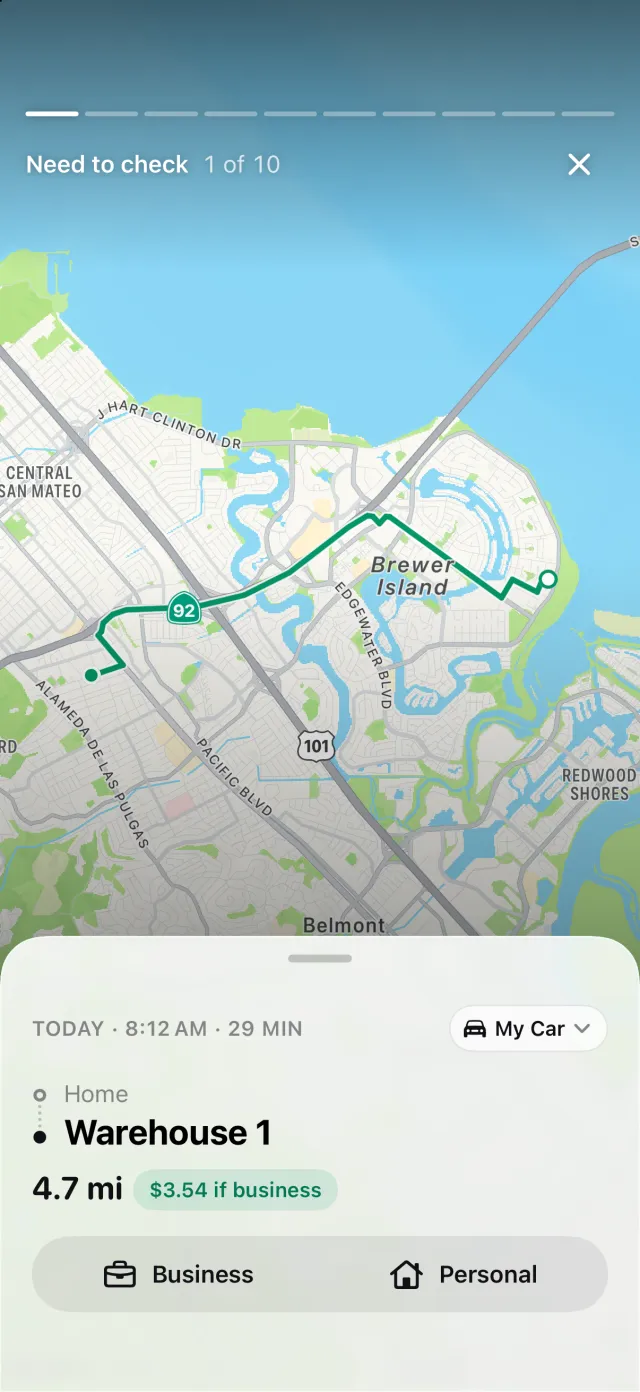
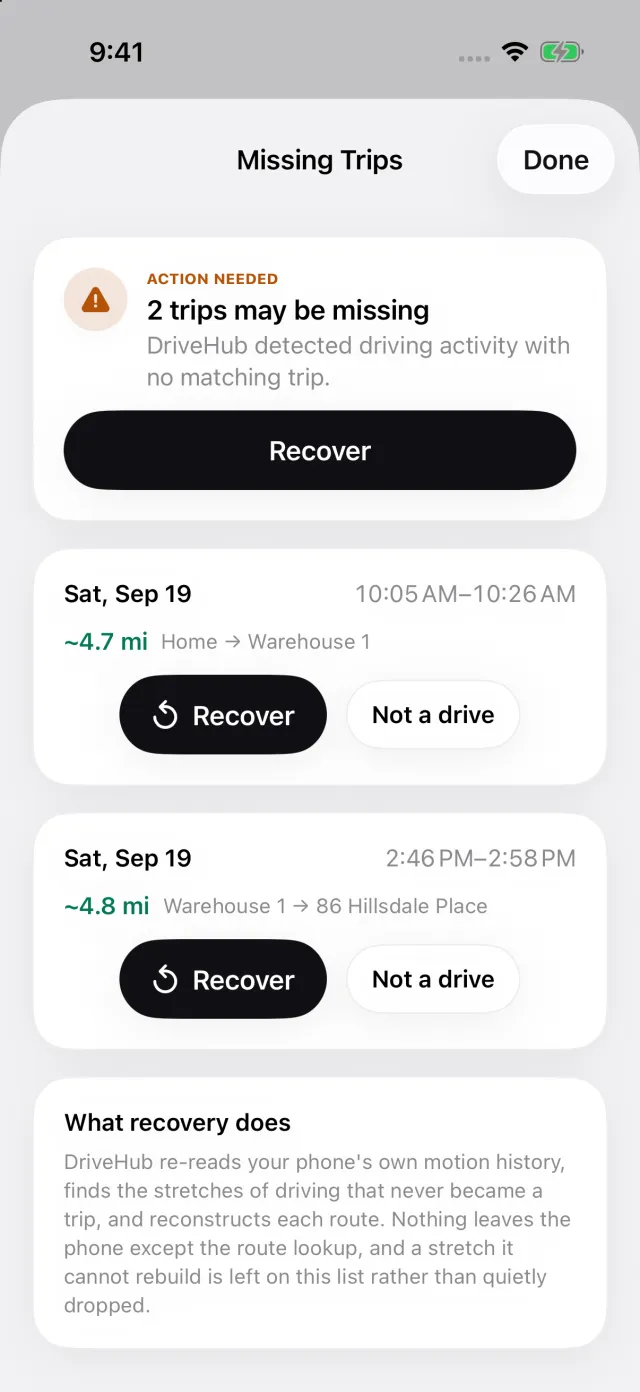
If your iPhone logged driving with no matching trip, a Missed drives story appears under For you at the top of the Trips tab. Recover rebuilds the route before you hand the statement in.
Reports shows business and personal kilometres for a month, a quarter or a year, priced at CHF 0.75, the SSK model figure, or at your employer's own rate if you set a custom rate. The report prints the date, both addresses, the distance and your note for each trip.
Where DriveHub stops: it doesn't know your car's actual costs or what your contract says your employer pays. It doesn't decide whether an allowance covers your costs, and it files nothing with your employer or your canton.
DriveHub is on the App Store for iPhone. The Swiss rules it follows are on the Switzerland page, and setting up automatic tracking takes a few minutes, once.
This page states what the OR, the federal ordinance and the cantonal tax authorities say, and cites them so you can check. It is not legal or tax advice. It can't account for your circumstances, and in Switzerland your canton is part of your circumstances. Where money is involved, ask your employer's HR or payroll team or your Treuhänder — and bring the record.
Do it in DriveHub
Employment dates, different rates and trips for more than one job.
The full rule for Switzerland, with the instruments it comes from: mileage log requirements in Switzerland.