 DriveHub
Country guide · Netherlands
Your employee pays for private use of the company car. What happens to the btw?
A Dutch business that lets an employee drive its car privately for a fee cannot use the ordinary car-VAT calculation. This is the order the Belastingdienst's rule runs in, and what DriveHub asks, works out and prints.

The short answer
When an employee pays an eigen bijdrage for private use of a car that belongs to your business for btw, the question is no longer "how many private kilometres?" but two others. Does the payment cover the costs of the private use? If not, is the btw on it more or less than the 2.7% / 1.5% forfait?
The Belastingdienst says so in its page Btw en privégebruik auto van de zaak, section "Eigen bijdrage werknemers". The same page states that its own calculator for car btw cannot be used when you or your staff pay an own contribution. DriveHub follows the same split: with a contribution, the usual actual-kilometre and forfait results are not produced, and a separate calculation runs. The underlying rules are in the besluit Omzetbelasting. Heffing privégebruik auto en toepassing BUA (Staatscourant 2020, nr. 35053): §2.4 defines the normal value, and §2.4.1 approves the forfait in its place.
It concerns a car classed as a business asset for btw. A sole proprietor cannot pay a contribution to themselves, so the question is about an employee.
The three outcomes
1. The contribution covers the costs. "Cost-covering" counts every cost attributable to private use, both those with btw (fuel, maintenance) and those without (bpm, motorrijtuigenbelasting, insurance, depreciation). You then account for btw on what the employee pays.
2. It does not cover them, and the btw on the payment is higher than the forfait. You still account for btw on the payment. The forfait is not available.
3. It does not cover them, and the btw on the payment is lower than the forfait. The payment is treated as raised to a cost-covering amount and you account for btw on that figure. Or you may choose to report 2.7% or 1.5% of the catalogusprijs (including btw and bpm) in the return for the last period of the year. In both cases you pay no btw on the amounts the employee paid.
The btw inside a payment that includes btw is taken out at 21/121, the method in the Belastingdienst's rekenvoorbeeld btw berekenen.
The forfait, as DriveHub computes it
- 2.7% of the catalogusprijs, or 1.5% when the private use falls more than four years after the year you took the car into use, or when no btw was deducted on purchase.
- Reduced pro rata by the days the car was also available for private use that year.
- Multiplied by your share of taxed turnover.
- Capped at the btw you deducted, after the same turnover share: that year's invoice btw, plus the full purchase btw in the purchase year, or a fifth of it in each of the following four years.
The forfait is only for a car whose administration does not establish private use. DriveHub applies it only when you answer Complete mileage log with No; otherwise the card says the forfait requires a log that does not establish private use.
What DriveHub does not do
- It does not work out the normal value for you. You enter the annual cost of private use, excluding btw, and confirm it includes non-btw costs and depreciation.
- One employee only. With several contributing employees DriveHub withholds the figure, because each payment has to be compared with its own cost.
- No other private use. If the owner or another driver also used the car free of charge, the figure is withheld; that needs a further correction.
- Only a completed year. A 2026 figure is not final before 2027, because October to December can still change it.
- No KOR. With the kleineondernemersregeling there is no input btw deduction and no figure.
- Years 2020 to 2026 only. A later year gets no amount until its rate and car rules have been checked.
- The return box for the btw due. DriveHub prints the deductible amount as box 5b. The btw on what the employee pays, or on its normal value, is btw on a service for payment and goes in rubriek 1a. If you use the 2.7% / 1.5% forfait instead, it goes in rubriek 1d of the last return of the year; the Toelichting bij de btw-aangifte 2026 says of 1d: "Vermeld de btw die u moet betalen over het privégebruik door uzelf of door uw personeel". The btw already reported on the payments in 1a is then reversed. The Belastingdienst does not name the box for the case where a payment below cost is raised to its normal value, so check that one with your accountant. The current version of DriveHub does not yet print the box next to this amount.
Home-to-work travel counts as private use for btw, which matters for the ordinary correction. Here the kilometre log does not set the amount.
How to do it in DriveHub
- Open Reports and choose the full calendar year. A partial period shows distances only.
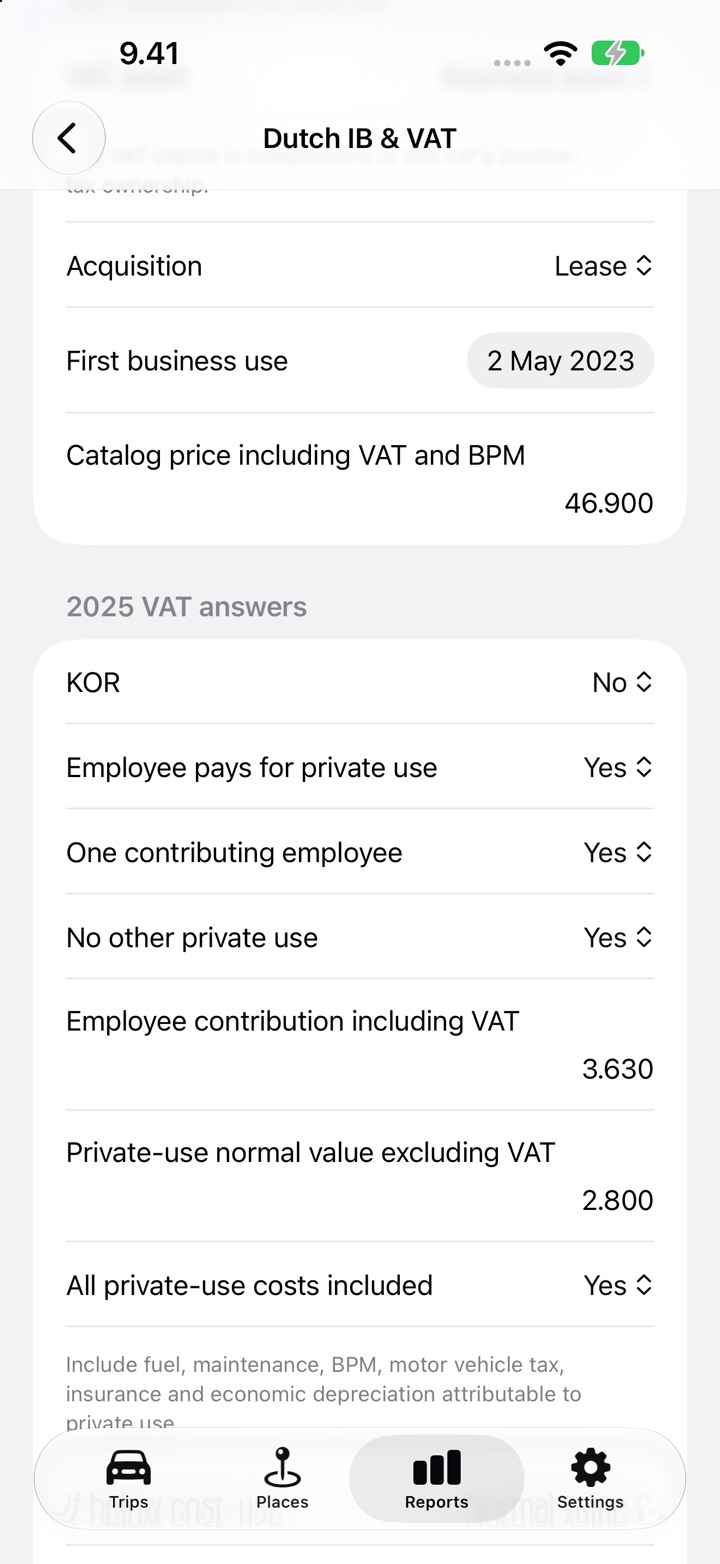
- Find the card Netherlands · IB and VAT and tap Edit car VAT and expenses. The screen is called Dutch IB & VAT.
- Under Calendar year, tap Set up VAT year if the year has no record.
- Under VAT treatment of this car, set VAT asset to Business asset, choose Acquisition, set First business use, and enter Catalog price including VAT and BPM. For a purchase with btw, enter the purchase price excluding btw and the purchase invoice btw.
- Under Car invoices tap Add invoice for every invoice of the year. Record insurance and motor vehicle tax as No VAT, so the annual record is complete.
- In the year's VAT answers set KOR to No and Employee pays for private use to Yes.
- Answer One contributing employee and No other private use. Enter Employee contribution including VAT and Private-use normal value excluding VAT, and set All private-use costs included.
- If the payment is below cost, set If below cost, use to Normal value or Forfait when eligible.
- Enter Taxed turnover share and set All car invoices entered. If the payment is below cost, also enter Days available for private use; for the forfait, set Complete mileage log to No.
What the report shows
Once the year is over and the answers are complete, the card and the PDF and Excel report print:
- VAT deductible (5b)
- Employee payment VAT rate, 21%
- Employee contribution including VAT
- Private-use normal value excluding VAT
- Employee private-use VAT due
- the method: Cost-covering employee contribution, Employee contribution exceeds forfait VAT, Employee contribution · normal value, or Employee contribution · 2.7% forfait or 1.5% forfait
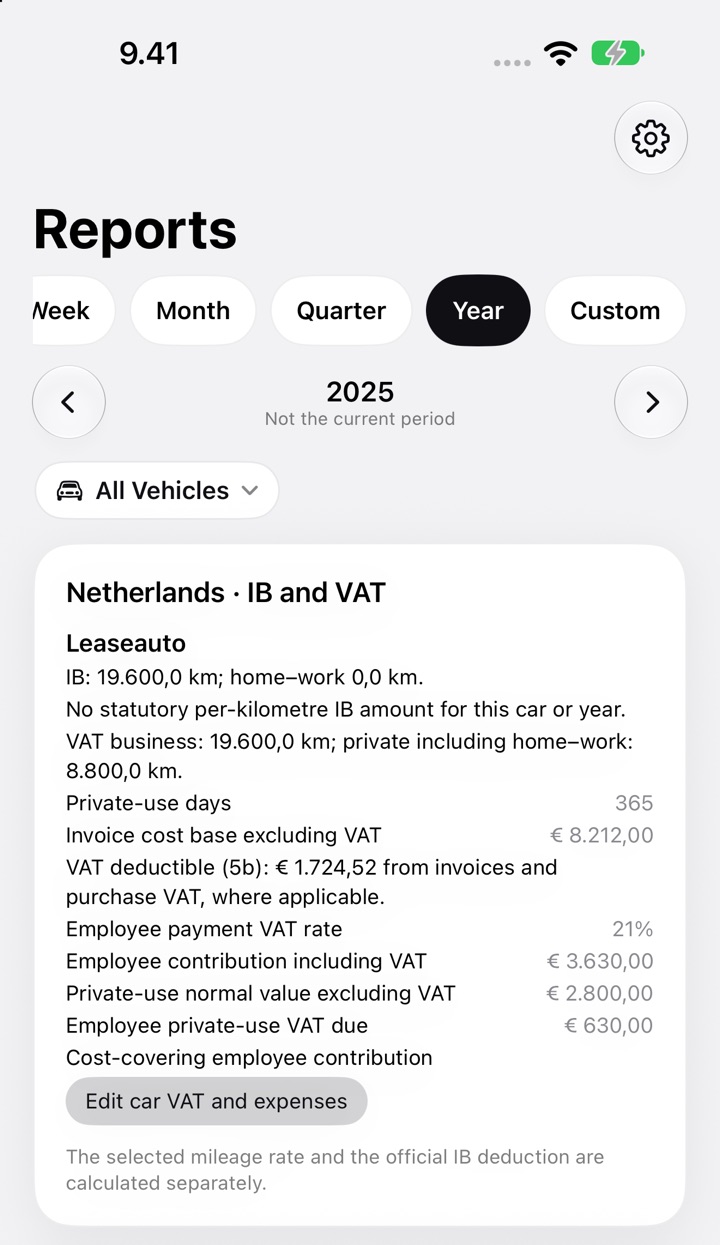
If an answer is missing, the card says VAT: insufficient data and names what to add.
Where to keep reading
The 500 kilometre rule for the same car is a separate test, covered in Auto van de zaak and the 500 km limit. How long to keep the records is in Seven years from when?. The other Dutch rules are on the Netherlands page.
This page states what the Belastingdienst page and the Staatscourant approval say, and names them so you can check. It is not tax advice. It can't account for your circumstances. Where money is involved, ask your belastingadviseur, and bring the administration.
The full rule for Netherlands, with the instruments it comes from: mileage log requirements in the Netherlands.