 DriveHub
Country guide · Spain
VAT on a car in Spain — the 50% presumption for an autónomo, how to prove more, and what it means for IRPF

The short answer
For a passenger car, a motorcycle, a moped, a vehículo mixto or a jeep-type off-roader, Spanish VAT law presumes the vehicle is used 50% for your business. That is Ley del IVA (LIVA) art. 95.Tres, regla 2.ª. You deduct half the IVA on it unless you prove a different share.
It is a presumption, not a cap. If the real share of business use is different, higher or lower, the deduction is corrected to it (regla 3.ª).
This is the Ley del IVA. It does not apply in the Canary Islands, Ceuta or Melilla (art. 3), which have their own indirect taxes.
Where the 50% does not apply
Regla 2.ª presumes 100% for six kinds of vehicle:
- mixed vehicles used to carry goods
- vehicles used to carry passengers for payment
- vehicles used to teach driving or piloting for payment
- vehicles a manufacturer uses for tests, trials, demonstrations or sales promotion
- vehicles used by representantes o agentes comerciales on their professional journeys
- vehicles used in servicios de vigilancia
Two cases get nothing at all. A car that is not in your accounts or official business registers, or that is not part of your business assets, is not business-used in any proportion (art. 95.Dos 3.º and 4.º, applied by regla 5.ª).
Proving a different share
Regla 4.ª says the degree of business use must be proved "por cualquier medio de prueba admitido en derecho". It then says what is not enough: your filed declaración-liquidación, or booking the car in your official registers.
A log of business trips against the odometer is evidence of the kind regla 4.ª allows. It is evidence, not a decision: the tax office weighs it.
Changing your mind later: regularización
If you deducted at one share on purchase and later prove another, regla 3.ª sends you to the bienes de inversión procedure:
- Art. 107.Uno: the deduction is regularised during the four calendar years after the year of purchase. If the car only goes into use later, it is that year and the four following. A year counts only where its final percentage differs from the one applied at purchase by more than ten points.
- Art. 109: the deduction you made on purchase, minus the deduction the year's percentage would give, is divided by five. The result is what you pay back, or deduct extra, for that year.
- Art. 107.Siete: the adjustment goes in the last return of the calendar year.
- Art. 108.Dos 5.º: an asset bought for less than 500 000 pesetas (3 005,06 €) is not a bien de inversión, so this procedure does not reach it.
Running costs follow the same rules
Art. 95.Cuatro applies the same rules, the 50% presumption included, to the VAT on parts and accessories, fuel and other energy, parking and tolls, and repairs. DriveHub's printed note adds that the tax office treats the business use of these costs as a separate question you must prove. It cites the tax office's binding reply DGT V0088-25 for that.
The IRPF side: a different test
Income tax does not borrow the VAT presumption. Under the Reglamento del IRPF art. 22, an asset used for both business and private needs is not afecto to the activity (22.2). An indivisible asset cannot be partly business (22.3). The exception for minor private use outside working hours does not cover passenger cars or motorcycles (22.4), except for five kinds of vehicle. These include mixed vehicles carrying goods and a commercial agent's car. Where the car does qualify, you deduct its actual costs.
No per-kilometre figure is deductible for an autónomo. The 0,26 €/km is what an employer may pay an employee tax-free under the common regime (Reglamento del IRPF art. 9.A.2.b, the figure raised to 0,26 by Orden HFP/792/2023). The Basque Country and Navarre have their own income-tax rules and figures. See who must prove the journey, and the other Spanish rules on the Spain page.
So VAT may let you deduct 50% of a car that, for IRPF, you cannot treat as business at all. The two answers can differ.
What DriveHub asks, computes and prints
The Car VAT screen is for a VAT-registered business. It works on one calendar year, and for Spain covers 2023 to 2026. An employee gets no figure.
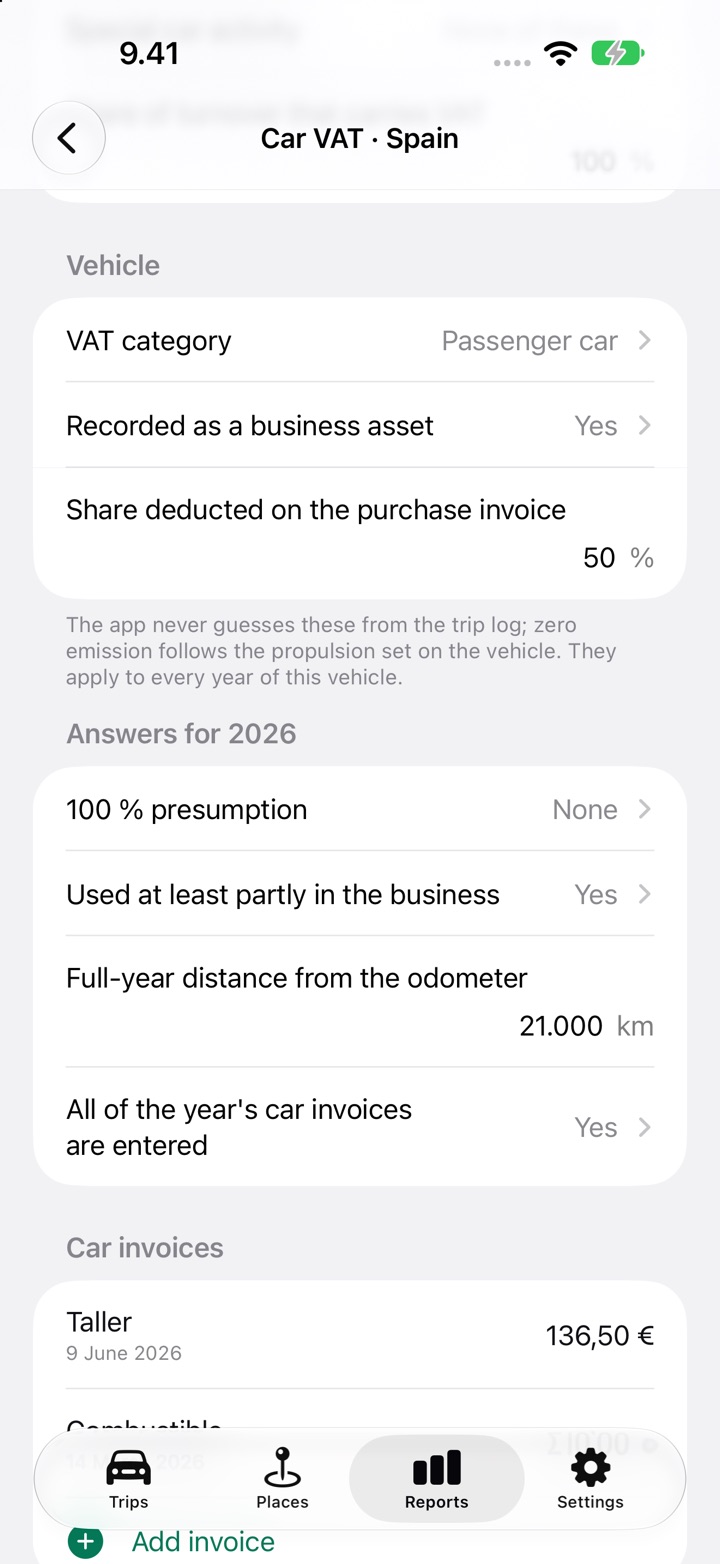
For Spain it asks:
- VAT registration, with an option for Simplified scheme or equivalence surcharge. Choosing that option gives no figure, because DriveHub does not calculate those schemes.
- Special car activity, and Share of turnover that carries VAT. Any special activity, or a share below 100%, gives no figure. Passenger transport, driving schools and demonstration cars are answered here, so DriveHub gives no figure for three of the six 100% cases.
- The VAT category: passenger car, motorcycle, mixed vehicle, off-roader or other commercial vehicle. For Other commercial vehicle it gives no figure and says general input VAT rules apply.
- Recorded as a business asset and Used at least partly in the business. Answering No to either gives No deduction, citing art. 95.Dos and 95.Tres.5.ª.
- 100 % presumption: None, Mixed vehicle carrying goods, Commercial agent or representative or Surveillance. These are the other three of the six cases.
- Full-year distance from the odometer, and Share deducted on the purchase invoice.
- All of the year's car invoices are entered, and each invoice with its date and VAT. With no invoice carrying VAT in the year, there is no figure.
With None it prints, side by side, the share presumed by law (50%) with the VAT it gives, and the logged business share (reviewed business trips over the odometer distance) with the VAT it gives. It never names either as "the" deduction. Commute and personal trips never count as business. With one of the 100% answers it prints only the 100% figure.
A Regularisation illustration, per year appears when all of these hold:
- you entered a vehicle purchase invoice of at least 3 005,06 € before VAT
- you entered the share you deducted on it
- the logged share can be worked out
- the report's year is one of the four after the year of purchase
If the gap is ten points or less, it says there is no regularisation. It does not handle a car that went into use after the year it was bought.
What it does not do:
- It does not decide your deduction. The logged share is evidence for regla 4.ª, and the printed note says so.
- It gives no logged figure while any trip is unreviewed, or if the odometer figure is missing or below the business distance. The presumed figure still appears.
- It does not calculate IRPF. For an autónomo with their own car it shows no per-kilometre amount.
- The regularisation is an illustration, not a figure for your return.
How to do it in DriveHub
- Open Reports and choose a full calendar year. For one car, tap Set up car VAT on its Car VAT card. On the all-vehicles report, tap Set up next to the car in the Car VAT card. Both read Edit once the year has answers.
- Under Business, set VAT registration and Share of turnover that carries VAT. Set Special car activity to None of these.
- Under Vehicle, choose the VAT category, answer Recorded as a business asset, and enter Share deducted on the purchase invoice if you bought the car in one of the four years before the report's year.
- Under Answers for 2026, answer 100 % presumption, Used at least partly in the business and Full-year distance from the odometer.
- Under Car invoices, add each invoice of the year. For the regularisation illustration, also add the purchase invoice as Vehicle purchase, with its own date. Then go back to Answers for 2026 and turn on All of the year's car invoices are entered.
- Review every trip of the year, then read the Estimate at the bottom and take it to your asesor.
This page states what the Ley del IVA and the Reglamento del IRPF themselves say, citing the articles so you can check. It is not tax advice. It can't account for your circumstances. Where money is involved, ask your asesor — and bring the records.
The full rule for Spain, with the instruments it comes from: mileage log requirements in Spain.