 DriveHub
Country guide · South Africa
Subsistence allowance in South Africa — R595 or R184 a day, and only with a night away

One question decides whether the deemed amount exists
If your employer pays you a subsistence allowance for a business trip inside South Africa, SARS does not ask you to prove what you spent on food. It deems an amount, and your deduction is that deemed amount, never more than the allowance you were paid. The deemed amount applies only if you were obliged to spend at least one night away from your usual place of residence on business, with the accommodation in South Africa. Interpretation Note 14 reads a night as one full period from sunset to sunrise.
With no night away, there is no deemed amount at all and the allowance is taxable. That is the reason a day trip, however long, produces a different answer from a trip with one night away.
The deduction is in section 8(1)(a)(i)(bb) of the Income Tax Act 1962. The daily amounts are set each year by the Commissioner's notice under section 8(1)(c)(ii). DriveHub follows that notice and SARS's own guidance: the page Subsistence allowances and advances, the employer guide PAYE-GEN-01-G03 for the 2027 tax year, and Interpretation Note 14 (Issue 5).
The deemed amount is one of two methods. The other is the actual method: you keep receipts and claim what you prove you spent, again never more than the allowance. DriveHub works out only the deemed amount.
The two deemed amounts
For each day or part of a day away, the deemed amount depends on what your allowance is meant to cover:
- R595 a day, where the allowance covers meals and incidental costs.
- R184 a day, where it covers incidental costs only.
Those are the figures in the Commissioner's notice of February 2026, for the 2027 year of assessment, which runs from 1 March 2026 to 28 February 2027. For 2026 they were R570 and R176. DriveHub also holds the earlier years back to 2022, because a trip is priced by the year each day falls in. A trip that crosses the end of February uses two rates.
A day counts if the journey touches it. There is no apportioning of a part day (SARS: "a part of a day could be an hour, a half-hour or even a minute"), so leaving at 18:00 and returning at 07:00 two days later is three days. A journey ending at exactly midnight does not touch the next day.
What reduces it
Meals your employer paid or reimbursed come off the deemed amount. DriveHub subtracts them once from the trip total, not day by day, and floors the result at zero. The deduction is then the smaller of two numbers: the allowance you received, and the deemed amount left after those meals.
Accommodation has no deemed amount. If your employer also paid an accommodation allowance, only costs you can prove count, and the part of the allowance above your proven cost is shown as taxable.
The part-day exception
A trip with no night away can still have a tax-free meal reimbursement, under section 8(1)(a)(ii). All of these must hold: your duties took you away from your usual place of work for part of a day, your employer allowed the meal expense, and you proved it to your employer and accounted for it. DriveHub then treats as tax-free the smallest of the reimbursement, the expense you proved, and the incidentals-only figure for that year (R184 in 2027). Anything above is taxable. The deemed R595 does not apply here. DriveHub uses the cap of the year the trip starts in.
How to do it in DriveHub
The calculator is for a South African employee or office holder. Interpretation Note 14 says an independent contractor is not an employee in the sense of section 8(1) and "is not entitled to any deduction under that section". If you choose Self-employed on a journey, DriveHub prints "Self-employed persons and independent contractors do not use the deemed subsistence amounts." and calculates nothing. If your logbook is set up as self-employed with your own car, the per-diem card does not appear at all.
- Open Reports. In a South African report you will see the card Per diems · South Africa. Tap Set up per diems.
- If you have marked your home place, DriveHub lists trips from your log under Suggested from your log, with a guess at the nights, for example "Probably 2 nights away". Tap Review journey, or Not a business journey to hide it. Otherwise use Add a journey by hand.
- Under You are, choose Employed. Check the start and end times, because the log records when the car moved, not when you left.
- Under Nights, enter Nights away. While the field is empty, DriveHub shows its own count from the times, and a button such as Use 2 nights accepts it. Count only nights you actually stayed away.
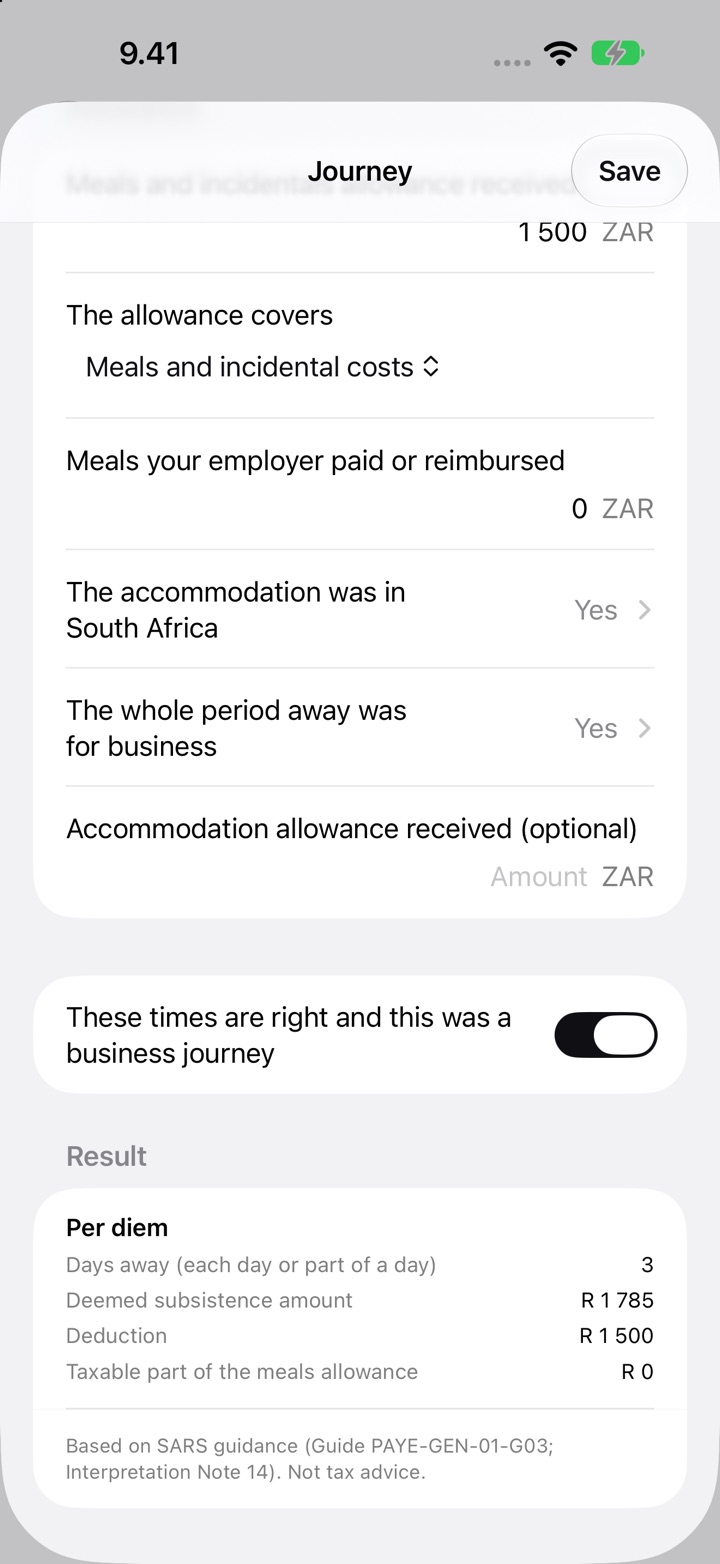
- Under Allowance, enter the Meals and incidentals allowance received, or zero. With a night away, also set The allowance covers to Meals and incidental costs or Incidental costs only, enter Meals your employer paid or reimbursed, and answer The accommodation was in South Africa and The whole period away was for business. If your employer also paid an accommodation allowance, enter it under Accommodation allowance received (optional) and then the Accommodation cost you can prove.
- With zero nights, a section Part-day away from your usual place of work appears. Enter the Meal reimbursement for this day (optional), then the Meal expense you can prove and whether Your employer permitted the expense.
- Switch on These times are right and this was a business journey, then tap Save.
The Rates and rules line on the setup screen shows the rates and the 2026 comparison. An unanswered question is never counted as zero: the journey says "Insufficient data — no amount is stated." and lists what is missing.
What the report shows
Per journey with a night away: Days away (each day or part of a day), Deemed subsistence amount, Deemed amount after meals your employer paid (only if you entered some), Deduction and Taxable part of the meals allowance. A journey without a night away shows the whole allowance as Taxable part of the meals allowance, plus Part-day reimbursement, tax-free and Part-day reimbursement, taxable if you entered one. Taxable part of the accommodation allowance appears when you entered an accommodation allowance. Whole rand print without cents. The footer reads "Based on SARS guidance (Guide PAYE-GEN-01-G03; Interpretation Note 14). Not tax advice." The card on Reports adds up the amounts over the report period.
What DriveHub does not do
- Accommodation outside South Africa. Answering No to the South African accommodation question gives "Accommodation outside South Africa is not supported."
- A trip that was partly personal. Answering No to "the whole period away was for business" blocks the figure until you enter the business part as its own journey.
- The actual method. DriveHub does not total receipts for meals and incidentals.
- Days from 1 March 2027. The 2028 year of assessment starts then, and no rate is held for it yet, so the journey states that the rates have not been added yet instead of guessing.
- Overlapping journeys. Two confirmed journeys that overlap, or share a logged trip, block each other, because one absence earns one allowance.
- Payroll. No PAYE and no IRP5 codes. It does not decide what your employer should have withheld, and it does not compute your tax. It states a deduction and the taxable part of the allowance.
A travel allowance for your car is a separate rule with its own logbook: see the 1 March odometer reading. Everything else about South Africa is at /help/za.
This page states what SARS's guidance and the Income Tax Act say, and names them so you can check. It is not tax advice. It can't account for your circumstances. Where money is involved, ask your tax practitioner, and bring the dates and the proof.
The full rule for South Africa, with the instruments it comes from: mileage log requirements in South Africa.