 DriveHub
Country guide · Slovenia · 5 min
A plug-in hybrid is not electric: its boniteta is 1,5 % now and after 2030
Your employer gave you a plug-in hybrid as a službeni avto, and someone said the boniteta is zero because it charges from a socket. It is not. The zero is for fully electric cars only. A hybrid pays the ordinary 1,5 % of its purchase value a month, and the one thing that can halve it is a month with under 500 private kilometres.

The short answer
- Is a hybrid company car's boniteta zero in Slovenia? No. The zero value for tax years 2025 to 2029 covers only a car on electric drive. FURS says the relief applies "samo na električna osebna vozila … ne pa tudi na hibridna vozila".
- What does a hybrid pay instead? The general rule in ZDoh-2 43. člen (2): 1,5 % of the car's purchase value a month, added to your tax base whatever you actually drove privately.
- Does that change in 2030? Not for a hybrid. The 0,75 % rate that starts in 2030 is for fully electric cars only. A hybrid stays at 1,5 %.
- Can it be lower? Yes, in two ways the same paragraph sets out. The value falls with the car's age, and it is halved in any month with under 500 private kilometres.
- Can it be higher? Yes. It is raised by 25 % where the employer also provides the fuel. A month that is both halved and fuelled comes to 0,9375 %.
- What do you need for the halving? A record of your private kilometres, month by month, with the drive between home and work counted as private. Without one, the full 1,5 % stands.
The zero is written for electric cars, and FURS says so
The relief comes from the amending act, ZDoh-2AB, 22. člen:
"Ne glede na novi deveti odstavek 43. člena zakona je vrednost bonitete, če delodajalec zagotovi osebno motorno vozilo na električni pogon za privatne namene, za davčna leta 2025 do 2029 enaka nič."
The test is "na električni pogon" — electric drive. FURS reads it narrowly: the relief "se nanaša samo na električna osebna vozila … ne pa tudi na hibridna vozila". Electric only, not hybrids. A plug-in hybrid charges from the mains and also burns fuel, so it sits with petrol and diesel cars for the boniteta.
From tax year 2030 the electric car's zero ends. FURS: "Za davčna leta 2030 in naprej pa se odpravlja vrednost bonitete nič." ZDoh-2 43(9) then values the electric car at 0,75 % of its purchase value a month. That paragraph is written for a car "na električni pogon" and nothing else. 43(2), the 1,5 % rule, applies to every company car "razen vozila iz devetega odstavka tega člena", so only the electric car leaves it. A plug-in hybrid pays 1,5 % now and still pays 1,5 % from 2030. The lower rate does not reach it.
What a hybrid pays: 1,5 % a month, whatever you drove
ZDoh-2 43. člen (2) values the private use of a company car this way:
"se ne glede na dejansko uporabo vozila za privatne namene … v davčno osnovo delojemalca všteva 1,5 % nabavne vrednosti vozila mesečno"
Ne glede na dejansko uporabo — regardless of actual use. The charge does not grow with private driving. It is a flat monthly share of the car's purchase value, and it goes into your tax base as income. The figure is not the tax itself; your tax is worked out on a base that includes it.
The same paragraph reduces the purchase value as the car ages, halves it in any month with under 500 private km, and raises the result by 25 % where the employer provides the fuel. How each of these works for any company car is in boniteta for a službeni avto in Slovenia. What matters for a hybrid is that all of them apply to it, through 43(2), and that two of them can meet in one month.
Halving and fuel in the same month
Both the halving and the fuel uplift apply to a hybrid exactly as to a petrol car: a month under 500 private km with employer fuel is 0,9375 % of the value, against 1,875 % in a fuelled month of 500 km or more. How the halving, the fuel uplift and the commute interact is in the 500 km rule for a službeni avto.
A worked example
A plug-in hybrid with a purchase value of €50 000, in its first year, the employer not paying for private fuel:
| Month | Base | Boniteta added to your tax base |
|---|---|---|
| 600 private km | 1,5 % × €50 000 | €750 |
| 420 private km | 1,5 % × €50 000 ÷ 2 | €375 |
If seven months of the year stay under 500 private km and five do not, the year adds 7 × €375 + 5 × €750 = €6 375 to your tax base, against 12 × €750 = €9 000 with no halving. The months under 500 km take €2 625 off it.
If the employer also pays for private fuel, a full month is €750 + 25 % = €937,50, and a month under 500 private km is €375 + 25 % = €468,75 (0,9375 % × €50 000).
The same car in its sixth year is valued on 35 % of €50 000, or €17 500 (the age table is in the general article). That makes €262,50 a month, or €131,25 in a month under 500 private km.
A fully electric car of the same price adds €0 in every month of 2025 to 2029, however far it is driven privately.
The halving is where a record comes in
For a hybrid driver this is the only lever the law offers, now and after 2030. An electric driver has no reason to count until 2030, when the halving starts to apply to the 0,75 %. What the record should show, and why the commute counts as private, is in the 500 km rule for a službeni avto.
Before you rely on the halving
- Check what your car is: fully electric cars are at zero for 2025 to 2029; plug-in and other hybrids are not.
- Know the car's purchase value and which year of its life it is in.
- Know whether your employer provides fuel for private driving.
- Keep your private kilometres by calendar month, the commute included, and see which months stayed under 500.
- Using your own car for business trips instead? That is kilometrina on a potni nalog — see kilometrina and the potni nalog in Slovenia.
How DriveHub makes this easier
The halving turns on one figure per month: how far the car was driven privately.
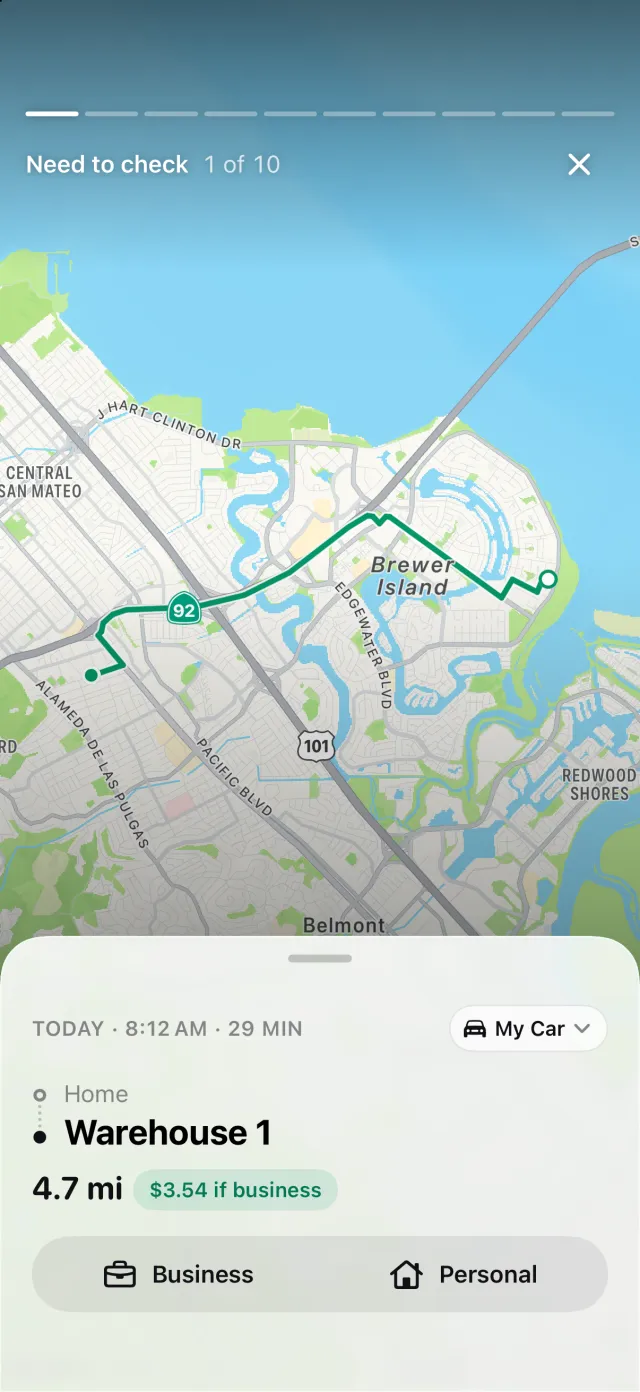
With location access set to Always, DriveHub records every drive in the background — and if it ever misses one, it tells you. Rules on places, your past drives on the same route and your working hours file many trips as Business or Personal. The rest wait under Need to check, one trip at a time.
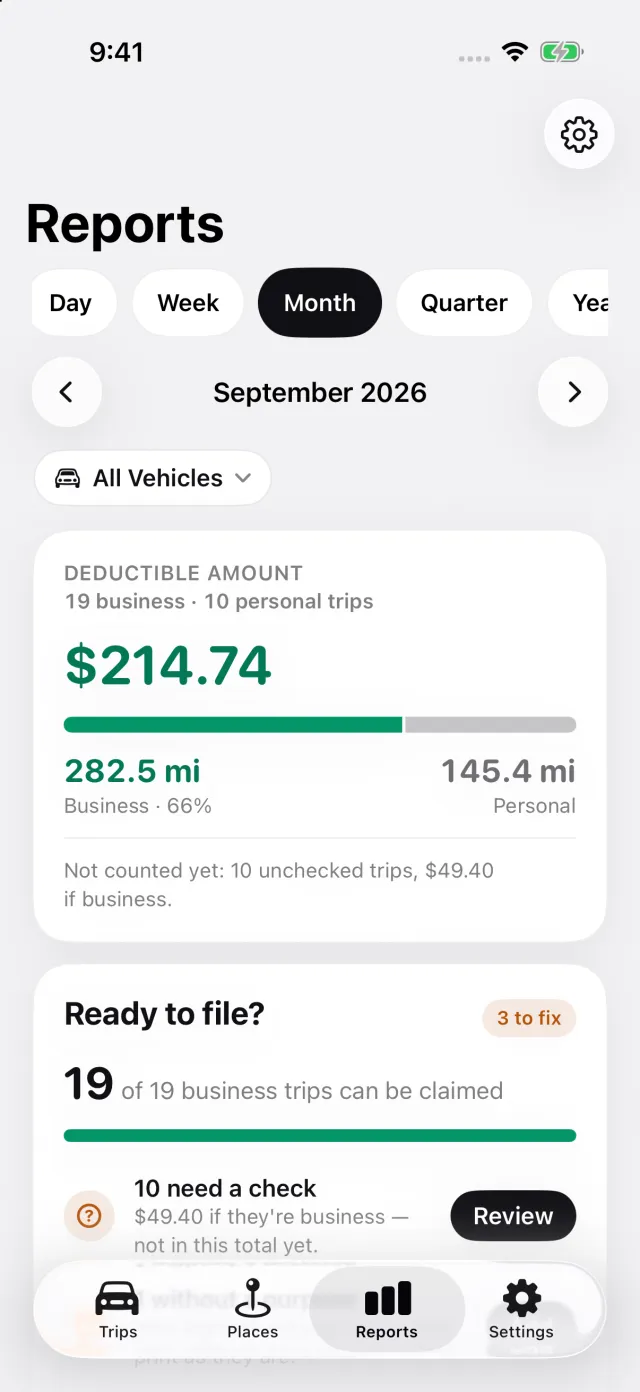
Reports shows business and personal kilometres for any month, for one vehicle or all.
For a Slovenian company car, the exported report about that one car adds Private driving by month: the private distance in each calendar month, with the finished months under 500 km marked. A month that is not over by the end of the report is not marked. For a fully electric car the block waits for 2030, because before then there is nothing to halve.
To get it:
- In Settings, open Vehicles and then the car. Under Whose car is this?, choose Company car, I pay for fuel or Company car, fuel included. Under Fuel, choose Plug-in hybrid, or Petrol, diesel or hybrid for a hybrid that cannot be plugged in.
- Where DriveHub asks, answer Personal for a private trip in the car and Commute for the drive to work; both count as private. If a private trip was filed as Business, change it. A trip still under Need to check is not settled and may sit on the wrong side, so clear them before you rely on a month's figure.
- Open Reports, tap the vehicle filter and choose the company car: the block is printed only for a report about one car. Export the report; exporting needs DriveHub Pro.
Where DriveHub stops: it does not ask for the purchase value or the car's age, does not compute the boniteta, and does not know whether the fuel your employer provides covers private driving. It sends nothing to your employer.
DriveHub is on the App Store for iPhone. The Slovenian rules are on the Slovenia page. Setting up automatic tracking takes a few minutes, once.
This page states what ZDoh-2, ZDoh-2AB and FURS say, and names the article so you can check. It is not tax advice. It can't account for your circumstances. Where money is involved, ask your računovodja or your employer's payroll — and bring the monthly kilometres.
Do it in DriveHub
File business and personal trips →
Review suggestions, set working hours and check place rules.
The full rule for Slovenia, with the instruments it comes from: mileage log requirements in Slovenia.