 DriveHub
Country guide · Slovenia · 7 min
Boniteta on a službeni avto: 1,5 % a month, halved in any month under 500 private km
Your employer lets you take the službeni avto home, and your payslip now carries a boniteta of 1,5 % of the car's value every month. The law halves it in any month with under 500 private kilometres. The commute counts as private, nothing says what form the record must take, and without one the full 1,5 % stands.

The short answer
- What is the boniteta on a company car? ZDoh-2 43. člen (2) adds 1,5 % of the car's purchase value a month to your tax base when your employer lets you use the car privately. It applies whatever you actually drove.
- When is it halved? In any calendar month in which you drive the car fewer than 500 kilometres privately.
- Does the commute count? Yes. FURS counts the drive between home and the workplace as private use, so it counts toward the 500 km.
- What if the employer pays for fuel? The base rises by 25 %. Both rules can apply in one month: a halved month with fuel is 0,9375 % of the value, against 1,875 % in a fuelled month of 500 km or more (and 1,5 % without fuel).
- What proves the halving? A record of your private kilometres, month by month. No form is prescribed, and nothing says who keeps it.
- Electric car? Zero for tax years 2025 to 2029. A hybrid is not electric — see boniteta on a hybrid službeni avto.
1,5 % of the car's value a month, whatever you drove
The rule is one paragraph of the income-tax act. ZDoh-2 43. člen (2):
"se ne glede na dejansko uporabo vozila za privatne namene…v davčno osnovo delojemalca všteva 1,5 % nabavne vrednosti vozila mesečno"
Ne glede na dejansko uporabo — regardless of actual use. There is no per-kilometre element. Apart from the 500 km halving below, a month with one weekend trip costs the same as a month of daily private driving. The amount goes into your tax base as income. It is not the tax itself.
FURS puts it the same way: the charge "se obračuna v pavšalnem znesku in se za namen določitve bonitete ne ugotavlja ali je delojemalec vsak dan v mesecu vozilo tudi dejansko koristil." A flat sum, without asking whether you used the car every day.
The purchase value also falls with the car's age. 43(2):
"Nabavna vrednost vozila … se v drugem letu zniža za 15% in v naslednjih letih do vključno četrtega leta še vsako leto za 15%, v petem letu se zniža še za 10% in v naslednjih letih do vključno osmega leta še vsako leto za 10%, v vseh naslednjih letih je enaka 10%."
| Year of the car's life | Share of the purchase price used |
|---|---|
| 1st | 100 % |
| 2nd | 85 % |
| 3rd | 70 % |
| 4th | 55 % |
| 5th | 45 % |
| 6th | 35 % |
| 7th | 25 % |
| 8th | 15 % |
| 9th and later | 10 % |
Every started month counts in full
The charge runs "za vsak začeti koledarski mesec uporabe vozila" (43(2)) — for each started calendar month. A car you get on the 25th is charged for that whole month, not pro rata.
If you have the right to two cars in one month, for example "tudi v primeru zamenjave vozila sredi meseca" (also when the car is swapped mid-month), FURS charges the boniteta "za vsako vozilo posebej, in sicer v celotnem znesku" — for each car separately, in full.
The 500 km test runs per calendar month as well. Whether it runs per car in a month with two cars, neither the act nor FURS says.
The halving under 500 private km
The same paragraph contains the one reduction that depends on your driving. 43(2):
"Če delojemalec mesečno prevozi manj kot 500 km v privatne namene, se nabavna vrednost, ugotovljena na način določen v prejšnjem stavku, zmanjša za 50%."
If you drive fewer than 500 km privately in a month, the value used in the formula is halved. Each month stands on its own. A month over the line costs the full amount and does not affect the months around it.
FURS restates the rule with a bracket that matters: "Davčna osnova se zmanjša za 50 %, če delojemalec mesečno prevozi manj kot 500 km v privatne namene (pomembno je vodenje ustreznih evidenc)." Keeping proper records is important. FURS also says why, even though the charge is flat: "Podatek o dejanski rabi vozila je pomemben za namen morebitnega zmanjšanja davčne osnove." Data on actual use matters for a possible reduction of the base.
Your commute counts toward the 500 km
This is where most drivers under-count. FURS defines the private use that triggers the boniteta as "zasebne poti, prav tako prevoz od doma do mesta opravljanja dela" — private trips, and also the drive from home to the workplace.
So home-to-work kilometres are private kilometres. They count toward the 500, not against them.
The arithmetic is quick to run. Live 12 km from work and drive in on 20 days, and the commute alone is 12 × 2 × 20 = 480 km. One 60 km trip at the weekend takes the month to 540 km, and the halving is gone.
A company car brings one more effect on the commute. If your employer also provides fuel for private use, any reimbursement for travel to work is taxed in full (Uredba 3. člen (5)). The commute allowance itself is explained in prevoz na delo in Slovenia.
When the employer pays for fuel: 0,9375 %
43(2) has a fuel sentence too: "Če delodajalec zagotovi gorivo za privatno uporabo vozila, se davčna osnova mesečno poveča za 25%."
The halving and the fuel uplift act on different things. The halving reduces the purchase value. The fuel sentence raises the tax base. Neither excludes the other, and FURS keeps both with no exception. So in one month:
- 500 private km or more, with fuel: 1,5 % × 125 % = 1,875 % of the value.
- Under 500 private km, with fuel: 1,5 % × 50 % × 125 % = 0,9375 % of the value.
The order does not matter, because both steps are multiplications.
A worked example
A petrol company car bought for €32 000, now in its third year, so it is valued at 70 %: €22 400.
| Month | Without employer fuel | With employer fuel |
|---|---|---|
| 500 private km or more | 1,5 % × €22 400 = €336 | €336 × 1,25 = €420 |
| Under 500 private km | €336 ÷ 2 = €168 | €168 × 1,25 = €210 |
The fuel column matches the percentages above: 1,875 % of €22 400 is €420, and 0,9375 % is €210.
Over a year without employer fuel, say eight months stay under 500 private km and four do not. That adds 8 × €168 + 4 × €336 = €1 344 + €1 344 = €2 688 to your tax base. With no record of any month, it would be 12 × €336 = €4 032. The record is worth €1 344 of tax base that year.
What proves the halving
The statute makes the halving depend on a fact — fewer than 500 private km — and asks for no document. FURS says records matter, but neither ZDoh-2 nor FURS prescribes a form or lists fields for the private-km record.
Where FURS describes car records elsewhere, it asks for "verodostojno izkazovanje stroškov v zvezi s službenim vozilom", and for a fuel split, one that is "pregledna in dokumentirana z verodostojnimi dokazili", with business kilometres "dokumentirane s potnimi nalogi". So what the text supports is a record of each month's private kilometres, kept in a form someone can check against the business trips on your potni nalogi. Nothing more specific is written down.
Nor does anything say who keeps it. The boniteta is charged on your payslip by your employer. Agree with payroll how your monthly private kilometres reach them, and keep your own copy.
Electric, hybrid, and your own s.p.
- Fully electric: the boniteta is zero for tax years 2025 to 2029 (ZDoh-2AB 22. člen). From 2030 it is 0,75 % a month, with the same age decline and the same halving under 500 km, and no fuel uplift (43(9)).
- Hybrid, including plug-in: not electric for this rule. It pays the 1,5 % now and from 2030. The details are in boniteta on a hybrid službeni avto.
- A car in your own s.p.: no boniteta on yourself. A sole trader is not their own employee, so private use is handled by disallowing the private share of the car's costs instead. See a car on your s.p..
Before you rely on the halving
- Know the car's purchase value and which year of its life it is in.
- Know whether your employer provides fuel for private driving.
- Count your commute as private kilometres.
- Keep your private kilometres by calendar month, and see which months stayed under 500.
- Agree with payroll how the monthly figure reaches them.
How DriveHub makes this easier
The halving turns on one figure per month: how far the car was driven privately, commute included.
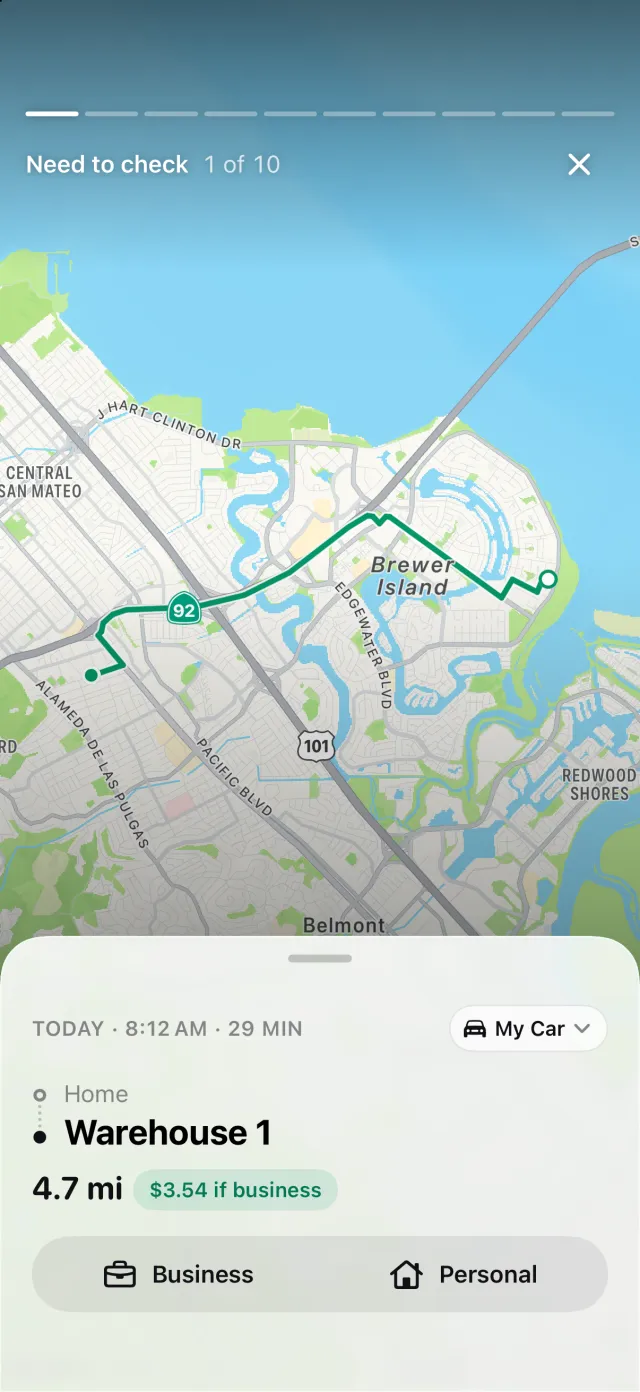
With location access set to Always, DriveHub records every drive in the background — and if it ever misses one, it tells you. Rules on places, your past drives on the same route and your working hours file many trips as Business or Personal. The rest wait under Need to check, one trip at a time.
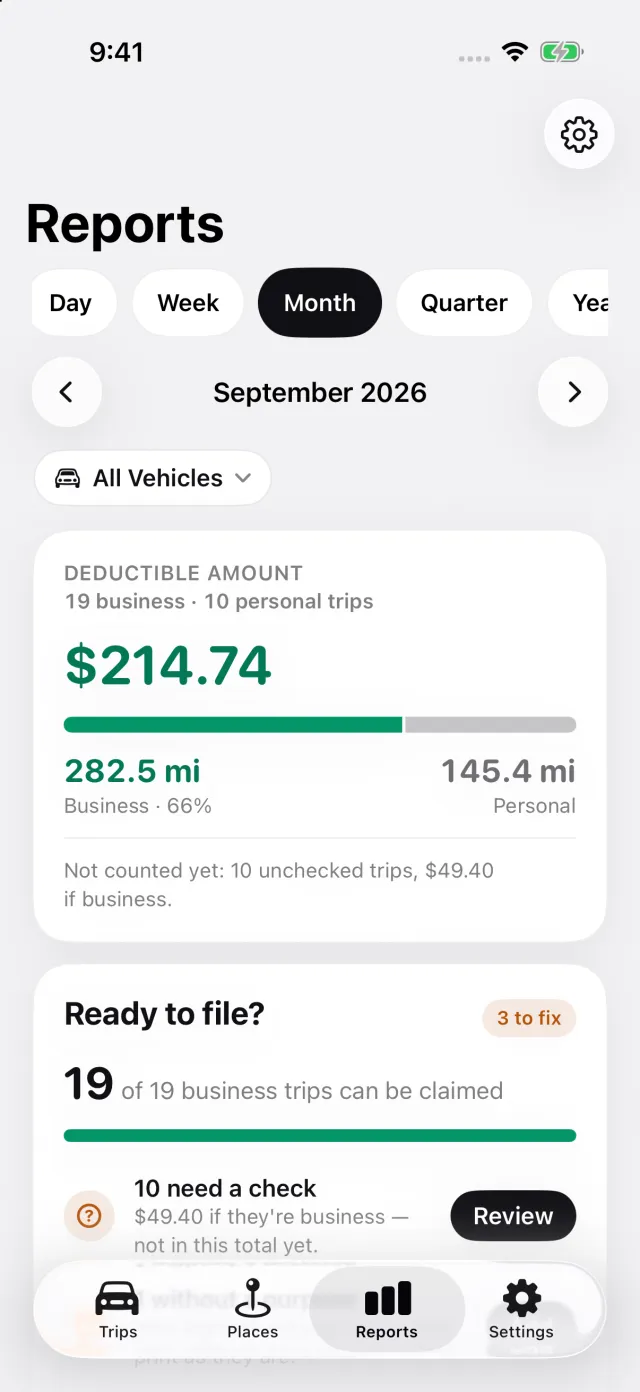
Reports shows business and personal kilometres for any month, for one vehicle or all.
For a Slovenian company car, the exported report about that one car adds Private driving by month: the private distance in each calendar month, with the finished months under 500 km marked. A month that is not over by the end of the report is not marked.
To get it:
- In Settings, open Vehicles and then the car. Under Whose car is this?, choose Company car, I pay for fuel or Company car, fuel included. Under Fuel, choose what the car runs on. For an electric car the block appears from 2030, when the boniteta stops being zero.
- Where DriveHub asks, answer Personal for a private trip in the car and Commute for the drive to work; both count as private. If a private trip was filed as Business, change it. A trip still under Need to check is not settled and may sit on the wrong side, so clear them before you rely on a month's figure.
- Open Reports, tap the vehicle filter and choose the company car: the block is printed only for a report about one car. Export the report; exporting needs DriveHub Pro.
Where DriveHub stops: it does not ask for the purchase value or the car's age, does not compute the boniteta, and sends nothing to your employer.
DriveHub is on the App Store for iPhone. The Slovenian rules are on the Slovenia page. Setting up automatic tracking takes a few minutes, once.
This page states what ZDoh-2, ZDoh-2AB, the Uredba and FURS say, and names the article so you can check. It is not tax advice. It can't account for your circumstances. Where money is involved, ask your računovodja or your employer's payroll — and bring the monthly kilometres.
Do it in DriveHub
File business and personal trips →
Review suggestions, set working hours and check place rules.
The full rule for Slovenia, with the instruments it comes from: mileage log requirements in Slovenia.