 DriveHub
Country guide · Slovenia · 6 min
Prevoz na delo in Slovenia: 0,21 €/km, a €140 floor, and when it is taxed
You drive your own car to work, and your payslip shows a line for prevoz na delo. One article of one Uredba sets how much stays out of tax: 0,21 € a full kilometre, there and back, per day at work, and at least €140 in any month you worked. Anything your employer pays above that is taxed.

The short answer
- What is tax-free? Up to 0,21 € per full kilometre of the distance between home and work, for each day you were present at work. Uredba o davčni obravnavi povračil stroškov in drugih dohodkov iz delovnega razmerja, 3. člen (1).
- Is it one way or both? Both. FURS computes a home 3 km away as "6 km x 20 dni x 0,21 eur".
- Is there a minimum? Yes. If the computed figure for a month is below €140, €140 is exempt instead, provided you were at work at least one day that month and live at least 1 km away (3. člen (1)–(2), as FURS reads them).
- When is it taxed? Only the part your employer pays above the larger of those two figures. A home under 1 km away: the whole payment is taxed.
- Company car with fuel paid by the employer? Then the whole commute payment is taxed, not just an excess (3. člen (5)).
- Do you have to prove there is no bus? Not for tax. The Uredba has no public-transport condition.
The rule: 0,21 € for each full kilometre, each day you are there
Uredba 3. člen (1) exempts the commute payment "…do višine 0,21 eura za vsak polni kilometer razdalje med običajnim prebivališčem in mestom opravljanja dela za vsak dan prisotnosti na delu, če je mesto opravljanja dela vsaj en kilometer oddaljeno od delojemalčevega običajnega prebivališča."
Three things in that sentence decide the figure:
- Full kilometres. The rate is per polni kilometer of the distance.
- Days present. It counts dan prisotnosti na delu, the days you were actually at work, not the days in the month.
- At least 1 km. Below that, nothing is exempt: FURS says the reimbursement "se delojemalcu … v celoti všteva v davčno osnovo", it is taxed in full.
FURS takes the distance there and back. Its example for a home 3 km away is "6 km x 20 dni x 0,21 eur", and a home 50 km away is "100 km x 20 dni".
The €140 floor, even for one day at work
3. člen (2): "Če je znesek, izračunan po prejšnjem odstavku za posamezni mesec nižji od 140,00 eurov, se … ne všteva povračilo stroškov prevoza na delo in z dela v višini 140 eurov mesečno."
FURS adds that the €140 applies "ne glede na število dni prisotnosti na delu", regardless of how many days you were at work. It sets two conditions only: "da je delavec na delu prisoten vsaj en dan v mesecu", and that home is at least 1 km from work.
It also holds "ne glede na to ali delojemalec prejme povračilo iz naslova kilometrine, zneska javnega prevoza, nakupa vozovnice". Whether your employer pays you per kilometre, a bus fare or a ticket, the floor is the same.
Which home, and which road
The home nearest to work. 3. člen (3): "Običajno prebivališče po tej uredbi je prebivališče delojemalca, ki je najbližje mestu opravljanja dela." A second home counts only "če se delojemalec od tam vsaj štirikrat tedensko vozi na mesto opravljanja dela": at least four times a week.
The shortest usual road, not the fastest. 3. člen (4): "…se upoštevajo najkrajše običajne cestne povezave." FURS: what counts is "dolžina v kilometrih in ne čas". A shorter local road sets the distance "četudi zaposleni koristi avtocestno povezavo", even if you take the motorway.
Your employer sets it. FURS says fixing and checking the distance "je v prvi vrsti v pristojnosti delodajalca", for example from "izjave delojemalca s podatki o razdalji": your statement of the distance.
When the payment is taxed
The exempt amount each month is the larger of the computed 0,21 € figure and the €140 floor. Whatever is paid above it goes into your tax base. Each month is worked out on its own.
FURS's own example: a home 50 km away, so 100 km a day there and back, and 6 days at work. 100 × 6 × 0,21 = €126, below the floor, so €140 is exempt. Of a €179 payment, "razlika … (39 eur) pa bi se vštela v davčno osnovo": €39 is taxed.
The same commute over 9 days gives 100 × 9 × 0,21 = €189. Now the exempt amount is €189, and the €179 payment is wholly tax-free.
A worked example
Two drivers, each with home and work measured on the shortest usual road:
| Driver A | Driver B | |
|---|---|---|
| Distance, one way | 12 km | 30 km |
| There and back | 24 km | 60 km |
| Days at work this month | 18 | 20 |
| 0,21 € × km × days | 24 × 18 × 0,21 = €90,72 | 60 × 20 × 0,21 = €252,00 |
| Exempt this month | €140,00 (the floor) | €252,00 |
| Employer pays €160 | €20,00 taxed | nothing taxed |
| Employer pays €280 | €140,00 taxed | €28,00 taxed |
Driver A is below the floor, so €140 is the line in any month of up to 27 days at work (at 28 days, 24 × 28 × 0,21 = €141,12). Driver B is above it, so every extra day at work raises the exempt amount by 60 × 0,21 = €12,60.
The company car exception
3. člen (5): "Če ima delojemalec pravico do uporabe službenega vozila za privatne namene in mu delodajalec za tako uporabo službenega vozila zagotovi tudi gorivo, se povračilo stroškov za prevoz na delo všteva v davčno osnovo".
Here the whole commute payment is taxed, not just the part above the limit. The trigger is both together: a company car you may use privately, and fuel the employer provides for that use.
A company car also carries its own boniteta, and the commute counts as private use there. FURS defines private use as "zasebne poti, prav tako prevoz od doma do mesta opravljanja dela". So the drive to work adds to the 500 private kilometres that decide whether the boniteta is halved. That is set out in the company car and the 500 km rule.
What the Uredba does not decide
Whether you are paid at all. The Uredba sets a tax ceiling, not an entitlement. FURS: "Uredba pa ne določa pravic in obveznosti delodajalcev in delojemalcev … Te pravice so določene v delovnopravnih predpisih, veljavnih kolektivnih pogodbah … ali pa v pogodbi o zaposlitvi". What your employer must pay comes from labour law, your collective agreement or your contract.
Whether a bus exists. There is no public-transport condition in the Uredba, so the 0,21 € does not depend on one. Where such a condition applies, it comes from labour law.
Commute or business trip: 0,21 € or 0,43 €
A drive between two of your workplaces on the same day is still commute under 3. člen. A drive on a potni nalog, for example to a meeting, is a business journey, reimbursed tax-free in your own car up to 0,43 €/km (FURS §1.2.3). That rule, and the order it needs, is in kilometrina and the potni nalog in Slovenia.
Two rates, two kinds of drive, and a record of each drive is what keeps them apart.
If you are self-employed
A sole trader reaches the same rule by cross-reference. ZDoh-2 57. člen point 3 names "stroški prevoza na delo in z dela", recognised on the Uredba's conditions. As with kilometrina, only a filer deducting actual expenses gets any use from it. A normiranec, on the flat statutory percentage, has no line for it.
Before your next payslip
- Measure home to work on the shortest usual road, from the home nearest to work.
- Double it for the way back.
- Count the days you were at work this month.
- Multiply by 0,21 €. If the result is under €140, you were at work at least one day and home is at least 1 km away, the line is €140. Under 1 km, nothing is exempt.
- Compare it with what your employer pays. Only the excess is taxed, unless you have a company car with employer-paid fuel.
- Keep business trips on a potni nalog apart from the commute.
How DriveHub helps, and where it stops
The commute payment is worked out from a fixed distance and a count of days, not from a log. So most of it is between you and payroll, and DriveHub does not compute it. It does not know the shortest-road distance the Uredba uses; a recorded drive follows the road you actually took. It does not know which days you were at work, only which days you drove.
Where it helps is the line between commute and business. With location access set to Always, DriveHub records every drive in the background — and if it ever misses one, it tells you. DriveHub files most trips as Business or Personal by your places, past routes and working hours, and asks you about the rest under Need to check, one trip at a time. There you can also answer Commute. Whether a drive is a commute is for you and your payroll to decide, not DriveHub.
Where DriveHub asks, answer Commute for the drive from home to work and Business for the trip to the client. If a commute was filed as Business by your working hours, change it. Reports then shows each month's business and personal kilometres apart, with commutes on the personal side, so the commute stays out of the business total that a potni nalog claim is made from.
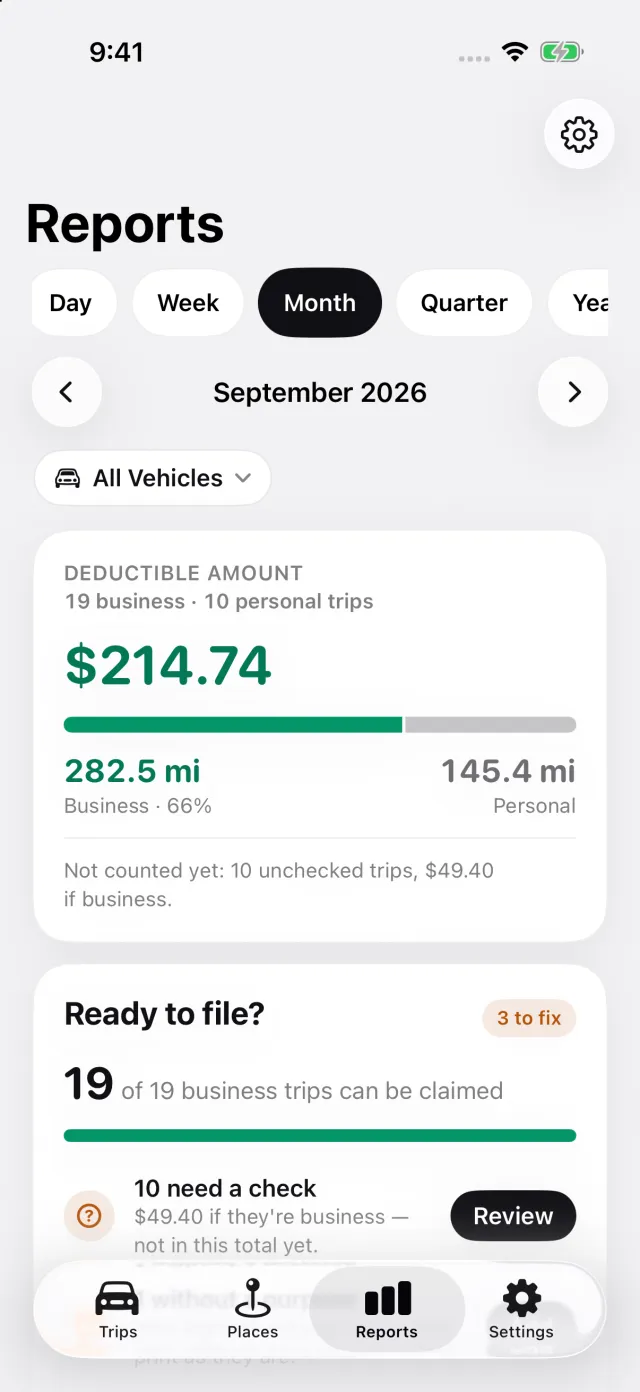
For a company car, the same Personal and Commute answers are what count toward its 500 private kilometres a month.
DriveHub is on the App Store for iPhone. The Slovenian rules are on the Slovenia page. Setting up automatic tracking takes a few minutes, once.
This page states what the Uredba, ZDoh-2 and FURS say, and names the article so you can check. It is not tax advice. It can't account for your circumstances. Where money is involved, ask your računovodja or your employer's payroll — and bring the distance and the days.
Do it in DriveHub
Mark a drive to work as Commute →
Commute is a third answer beside Business and Personal. See where to give it and what it changes.
The full rule for Slovenia, with the instruments it comes from: mileage log requirements in Slovenia.