 DriveHub
Country guide · Australia · 8 min
Does my ute need a logbook? Not if it carries a tonne or more
You bought a ute for work, and everyone has a different answer about the logbook. Over a tonne, none is required, but that isn't the whole answer. It turns on one number most owners have never worked out: how much load the ute is designed to carry.

The short answer
- Does your ute need a logbook? Not if it is designed to carry 1 tonne or more, but you must still show how you worked out the work share. Under 1 tonne, only the logbook method needs one; cents per kilometre doesn't.
- Designed to carry 1 tonne or more: the ute is not a "car" for income tax. The cents per kilometre method, the logbook method and the 5,000 km cap do not apply to it.
- You claim the work share of what it actually costs, as a general deduction under s 8-1 of the Income Tax Assessment Act 1997.
- No logbook, but evidence. The ATO calls a document similar to a logbook the easiest way to show your work-related use. You must keep evidence of how you calculated it.
- Designed to carry less than 1 tonne: it is a car, and Division 28 applies. That means 91 cents per km for 2026-27, up to 5,000 km, with no logbook, or the logbook method with a 12-week log book.
- Carrying capacity is gross vehicle weight minus kerb weight, by the ATO's own formula.
- An employer-provided ute is a question for fringe benefits tax, with an exemption on both sides of the tonne where private use is limited.
What the Act means by "car"
The definition is in the dictionary section of the Act, s 995-1(1): "car means a motor vehicle (except a motor cycle or similar vehicle) designed to carry a load of less than 1 tonne and fewer than 9 passengers." A "motor vehicle" is "any motor-powered road vehicle (including a 4 wheel drive vehicle)".
So a vehicle stops being a car when it reaches either limit: a load of 1 tonne, or 9 passengers. The ATO's page on vehicles that aren't cars names both. It lists vehicles with "one tonne or greater carrying capacity such as trucks, heavy vehicles and some utes", and those with "a carrying capacity of 9 or more passengers (including the driver), such as a minibus".
Why this matters: everything most Australians know about claiming a vehicle sits in Division 28, and Division 28 is about car expenses. s 28-13(1): "A car expense is a loss or outgoing to do with a car". A ute outside the definition is outside both methods, the 5,000 km cap and the log book, all at once.
Does my ute carry a tonne?
The Act says "designed to carry a load". The ATO gives the arithmetic, on its fringe benefits tax page Exempt use of eligible vehicles:
"You can use the following formula to calculate the carrying capacity of a vehicle: Maximum loaded vehicle weight (or gross vehicle weight, which is typically shown on the compliance plate…). Less: Unladen vehicle weight (or basic kerb weight, which is the weight of the vehicle with a full capacity of lubricant, coolant and fuel together with spare wheel, tools (including jack) and installed options, but excluding the weight of goods or occupants)."
In short: gross vehicle weight minus kerb weight. The formula is on an FBT page, but the FBT Act borrows the same definition of "car" (s 136(1)).
A worked example, with illustrative figures. Take a ute with a gross vehicle weight of 3,200 kg on its compliance plate.
| Ute A | Ute B | |
|---|---|---|
| Gross vehicle weight | 3,200 kg | 3,200 kg |
| Less kerb weight | 2,150 kg | 2,300 kg |
| Carrying capacity | 1,050 kg | 900 kg |
| A "car"? | No: 1 tonne or more | Yes: less than 1 tonne |
The ATO says only "some utes" reach a tonne, and its kerb weight counts installed options. So work it out from the figures for your exact variant, not from a model name. Use the gross vehicle weight on its compliance plate and the kerb weight for that variant as built. "Dual cab" or "one-tonner" on a brochure settles nothing. The number does.
Under one tonne: it's a car, and Division 28 applies
A ute designed to carry less than 1 tonne is a car like any sedan, and you choose between the two Division 28 methods.
Cents per kilometre. 91 cents per kilometre for 2026-27, for the first 5,000 business kilometres per car; s 28-25(2) says "you must discard the kilometres in excess of 5,000". It needs no log book, only a record of how you worked out your work kilometres.
The logbook method. Actual costs multiplied by your business-use percentage, taken from a log book kept for a continuous period of at least 12 weeks. The logbook method in detail covers what each entry must hold.
Which of the two suits you, and when you can change your mind, is its own question: cents per kilometre or the logbook method.
Over a tonne: how do I claim it?
Without Division 28, the claim falls back to the general deduction in s 8-1(1): "any loss or outgoing to the extent that: (a) it is incurred in gaining or producing your assessable income". And s 8-1(2)(b) excludes it "to the extent that… it is a loss or outgoing of a private or domestic nature".
"To the extent that" is the whole method. You add up what the ute actually costs and claim the share that is work. The ATO calls this "a work-related travel expense, rather than a work-related car expense".
What the ATO says about records. Quoted in full, because this is the sentence people paraphrase wrongly in both directions:
"You can't use the cents per kilometre method or the logbook method to work out your claim. However, as you can only claim a deduction for the expenses related to your work-related travel, you may wish to keep a document similar to a logbook to calculate your work-related use percentage. While it is not a requirement, it is the easiest way to show how you calculated the expenses related to your work-related travel."
So "no logbook needed" is true, and incomplete. The same page lists what you must keep:
- "evidence of how you calculated your work-related use of the vehicle"
- "original receipts for all of your vehicle expenses"
- "details of how you work out your claim for the decline in value of the vehicle"
The first item is the one a logbook would have answered. Without one, you still need something that shows how you got to your percentage.
The ATO's own worked example
The ATO's page works a claim for Ben, whose vehicle is a motorcycle, which s 995-1 also excludes from "car". Ben keeps "a record, similar to a logbook" over "the 12 week period he kept his record of trips":
- Work-related kilometres in the 12 weeks: 600 of 800
- Work-related use: 600 ÷ 800 = 75%
- Vehicle expenses: $3,600
- Claim: $3,600 × 75% = $2,700
A one-tonne ute runs through the same arithmetic. With illustrative figures: 3,900 work kilometres out of 6,000 over twelve weeks is 65%. Against $9,800 of running costs and decline in value for the year, that is a claim of $6,370.
Paper, a spreadsheet and an app can all produce that record. Four ways to keep a mileage log compares them.
If your employer provides the ute
Then the question is fringe benefits tax. The one-tonne line decides which exemption applies, but the limited-private-use test is the same on both sides of it.
A ute designed to carry 1 tonne or more isn't a car, so providing it is a residual benefit, exempt under FBTAA s 47(6). One designed to carry less is a car, exempt under s 8(2) if it is "(i) a panel van or utility truck, designed to carry a load of less than 1 tonne", or "(ii) any other road vehicle designed to carry a load of less than 1 tonne (other than a vehicle designed for the principal purpose of carrying passengers)".
Both sections then require that "there was no private use… other than: (i) work-related travel of the employee; and (ii) other private use… that was minor, infrequent and irregular". Work-related travel includes travel between the employee's home and place of employment (s 136(1)).
On dual cabs, the ATO's page lists "a dual cab ute that is designed to… carry a load of less than 1 tonne but is not designed for the principal purpose of carrying passengers". On records: "You don't have to keep special records to be eligible for the exemption. However, you must be able to demonstrate that the use of the vehicle at all times meets the limited private use conditions."
PCG 2018/3 is the ATO's practical line, for cars and residual benefits alike. Among its other conditions, an employer may rely on it where "any diversion adds no more than two kilometres" to home–work travel. Wholly private journeys must stay within 1,000 kilometres in total in the FBT year, with no return journey over 200 kilometres. Where it applies, para 7(a) says the employer does "not need to keep records" showing the private use was minor, infrequent and irregular.
How DriveHub makes this easier
For a ute over a tonne, the ATO asks for one thing a receipt can't give you: evidence of how you calculated the work share. That comes from a record of your drives, not only the ones you remembered to write down.
With location access set to Always, DriveHub records every drive in the background — and if it ever misses one, it tells you. Each trip carries the date, the start and end, and the distance. Afterwards you mark it Business or Personal, and add the purpose in your own words.
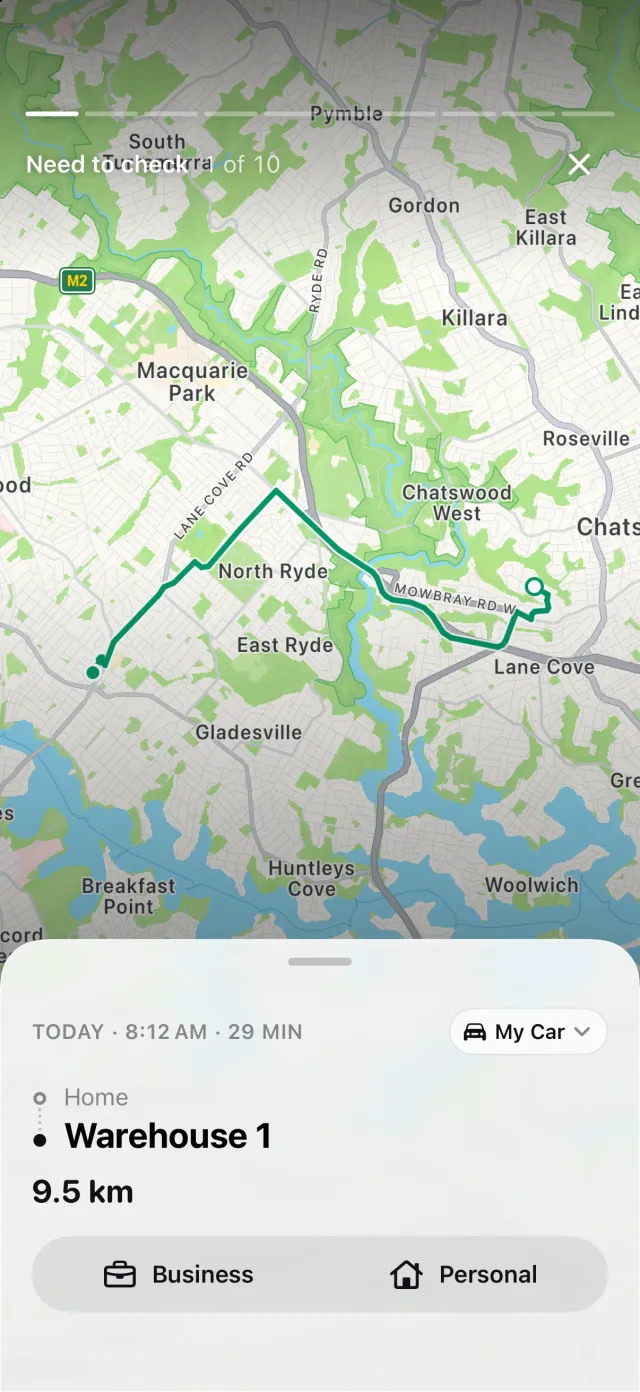
If your iPhone logged driving with no matching trip, a Missed drives story appears on the Trips tab. It opens Missing Trips, where Recover rebuilds the route. The report gives the business and personal kilometres and the business percentage for the period you pick. For an Australian, "Year" means 1 July to 30 June. It exports as PDF, or Excel or CSV for your accountant.
One thing plainly. DriveHub's Australian report is laid out for Division 28's log book. For a ute that isn't a car, you can ignore its odometer readings and car details: the Act asks for none of them. Its deductible amount is worked out at a per-kilometre rate, which a ute over a tonne can't use. Take the business percentage instead, and apply it to what the ute actually cost.
DriveHub is on the App Store for iPhone. The Australian rules it follows are on the Australia page, and setting up automatic tracking takes a few minutes, once.
This page states what the Income Tax Assessment Act 1997, the Fringe Benefits Tax Assessment Act 1986 and the ATO say, and cites them so you can check. It is not tax advice. It can't account for your circumstances. Where money is involved, ask your tax agent — and bring the records.
The full rule for Australia, with the instruments it comes from: mileage log requirements in Australia.