 DriveHub
Country guide · France · 8 min
Frais réels, domicile–travail over 40 km: what you can deduct
On frais réels, France lets you deduct the domicile–travail commute. The first 40 km of each leg count by right. Beyond 40 km, the extra kilometres count only with a reason the tax office accepts, set out in a note explicative.

The short answer
If you opt for frais réels, the drive from home to work (the trajet domicile–travail) is a professional expense in France. Whether that pays, and how much of it counts, comes down to five points:
- Frais réels replace the automatic 10 % deduction, so they pay only when your real costs are higher. For 2025 income that deduction is at least €509 and at most €14,555 (CGI art. 83, 3°).
- Up to 40 km each way, by right. You do not have to explain why you live where you do. You do still have to justify the kilometres and the costs.
- Beyond 40 km, only with a reason. The reason has to be a circonstance particulière, typically linked to your job or your family, not personal convenience. You explain it in a note explicative on your return.
- Without a reason, the claim is cut to the first 40 km: on the barème, 80 km × the number of days you drove to work.
- One return trip a day. A second one, such as going home for lunch, needs its own justification.
What the law says
The rule is in CGI art. 83, 3°:
"Les frais de déplacement de moins de quarante kilomètres entre le domicile et le lieu de travail sont admis, sur justificatifs, au titre des frais professionnels réels. Lorsque la distance est supérieure, la déduction admise porte sur les quarante premiers kilomètres, sauf circonstances particulières notamment liées à l'emploi justifiant une prise en compte complète."
Three things are in that sentence. The limit is 40 km between home and work, so it applies to each leg, not to the day. Below it, the costs are admitted "sur justificatifs". Above it, you keep the first 40 km and can claim the full distance only where circonstances particulières justify it. The tax administration explains how it reads this in its BOFiP guidance, BOI-RSA-BASE-30-50-30-20.
Under 40 km: no reason needed, but still justified
Under the limit, the BOFiP is clear that the distance itself is not questioned: "le salarié n'a pas à justifier du caractère normal de l'éloignement. La déduction est admise de plein droit" (§ 20). It adds that being a few kilometres over is not enough on its own to refuse the kilometres beyond 40: "Le fait que la distance parcourue dépasse de quelques kilomètres la limite de quarante ne suffit pas à lui seul à remettre en cause la déduction des frais de déplacement domicile-travail pour la part excédant quarante kilomètres."
"By right" does not mean "without proof". The same paragraph says the costs "ne sont déductibles que s'ils sont justifiés", and § 220 says the justifications "doivent être apportées quelle que soit la distance parcourue". What those justifications are is set out below.
Which reasons let you claim more than 40 km?
The BOFiP does not give a closed list. "Il n'est pas possible de donner une liste exhaustive des circonstances particulières, autres que des motifs de pure convenance personnelle" (§ 30). It weighs, among other things, "les difficultés économiques du bassin d'emploi", a home in a rural area, and a job "du côté étranger d'une zone frontalière".
It then gives examples in two groups.
Reasons linked to your job (§§ 40–70):
- Difficulty finding work near home (§ 50) — for example, an employee who was dismissed and found a new job far away. The BOFiP allows three years to be sure a new job is stable before moving closer. In its words: "le délai raisonnable pour un salarié de s'assurer de la stabilité de son emploi pour se reloger peut être estimé à 3 ans".
- Precarious or mobile employment (§ 60) — a fixed-term contract, a stagiaire, or a place of work that changes every year.
- A transfer you did not choose (§ 70) — one "indépendant de la volonté du salarié".
Family and social reasons (§§ 80–140):
- Your spouse, PACS partner or concubin works near the shared home (§ 90). Where both of you work more than 40 km away, "la déduction est autorisée pour chaque conjoint à hauteur des 40 premiers kilomètres".
- Health — your own, your family's, or ageing parents who need your help, shown "notamment par la production de certificats médicaux" (§ 100).
- Your children's schooling, for example a specialised centre (§ 110).
- Housing costs near work that are "hors de proportion avec ses revenus" (§ 120). Cheaper land, or living with your parents, is not enough on its own.
- A local elected office where you live (§ 130).
- A stable concubinage, shown by a "faisceau d'éléments" (§ 140).
The administration is told to apply these "de façon pragmatique et bienveillante" (§ 150). Two more are named as not enough: an occasional side activity at home (§ 60), and part-time teleworking from home (§ 170).
What if you have no accepted reason?
If you have no reason the tax office accepts, you are not refused the whole commute. "la déduction est admise à concurrence des 40 premiers kilomètres" (§§ 155–160). How the cut is applied depends on how you calculate your costs.
On the barème kilométrique, the BOFiP says to multiply "la distance de 80 km par le nombre de jours concernés et le tarif applicable". Take a 5 CV petrol car, a commute of 75 km each way and 200 working days. Assume the car does no other professional driving that year:
- With an accepted reason: 150 km × 200 days = 30,000 km. That is beyond 20,000 km, so the formula is d × 0.427: €12,810.
- Without one: 80 km × 200 days = 16,000 km. That falls between 5,001 and 20,000 km, so the formula is (d × 0.357) + €1,395: €5,712 + €1,395 = €7,107.
The band is chosen by the year's distance for that car, which is why the second case, at 16,000 km, lands in a different one. How the barème works covers the formula, the horsepower rows and the +20 % for a 100 % electric car.
On real costs, the cut is pro rata. The BOFiP's own example: €4,500 of real costs for a 75 km commute becomes 4,500 × 40/75 = €2,400.
One return trip a day, and going home for lunch
The rule is "un salarié ne peut déduire que les frais de transport afférents à un seul aller et retour quotidien" (BOI-RSA-BASE-30-50-30-20 § 180). A second return trip can be deducted where "circonstances particulières" make it necessary. The BOFiP names "des problèmes personnels de santé ou de l'existence, au domicile, de personnes nécessitant leur présence, ou encore qui ne peuvent se restaurer à proximité de leur lieu de travail", and "des horaires de travail atypiques".
For lunch, a missing canteen is not enough on its own: you also have to show you could not eat near work for less than the second trip costs. A bare annual mileage figure does not prove the trips home (§ 230).
The note explicative, and where it goes
Claiming more than 40 km means writing a note. BOFiP § 210: the filer "doit joindre à la déclaration des revenus de l'année au titre de laquelle la déduction est demandée, une note explicative précisant les raisons pour lesquelles il a fixé ou maintenu son domicile à une telle distance de son travail." impots.gouv.fr says the same: "vous devez joindre une note explicative à votre déclaration de revenus, précisant les raisons de cet éloignement."
The note is about why you live where you do, not a list of trips. It is the place to name the circumstance from the list above that fits your case.
Where it goes, according to impots.gouv.fr:
- The amount of your frais réels goes in boxes 1AK to 1DK.
- The detail goes in the «Informations» section of the online return, or in «Détails», reached by ticking «Traitements, salaires», then «suivant» and the «option frais réels» button.
- On paper, you attach a note to the return.
You do not send your receipts with the return: "Vous n'avez pas à joindre les justificatifs de vos frais réels à votre déclaration (factures ..) mais conservez les". And if your employer pays you any allowance or reimbursement for travel, you must "ajouter à vos salaires la totalité des allocations et remboursements versés par votre employeur".
The tax year is the calendar year (CGI art. 12). Income of 2025 was declared in 2026: online between 21 May and 4 June depending on the département, on paper by 19 May.
What the tax office may ask for
Whatever the distance, you need to be able to back the claim. impots.gouv.fr, Frais de transport: "Vous devez pouvoir justifier du montant des frais engagés (facture, ticket de péage..) quelle que soit la distance parcourue", and, on the barème or on real costs alike, "vous devez pouvoir justifier la réalité et le nombre de kilomètres parcourus ainsi que l'utilisation du véhicule pour les besoins de l'activité professionnelle."
On the barème, the BOFiP names documents the office may request, among others, even when the commute is under 40 km (§ 230):
- the purchase invoice for the car;
- the registration certificate (certificat d'immatriculation);
- servicing and repair invoices;
- a copy of the insurance contract.
What it asks you to show about the driving itself is aggregate rather than trip by trip: "la distance journalière parcourue, le nombre de jours ou de postes de travail où le déplacement a été nécessaire" (§ 230). A record of the days you actually drove to work is what makes "× 200 days" a fact rather than an estimate. Ways to keep a mileage log compares paper, spreadsheets and apps for exactly that.
If your employer pays you indemnités kilométriques for business trips, the rules on the employer's side are different; see what URSSAF asks an employer to prove.
How long to keep it
For an employee on frais réels, impots.gouv.fr gives three years: "Vous ne devez pas joindre les pièces justificatives à votre déclaration mais les conserver au moins pendant trois ans pour les produire, si nécessaire, à votre service des impôts." That matches the reach of a reassessment under LPF art. L169: read literally, income of 2025 stays open until 31 December 2028.
How DriveHub makes this easier
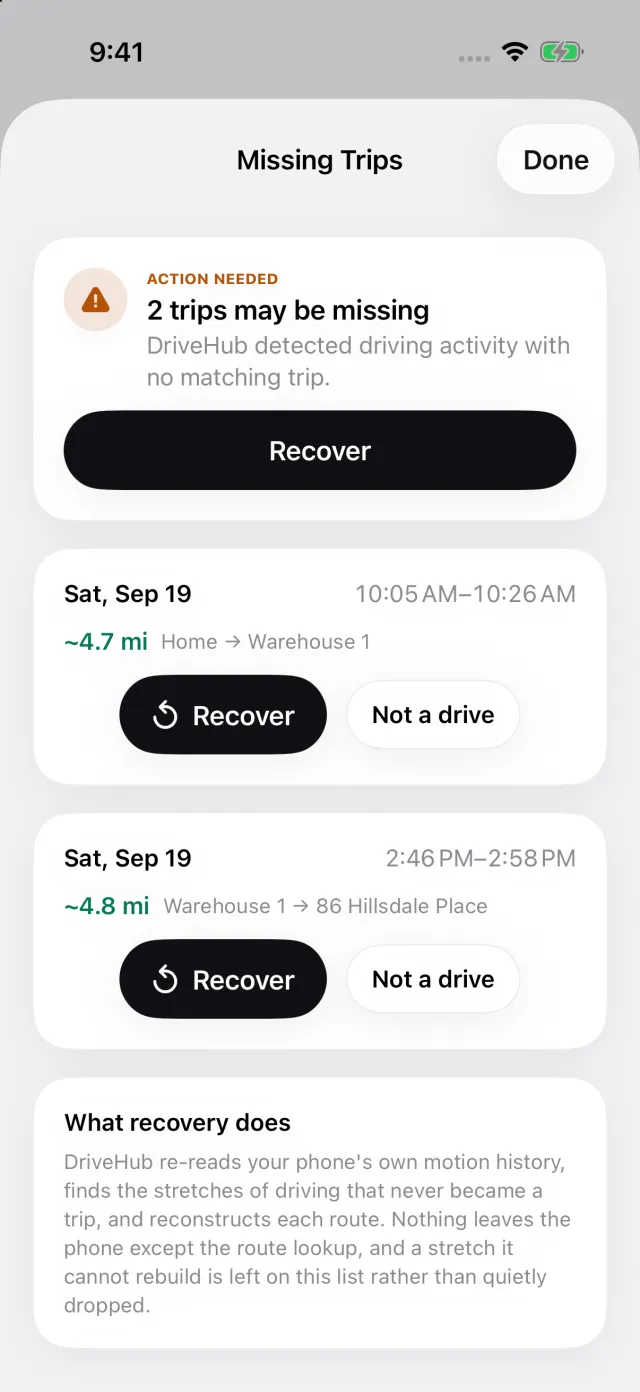
With location access set to Always, DriveHub records every drive in the background — and if it ever misses one, it tells you, the commute included. Anything it cannot file by your rules waits under Need to check for you to mark Business or Personal.
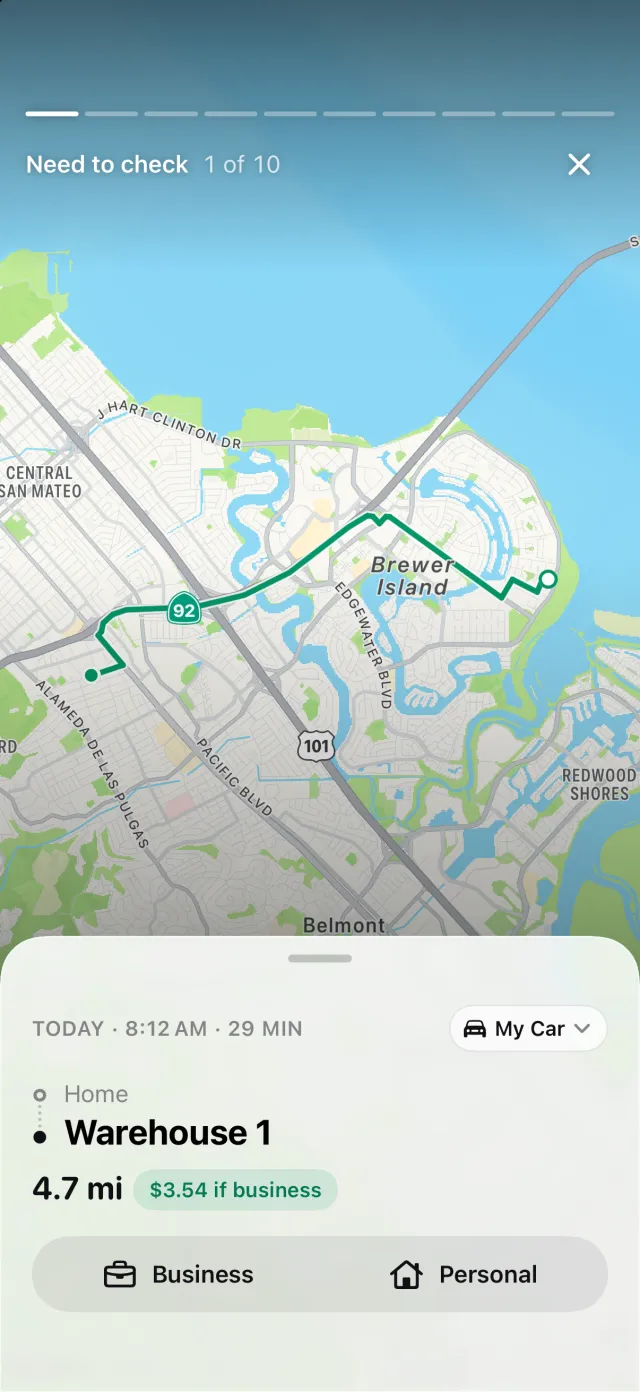
Mark a place as Home and another as Work, and a personal trip between them is counted as commuting: up to 40 km a leg, one return trip a day. DriveHub then shows what those limits left out, rather than dropping it silently. Claiming that part is your own note explicative to write: whether your reason is accepted is a fact about your life, and DriveHub does not decide it.
If iOS logged driving that DriveHub has no trip for, a Missed drives story appears under For you on the Trips tab. It opens a list of drives it may have missed (Missing Trips), so a day of commuting is flagged rather than quietly lost.
This page states what the texts themselves say, and names the article so you can check. It is not tax advice. It can't account for your circumstances. Where money is involved, ask your expert-comptable — and bring the records.
The full rule for France, with the instruments it comes from: mileage log requirements in France.