 DriveHub
Country guide · France · 7 min
Indemnités kilométriques: URSSAF wants the trips and exact kilometres
Your employer pays you indemnités kilométriques for driving your own car for work. Up to the barème they carry no contributions, provided the employer has a justificatif for two things: that the business trips happened, and exactly how many kilometres they covered.

The short answer
If you have to use your own car for work, your employer can pay you indemnités kilométriques. Up to the tax barème, the allowance is presumed used for its purpose, so it carries no social contributions.
For a 5 CV petrol car driven 8,000 business kilometres, that ceiling is €4,251 for the year. Anything above it needs its own proof (worked example below).
The presumption covers whether the money matched the car costs it stands for. It does not cover whether the trips happened. For that, BOSS asks the employer for two things: that the business trips existed, and the exact number of kilometres driven. BOSS's mileage chapter names no form, no columns and no carte grise.
Without that proof, the whole allowance goes back into the base for contributions. URSSAF can look back three years from the end of the calendar year they were due for.
Up to the barème, the allowance is presumed
The rule sits in BOSS, Frais professionnels, Chapter 3 — Frais d'utilisation d'un véhicule personnel à des fins professionnelles. § 390 reads, in full:
"Les indemnités forfaitaires kilométriques sont réputées utilisées conformément à leur objet dans les limites fixées par les barèmes kilométriques annuellement publiés par l'administration fiscale. L'employeur doit cependant justifier de l'existence de déplacements professionnels et du nombre exact de kilomètres parcourus. En l'absence de pièce justificative établissant la nature, l'importance et la réalité des frais engagés par les salariés, les indemnités kilométriques seront intégrées dans l'assiette des cotisations et contributions sociales."
BOSS cites two Cour de cassation rulings for it: Cass. soc., 11 January 1996, n° 93-18.295 and n° 94-10.903.
The ceiling is the tax-return barème; its legal basis is the arrêté du 4 septembre 2025, which replaced the arrêté du 20 décembre 2002. Its art. 4: "Lorsque le travailleur salarié ou assimilé est contraint d'utiliser son véhicule personnel à des fins professionnelles, l'indemnité forfaitaire kilométrique est réputée utilisée conformément à son objet dans les limites fixées par les barèmes kilométriques annuellement publiés par l'administration fiscale."
How strong is "réputée"? BOSS § 110 calls the presumption for flat allowances "une présomption absolue ne pouvant être renversée par la preuve contraire" — "à condition toutefois que les circonstances de fait correspondent à celles prévues par la réglementation." The circumstances the arrêté names are an employee who has to use their own car for work.
§ 120 adds a condition: the presumption "n'est établie que si l'indemnisation des dépenses exposées par le salarié est effectuée exclusivement sous forme d'une allocation forfaitaire et non si l'employeur procède également au paiement direct des dépenses." If the employer also pays some car costs directly, it "doit prouver que l'indemnité forfaitaire a été utilisée en totalité conformément à son objet."
What proof does URSSAF ask for?
Two facts, both named in § 390: the existence of business trips and the exact number of kilometres driven. Chapter 3 prescribes no document type, no per-trip purpose field and no layout. The word BOSS uses is exact.
Two conditions come first. The exemption needs "Que les frais aient un caractère professionnel" and "Que l'utilisation des indemnités soit faite conformément à leur objet" (§ 380). And the employee must be "contraints d'utiliser leur véhicule personnel à des fins professionnelles" (§ 415); the old tolerance for a car used "pour convenance personnelle" on the way to work "ne s'applique plus."
What happens without a justificatif?
The last sentence of § 390: without a document establishing the nature, size and reality of the costs, the allowances "seront intégrées dans l'assiette des cotisations et contributions sociales."
It is the whole amount. Under BOSS § 100, where the employer cannot show real professional costs behind an allowance, "celle-ci constitue un complément de rémunération et est réintégrée dans l'assiette des prélèvements pour la totalité de son montant." An allowance with no trips behind it is treated as salary.
Above the barème, the excess needs its own proof
For anything paid above the barème, BOSS § 400: "il appartient également à l'employeur de justifier l'utilisation effective des indemnités conformément à leur objet. A défaut, la fraction excédentaire est assujettie à l'ensemble des cotisations et contributions sociales."
So the part below the ceiling needs the trips and the kilometres. The part above it also needs proof that the money was actually spent on the car.
A worked example
Take an employee with a 5 CV petrol car who drives 8,000 business kilometres in the year. On urssaf.fr's barème, the 5 CV row for 5,001 to 20,000 km is (d × 0,357) + 1 395, where d is the "distance parcourue à titre professionnel en km".
- 8,000 × 0.357 = €2,856
- €2,856 + €1,395 = €4,251 — the exempt ceiling for that year's driving.
At €0.50 a kilometre the employer pays €4,000. That is under the ceiling, so it is presumed used for its purpose; what the employer still needs is the trips and the 8,000 km.
At €0.60 a kilometre it pays €4,800. The €549 above €4,251 needs proof of actual use on top (§ 400), or it carries contributions.
With no record of the trips at all, neither figure is protected: the whole €4,000 or €4,800 goes into the base (§§ 100, 390). How the bands and rows work in general is in the barème kilométrique explained.
Whose car counts
BOSS § 420: the barème is "réservée aux véhicules dont le salarié lui-même, ou le cas échéant son conjoint ou l'un des membres de son foyer fiscal, est propriétaire ou copropriétaire ou qu'il loue." Your car, your spouse's, a tax-household member's, one you co-own or one you rent all qualify.
An electric car: +20 %
BOSS § 380: "En cas d'utilisation d'un véhicule électrique, le montant de l'indemnité kilométrique est majoré de 20 %." The 20 % is in BOSS and the tax barème, not in the arrêté.
urssaf.fr publishes a separate "Véhicules 100 % électriques" table for 2026 (page "Vérifié le 24 avril 2026"). For 5 CV it reads d × 0,763 up to 5,000 km, (d × 0,428) + 1 674 to 20,000 km, and d × 0,512 beyond. That is the thermal row (d × 0,636, (d × 0,357) + 1 395, d × 0,427) × 1.2. For the same 8,000 km: 8,000 × 0.428 = €3,424, plus €1,674 = €5,098.
Parking and car-sharing
BOSS § 410 makes parking an additional professional expense "même si l'employeur rembourse déjà au salarié des indemnités kilométriques." The allowance does not absorb it.
On car-sharing, § 400: "Pour la pratique du covoiturage, seul le propriétaire du véhicule peut bénéficier de l'indemnité pour un trajet donné." Colleagues riding along get no allowance for that trip.
Gérants and présidents
BOSS extends the same rules to some company officers, as a simplification. § 130: "A titre de simplification, les gérants minoritaires ou égalitaires de sociétés à responsabilité limitée et de sociétés d'exercice libéral à responsabilité limitée, les présidents directeurs généraux de société anonyme et les présidents et dirigeants de société par actions simplifiées peuvent bénéficier de ces indemnités forfaitaires kilométriques suivant les mêmes règles que celles prévues pour les salariés."
Underneath, § 90 says their professional expenses are reimbursed "que sur la base des dépenses réelles"; the car is the exception, with the same proof. A majority gérant is not on that list, and BOSS says nothing about him in this chapter.
How far back URSSAF can look
Code de la sécurité sociale art. L244-3: "Les cotisations et contributions sociales se prescrivent par trois ans à compter de la fin de l'année civile au titre de laquelle elles sont dues." Where travail illégal is recorded, art. L244-11: "les délais mentionnés aux articles L. 244-3, L. 244-8-1 et L. 244-9 sont portés à cinq ans."
How long the employer keeps the documents is a separate, tax rule. LPF art. L102 B requires documents open to the administration's checks to be kept for six years, and a document created electronically is kept electronically.
The "carte grise" checklist is a different allowance
Many pages on this topic give the same list: date, purpose, fiscal horsepower, a copy of the carte grise. It does not come from the BOSS chapter on mileage allowances.
The carte grise and horsepower are in BOSS § 980, on the home-to-work fuel allowance. It reads: "L'employeur doit en outre être en mesure de présenter la photocopie du certificat d'immatriculation (carte grise) du véhicule du salarié". Its justificatifs relate "au moyen de transport utilisé par le salarié ; à la distance séparant le domicile du lieu de travail ; à la puissance fiscale du véhicule ; au nombre de trajets effectués chaque mois." For an employee's own frais réels, BOFiP § 230 names the certificat d'immatriculation among what "pourront être demandés".
Chapter 3, which governs business mileage, has no per-trip date-and-purpose list. Keeping a purpose for each trip is still sensible, since it shows a trip was a business one, but it is not a BOSS field.
If you also claim frais réels
An employee who opts for frais réels on the income-tax return is in a different system. It has its own proof and its own 40 km rule for the drive to work.
One link between the two: impots.gouv.fr tells that filer to "ajouter à vos salaires la totalité des allocations et remboursements versés par votre employeur". BOFiP (BOI-RSA-BASE-30-50-30-20 § 240) says the same of reimbursed business trips, "même lorsque le salarié utilise sa voiture personnelle".
What DriveHub does with this
§ 390 asks which trips were business ones, and exactly how many kilometres they came to. With location access set to Always, DriveHub records every drive in the background — and if it ever misses one, it tells you. Each drive keeps its start, end, time and distance, and nothing needs starting.
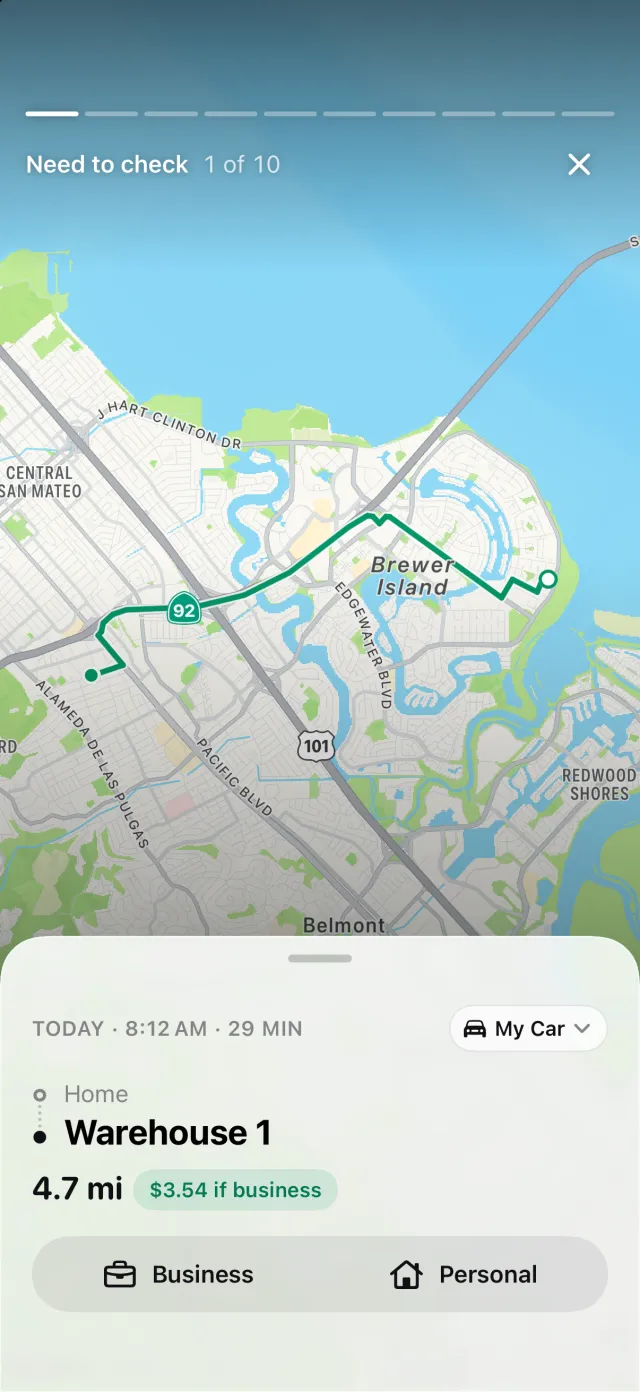
Place rules, your past routes and working hours classify what they can. Whatever is left waits under Need to check for a tap on Business or Personal, so the business kilometres are a sum of recorded trips rather than an estimate.
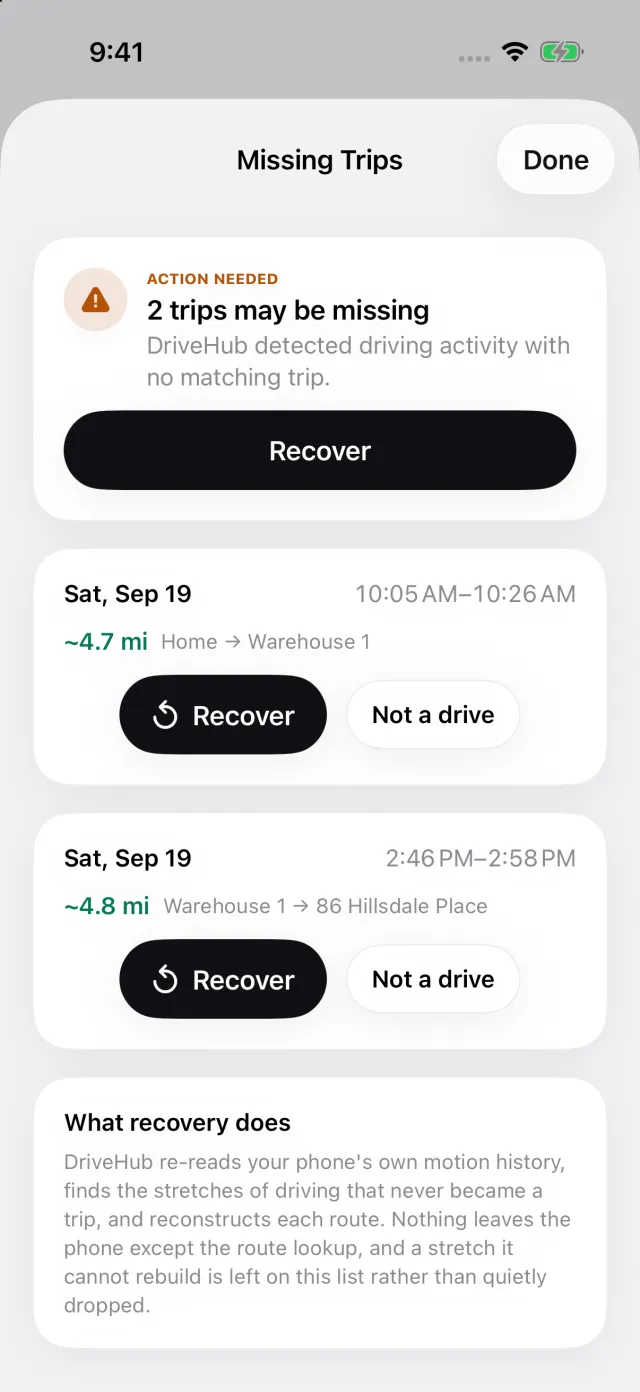
If the iPhone logged driving that has no matching trip, a Missed drives story appears on the Trips tab. It opens the Missing Trips list, where Recover rebuilds the route — so a gap shows itself before anyone checks the year.
For France, DriveHub asks each car's fiscal horsepower and works out the barème per car over the calendar year. Reports export as PDF for the employer's file, and as Excel or CSV for an accountant. Trips stay on your iPhone and in your own iCloud, with no account.
- DriveHub on the App Store
- France: what a mileage log must contain
- Set up automatic tracking
- Four ways to keep a mileage log, compared
This page states what BOSS, the arrêté and the codes themselves say, and names the paragraph so you can check. It is not tax or payroll advice. It can't account for your circumstances. Where money is involved, ask your expert-comptable — and bring the records.
The full rule for France, with the instruments it comes from: mileage log requirements in France.