 DriveHub
Country guide · Spain · 5 min
Kilometraje in Navarra is 0,36 €/km in 2026, and 0,29 in the Basque Country — not the state's 0,26
Kilometraje in Navarra is 0,36 € per kilometre from 1 January 2026. In the Basque Country (País Vasco / Euskadi) it is 0,29 € in Álava, Bizkaia and Gipuzkoa alike. Neither territory uses the state's 0,26 €.

The short answer
Kilometraje in Navarra in 2026 is 0,36 € per kilometre. In the Basque Country (País Vasco / Euskadi) it is 0,29 € in all three provinces: Álava, Bizkaia and Gipuzkoa. The state's 0,26 € does not apply in either territory.
| Where your income tax is governed | Exempt per km | Instrument |
|---|---|---|
| Common regime (the rest of Spain) | 0,26 € | Reglamento del IRPF art. 9.A.2.b); Orden HFP/792/2023 |
| Bizkaia | 0,29 € | DF 47/2014 art. 13 A).2.b) |
| Gipuzkoa | 0,29 € | DF 33/2014.pdf/8a554458-dd89-7894-880f-527c56cb8af3) art. 13 A).2.b) |
| Álava | 0,29 € | DF 40/2014 art. 13 A).2.b) |
| Navarra | 0,36 € from 1 January 2026 | DF 174/1999 art. 8 A).2.b), as set by DF 148/2025 |
Each figure is what an employer may pay an employee per kilometre without it being taxed. How the state's 0,26 € works is on kilometraje at 0,26 €/km.
Why two territories have their own figure
The Basque Country and Navarra legislate their own income tax. The Basque provinces do it under the Concierto Económico, Navarra under the Convenio Económico. Each has its own Norma Foral or Ley Foral del IRPF, and its own decree setting the kilometre figure.
So the 0,26 € from the state's Reglamento does not govern them. A Basque or Navarrese figure is not a regional top-up on the state rate. It is a separate rule from a separate legislator.
Which of these regimes your own income tax falls under is set by the Concierto and the Convenio. This page does not cover that test. If you are not sure, your asesor can tell you in one question.
Navarra: 0,32, then 0,35, now 0,36
Navarra's figure has changed twice, and that is why the number you find depends on the page you land on.
- It was 0,32 €.
- DF 234/2023, de 31 de octubre, raised it to 0,35 €. Its own preamble says so: "pasando de 0,32 a 0,35 euros". It was published in the BON on 23 November 2023 and took effect the next day, so 0,35 € applied from 24 November 2023 to 31 December 2025.
- DF 148/2025, de 23 de diciembre, published in the BON on 31 December 2025, set 0,36 €, in force from 1 January 2026.
Several sites still publish 0,32 €. That figure is two changes out of date.
What the gap is worth
Take 1 000 business kilometres driven in Navarra in 2026.
- At 0,36 €: 1 000 × 0,36 = 360 € exempt.
- At the stale 0,32 €: 1 000 × 0,32 = 320 €, which is 40 € under the current figure.
- At the state's 0,26 €: 1 000 × 0,26 = 260 €, which is 100 € under it.
The same 1 000 km in Bizkaia, Gipuzkoa or Álava give 1 000 × 0,29 = 290 €.
País Vasco: 0,29 € in Bizkaia, Gipuzkoa and Álava, from three decrees
Each Basque province sets its figure in its own decree, and all three arrive at 0,29 €:
- Bizkaia: DF 47/2014, art. 13 A).2.b)
- Gipuzkoa: DF 33/2014, art. 13 A).2.b)
- Álava: DF 40/2014, art. 13 A).2.b)
One correction for Gipuzkoa. Older references cite DF 137/2007 art. 13. That decree is repealed: DF 33/2014's Disposición Derogatoria Primera repeals it by name. The wording and the figure carried over unchanged, so the 0,29 € stands. The live citation is DF 33/2014 art. 13 A).2.b).
What the figure requires, and what is taxed above it
Every foral decree attaches the same three conditions to its figure as the state rule does to the 0,26 €.
- The trip must be shown to have happened. Bizkaia's DF 47/2014 art. 13 A).2.b) exempts 0,29 € per kilometre "siempre que se justifique la realidad del desplazamiento"; Álava and Gipuzkoa use the same words. Navarra's DF 174/1999 art. 8 A).2.b) reads "siempre que se acredite la realidad del desplazamiento".
- Tolls and parking go on top only against receipts: "más los gastos, que se justifiquen, de peaje y aparcamiento" in Bizkaia, "más los gastos de peaje y aparcamiento que se justifiquen" in Navarra.
- Anything paid above the figure is taxed. Bizkaia's art. 13 A).6: allowances "que excedan de los límites previstos en este artículo estarán sujetas a gravamen, en concepto de rendimientos del trabajo". Navarra's art. 8 A).6: allowances "que excedan de los límites previstos en este artículo estarán sujetas a gravamen". Only the excess is taxed, not the whole payment.
Gipuzkoa's Hacienda Foral puts it in one sentence: "se excluye de tributación la cantidad que resulte de computar 0,29 euros por kilómetro recorrido, más los gastos justificados de peaje y aparcamiento, siempre que se justifique la realidad del desplazamiento, tributando como rendimientos del trabajo la cantidad que exceda de dicho importe."
So at 0,40 € a kilometre for 1 000 km in Navarra in 2026, 360 € is exempt and the other 40 € is taxed as employment income. In Bizkaia the same payment leaves 290 € exempt and 110 € taxed.
For comparison, the state rule prescribes no form. What has to be provable under it is that the journeys happened, by what means, how many (an approximate count is accepted) and at what times.
Under the state rule, the burden of proof for exempt travel expenses sits with the employer, not the employee. If it fails, the allowance is treated as ordinary employment income. Who must prove the journey covers that in full.
The drive from home to work is not covered
All four foral texts exempt only what an employer pays an employee "que se desplace fuera de la fábrica, taller, oficina, o centro de trabajo, para realizar su trabajo en lugar distinto". That is the state rule's wording too. So kilometres between home and your usual workplace are outside the 0,29 € and the 0,36 €, as they are outside the 0,26 €. More on that in kilometraje from home to work.
Self-employed? There is no per-kilometre figure here either
The 0,29 € and 0,36 € are employee figures. No foral territory gives an autónomo a figure per kilometre. Each one sends you to a share of the car's actual costs. There are two caps a year: one on the car's own cost, one on the other running costs. The share and the caps differ by territory. Navarra by default, and Bizkaia and Álava where the car is notoriamente relevante y habitual in the business, allow half the costs of a car in mixed use. Gipuzkoa allows nothing unless the car is used only for the business.
That is a separate question with its own answer: see kilometraje for an autónomo. VAT on the car is covered in IVA del coche para autónomos.
How DriveHub uses the regional figure
In Settings, under Country, the Tax region row offers Common regime, Basque Country (Euskadi) and Navarre (Nafarroa). Choose yours, and DriveHub values an employee's business trips at 0,29 € or 0,36 € instead of 0,26 €. As an autónomo you get no per-kilometre amount, for the reason above.
Each trip is valued at the figure in force on the day it happened. A Navarra trip in December 2025 and one in January 2026 are not priced alike, and a report that spans the change needs no redoing.
With location access set to Always, DriveHub records every drive in the background — and if it ever misses one, it tells you. DriveHub files most trips as Business or Personal by your places, past routes and working hours, and asks you about the rest under Need to check. For a drive from home to your usual workplace, answer Commute there: it is kept out of the business total. For an employee, the PDF, Excel or CSV report carries the business trips at your territory's figure.
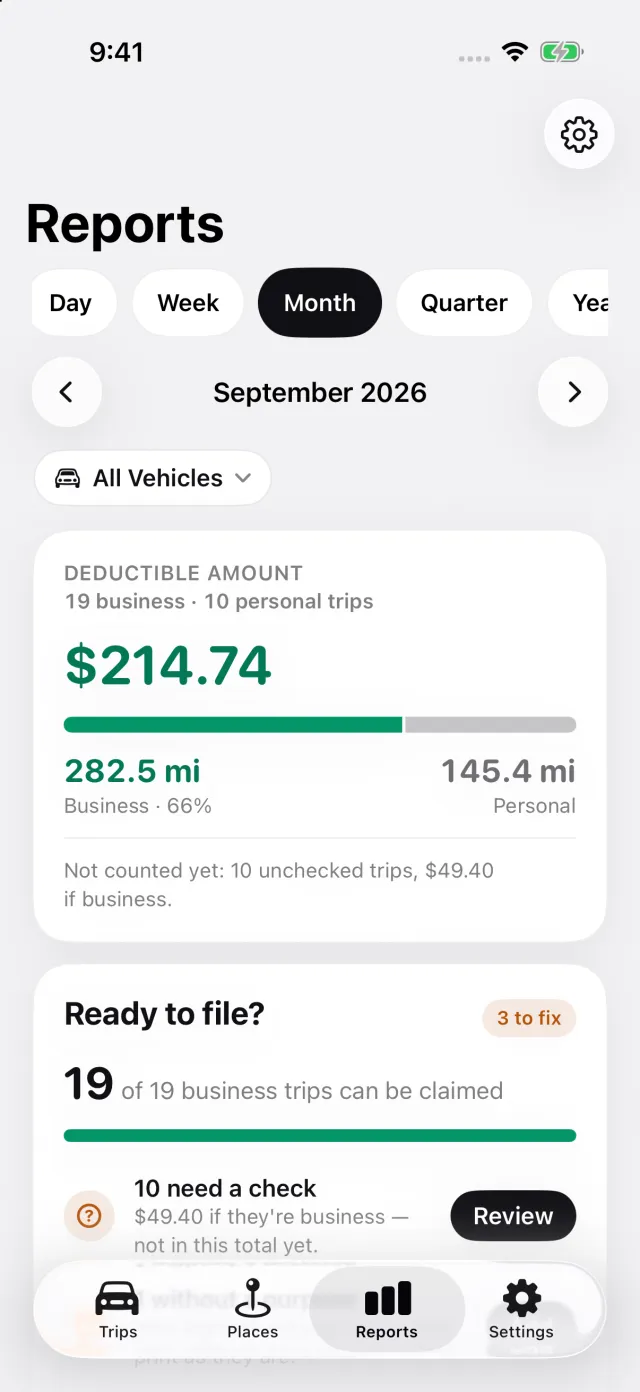
DriveHub is on the App Store for iPhone. The Spanish rules are on the Spain page, and setting up automatic tracking takes a few minutes, once.
This page states what the foral decrees and the Reglamento del IRPF themselves say, citing them so you can check. It is not tax advice. It can't account for your circumstances. Where money is involved, ask your asesor — and bring the records.
Do it in DriveHub
Country, official rates, your own rate and when a change applies.
The full rule for Spain, with the instruments it comes from: mileage log requirements in Spain.
Longer reads
- Driving from home to work is not exempt kilometraje in Spain, even when it is paid at 0,26 €/km
- VAT on a car in Spain — the 50% presumption for an autónomo, how to prove more, and what it means for IRPF
- Kilometraje in Spain is still 0,26 €/km in 2026: what to record for each trip, and what is taxed above it