 DriveHub
Country guide · Spain · 8 min
Driving from home to work is not exempt kilometraje in Spain, even when it is paid at 0,26 €/km
Is kilometraje casa-trabajo exempt (exento)? No. The 0,26 €/km is for driving away from your workplace to work somewhere else. What your employer pays for the drive from home to that workplace is fully taxed, even per kilometre, even at 0,26, even across town lines.

The short answer
- The commute is outside the exemption. The 0,26 €/km covers an employee who travels "fuera de la fábrica, taller, oficina, o centro de trabajo, para realizar su trabajo en lugar distinto" (Reglamento del IRPF art. 9.A.2).
- Paying the commute per kilometre changes nothing. The DGT held in 2025 that per-km pay for the drive from home to the workplace is fully taxed (V2290-25).
- A plus de transporte is salary. It is employment income, with withholding (DGT V0699-13).
- If your workplace is the client's site you are posted to, the drive from home to it is a commute too (DGT V0873-20).
- Driving straight from home to a client, when you normally work at the office, is not settled. No published rule, DGT ruling or AEAT guidance found answers it, and Spain has no "deduct your normal commute" rule.
What the 0,26 €/km actually covers
The Reglamento del IRPF, article 9.A.2, exempts what an employer pays to cover the travel costs of an employee "que se desplace fuera de la fábrica, taller, oficina, o centro de trabajo, para realizar su trabajo en lugar distinto". For your own car, letter b) sets the figure: 0,26 € per kilometre under Orden HFP/792/2023, plus justified tolls and parking, "siempre que se justifique la realidad del desplazamiento".
Two conditions sit in that sentence. You leave the workplace, and you go to work somewhere else. The drive from your home to the workplace meets neither: it ends where your work is.
The rule rests on the Ley del IRPF, art. 17.1.d). It taxes "Las dietas y asignaciones para gastos de viaje, excepto los de locomoción y los normales de manutención y estancia … con los límites que reglamentariamente se establezcan". Travel pay is income by default. Only what the Reglamento lets out is exempt.
The AEAT manual: taxed even when home is in another town
The AEAT's Manual práctico Renta 2025, in its section on gastos de locomoción, states both halves of the rule.
A trip out of the workplace is exempt "con independencia de que este último esté situado en el mismo o en distinto municipio que el centro de trabajo habitual".
The commute is not: "Por el contrario, están plenamente sujetas al impuesto … las cantidades percibidas por el desplazamiento del empleado o trabajador desde su domicilio al lugar de trabajo, aun cuando ambos estén situados en distintos municipios."
So living in another town does not help. Neither does a long drive. The test is where the trip starts and ends, not how far it is.
Paid per kilometre, at 0,26, under a convenio: still taxed
Some employers pay the commute exactly like a work trip, so many euros per kilometre. That is the case the DGT answered in binding ruling V2290-25 (25 November 2025).
A town council paid its staff per kilometre, at the civil-service rate, to drive from home to their posts in outlying hamlets. The DGT's answer: the exemption applies "quedando fuera de la aplicación de dicho precepto los desplazamientos desde el domicilio particular". The amounts "están plenamente sometidos al Impuesto … al no darse las condiciones exigidas en el citado artículo 9".
What makes a payment exempt is the trip, not the way it is calculated. A commute paid at 0,26 €/km is still a commute.
A plus de transporte is salary
Many convenios pay a fixed monthly plus de transporte for getting to work. In V0699-13 (5 March 2013) the DGT said such a bonus "tiene la consideración de renta dineraria" and "tendrá la calificación de rendimiento del trabajo para su perceptor, sujeto al Impuesto … y a su sistema de retenciones".
The only tax-free help with the commute is in kind and for public transport. The Ley del IRPF, art. 42.3.e), exempts "Las cantidades satisfechas a las entidades encargadas de prestar el servicio público de transporte colectivo de viajeros con la finalidad de favorecer el desplazamiento de los empleados entre su lugar de residencia y el centro de trabajo, con el límite de 1.500 euros anuales para cada trabajador".
That money goes to the transport operator. Cash handed to you is outside it (LIRPF art. 42.1).
When the client's site is your workplace
Some workers are posted to the place where the job is done: a building site, a shop, a client's premises. For them, that place is the centro de trabajo.
In V0873-20 (15 April 2020) a promoter, hired por obra o servicio, drove from home to a different tobacconist each day. The DGT's settled line is that such payments "lo serían para compensar los desplazamientos desde los domicilios particulares a los centros de trabajo a los que están destinados los trabajadores, lo cual conllevaría a que estuvieran sometidos a tributación en su totalidad".
Only trips from that site to other sites qualify under art. 9.A.2. The rule for a mobile workplace (art. 9.A.4) does not rescue the drive from home. It "opera única y exclusivamente cuando cabe predicar la movilidad del propio centro de trabajo, y no atendiendo a la naturaleza móvil o itinerante de la actividad".
Compare the employee attached to the employer's own centre who drives out to clients or to users' homes. The DGT holds that those trips "pueden tener cabida" in the exemption, because the employee "se desplaza fuera de su centro de trabajo para realizar su trabajo en lugar distinto" (V0540-24, V0528-20).
A worked example
Take an employee in the common territory. She lives 18 km from her office and drives in on 20 days a month. Her convenio pays 0,26 €/km for every kilometre she drives, commute included. This month she also made six visits to clients from the office, 40 km there and back each.
| Trips | Kilometres | Paid at 0,26 € | Tax treatment |
|---|---|---|---|
| Home ↔ office | 18 × 2 × 20 = 720 | 720 × 0,26 = 187,20 € | fully taxed |
| Office ↔ clients | 6 × 40 = 240 | 240 × 0,26 = 62,40 € | exempt, if the trips are justified |
| Total | 960 | 960 × 0,26 = 249,60 € |
Her payslip may show one line of 249,60 € of kilometraje. Only 62,40 € of it can be exempt. The other 187,20 € pays for the commute, and the commute is taxed in full.
Swap the per-km commute pay for a flat plus de transporte of any amount, and the answer is the same: all of it is taxed.
The open question: straight from home to a client
Suppose you normally work at the office, but one morning you drive straight from home to a client, or home from the last client of the day. Is that leg exempt in full, only beyond your usual commute, or not at all?
No published text found settles it. Neither article 9 of the Reglamento, nor the AEAT manual, nor any published DGT ruling or TEAC resolution found answers it for kilometres.
Spain has no published "deduct the normal commute" rule, unlike HMRC's. Advice that subtracts your usual commute is borrowing a rule from elsewhere.
Two texts come near without deciding it. V2290-25's phrase "quedando fuera … los desplazamientos desde el domicilio particular" is broad, but its facts were home to the employee's own workplace. V2553-19 (19 September 2019) concerned staff contracted to work from home who visit an assigned centre a few times a month. Their trip from home to that centre "no estarán exentas". That ruling, though, is about meal allowances (art. 9.A.3), not kilometres.
So the question is your employer's to decide. It is also your employer's to defend: the payer must show the day, place and reason of each trip (TEAC 00/03972/2018, 6 November 2018). More on that is in who must prove the journey.
The Basque Country and Navarra: the same line
The foral decrees in Bizkaia, Gipuzkoa, Álava and Navarra exempt 0,29 € and 0,36 € per kilometre instead of 0,26 €. All four use the same words as the state rule: "fuera de la fábrica, taller, oficina, o centro de trabajo, para realizar su trabajo en lugar distinto".
So the commute is outside the exemption in every territory. The figures are on kilometraje in Navarra and the Basque Country. How the state's 0,26 €/km works, and what is taxed above it, is on kilometraje at 0,26 €/km.
If you are self-employed, none of this applies to you: there is no per-kilometre figure for an autónomo. See kilometraje for an autónomo.
Before you hand in your kilometres
- The drives from home to your usual workplace are not on your kilometraje claim.
- If you are posted to a client's or a site's premises, the drive from home to it is not on the claim either.
- The trips you do claim leave the workplace and go to work somewhere else.
- Each trip has a date, where you went and why, and the kilometres.
- Any drive straight from home to a client is flagged, so your employer can decide how to treat it.
- You keep the toll and parking receipts in your name.
How DriveHub makes this easier
The rule turns on one fact per trip: did it leave the workplace for work elsewhere, or did it bring you to work? A log that holds every drive lets you answer that trip by trip.
With location access set to Always, DriveHub records every drive in the background — and if it ever misses one, it tells you. DriveHub files most trips as Business or Personal by your places, past routes and working hours, and asks you about the rest under Need to check.
There, a drive from home to your usual workplace gets its own answer: tap Commute, not Business or Personal. DriveHub counts a commute on the private side, so it never adds to your business kilometres.
Reports then shows business and personal kilometres for a month or a year. The business figure is the one the 0,26 €/km applies to.
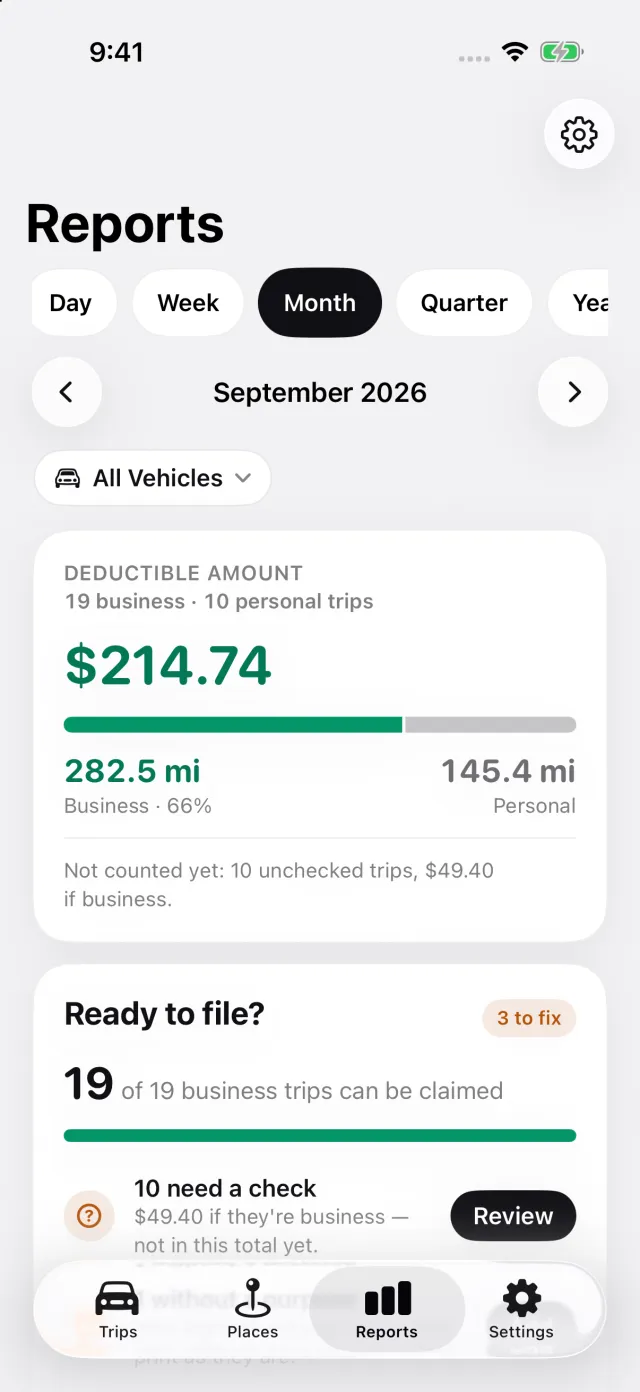
For a drive straight from home to a client, DriveHub does not decide the open question for you. Answer it the way your employer treats those trips, and the log keeps the date, the route and the distance either way.
DriveHub is on the App Store for iPhone. The Spanish rules are on the Spain page. Setting up automatic tracking takes a few minutes, once.
This page states what the Reglamento and Ley del IRPF, the AEAT and the DGT's rulings say, citing them so you can check. It is not tax advice. It can't account for your circumstances. Where money is involved, ask your asesor — and bring the records.
Do it in DriveHub
Mark a drive to work as Commute →
Commute is a third answer beside Business and Personal. See where to give it and what it changes.
The full rule for Spain, with the instruments it comes from: mileage log requirements in Spain.