 DriveHub
Country guide · Spain · 8 min
Kilometraje in Spain is still 0,26 €/km in 2026: what to record for each trip, and what is taxed above it
Your employer pays you kilometraje for driving your own car for work. In 2026, up to 0,26 € per kilometre is still not income, as long as you can justify the trip. Here is what that means trip by trip, and what happens when the company pays more.

The short answer
- 0,26 € per kilometre is exempt, plus tolls and parking backed by receipts. The source is the Reglamento del IRPF art. 9.A.2.b), with the figure set by Orden HFP/792/2023.
- It is still 0,26 in 2026. The Orden has been in force since 17 July 2023, and on 4 October 2026 the BOE listed nothing that replaces it.
- Each trip needs its day, place and reason, plus the kilometres the payment multiplies. No form is prescribed: any means of proof admitted in law can be used, and the tax office weighs it.
- Pay above 0,26 is not lost, it is taxed. Only the part over 0,26 × km goes on your payslip as salary. The rest stays exempt.
- A flat monthly car allowance works the same way. It is exempt only up to 0,26 × the kilometres that are justified, plus justified tolls and parking.
This is the common-territory rule. In the Basque Country the figure is 0,29 €, in Navarra 0,36 €: see kilometraje in Navarra and the Basque Country.
Where the 0,26 €/km comes from
Orden HFP/792/2023, art. único.1, in its own words:
"A efectos de lo previsto para los gastos de locomoción en la letra b) del artículo 9.A.2 del Reglamento del Impuesto sobre la Renta de las Personas Físicas … se excluirá la cantidad que resulte de multiplicar 0,26 euros por el número de kilómetros recorridos, siempre que se justifique la realidad del desplazamiento, más los gastos de peaje y aparcamiento que se justifiquen."
The Orden came into force on the day it was published, 17 July 2023. Letter a) of the same article covers public transport. Letter b) is the private car.
If you look the article up yourself, expect a trap. The BOE's consolidated text of art. 9 still prints 0,19 € in its body: «b) En otro caso, la cantidad que resulte de computar 0,19 euros por kilómetro recorrido…». The 0,26 sits beneath it only as a «Téngase en cuenta» note. The 0,19 is the figure that stood until 17 July 2023.
The 0,26 is what an employer may pay an employee without it being income. It is not a deduction a self-employed person takes. For an autónomo, see kilometraje for an autónomo.
What to record for each trip
The condition is "siempre que se justifique la realidad del desplazamiento": the reality of the trip has to be shown. The law sets the outcome, not a form.
The Tribunal Económico-Administrativo Central said what that outcome is made of in its unification ruling 00/03972/2018 (6 November 2018). The payer must justify "el día y lugar del desplazamiento que, junto con el motivo o razón de éste, son precisamente los extremos que permiten acreditar que las cantidades (euros por kilómetro o euros por día) establecidas en la norma quedan exoneradas de tributación por obedecer a razones laborales".
So for each trip:
| What | Why |
|---|---|
| The day | named by the TEAC |
| The place: where you drove to | named by the TEAC |
| The reason for the trip | named by the TEAC |
| The kilometres | the figure the 0,26 multiplies |
| The time | part of what must be provable |
| The means: your own car | part of what must be provable |
The wider requirement adds two things. What has to be provable is that the journeys happened, by what means, how many (an approximate count is accepted) and at what times. So also note the time of each trip, and that you went in your own car.
A blank Spanish mileage log (PDF) has exactly these columns.
Any means of proof, no prescribed form
An employer asked the Dirección General de Tributos exactly this: "Cómo registrar y justificar el kilometraje efectuado de cara a posibles inspecciones". The binding answer, V0540-24 (9 April 2024):
"la justificación de la realidad de los desplazamientos … podrá realizarse por medio de cualquiera de los medios de prueba admitidos en Derecho, según dispone el artículo 106 de la Ley General Tributaria … si bien corresponderá a los órganos de gestión e inspección de la Administración Tributaria su valoración."
No form, no list of fields, no template and no app is named. A notebook, a spreadsheet or an app export can each be offered as proof. The tax office weighs them.
Tolls and parking: keep the receipts yourself
Tolls and parking go on top of the 0,26, but only "que se justifiquen". Here the TEAC ruling shifts the burden: like public-transport tickets, they "habrán de justificarse, en principio, por el empleado o perceptor", because the receipts are in the employee's name. The employer still proves that the expense was linked to its work.
In practice: you keep the toll and parking receipts. The kilometre record is the employer's to hold.
A fuel receipt shows the fuel, not the trip
In V0528-20 (4 March 2020), a home-care company paid its staff per kilometre against a fuel ticket and asked whether that was enough. The DGT did not endorse the ticket. It answered only that the trips may be proved by any means of proof and that the inspectors weigh it. A fuel invoice proves the fuel, not the trip.
Who carries the burden
For exempt travel expenses, the burden of proof sits with the employer, not with you. That changes who the record is for, and it is covered in full on who must prove the journey.
Which trips count
The exemption is for an employee "que se desplace fuera de la fábrica, taller, oficina, o centro de trabajo, para realizar su trabajo en lugar distinto" (RIRPF art. 9.A.2). The drive from home to your usual workplace is not one of them, even if the company pays it per kilometre at 0,26. That has its own page: is the drive from home to work kilometraje?.
What is taxed above 0,26
RIRPF art. 9.A.6: "Las asignaciones para gastos de locomoción, manutención y estancia que excedan de los límites previstos en este artículo estarán sujetas a gravamen."
The AEAT's Manual práctico Renta 2025 puts it plainly: "el exceso percibido, en su caso, sobre las cantidades indicadas está plenamente sujeto a gravamen en concepto de rendimientos del trabajo." And V0540-24 adds that the withholding on that excess follows the ordinary payroll procedure ("el procedimiento general establecido en el artículo 82 y siguientes del Reglamento").
So a higher rate does not make the whole payment taxable. Only the excess is salary.
Worked example: a convenio paying 0,35 €/km
In a month you drive 800 justified business kilometres, and you pay 12 € in tolls, with receipts in your name. Your convenio pays 0,35 € per kilometre plus the tolls.
| Amount | |
|---|---|
| Paid for kilometres: 800 × 0,35 | 280,00 € |
| Exempt: 800 × 0,26 | 208,00 € |
| Taxed as salary: 280,00 − 208,00 (= 800 × 0,09) | 72,00 € |
| Tolls, justified | 12,00 €, exempt on top |
You receive 292 €. Of that, 220 € is exempt and 72 € goes on your payslip with ordinary withholding.
A flat monthly car allowance
Some employers pay a fixed amount a month for the car instead of a figure per kilometre. In V0798-22 (11 April 2022), an employee received a fixed "subvención mensual fija, coche propio" and handed in a monthly sheet of business kilometres. The employer withheld tax on the whole amount.
The DGT's answer: the allowance "quedará exonerada de gravamen en su totalidad o en la parte que corresponda" to the per-kilometre figure "en los desplazamientos cuya realidad se justifique", plus justified tolls and parking. The ruling used 0,19, the figure in force on 1 January 2022. Today the same reasoning runs on 0,26.
What the payment is called does not matter. The exempt part is the rate × the justified kilometres:
- A 250 € monthly allowance and 600 justified km: 600 × 0,26 = 156 € exempt, 94 € taxed as salary.
- The same 250 € and 1 200 justified km: 1 200 × 0,26 = 312 €, more than the allowance, so all 250 € is exempt.
If the employer withholds tax on a part that should have been exempt, the ruling notes how to challenge it. That is a reclamación económico-administrativa (LGT art. 229.5), not a question to the DGT.
If the trip can't be justified
Then the kilometraje is taxed as ordinary employment income. The 0,26 protects only kilometres whose reality can be shown.
How long the record is kept
Spain's tax law names no fixed period. The duty runs with the four-year limitation on assessment (LGT art. 66.a), counted from the day after the filing deadline (art. 67.1). Where the record backs somebody else's tax position, the period is longer. That is the case for an employer holding the evidence for an exempt allowance. Art. 70.2 then extends it to the commercial-law period: "seis años, a partir del último asiento realizado en los libros" (Código de Comercio art. 30.1).
One more case: the employer pays nothing
Orden HFP/792/2023, art. único.2, applies the same 0,26 to workers in a relación laboral especial de carácter dependiente (RIRPF art. 9.B.1.a) whose employer does not reimburse them, "siempre que justifiquen la realidad de sus desplazamientos".
Checklist
- Each business trip has its day and time, the place you drove to, the reason, the kilometres, and that you went by car.
- Each trip took you out of your workplace to work somewhere else. The drive from home to work is not one of them.
- Toll and parking receipts are kept, in your name.
- Payment above 0,26 €/km (or a flat allowance above 0,26 × justified km) shows as salary on your payslip, not the whole amount.
- The record reaches your employer in a form it can keep.
How DriveHub makes this easier
The weak point of a kilometraje record is rarely the rule. It is the trip nobody wrote down, and the reason nobody remembers three weeks later.
With location access set to Always, DriveHub records every drive in the background — and if it ever misses one, it tells you. It keeps the date, both ends and the distance. DriveHub files most trips as Business or Personal by your places, past routes and working hours, and asks you about the rest under Need to check. For the drive from home to your workplace, answer Commute, so it never counts as business. You add the reason in your own words.
Reports shows the month's business and personal kilometres, and what the business kilometres come to at 0,26 € per km. Each trip is priced at the figure in force on its date. In the Basque Country or Navarra, choose your Tax region under Country in Settings, and DriveHub values business trips at 0,29 € or 0,36 € instead.
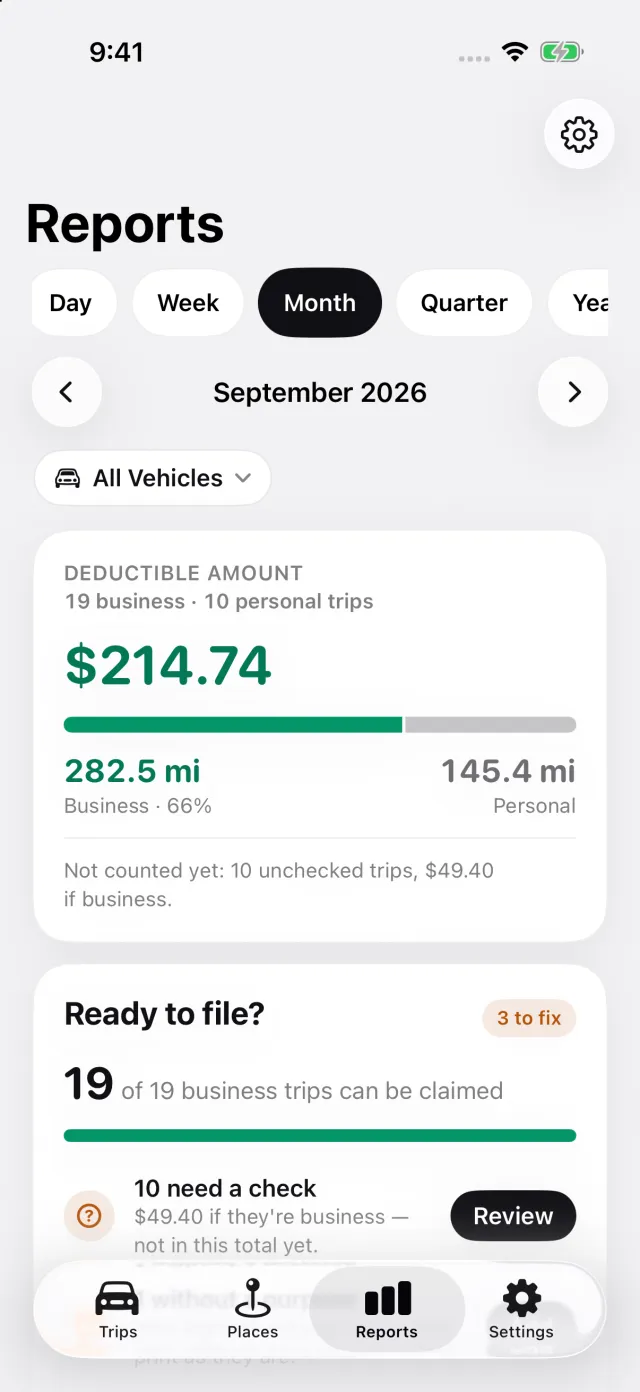
The report, a PDF, Excel or CSV file with DriveHub Pro, lists each business trip with its date, both addresses, the distance and the purpose you wrote. On a report for one car, the driver and the plate print once in the header. Your name appears there once you choose the car and enter your name in the report settings. That is a file your employer can keep, which matters because the employer is the one who has to justify the trips.
Where DriveHub stops: it does not keep your toll and parking receipts, work out what part of a convenio rate is salary, or decide whether a trip qualifies. Those stay with you, your employer and your asesor.
DriveHub is on the App Store for iPhone. The Spanish rules are on the Spain page, and setting up automatic tracking takes a few minutes, once.
This page states what the Reglamento del IRPF, Orden HFP/792/2023, the TEAC and the DGT say, citing them so you can check. It is not tax advice. It can't account for your circumstances. Where money is involved, ask your asesor — and bring the records.
Do it in DriveHub
Employment dates, different rates and trips for more than one job.
The full rule for Spain, with the instruments it comes from: mileage log requirements in Spain.