 DriveHub
Country guide · United Kingdom · 7 min
Own car for work in the UK: 55p a mile and Mileage Allowance Relief
You use your own car for work in the UK. HMRC publishes a rate per mile, but your employer doesn't have to pay it. Claiming the difference, called Mileage Allowance Relief, depends on a year total, your tax rate and a four-year clock.

The short answer
- What is the rate? For 2026-27, 55p a mile for the first 10,000 business miles and 25p after. Until 5 April 2026 it was 45p and 25p.
- Does my employer have to pay it? No. HMRC calls the rate advisory, and employers can pay more or less.
- Is what I'm paid taxed? Not up to HMRC's approved amount for the year. Anything above it is taxable.
- Paid less, or nothing? You can claim Mileage Allowance Relief on the difference. It is worth the tax on the gap, not the gap itself.
- How do I claim? Online or on form P87, up to £2,500 of expenses a year. Above that, or if you file Self Assessment, on the return.
- What do I need? A mileage log with the reason, the start postcode and the end postcode of every journey, one log per job.
- How far back? The current tax year and the four before it. The oldest open year, 2022-23, closes on 5 April 2027.
- Is the commute covered? No. Home to a permanent workplace is never a business mile.
55p a mile from 6 April 2026, set retrospectively
The approved rate for a car or van is in ITEPA 2003 s. 230(2). The Taxation (Energy and Vehicles) Act 2026, s. 2 raised it: "for '45p' substitute '55p'", with effect "for the tax year 2026-27 and subsequent tax years."
HMRC's policy paper: "The increase is retrospective taking effect from 6 April 2026." So a journey on 10 April 2026 counts toward the 2026-27 approved amount, at 55p for the first 10,000 miles, even if your employer paid 45p at the time.
HMRC's employment income manual, EIM31240, prints both tables:
| Tax year | First 10,000 miles | After 10,000 miles |
|---|---|---|
| 2011-12 to 2025-26 | 45p | 25p |
| 2026-27 onwards | 55p | 25p |
A motorcycle is 24p and a bicycle 20p a mile in both. The government will set out a review of the rates beyond 2026-27 at the Budget 2026.
Does my employer have to pay 55p a mile?
No. The rate sets what is tax-free, not what you are owed. The policy paper: "The AMAP rate is advisory, and employers can choose to reimburse more or less. If an employee receives less than the advisory rate, they can claim tax relief from HMRC by applying for Mileage Allowance Relief (MAR) on the difference. If they receive more, they will be liable to pay Income Tax on the difference."
The comparison is one year total, not trip by trip
Section 229(1) is the exemption: "No liability to income tax arises in respect of approved mileage allowance payments". Section 229(3) approves the payments only as far as the year's total stays within the approved amount, which s. 230(1) defines as "M×R": your business miles in the year times the rate.
So the 10,000 miles at 55p are counted over the tax year, not per trip or per month, and you can't be taxed on an excess and claim relief in the same year for the same kind of vehicle (EIM31330). Cars and vans are one kind: their miles and payments are added together (EIM31240).
Three worked examples
Paid 45p for 6,000 miles in 2026-27.
- Approved amount: 6,000 × 55p = £3,300
- Paid: 6,000 × 45p = £2,700
- Mileage Allowance Relief: £3,300 − £2,700 = £600
Paid 45p for 20,000 miles in 2026-27. The band drops to 25p after 10,000 miles, so the year total goes the other way.
- Approved amount: 10,000 × 55p + 10,000 × 25p = £5,500 + £2,500 = £8,000
- Paid: 20,000 × 45p = £9,000
- No relief. The £1,000 above the approved amount is taxable.
Paid 25p for 4,000 miles in 2025-26. That year's rate is 45p.
- Approved amount: 4,000 × 45p = £1,800
- Paid: 4,000 × 25p = £1,000
- Mileage Allowance Relief: £1,800 − £1,000 = £800
An employer that paid 45p a mile up to 5 April 2026 left no gap in those years. If they still pay 45p, a gap opens on 6 April 2026 for anyone under 15,000 business miles in the year. At 15,000, 55p on the first 10,000 and 25p on the rest come to £6,750, the same as 45p on all of them.
Mileage Allowance Relief is the tax on the gap, not the gap
The relief is a deduction from your taxable pay, not a payment of the difference. ITEPA 2003 s. 232(1): "A deduction is allowed for mileage allowance relief to which an employee is entitled for a tax year."
gov.uk puts it in numbers: "If you claim £60 and pay tax at a rate of 20% in that year, the amount you are entitled to is £12 (20% of £60)." The £600 in the first example is worth £120 at 20% and £240 at 40%.
You also need tax to set it against: "The amount of tax relief you get cannot be more than the amount of tax you paid in that year." For the current year, HMRC "will usually adjust your tax code so you pay less tax"; for earlier years, it "will either adjust your tax code or give you a tax refund."
Two jobs, one band or two
The 10,000 miles are counted per employment (s. 230(3)–(4)). Two jobs at unconnected employers each get their own 10,000 miles at 55p; associated employments (the same employer, one person's control, or associated companies) share one count. gov.uk also asks for a separate log for each job; more in postcodes and the 10,000-mile band.
What the rate already covers
The mileage rate is the whole relief for an own car. EIM31330: "There is no alternative whereby, for example, employees may claim for actual expenditure incurred". gov.uk says the rate "covers the cost of owning and running your vehicle. You cannot claim separately for things like: fuel; electricity; vehicle tax; MOTs; repairs".
Passenger payments (5p a mile per colleague carried) are the employer's to make tax-free; if yours doesn't pay them, there is nothing to claim back (EIM31410).
Can I claim my commute?
No. The relief counts only "business travel". Section 236(1) defines it through the travel rules in ss. 337 to 342, and s. 338(3) takes out "ordinary commuting": travel between "(a) the employee's home and a permanent workplace".
The P87 notes add: "Most people only have one place where they go to work. That place is their permanent workplace even if the employment is casual or temporary." Hybrid working doesn't change that: HMRC's guide 490 says journeys from home to the base office "will be ordinary commuting" (chapter 3).
When a site stops being temporary, and how the 24-month and 40% tests work, is in commuting or a temporary workplace.
How do I claim Mileage Allowance Relief?
Self Assessment filers claim on the return. gov.uk: "If you complete a Self Assessment tax return, you must claim through your tax return instead."
Online. Everyone else can use HMRC's online claim service. Two answers send you elsewhere: expenses of more than £2,500 in a tax year go to Self Assessment, and more than 5 jobs go to the postal form.
By post, on form P87. gov.uk allows it if the claim is within 4 years of the tax year's end, "your total expenses claim for each tax year is £2,500 or less", and you paid tax that year. "We'll reject postal claims that do not use this form." The £2,500 is the total across all your jobs, and the form is rejected without each employer's PAYE reference number.
Four years, and the oldest closes in April
A claim can't be made "more than 4 years after the end of the year of assessment to which it relates" (TMA 1970 s. 43(1)). The oldest open year is 2022-23. Four years after it ended on 5 April 2023 is 5 April 2027; after that, a 2022-23 gap can't be claimed at all.
What to send
The online service's evidence page: "You must send a copy of your mileage log to HMRC for each job. This should show why you made each journey, with the starting and finishing postcodes. If your employer has not paid you back for any mileage or travel costs, you need to send a letter explaining why."
The P87 notes word the letter differently: "a letter from your employer is required if they did not pay any of your mileage payments". Neither page says which prevails, so follow the route you are using. Online, you write that letter yourself. On a P87, it comes from your employer; if yours paid nothing, ask for it before you fill in the form.
What the log has to show
gov.uk lists what the log must include: "the reason for every journey; the postcode for the start point of every journey; the postcode for the end point of every journey." It also tells you to "keep records of the dates and mileage of your work journeys".
HMRC's guide for employees adds: "Employees must be able to substantiate the statements they make." Where relief was overstated, HMRC "will seek to recover from the employee the tax lost, together with interest and, where appropriate, penalties and a surcharge" (490, chapter 12).
As an employee, keep the records until at least the first anniversary of the 31 January after the tax year (TMA 1970 s. 12B(2)(b)), which HMRC's guides round to 22 months. For a 2026-27 log, that is 31 January 2029. If you are sent a Self Assessment return for the year, keep it until HMRC can no longer open an enquiry into that return, or until its enquiry closes, if that is later.
Paper, a spreadsheet and an app can all produce this log; four ways to keep a mileage log compares them. If your employer gives you a company car instead, see company car and private fuel.
How DriveHub makes this easier
What goes missing from a claim is the journey nobody wrote down, and the postcode you set off from.
With location access set to Always, DriveHub records every drive in the background — and if it ever misses one, it tells you. It keeps the date, both ends and the distance. Afterwards you mark each trip Business or Personal, and add the reason in your own words.
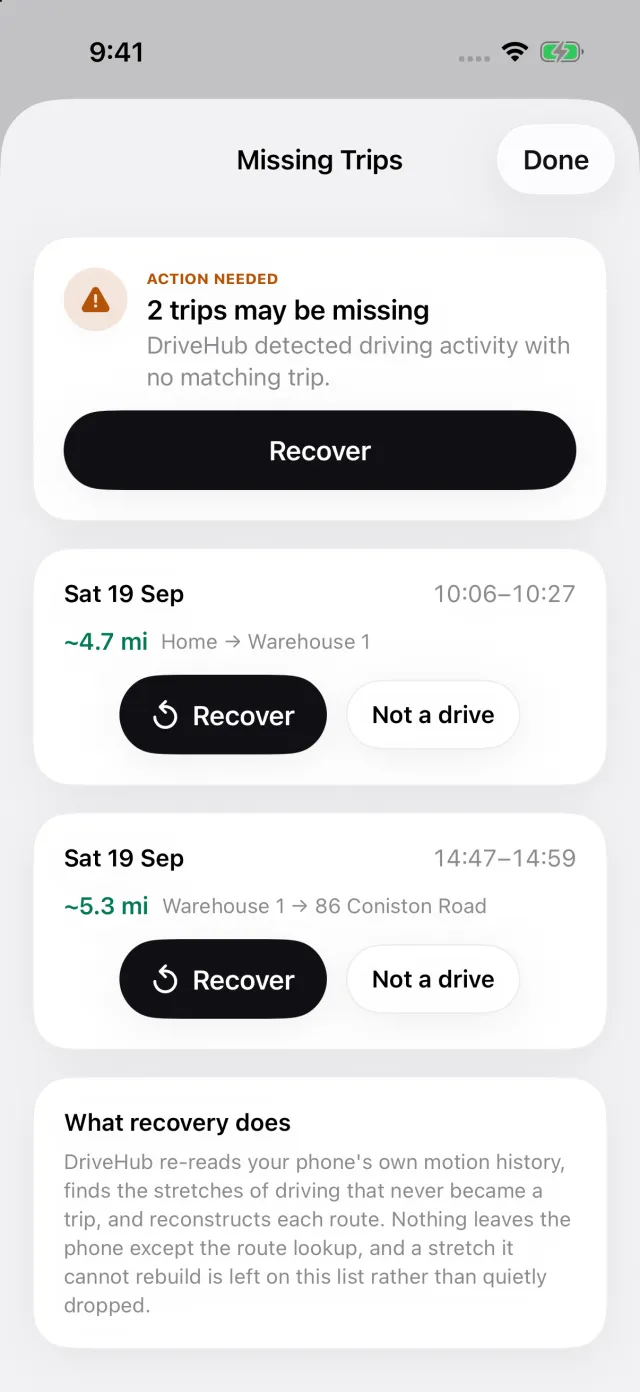
If your iPhone logged driving with no matching trip, a Missed drives story appears on the Trips tab. It opens the list of missing trips, where Recover rebuilds the route, before the claim goes in rather than after.
The report prints the date, both addresses, the distance and your reason for each journey. It counts the 10,000-mile band per employment and can be scoped to one job, as HMRC asks. Where you say what each employer pays per mile, it prints the Mileage Allowance Relief: HMRC's banded approved amount minus what was paid. If you haven't entered what a journey was paid, it stays out of that figure; DriveHub doesn't assume you were paid nothing.
Where DriveHub stops: it files nothing with HMRC. A drive it didn't record and can't recover, because the phone was off, flat or in Airplane Mode, stays out of the report until you add it by hand. It doesn't know whether two employers are associated; if they are, name one employer for both. It doesn't decide whether a site is a permanent workplace.
DriveHub is on the App Store for iPhone. The UK rules it follows are on the UK page, and setting up automatic tracking takes a few minutes, once.
This page states what HMRC and the legislation say, and cites them so you can check. It is not tax advice. It can't account for your circumstances. Where money is involved, ask your employer's payroll team or your accountant — and bring the log.
The full rule for United Kingdom, with the instruments it comes from: mileage log requirements in the United Kingdom.