 DriveHub
Country guide · United Kingdom · 8 min
Commute or temporary workplace? The UK's 24-month rule
Is your commute claimable in the UK? The answer turns on the place at the other end: a permanent workplace or a temporary one. Under the 24-month rule, a temporary workplace can become permanent partway through a posting.

The short answer
Driving between your home and a permanent workplace is ordinary commuting, and it is never claimable. ITEPA 2003 s. 338(2) takes it out of the deduction: "Subsection (1) does not apply to the expenses of ordinary commuting or travel between any two places that is for practical purposes substantially ordinary commuting."
Driving from home to a temporary workplace is business travel, and it is claimable. gov.uk says so in one line, on claiming for vehicles you use for work: "This does not include travelling to and from your work, unless it's a temporary place of work."
A workplace stops being temporary when you spend 40% or more of your working time there over a period that lasts, or is expected to last, more than 24 months. What counts is what you were told to expect when the posting started, and the date that expectation changed.
Working from home some days changes nothing: the drive to your base office is still a commute. A drive from home to a client or project site you attend for a limited job is business travel.
Your normal office, or the place you go every day
This is the commute in its plain form. s. 338(3) defines it: "In this section "ordinary commuting" means travel between— (a) the employee's home and a permanent workplace, or (b) a place that is not a workplace and a permanent workplace."
A permanent workplace is one you "regularly attend" that "is not a temporary workplace" (s. 339(2)). For most people it is simply where they go to work. The P87 notes put it plainly: "Most people only have one place where they go to work. That place is their permanent workplace even if the employment is casual or temporary."
Two more kinds of place are permanent even when each visit is short. One is a base, s. 339(4): a place that "forms the base from which those duties are performed" or where "the tasks to be carried out in the performance of those duties are allocated". HMRC 490's Example 28 is a bus driver's depot, which is a permanent workplace however brief the visit.
The other is an area. HMRC 490, paragraph 3.32: "Where these employees have no other permanent workplace the geographical area will be their permanent workplace." If you have an office you regularly attend, the office is the permanent workplace instead. HMRC's Example 33 is a social worker with an area and an office: "Her travel to and from the clients is business travel."
You drive to different sites for a limited task
If you go to a site for a job that has an end, driving there from home is business travel, and you claim the whole journey. A temporary workplace is one you attend "(a) for the purpose of performing a task of limited duration, or (b) for some other temporary purpose" (s. 339(3)).
You do not subtract the commute you would otherwise have made. HMRC 490, paragraph 5.1: "In working out the full cost of a business journey, take no account of any savings an employee realises by not having to make their ordinary commuting journey."
One guard against abuse applies here. A trip to a temporary site can still be "substantially ordinary commuting" if it is really your normal commute with a detour. EIM32300, and HMRC 490 at 4.11, set out where HMRC stops arguing:
- "you should not try to argue that a journey to or from a temporary workplace is substantially ordinary commuting where the extra distance involved is 10 miles or more each way";
- "A journey to a temporary workplace that takes the employee in a completely different direction to his or her ordinary commuting journey is not substantially ordinary commuting even if the distance is the same."
You have been sent to another office for a while
This is where the 24-month rule comes in. s. 339(5): "A place is not regarded as a temporary workplace if the employee's attendance is— (a) in the course of a period of continuous work at that place— (i) lasting more than 24 months, or (ii) comprising all or almost all of the period for which the employee is likely to hold the employment, or (b) at a time when it is reasonable to assume that it will be in the course of such a period."
A period of continuous work is one over which "the duties of the employment are performed to a significant extent at the place" (s. 339(6)). The statute gives no percentage. The 40% is HMRC's reading of "significant extent", in EIM32080: "The test is whether the employee has spent, or is likely to spend, 40% or more of his or her working time at that particular workplace over a period that lasts, or is likely to last, more than 24 months."
HMRC's own guides disagree at exactly 40%. EIM32080 and HMRC 490 paragraph 3.19 say "40% or more"; paragraphs 3.21 and 3.22 of the same guide say "more than 40%". If your share of time sits at 40% precisely, raise it with an adviser rather than settle it from either page.
Both halves of the test must be met. HMRC 490, 3.22: "For the 24 month rule to apply, both parts of the test must be met". Its Example 16 is an employee at a site for 1½ days a week for 28 months. That is 30% of a five-day week (1.5 ÷ 5), under 40%, so the site stays temporary.
Expectation, not outcome
The test looks at what you expected, starting with what you were told about the length of the assignment (HMRC 490, 3.23). EIM32080: "The effect of the rule is not altered where the expectation does not match the outcome ... The effect of the rule can be altered when there is a change of expectation".
HMRC 490 works through three postings (Examples 13–15):
| Expected at the start | What happened | Relief |
|---|---|---|
| 28 months | Ended at 18 | None at any point |
| 18 months | Extended to 28 after 10 | The first 10 months only |
| 28 months | Cut to 18 after 10 | The final 8 months (18 − 10) |
The first gets nothing because from day one it was expected to exceed 24 months. For the second, paragraph 3.21: "it will stop being a temporary workplace from the date that the expectation changed." EIM32085 gives the third example too.
A fixed-term job at one site
The second limb of s. 339(5) catches a job that is spent almost entirely at one place. EIM32125: "You should not normally challenge relief under this paragraph where the likely duration of work at a workplace is less than 80% of the likely duration of the employment." HMRC 490's Example 26 is an 18-month fixed-term job spent at one site. There is no relief, even though 18 months is under 24.
You work from home some days
Hybrid working does not turn home into a workplace. HMRC 490, paragraph 3.39: "Under such arrangements, the employee will have a base office and journeys from home to that location will be ordinary commuting."
So on the days you go in, the drive to the office is a commute, just as it would be if you went in every day. In a company car with fuel paid, those commutes are also private miles for the fuel benefit; see company car fuel benefit.
A posting, worked through
Say your base office is 8 miles from home. On 1 May 2026 your employer sends you full time to a client site 20 miles away, and tells you it will last 18 months. You drive your own car.
The site is a temporary workplace. You are there all your working time, which is over 40%, but the expected 18 months is under 24. The extra distance is 12 miles each way (20 − 8), which is over 10, so HMRC will not normally argue that the trip is substantially your commute.
On 1 March 2027 the client extends the work to 28 months in total, moving the expected end from 31 October 2027 to 31 August 2028. From that day the site is permanent, and the drive there is ordinary commuting. The ten months from 1 May 2026 to 28 February 2027 stay claimable.
What the ten months are worth. Take 20 working days a month: 40 miles a day (20 each way), 800 miles a month, 8,000 miles over ten months. All of it falls in the 2026-27 tax year, which runs from 6 April 2026 to 5 April 2027.
- HMRC's approved amount: 8,000 × 55p = £4,400, under the 10,000-mile band, assuming no other business miles in that job that year.
- If your employer paid 45p a mile: 8,000 × 45p = £3,600, so Mileage Allowance Relief is £4,400 − £3,600 = £800.
- Relief is a deduction from your taxable pay, so £800 of it saves £160 at 20% or £320 at 40%.
The 8-mile commute you no longer make is not subtracted (HMRC 490, 5.1).
You use your own car
In your own car, relief for a qualifying journey comes at the mileage rate, not at what the journey cost you. EIM32055: "Where employees use their own vehicle or bicycle for business travel a deduction is given at statutory mileage rates and not for actual costs".
That rate is 55p a mile for the first 10,000 business miles in 2026-27 and 25p after, compared with what your employer paid. Using your own car for work in the UK covers the claim itself.
If you are self-employed
The 24-month and 40% test applies to employees only. A sole trader's home-to-base travel is generally disallowed under ITTOIA 2005 s. 34, unless home is an itinerant trader's base (BIM37605, BIM37620). How the self-employed claim the miles that do count — simplified expenses at 55p a mile, or actual costs — is in self-employed mileage in the UK.
What your log has to show
The log is kept per journey. gov.uk asks for "the reason for every journey; the postcode for the start point of every journey; the postcode for the end point of every journey", and a separate log for each employment. The relief is refused for the journeys that cannot be evidenced. Postcodes and the band covers those fields in full.
For a temporary workplace, the reason and the dates carry the weight. "Client site, audit" says why a journey is business; a bare address does not. The dates show when you started going to a site, how often, and when it stopped: the facts the 24-month and 40% questions are checked against. HMRC 490, 12.10: "Employees must be able to substantiate the statements they make."
How DriveHub makes this easier
With location access set to Always, DriveHub records every drive in the background — and if it ever misses one, it tells you. The commute is recorded too. A rule on a place, your past drives on the same route and your working hours file many trips on their own. Anything still open waits under Need to check for you to mark Business or Personal, and a commute marked Personal stays in the log rather than disappearing from it.
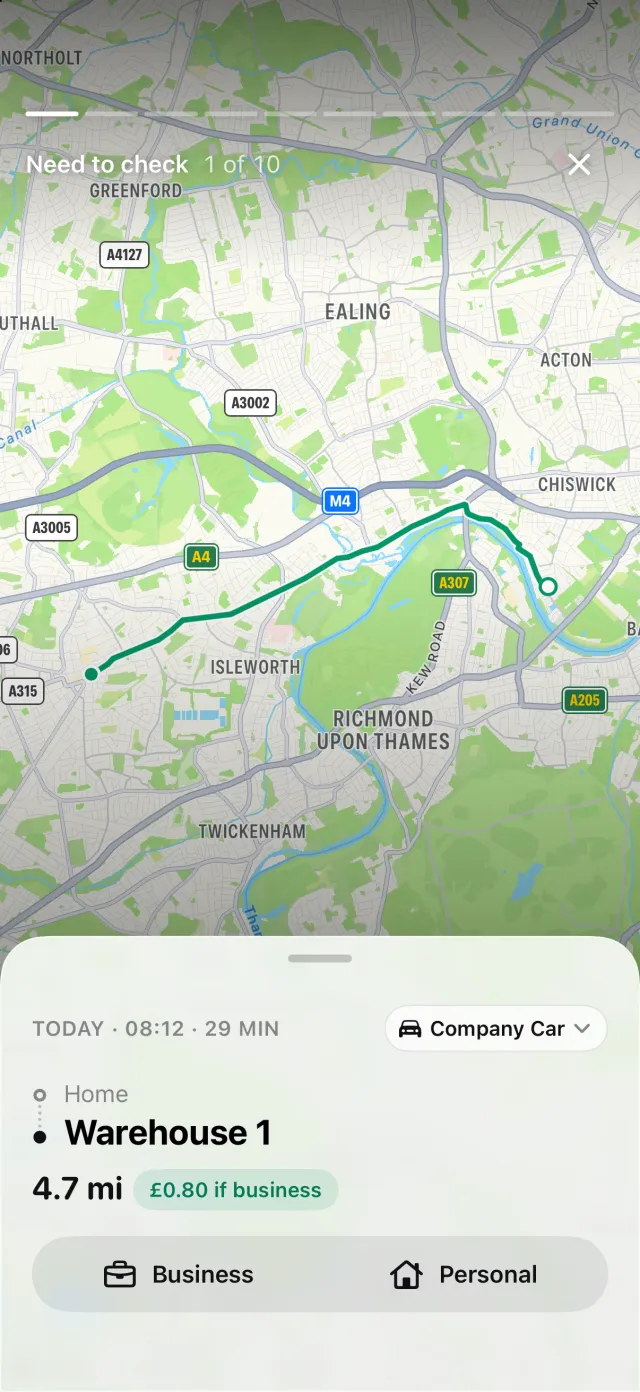
Working hours can file a commute made inside them as Business. A Personal rule on your base office stops that for the drives to it, because a place rule always wins over working hours.
What DriveHub does not do is decide whether a workplace is temporary. That turns on what you were told about a posting, how much of your time you spend at a site and when that changed. DriveHub does not know any of it. You change a site's rule on the day it becomes permanent; trips before that keep the type they had.
Every trip keeps its date, both ends and its distance, so the dates you drove to each site are already in the log. If your iPhone logged driving with no matching trip, Missed drives appears on the Trips tab. The report prints the date, both addresses, the distance and your own reason for each journey. Ways to keep a mileage log compares this with paper and spreadsheets.
This page states what HMRC and the legislation say, and cites them so you can check. It is not tax advice. It can't account for your circumstances. Where money is involved, ask your accountant — and bring the logs.
The full rule for United Kingdom, with the instruments it comes from: mileage log requirements in the United Kingdom.