 DriveHub
Country guide · United Kingdom · 6 min
Company car fuel benefit: repay every private mile by 6 July
Your company car comes with fuel, and some of the miles are yours. Repay every private mile by 6 July and the company car fuel benefit is nil. Repay less, and you're taxed as if the fuel were worth £29,200 times your car's percentage.

The short answer
- Is private fuel taxed? Yes. If the company pays for fuel you use privately, you're taxed on a car fuel benefit: your car's percentage of £29,200 for 2026-27.
- How do I avoid it? Be required to repay the whole cost of your private fuel, and repay it on or before 6 July after the tax year.
- Does repaying part of it help? No. The charge can be cut by time, never by amount.
- Is my commute private? Yes. Home to your permanent workplace isn't business travel.
- How much do I repay? Your private miles × the Advisory Fuel Rate (or a higher rate), each mile at the rate in force when it was driven.
- Is it worth repaying? For example, with a 25% petrol car (1401–2000cc, 17p a mile), a 20% taxpayer saves by repaying up to about 8,590 private miles a year.
- Fully electric car? Electricity isn't fuel for this charge. There is nothing to repay.
What the fuel benefit is
ITEPA 2003 s. 149(1) applies where "fuel is provided for a car by reason of an employee's employment": "the cash equivalent of the benefit of the fuel is to be treated as earnings". Under s. 149(3)(d), paying "any sum ... in respect of expenses incurred in providing fuel for the car" counts, so reimbursed fuel receipts count too.
s. 150(1) fixes the amount: "The cash equivalent of the benefit of the fuel is the appropriate percentage of £29,200." The percentage is the car's own (s. 150(2)). £29,200 is new for 2026-27 (SI 2025/1254, replacing £28,200).
The formula doesn't contain your private mileage. Ten private miles a year and ten thousand produce the same charge.
A nil charge: repay all of it by 6 July
s. 151(1): "The cash equivalent of the benefit of the fuel is nil if condition A or B is met." Condition B is fuel "made available only for business travel".
Condition A, s. 151(2): "(a) in the tax year in question, the employee is required to make good to the person providing the fuel the whole of the expense incurred by that person in connection with the provision of the fuel for the employee's private use, and (b) the employee does make good that expense on or before 6 July following that tax year."
Both limbs have to hold:
- You must be required to repay. Paying voluntarily, without an arrangement with your employer, doesn't meet (a).
- You must repay the whole. Repaying most of it meets nothing.
For 2026-27, which ends on 5 April 2027, the deadline is 6 July 2027.
Private means every mile that isn't business travel
s. 118(2) defines "private use" for these rules as "any use other than for the employee's business travel (see section 171(1))". s. 171(1) makes business travel the travel whose cost is deductible under ss. 337 to 342 and a few other sections. s. 338(2)–(3) excludes "ordinary commuting": travel between "the employee's home and a permanent workplace".
So the drive to your usual office is a private mile and belongs in the repayment. A trip to a temporary workplace is business travel; see commuting or a temporary workplace.
Part of the year can count, part of the cost can't
The one reduction is by time. s. 152(2) reduces the charge "proportionately" for days with no fuel available, business-only fuel, or full repayment by 6 July. But s. 152(3): "The fact that any of the conditions specified in subsection (2) is met for part of a tax year is to be disregarded if there is a time later in that year when none of those conditions is met."
So the order matters. Stop private fuel in October and keep it stopped, and the charge falls by days. Repay from April to September, then keep the fuel and stop repaying, and the charge isn't reduced at all.
How much "the whole" is: private miles × the Advisory Fuel Rate
HMRC's Advisory fuel rates page (updated 21 August 2026) gives the measure:
"There will be no fuel benefit charge if you correctly record all private travel mileage and use the correct rate (or higher), to work out how much your employees must repay you for fuel used for private travel."
The words that carry the weight are all private travel mileage. A private trip missing from the log is fuel nobody repaid, so the repayment can fall short of "the whole", and then condition A fails.
A lower rate works only if it still covers everything: "You will not need to use the advisory rates where you can show that employees cover the full cost of private fuel by repaying at a lower mileage rate." And "Hybrid cars are treated as either petrol or diesel cars for advisory fuel rates."
The rates move every quarter
"HMRC reviews rates quarterly on: 1 March; 1 June; 1 September; 1 December". From 1 September 2026:
| Fuel | Engine size | Per mile |
|---|---|---|
| Petrol | 1400cc or less | 14p |
| Petrol | 1401–2000cc | 17p |
| Petrol | over 2000cc | 27p |
| Diesel | 1600cc or less | 15p |
| Diesel | 1601–2000cc | 16p |
| Diesel | over 2000cc | 22p |
LPG rates are on the same page. "You can use the previous rates for up to 1 month from the date any new rates apply." To price each mile at the rate for its quarter, one annual total isn't enough: you need to know when the private miles were driven.
Is repaying private fuel cheaper than the fuel benefit?
This is arithmetic, not a rule. Take a petrol car at 25% (an example; use your car's own percentage), 1401–2000cc, at 17p a mile.
- The charge: 25% × £29,200 = £7,300, taxed at 20% = £1,460, or at 40% = £2,920.
- Break-even at 20%: £1,460 ÷ £0.17 = about 8,590 miles.
- Break-even at 40%: £2,920 ÷ £0.17 = about 17,180 miles.
One example year. 5,000 private miles cost 5,000 × £0.17 = £850 to repay, against £1,460 in tax at 20%. Repaying saves £610. Above the break-even, the charge is cheaper.
Is there a fuel benefit on an electric company car?
No. s. 149(4): "References in this section to fuel do not include any facility or means for supplying electrical energy or any energy for a car which cannot in any circumstances emit CO2 by being driven." The AFR page's electric rates, 7p home and 15p public charging, are for reimbursing business miles, not repaying private ones.
If you buy the fuel yourself and claim relief, the P87 notes say to use "your actual fuel costs, not any set mileage rates". Keep the receipts. Driving your own car instead? See using your own car for work.
From April 2027: payrolled benefits, same 6 July
HMRC's interim payrolling guidance puts "company cars; car fuel" in phase 1, due to start on 6 April 2027. It keeps the deadline: "Employees have until 6 July, following the end of the tax year, to make good."
The regulations that make payrolling mandatory are still in draft. Final phase-1 guidance is due with the Autumn Budget on 28 October 2026.
Before 6 July
- An arrangement with your employer requires you to repay private fuel.
- Every private trip in the year, commutes included, is in the log.
- Each private mile is priced at the AFR for your car, for the quarter it was driven in.
- The repayment reaches your employer on or before 6 July.
- If you stopped private fuel part-way through the year, it stayed stopped.
- Claiming business miles too? Check what HMRC asks your mileage log to show.
How DriveHub makes this easier
The fuel benefit turns on your private miles, all of them, split by when they were driven.
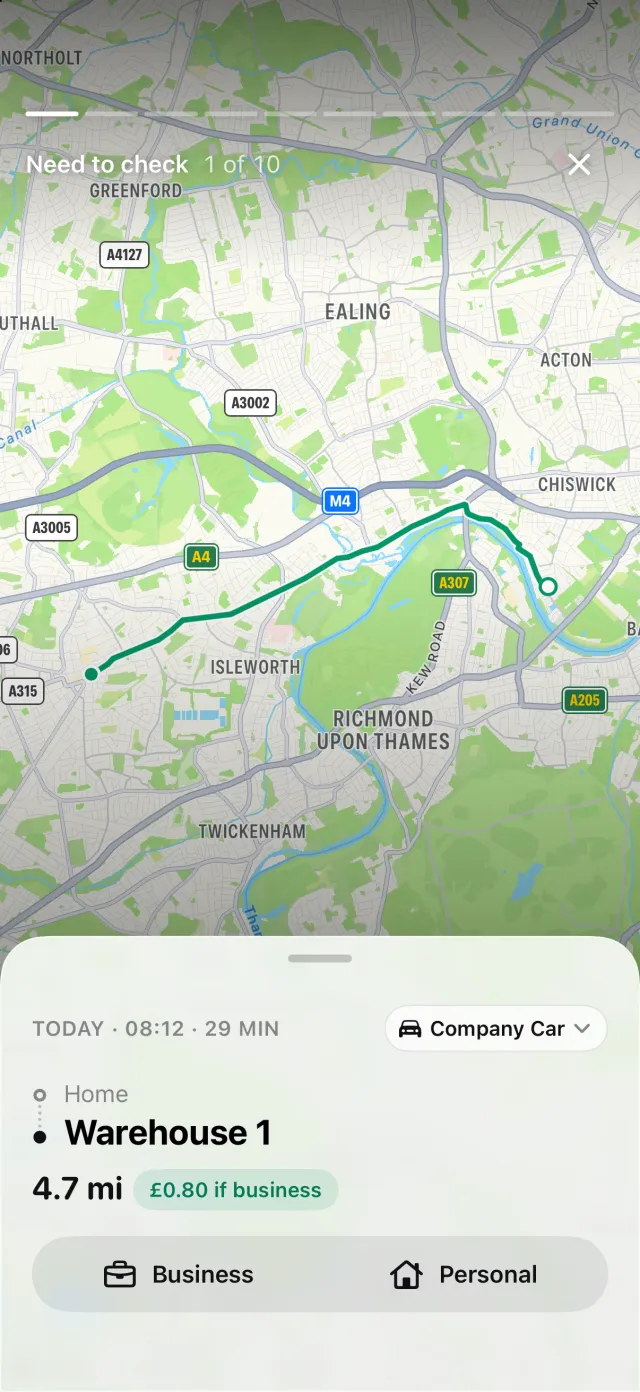
With location access set to Always, DriveHub records every drive in the background — and if it ever misses one, it tells you. A rule on a place, your past drives on the same route and your working hours file many trips as Business or Personal. The rest wait under Need to check, so none is lost between the two. Working hours can file a commute made inside them as Business; a Personal rule on your office stops that, because a place's own rule always wins.
If your iPhone logged driving with no matching trip, Missed drives appears on the Trips tab, and Recover rebuilds the route. A private trip that failed to record is the one that would make your repayment short.
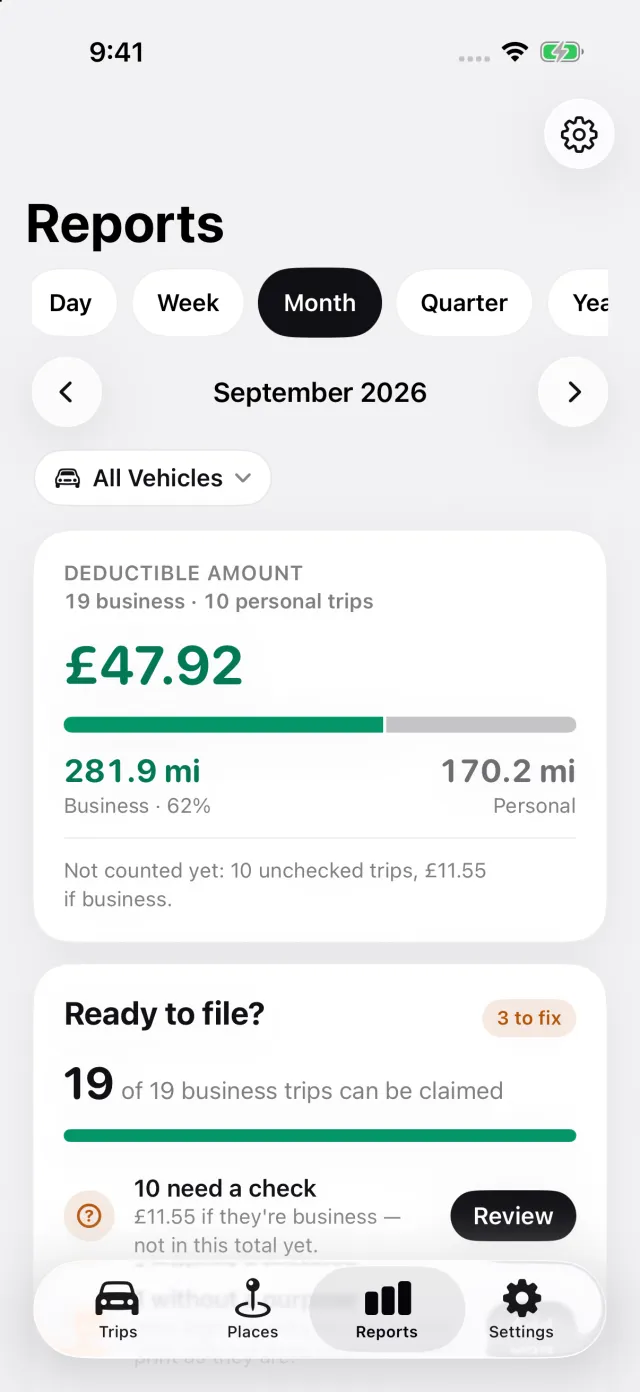
Reports shows business and personal miles for any period or a range you choose, for one vehicle or all. Pick a range that matches an AFR period, such as 1 September to 30 November. The Personal figure is the one to multiply by that period's rate.
Where DriveHub stops: it doesn't know whether your employer requires repayment, it doesn't repay anyone, and it doesn't decide whether repaying beats the charge.
DriveHub is on the App Store for iPhone. The UK rules and rates are on the UK page. Setting up automatic tracking takes a few minutes, once. For paper, spreadsheets and apps compared, see four ways to keep a mileage log.
This page states what HMRC and the legislation say, and cites them so you can check. It is not tax advice. It can't account for your circumstances. Where money is involved, ask your accountant or your employer's payroll team — and bring the log.
The full rule for United Kingdom, with the instruments it comes from: mileage log requirements in the United Kingdom.