 DriveHub
Country guide · Finland · 8 min
Company car in Finland: vapaa autoetu or käyttöetu in 2026
Your employer in Finland gives you a car, and you drive it privately too. Whether that is vapaa autoetu or käyttöetu depends on one question: who pays the fuel. Whether a logbook lowers your tax depends on how much you drive privately.

The short answer
- Which one is it? If your employer pays the car's costs, fuel included, it is vapaa autoetu (a full car benefit). If you pay at least the fuel yourself, it is auton käyttöetu (a use-only benefit).
- Which costs less? Käyttöetu has a lower taxable value, but you buy the fuel.
- What is the value in 2026? For a car first used in 2024–2026: 1,5 % of the new price plus 285 € a month (vapaa) or 105 € (käyttöetu).
- Can a logbook lower it? Yes. With an ajopäiväkirja (logbook), a 2024–2026 car can use 19 c (vapaa) or 7 c (käyttöetu) per private kilometre instead of the monthly sum. That is less below 1 500 private kilometres a month, and more above it.
- Does the commute count? Yes, as private driving.
- Driving over 30 000 business km a year? The base value drops to 80 %, and the logbook is what shows it.
- Fully electric? From 2026 to 2029 the value is 170 € a month lower for both kinds. A vapaa autoetu also loses 120 € of its monthly running-cost sum, so on the monthly value it falls by 290 € in all.
Who pays the fuel decides which benefit you have
A car your employer lets you use privately is a taxable benefit in kind (Tuloverolaki 64 §). Verohallinto sets its value every year; for 2026 in luontoisetupäätös 998/2025. The decision covers a car or a van used privately by you or your family.
Its § 21 draws the line by costs, not by the car:
"Vapaa autoetu on kysymyksessä, kun työnantaja suorittaa autosta johtuvat kustannukset. Auton käyttöetu on kysymyksessä, kun palkansaaja suorittaa itse ainakin auton käyttövoimakulut."
Käyttövoimakulut are the running costs of the fuel or energy. Verohallinto's guidance on benefits in kind, VH/6801/00.01.00/2025, adds in § 7.1 that you pay them to someone else: "Palkansaajan on maksettava kulut muulle taholle kuin omalle työnantajalle."
Anything you pay your employer toward the car's costs comes straight off the taxable value, under either kind (§ 21: "…vähennetään vapaan autoedun tai auton käyttöedun raha-arvosta").
The 2026 values
The monthly value is a base value, a percentage of the car's new price, plus a running-cost part: a fixed monthly sum or a per-kilometre value. Decision 998/2025 § 17(1) sets them by age group:
| Age group (year first used) | Vapaa autoetu | Auton käyttöetu |
|---|---|---|
| A — 2024–2026 | 1,5 % + 285 € or 19 c/km | 1,5 % + 105 € or 7 c/km |
| B — 2021–2023 | 1,2 % + 300 € or 20 c/km | 1,2 % + 120 € or 8 c/km |
| C — before 2021 | 0,9 % + 315 € or 21 c/km | 0,9 % + 135 € or 9 c/km |
The age group moves every year. A car is in group A for its first three years of use, B for the next three, then C (VH/6801 § 7.2: "Autoedun ikäryhmät vaihtuvat vuosittain.").
Three rules shape the new price:
- It is the list price on the purchase date minus 3 400 € (§ 18).
- The percentage result "pyöristetään lähinnä alempaan 10 euroon" — rounded down to the nearest 10 € (§ 18).
- Accessories count "siltä osin kuin niiden arvo ylittää 1 200 euroa" — only the part above 1 200 € (§ 20).
Verohallinto's own example (Esimerkki 16)
VH/6801 § 7.6 works through a group A car with a 27 000 € list price and 2 500 € of accessories:
- New price: 27 000 € − 3 400 € = 23 600 €
- Accessories above the threshold: 2 500 € − 1 200 € = 1 300 €
- Basis: 23 600 € + 1 300 € = 24 900 €
- Base value: 1,5 % × 24 900 € = 373,50 € → rounded down to 370 €
- Vapaa autoetu: 370 € + 285 € = 655 € a month
- Käyttöetu: 370 € + 105 € = 475 € a month ("Saman auton arvo auton käyttöetuna on 475 euroa (370 + 105).")
The base value is the same in both. The whole difference is the running-cost part: 285 € − 105 € = 180 € a month of taxable value, against the fuel you buy yourself under käyttöetu.
When a logbook lowers the tax: the 1 500 km line
The monthly running-cost sum rests on an assumption. VH/6801 § 7.5.1: "Autoedun kuukausikohtainen käyttökustannusten arvo on laskettu olettaen, että yksityisajoja on 1 500 kilometriä kuukaudessa, eli 18 000 kilometriä vuodessa. Jos yksityisajoa on jatkuvasti tätä vähemmän, palkansaaja pääsee edullisempaan verotusarvoon pitämällä ajopäiväkirjaa."
The 1 500 km a month is the guidance's assumption. The decision itself sets the condition for the per-km value, in § 17(4): "Kilometrikohtaisen arvon käyttäminen edellyttää ajopäiväkirjaa tai muuta luotettavaa selvitystä autolla ajetuista kilometrimääristä."
Every row of the table breaks even at exactly 1 500 private km a month. For group A: 285 € ÷ 0,19 € = 1 500, and 105 € ÷ 0,07 € = 1 500. Groups B and C divide the same way.
A worked example, on the Esimerkki 16 car
Arithmetic from the figures above, not a rule. The same car, base value 370 €, and 600 private km in a month:
- Vapaa, per km: 370 € + 600 × 0,19 € = 370 € + 114 € = 484 €, against 655 € flat. That is 171 € less taxable value that month.
- Käyttöetu, per km: 370 € + 600 × 0,07 € = 370 € + 42 € = 412 €, against 475 € flat. That is 63 € less.
Now 2 000 private km in a month:
- Vapaa, per km: 370 € + 2 000 × 0,19 € = 370 € + 380 € = 750 €, against 655 € flat.
The lower figures are taxable value, not tax. What you save is that difference times your own tax rate.
The choice sticks, and has no ceiling
The per-km choice "on noudatettava systemaattisesti", and "Kuukausiarvo ei tässä tapauksessa rajoita veronalaisen edun määrää" (VH/6801 § 7.5.1). The monthly sum is no cap: a heavy private month costs more. The per-km route pays only if you stay under 1 500 km a month consistently.
You can claim it yourself
Your employer may keep the monthly value in withholding. Then "palkansaaja ilmoittaa ajopäiväkirjan mukaan ajetun kilometrimäärän veroilmoituksellaan ja vaatii edun arvon alentamista" (§ 7.5.1): you report the logged kilometres on your own tax return (veroilmoitus) and ask for the lower value. The logbook stays with you until Verohallinto asks for it.
The commute counts, and 18 000 km can raise the value
Decision 998/2025 § 22: "Autoetua vahvistettaessa luetaan yksityisajoihin myös auton käyttäminen asunnon ja työpaikan välisiin matkoihin." Driving between home and your regular workplace is private, and it counts toward the 1 500 km a month. One exception in VH/6801 § 7.5.3.2: a drive from home straight to a client in the morning is business.
The logbook works in the other direction too. § 17(4) goes on: "Verotusta toimitettaessa autoedun arvoa voidaan korottaa, jos on ilmeistä, että autolla vuoden aikana ajettujen yksityisajojen määrä ylittää 18 000 kilometriä."
The commute alone can get there. VH/6801 § 7.7's example is a 41 km one-way commute on 220 working days: 41 km × 2 × 220 = 18 040 km, just over the line. And "Myös kesämökkimatkat ovat yksityisajoa" — trips to the summer cottage are private as well.
Over 30 000 business kilometres: the base value at 80 %
Decision 998/2025 § 19: "Jos luontoisetuautolla ajettujen työajojen määrä on kalenterivuoden aikana yli 30 000 kilometriä, … edun perusarvo on 80 prosenttia edellä 17 ja 18 §:ssä tarkoitetusta perusarvosta."
Only the base value is cut; the running-cost part stays (VH/6801 § 7.8.2). Your employer may apply the cut in advance, but "Ajopäiväkirja on kuitenkin aina tarkistettava vuoden lopussa, jotta varmistutaan rajan ylittymisestä." In your own taxation, business kilometres for several employers in the same calendar year are added together.
Verohallinto's Esimerkki 18, on the same car:
- Base value: 370 € × 80 % = 296 € ("Alennettua arvoa ei pyöristetä" — it is not rounded)
- Vapaa autoetu: 296 € + 285 € = 581 € a month, instead of 655 €
An electric car: 170 € off, and more for vapaa
TVL 64 a §, added by law 702/2024, takes 170 € off the value "jokaiselta sellaiselta kuukaudelta" — each month the benefit is a car whose CO₂ emission is 0 g/km. It is in force from 1 January 2026 to 31 December 2029. VH/6801 § 7.5.4 applies it to vapaa autoetu and käyttöetu alike, on the flat and the per-km value.
For vapaa autoetu only, § 17(3) of the decision also cuts the running-cost part: "0,08 euroa kilometriltä tai 120 euroa kuukaudessa, jos auton ainoa mahdollinen käyttövoima on sähkö". For an externally chargeable hybrid or a methane car, it is 0,04 €/km or 60 € a month. The guidance: "Vähennys ei koske käyttöetuna annettua autoetua."
Verohallinto's Esimerkki 17, the same car as a full EV:
- Vapaa: 370 € + 285 € − 120 € = 535 €; 535 € − 170 € = 365 € a month (290 € below 655 €)
- Käyttöetu: 370 € + 105 € − 170 € = 305 € a month (170 € below 475 €)
Business trips in the benefit car: kilometre allowances
With vapaa autoetu, your employer "ei voi maksaa verovapaita kilometrikorvauksia" for business driving in that car (VH/630/00.01.00/2026 § 8.2.5) — no tax-free kilometre allowance.
With käyttöetu, where you pay the fuel, your employer may pay a tax-free 0,11 € per kilometre for business driving in 2026 (decision 970/2025 § 9(3)). Using your own car for work is a different regime, covered in using your own car for work in Finland.
What the logbook has to show
If you use the per-km value, the ajopäiväkirja is defined by decision 998/2025 § 24. It must show "autolla verovuonna päivittäin ajettu kilometrimäärä" — the kilometres driven each day. For each business drive it also needs:
- the start and end time
- the place, and the route where needed
- "matkamittarin lukema ajon alkaessa ja päättyessä" — the odometer reading at the start and the end
- the distance
- the purpose
- "auton käyttäjä" — who drove
For private driving, the kilometres are enough (VH/6801 § 7.5.2): "Yksityisajoista riittää pelkkä kilometrimäärä."
Paper or electronic. "Ajopäiväkirja voi olla manuaalinen tai elektroninen" (§ 7.5.2). The guidance also mentions tracking services an employer fits to the car (§ 7.4.6), and says nothing about phone apps either way.
How DriveHub makes this easier
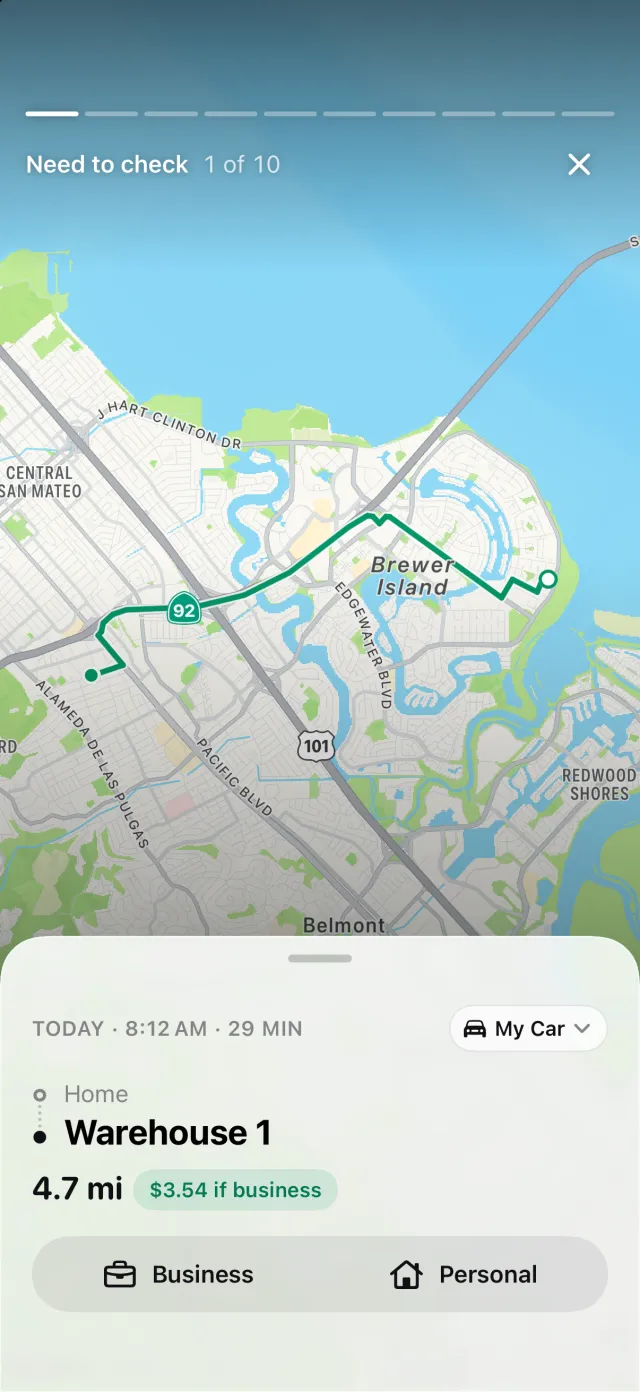
With location access set to Always, DriveHub records every drive in the background — and if it ever misses one, it tells you. You mark each trip Business or Personal, and a trip not sorted yet waits under Need to check. If your iPhone logged driving with no matching trip, it shows under Missed drives, where Recover rebuilds the route.
A report for one company car gets a kilometres-per-day appendix, the daily figure § 24 asks for.
Where DriveHub stops: it does not compute your autoetu, and it files nothing. It can remind you to enter an odometer reading, but the per-drive readings § 24 names are yours to note. Whether the per-km value suits you is your decision, with your employer's payroll or your adviser.
DriveHub is on the App Store for iPhone. The Finnish rules and rates are on the Finland page. Setting up automatic tracking takes a few minutes, once. If the car is in your own company, see a car in your own osakeyhtiö; if it is your toiminimi's, see a toiminimi car: business or private.
Sources
- Tuloverolaki 1535/1992, 64 § and 64 a § (law 702/2024).
- Verohallinnon päätös luontoisetujen laskentaperusteista, 998/2025 — §§ 17, 18, 19, 20, 21, 22 and 24.
- Verohallinto, Luontoisedut verotuksessa, VH/6801/00.01.00/2025 — §§ 7.1, 7.2, 7.4.6, 7.5.1–7.5.4, 7.6, 7.7 and 7.8.2.
- Verohallinto, Työmatkakustannusten korvaukset verotuksessa, VH/630/00.01.00/2026 — § 8.2.5.
- Verohallinnon päätös verovapaista matkakustannusten korvauksista, 970/2025 § 9(3).
This page states what the Finnish legislation and Verohallinto's decisions and guidance say, and cites them so you can check. It is not tax advice. It can't account for your circumstances. Where money is involved, ask your employer's payroll team or your adviser — and bring the log.
The full rule for Finland, with the instruments it comes from: mileage log requirements in Finland.