 DriveHub
Country guide · Finland · 7 min
A car in your own osakeyhtiö: fuel, private kilometres and the logbook
You bought the car through your own osakeyhtiö, and the company pays for the fuel. Your private kilometres are then a taxable car benefit — and "an oy needs no logbook" is only half true.

The short answer
- Your oy can give you the car and its fuel as a car benefit (autoetu). As the owner you count as the employee (VH/6801 § 1.3), and your private use is taxable income.
- It is valued by Verohallinto's figures only if handled as salary: booked as salary and reported to the Incomes Register (tulorekisteri). An unusual benefit can still be taxed as a hidden dividend (peitelty osinko).
- The company pays the fuel, so it is a vapaa autoetu (full benefit). Paying the fuel back to your own company does not turn it into käyttöetu.
- Private driving, the commute included, is what the benefit prices. The flat monthly value assumes 1 500 private km a month.
- No logbook is needed for the flat value. A logbook or another reliable record is needed for the per-kilometre value, the 30 000 km reduction, and a kilometre allowance for trips in another car.
- A kilometre allowance to yourself next to a vapaa benefit car is not tax-free without a special justification (VH/490 § 6). In Verohallinto's example, such allowances are treated as a hidden dividend.
Your company can give you a car benefit — a toiminimi cannot
The legal basis is tuloverolaki (TVL) 64 §, 1 momentti: "Työnantajalta saatu luontoisetu on veronalaista ansiotuloa ja arvioidaan käypään arvoon. Verohallinto määrää vuosittain luontoisetujen käypien arvojen laskentaperusteet." For 2026 that annual decision is luontoisetupäätös 998/2025.
As the owner, you are the employee here. Verohallinto's guidance on benefits in kind, VH/6801/00.01.00/2025 § 1.3, says so directly:
"Osakeyhtiön osakkeenomistaja ja henkilöyhtiön (ay ja ky) yhtiömies voivat saada palkkaa omistamastaan yhtiöstä. Siten he voivat saada yhtiöstään myös luontoisetuja."
A sole trader is in a different position. The same section: "Yksityinen elinkeinonharjoittaja (toiminimiyrittäjä ja maa- ja metsätaloudenharjoittaja) ei voi nostaa yrityksestään palkkaa eikä ottaa luontoisetuja." If your car is in a toiminimi, read toiminimi and the car: business or private instead.
The condition an owner has to meet: salary in the books, reported
§ 1.3 attaches a condition to the owner's benefit. It is valued by the decision's figures only "jos etuja on käsitelty asianmukaisesti palkkatulona kirjanpidossa ja edut on ilmoitettu tulorekisteriin palkkatietoilmoituksella." In plain terms: booked as salary, and reported to the Incomes Register.
The same paragraph names the risk: "Esimerkiksi epätavanomaiset ja perusteettomat edut osakeyhtiöstä voidaan verottaa peiteltynä osinkona, vaikka ne olisi kirjanpidossa käsitelty palkkana tai luontoisetuna." Peitelty osinko is a hidden dividend. Booking the car as a benefit does not by itself protect you from that reading.
Who pays the fuel: vapaa autoetu or käyttöetu
998/2025 § 21 defines the two kinds by the costs:
"Vapaa autoetu on kysymyksessä, kun työnantaja suorittaa autosta johtuvat kustannukset. Auton käyttöetu on kysymyksessä, kun palkansaaja suorittaa itse ainakin auton käyttövoimakulut."
If the company pays for the fuel, the benefit is vapaa. For käyttöetu you pay at least the fuel, and VH/6801 § 7.1 adds to whom: "Palkansaajan on maksettava kulut muulle taholle kuin omalle työnantajalle." Paying the fuel back to your own company does not turn it into käyttöetu.
What you do pay the company for the car's costs still lowers the benefit's value: "korvaus vähennetään vapaan autoedun tai auton käyttöedun raha-arvosta" (§ 21).
What the benefit is worth in 2026
For a car first used in 2024–2026, the monthly value is 1,5 % of its new price plus 285 € (vapaa) or 105 € (käyttöetu), per 998/2025 § 17(1). Verohallinto's own example is a 27 000 € car with 2 500 € of accessories. It comes to 655 € a month as a vapaa autoetu and 475 € as käyttöetu (VH/6801 § 7.6, Esimerkki 16).
A car with zero driving emissions is 170 € a month lower until the end of 2029 (TVL 64 a §). A vapaa benefit on a fully electric car also loses 120 € a month from its running-cost part (998/2025 § 17(3)).
Older cars, the 3 400 € deduction from the list price, the accessories rule and the worked examples are on vapaa autoetu or käyttöetu. These are 2026 figures; the decision for 2027 was not yet published in September 2026.
Do you need an ajopäiväkirja?
For the flat monthly value, no. That is the part of the common answer that holds. The flat value rests on an assumption, stated in VH/6801 § 7.5.1:
"Autoedun kuukausikohtainen käyttökustannusten arvo on laskettu olettaen, että yksityisajoja on 1 500 kilometriä kuukaudessa, eli 18 000 kilometriä vuodessa. Jos yksityisajoa on jatkuvasti tätä vähemmän, palkansaaja pääsee edullisempaan verotusarvoon pitämällä ajopäiväkirjaa."
With a logbook, a new car can be valued at 19 or 7 cents per private kilometre instead of 285 € or 105 €. The condition is in 998/2025 § 17(4): "Kilometrikohtaisen arvon käyttäminen edellyttää ajopäiväkirjaa tai muuta luotettavaa selvitystä autolla ajetuista kilometrimääristä."
The two break even at the same point: 285 € ÷ 0,19 € = 1 500 km, and 105 € ÷ 0,07 € = 1 500 km. The older age groups do too. If your private driving stays below 1 500 km a month, the per-kilometre value is lower.
The choice is sticky. VH/6801 § 7.5.1: "Jos valitaan autoedun kilometriperusteinen laskentatapa, valintaa on noudatettava systemaattisesti. Kuukausiarvo ei tässä tapauksessa rajoita veronalaisen edun määrää." Once you choose kilometres, the monthly value is no ceiling.
Your company can keep withholding on the monthly value. You then claim the lower value yourself: "palkansaaja ilmoittaa ajopäiväkirjan mukaan ajetun kilometrimäärän veroilmoituksellaan ja vaatii edun arvon alentamista." You keep the logbook and hand it over "ainoastaan pyydettäessä" — only when asked.
The commute is private driving
998/2025 § 22: "Autoetua vahvistettaessa luetaan yksityisajoihin myös auton käyttäminen asunnon ja työpaikan välisiin matkoihin." Trips to a summer cottage are private too (VH/6801 § 7.7). And where private driving evidently passes 18 000 km a year, § 17(4) lets Verohallinto raise the value.
Over 30 000 business kilometres
998/2025 § 19 cuts the percentage part of the value to 80 % when business driving in the calendar year passes 30 000 km. The log is what proves it: "Ajopäiväkirja on kuitenkin aina tarkistettava vuoden lopussa, jotta varmistutaan rajan ylittymisestä" (VH/6801 § 7.8.2).
What the logbook shows
§ 24 asks for "autolla verovuonna päivittäin ajettu kilometrimäärä" — the kilometres driven each day. For each business drive it adds the start and end time, the place and route where needed, and "matkamittarin lukema ajon alkaessa ja päättyessä". Then the distance, the purpose and "auton käyttäjä", the driver.
Private driving needs less: "Yksityisajoista riittää pelkkä kilometrimäärä" (VH/6801 § 7.5.2). The same section leaves the form open: "Ajopäiväkirja voi olla manuaalinen tai elektroninen."
A kilometre allowance on top of the benefit car
Driving the benefit car for the company earns you no tax-free allowance. VH/630/00.01.00/2026 § 8.2.5:
"Työnantaja, joka on antanut palkansaajalle vapaan autoedun, ei voi maksaa verovapaita kilometrikorvauksia sellaisista työajoista, jotka palkansaaja on ajanut luontoisetuna saamallaan autolla."
With käyttöetu, where you pay the fuel, the company may pay 0,11 € per km for business driving in 2026 (970/2025 § 9(3)).
What about trips in a car you own privately? Verohallinto's kannanotto VH/490/00.01.00/2021 sets the general rule in § 2. An employee with a vapaa autoetu can be paid tax-free for such trips, with proof: "luotettava selvitys (esimerkiksi ajopäiväkirja) siitä, että matka on tosiasiassa tehty muulla kuin työnantajalta vapaana autoetuna saadulla autolla."
For an owner, § 6 is stricter: "Yrityksen omistajalle maksettuja kilometrikorvauksia ei ilman erityisesti perusteluita voida katsoa verovapaaksi, jos tällä on käytettävissään omistamaltaan yritykseltä saatu luontoisetuauto (pois lukien käyttöetu)." And: "Kilometrikorvauksia maksamalla ei voi korvata veronalaista voitonjakoa tai palkanmaksua."
Its Esimerkki 3 is a 30 % shareholder with a vapaa autoetu. He claims 20 000 of 22 000 business km were in his own car. The allowances, 20 000 × 0,44 € = 8 800 €, "katsotaan peitellyksi osingoksi" unless he explains why the benefit car was not used. Small allowances paid only now and then can usually be treated as tax-free.
Read this position with care: it dates from 29.1.2021 and uses the 2021 figure of 0,44 €. vero.fi shows its validity as "Tietoa ei saatavilla" — no information available. The current figure for your own car is on using your own car for work in Finland.
Before the year ends
- The benefit is booked as salary and reported to the Incomes Register.
- You know which kind it is: who paid the fuel, and to whom.
- Your commute is counted as private driving.
- You checked your private kilometres against 1 500 a month and 18 000 a year.
- If you use the per-kilometre value, the log shows kilometres per day and every business drive's § 24 details.
- Over 30 000 business kilometres, the log proves it.
- No tax-free kilometre allowance was paid for driving the vapaa benefit car, and any allowance for your own car is backed by a reliable record.
What this page does not cover
Two questions come with every car in an oy, and this page answers neither.
- How the osakeyhtiö deducts the car's costs and the fuel in its own taxation. The sources above describe the employee side only.
- ALV (VAT). Arvonlisäverolaki 114 § 1 mom 5 k limits input VAT on "henkilöautot" and goods and services for their use, with exceptions. A van's (pakettiauto) private use is not covered here.
Both are questions for your accountant.
How DriveHub makes this easier
Every lever above turns on one split: business kilometres and private kilometres, day by day.
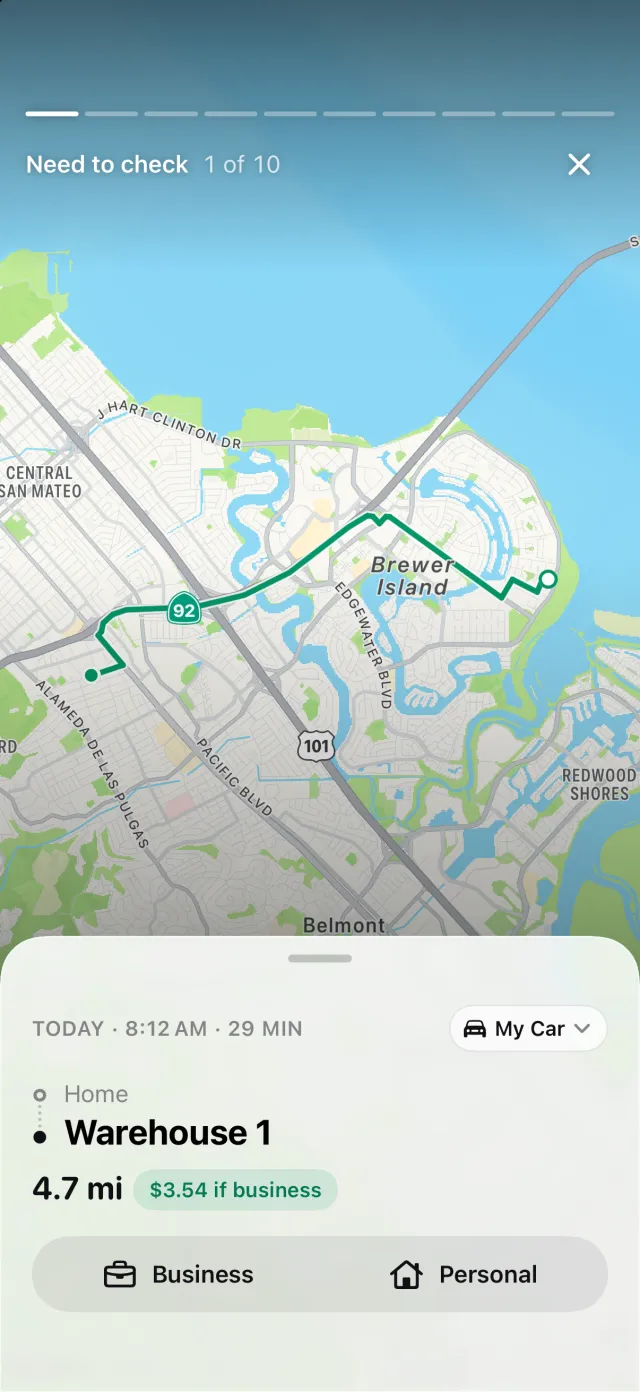
With location access set to Always, DriveHub records every drive in the background — and if it ever misses one, it tells you. You mark each trip Business or Personal, and a trip not sorted yet waits under Need to check. If your iPhone logged driving with no matching trip, Missed drives shows drives it may have missed, and Recover rebuilds the route.
For a Finnish company car, a report about that one car adds a Kilometres per day appendix. It lists every day driven, business and private apart, with the period's totals. That covers § 24's daily kilometres. Check the rest of § 24's list against your exported report: the odometer readings at the start and end of each business drive are yours to note. DriveHub can remind you to enter an odometer reading.
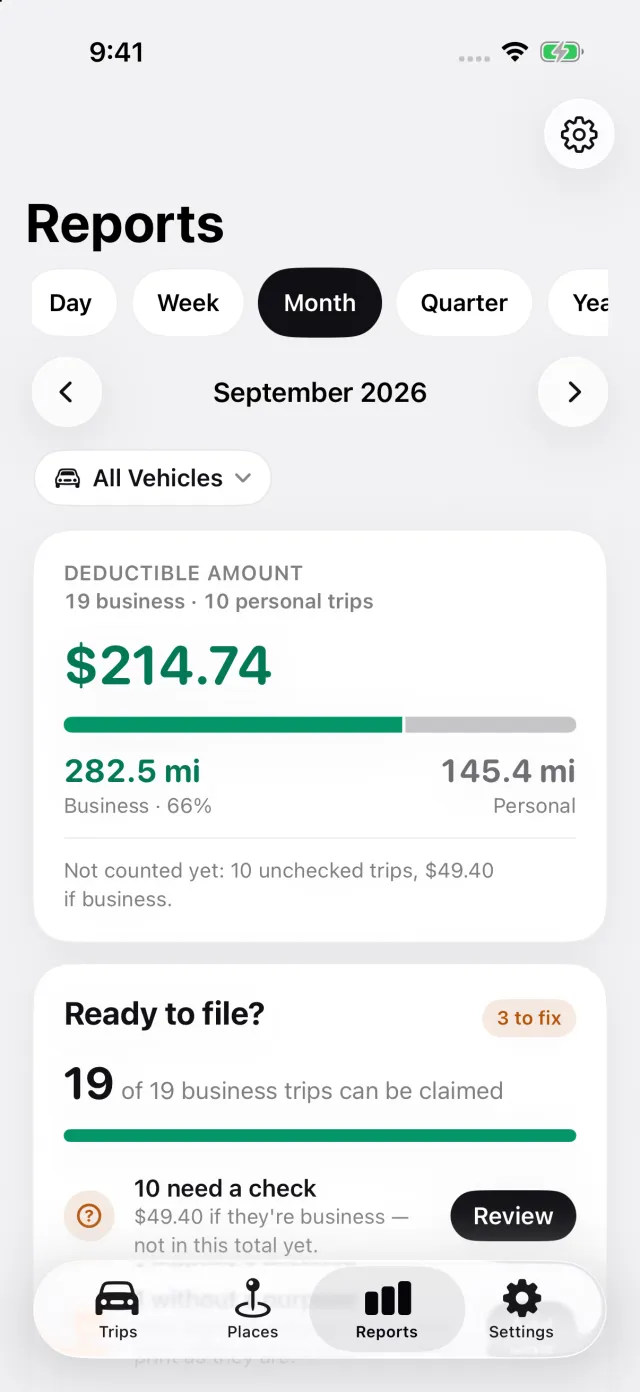
Reports shows business and personal kilometres for a month or a year, narrowed to one vehicle. That is the private total you compare with 1 500 a month.
Where DriveHub stops: it does not compute your autoetu value or choose flat or per kilometre for you. It does not book the fuel or the car's costs, and it does not handle ALV, payroll or the Incomes Register. Those belong to you and your accountant.
DriveHub is on the App Store for iPhone. The Finnish rules are on the Finland page. Setting up automatic tracking takes a few minutes, once. For paper, spreadsheets and apps side by side, see four ways to keep a mileage log.
Sources
- Tuloverolaki 1535/1992, 64 § and 64 a §; laki 702/2024 (64 a § in force 1.1.2026–31.12.2029).
- Verohallinnon päätös luontoisetujen laskentaperusteista vuodelta 2026, 998/2025 — §§ 17, 19, 21, 22 and 24.
- Verohallinto, Luontoisedut verotuksessa, VH/6801/00.01.00/2025 — §§ 1.3, 7.1, 7.5.1, 7.5.2, 7.6, 7.7, 7.8.2.
- Verohallinto, Työmatkakustannusten korvaukset verotuksessa, VH/630/00.01.00/2026 — § 8.2.5; and 970/2025 § 9 (0,11 €/km).
- Verohallinto, kannanotto Luontoisetuauton vaikutus kilometrikorvausten verovapauteen, VH/490/00.01.00/2021 — §§ 2 and 6, Esimerkki 3.
- Arvonlisäverolaki 1501/1993, 114 § 1 mom 5 k.
This page states what Verohallinto and the legislation say, and cites them so you can check. It is not tax advice. It can't account for your circumstances. Where money is involved, ask your accountant — and bring the log.
The full rule for Finland, with the instruments it comes from: mileage log requirements in Finland.