 DriveHub
Country guide · Finland · 9 min
Toiminimi car deduction: book the costs or claim up to 0,55 €/km
You run a toiminimi and drive your own car for the business. Which car deduction you get is not your choice: Verohallinto reads it off your kilometres, and each answer asks for a different record.

The short answer
- Who decides? Your kilometres do, not you. If more than half of the car's kilometres in the tax year are business driving, there is no kilometre deduction that year (VH/721 § 7). Whether the car is a business asset is judged over more than one year.
- Over 50 % business: it is normally a business car. Its actual costs, fuel included, go in your accounts. The private kilometres' share of those costs is then added back to your business income on the return.
- 50 % or less: it is a private car. You can book the costs of your business drives, fuel included, then claim the lisävähennys on Form 5 to top them up to 0,55 €/km (tilikausi ending in 2026). The lisävähennys itself is never booked.
- Your commute is private driving in both cases.
- You can't give yourself an autoetu. A toiminimi can't pay itself a salary or benefits, so the private share is handled by the add-back.
- Do you have to keep a log? Both branches run on the year's total kilometres, private ones included. Without that total there is no lisävähennys, and without a log the private share is estimated.
Why the kilometres decide, not you
The rule starts in the business income tax act. EVL 53 § 2 mom puts an asset other than real estate in the business source when it is one "jota käytetään yksinomaan tai pääasiallisesti elinkeinotoiminnassa" — used only or mainly in the business.
Verohallinto's guidance on the self-employed's travel costs, VH/721/00.01.00/2025, turns "mainly" into a number. § 7:
"Jos kaikista verovuonna ajetuista kilometreistä yli puolet on elinkeinotoimintaan tai maatalouteen liittyvää ajoa, auto kuuluu elinkeinotoiminnan tai maatalouden tulolähteeseen."
The mirror rule for a private car is in § 5.3. The car counts as private when the non-business driving is at least half of the total: "mikäli auton muut kuin elinkeinotoimintaan liittyvät ajot ovat vähintään 50 % auton kokonaisajosta". Verohallinto's entrepreneur page says the same in plain words: business vehicles are those "hankittu elinkeinotoiminnan käyttöön ja yli 50% ajokilometreistä on elinkeinotoiminnan ajoja".
Exactly half business is still a private car. Only more than half moves it to the business.
One bad year does not move the car
The 50 % test is read per tax year when it decides the lisävähennys. Whether the car belongs to the business's net assets is judged over a longer stretch. VH/721 § 7 again:
"Sen sijaan, kun arvioidaan auton kuulumista elinkeinotoiminnan tai maatalouden nettovarallisuuteen, huomioidaan useamman kuin yhden verovuoden olosuhteet. Jos auto on hankittu elinkeinotoiminnan tai maatalouden käyttöön, tilapäinen liike- tai maatalouskäytön aleneminen jonakin vuonna alle puoleen, ei merkitse auton siirtymistä pois elinkeino- tai maataloustulolähteen nettovarallisuudesta."
So a car bought for the business stays a business asset through one quiet year. The same paragraph has the mirror sentence for a private car that is over half business for one year. What you need either way is the business share for every year, which only a full-year record gives you.
Over 50 %: a business car, and the private share comes back
A business car's costs are booked in the accounts: fuel, the other running costs and the depreciation. Private driving in it is not deductible. VH/721 § 7:
"Kun yksityinen liikkeen- tai ammatinharjoittaja käyttää elinkeinotulolähteeseen kuuluvaa autoa yksityisajoihin, yksityisajojen osuus auton kuluista ei ole elinkeinotulosta vähennyskelpoista menoa. … Yksityisajoja vastaava osuus kirjanpitoon sisältyvistä autokuluista lisätään elinkeinotoiminnan tuottoihin veroilmoituksella."
The legal basis is EVL 51 b §, the rule for taking business assets or benefits into your private household. The same § 7 gives the formula, from KHO 1987-B-515:
"Yksityisajojen osuus lasketaan jakamalla autokulujen kokonaismäärä ja auton vuotuinen poisto ajokilometrien yhteismäärällä ja saatu luku kerrotaan ajopäiväkirjan mukaisella yksityisajojen kilometrimäärällä"
In words: (car costs + the year's depreciation) ÷ total kilometres × private kilometres from the logbook. And if the private driving can't be shown reliably, "joudutaan yksityisajojen osuus arvioimaan" — it is estimated.
No autoetu to yourself
An employee's private use of a company car is taxed as autoetu. A toiminimi has no employer to give one. Verohallinto's guidance on benefits (VH/6801/00.01.00/2025 § 1.3) says it directly: "Yksityinen elinkeinonharjoittaja (toiminimiyrittäjä ja maa- ja metsätaloudenharjoittaja) ei voi nostaa yrityksestään palkkaa eikä ottaa luontoisetuja."
The guidance on private withdrawals (Tulolähdesiirrot, yksityiskäyttöönotot ja yksityissijoitukset, § 3.2.4) adds: "Elinkeinonharjoittaja ei voi maksaa auton tai asunnon yksityiskäytöstä itselleen vuokraa eikä antaa itselleen myöskään asunto- tai autoetua." The add-back is the only route. If your car sits in your own osakeyhtiö instead, the rules differ; see a company car in your own osakeyhtiö.
Verohallinto's own example
Esimerkki 13 in that same guidance: 30 000 km driven in total, 10 000 of them private. Car costs 3 000 € and depreciation 5 000 €, together 8 000 €.
- 8 000 € ÷ 30 000 km = 0,267 €/km, which the guidance rounds to 0,27 €/km
- 10 000 km × 0,27 € = 2 700 € added to business income
Where it goes on the return
The Form 5 guide (updated 17.11.2025) says where. In OmaVero, choosing "Yksityisajojen kulut on vähennetty kirjanpidossa" makes the service compute the private share. On paper, "Erittele ajot ja laske kulut veroilmoituksen osassa 6", then carry the result to part 2.1, "Tuloutus yksityiskäytöstä - auton yksityiskäyttö".
The first year can hurt
Depreciation starts in the year the car is taken into use, and a full year's depreciation is granted even if that was in December. VH/721 § 7: "Vaikka auto olisi otettu käyttöön aivan loppuvuodesta, myönnetään poisto silti täysimääräisenä." The add-back spreads that whole depreciation over the few kilometres driven since, so each private kilometre carries a large share: "Yksityiskäytön tuloutus saattaa tällöin muodostua hyvinkin suureksi ajettua ajokilometriä kohti".
50 % or less: a private car and the kilometre deduction
Below the line, the car stays in your private assets. You can book the actual costs of your business drives, fuel included. The lisävähennys then tops them up to a per-kilometre maximum: 0,55 €/km for a tilikausi that ends in 2026, 0,59 for one ending in 2025. The maximum is the figure for the calendar year the tilikausi ends in (VH/721 § 3.3.5).
The amount is a difference. VH/721 § 3.3.2: "lisävähennyksen määrä on verovapaan päivärahan ja verovapaan kilometrikorvauksen enimmäismäärän ja todellisten elinkeinotoiminnan kirjanpitoon kirjattujen kulujen erotus." The guidance's Esimerkki 17 (§ 5.5.2) works it through for a car:
- 389 business km × 0,59 € = 229,51 €, the maximum for 2025
- 45 € of fuel for those drives was already booked
- lisävähennys: 229,51 € − 45 € = 184,51 €
Book nothing, and the lisävähennys is the whole maximum: 229,51 € in Esimerkki 19 (§ 5.5.3). Either way the total deduction is the same.
The lisävähennys is claimed on Form 5, part 10, and never booked: "Lisävähennystä ei siis kirjata kirjanpitoon. Kirjanpitoon kirjataan vain todelliset kulut." (§ 3.4). Part 10 asks for the total and business kilometres, the per-km maximum, the maximum total, car costs already booked, and the lisävähennys.
The ownership conditions, the field list and the § 4.6 example of a cut claim are in using your own car for work in Finland. They are not repeated here.
Your commute is private in both cases
Driving between home and your permanent place of business is not business driving. VH/721 § 2.1: "Elinkeinonharjoittajan asunnon ja työpaikan eli pysyvän toimipaikan väliset matkat ovat elinkeinonharjoittajan yksityistalouden matkoja."
That has three effects:
- The commute counts as private kilometres in the 50 % test.
- In a business car it counts as private in the add-back formula. § 7: "Asunnon ja työpaikan väliset matkat ovat edellä tarkoitettua yksityisajoa."
- If commute costs were deducted in the accounts, "ne on lisättävä elinkeinotoiminnan … tuloon" on Form 5.
The commute has its own deduction under TVL 93 § on your pre-filled personal return. It is capped at 7 000 € and applies only above the first 900 €.
One car, two outcomes: an illustration
The figures below are invented to show the arithmetic. They are not from Verohallinto.
Car A, business car. 25 000 km in the tax year: 17 000 business, 8 000 private, commute included.
- Business share: 17 000 ÷ 25 000 = 68 %, so more than half. It is a business car.
- Booked: running costs incl. fuel 4 000 € + depreciation 3 500 € = 7 500 €
- Per kilometre: 7 500 € ÷ 25 000 km = 0,30 €/km
- Added back: 8 000 km × 0,30 € = 2 400 €
Car B, private car. 20 000 km in a tilikausi that ends in 2026: 8 000 business, 12 000 private.
- Business share: 8 000 ÷ 20 000 = 40 %, so it stays private.
- Maximum total for Form 5, part 10: 8 000 km × 0,55 € = 4 400 €
- Fuel for the business drives booked: 1 000 €
- lisävähennys: 4 400 € − 1 000 € = 3 400 €, so 4 400 € in all
Both calculations start from the same two numbers: the business kilometres and the total. With a gap in the private driving, Car A's add-back becomes an estimate. Car B's total can't be shown at all.
Is a log compulsory for a toiminimi?
For the lisävähennys, yes in substance. It "edellyttää ajopäiväkirjaa tai muuta luotettavaa selvitystä". VH/721 § 5.4 lists the fields for each business drive (see using your own car for work in Finland) and adds: "Ajopäiväkirjasta on lisäksi käytävä ilmi autolla verovuonna ajettu kokonaiskilometrimäärä."
That total is not optional. VH/721 § 6.3:
"Jos autolla verovuonna ajettujen kilometrien kokonaismäärää ei selvitetä, auton kuulumista yksityisvaroihin ei pystytä todentamaan. Tällöin ei ole myöskään mahdollisuutta myöntää lisävähennystä"
What remains is the actual costs, and failing those the matkakuluvähennys figure. For tax year 2025 that is 0,27 €/km (decision 974/2025 § 1: "auto 0,27 euroa kilometriltä"); the 2026 figure is not yet published. Verohallinto's Esimerkki 23: 3 079 business km × 0,27 € = 831,33 €. At 2025's 0,59 the same kilometres would have allowed up to 3 079 × 0,59 = 1 816,61 €.
For a business car, the add-back formula is built on "ajopäiväkirjan mukaisella yksityisajojen kilometrimäärällä". § 7 also accepts the 0,27 figure for a mainly-business car whose costs were not booked, "Myös tällöin edellytyksenä on, että ajojen määrä on selvitetty ja että kustannuksia on syntynyt." Verohallinto's entrepreneur page puts it plainly: "Säilytä autokulujen kuitit ja pidä ajopäiväkirjaa heti toiminnan alusta alkaen."
Keep the log and the receipts for six years from the end of the calendar year in which the tilikausi ends (kirjanpitolaki 2:10 §, 2 momentti). Four ways to keep a mileage log compares the options.
ALV is a separate question. AVL 114 § limits input VAT on passenger cars and their use, with exceptions; this page does not cover it.
Before you file
- You know the car's total kilometres for the tax year, private and commute included.
- You know whether business driving was more than half of that total.
- Business car: the private share of the booked costs and depreciation is added back, through OmaVero or part 6 and part 2.1.
- Private car: booked costs of the business drives stay in the accounts. The lisävähennys tops them up on Form 5, part 10, at the figure for the year your tilikausi ends in.
- Commute costs booked in the accounts are added back.
- Every business drive has its times, places, distance and purpose.
How DriveHub makes this easier
Both branches need the same two numbers for the tax year: business kilometres and the total. With location access set to Always, DriveHub records every drive in the background — and if it ever misses one, it tells you. You mark each drive Business or Personal. A trip not sorted yet waits under Need to check.
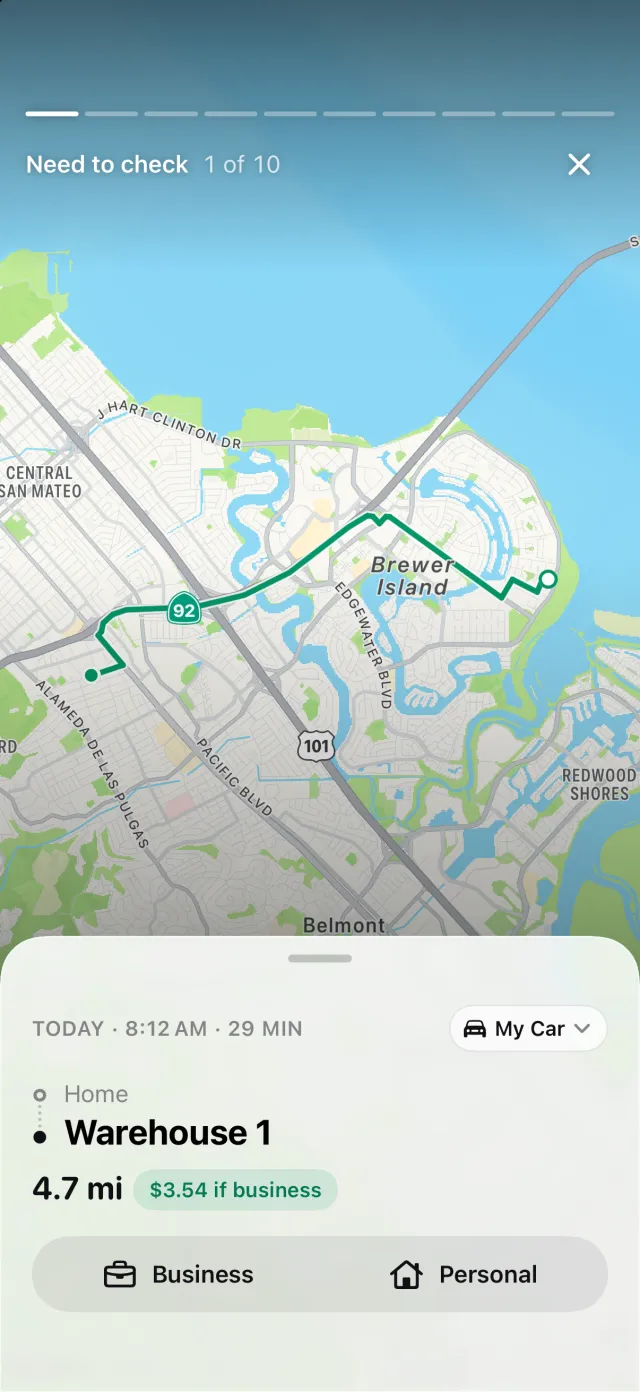
If your iPhone logged driving with no matching trip, DriveHub shows drives it may have missed, and Recover rebuilds the route. Reports shows business and personal kilometres and the business share for a month, a quarter or a year, and can be narrowed to one car.
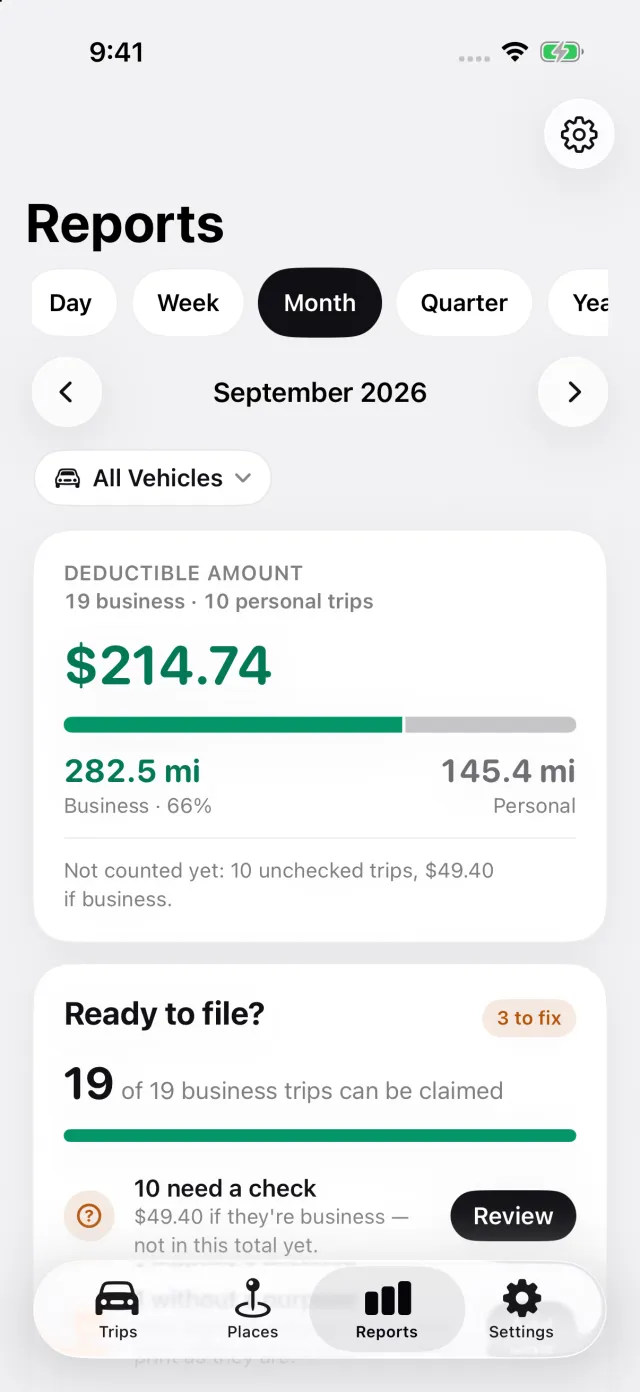
In Settings → Rate & units, a Finnish toiminimi can say when their accounts start. The report's tax year then follows your tilikausi. Its Distance, tax year block shows the total driven between the odometer readings you enter at each end of that year, and says so when one is missing. On a report for one car, when more than half of its recorded distance is business, the report warns that in Finland the car may belong to the business. A toiminimi's report states that the lisävähennys goes on Form 5 and is not booked.
Where DriveHub stops: it doesn't book your fuel or car costs, doesn't compute the private-use add-back, and doesn't fill in Form 5. It doesn't decide whether your car is a business asset either. That is judged over more than one year, with your accountant.
DriveHub is on the App Store for iPhone. The Finnish rules and rates are on the Finland page. Setting up automatic tracking takes a few minutes, once.
This page states what Verohallinto's guidance and the legislation say, and cites them so you can check. It is not tax advice. It can't account for your circumstances. Where money is involved, ask your accountant — and bring the log.
The full rule for Finland, with the instruments it comes from: mileage log requirements in Finland.