 DriveHub
Country guide · Estonia · 7 min
Autokompensatsioon from your own OÜ: paid to the juhatuse liige, not to the omanik
You own an OÜ and drive your own car for it. Can the company pay you autokompensatsioon tax-free? Yes, if you sit on its board: the law exempts payments to the juhatuse liige, not to the omanik as shareholder.

The short answer
Autokompensatsioon is the everyday name for what the law calls isikliku sõiduauto kasutamise hüvitis: compensation for using your own car for work.
- The tax-free car compensation is paid to a board member, not to an owner. TuMS § 13 lg 3 p 2 names "ametnikule, töötajale või juriidilise isiku juhtimis- või kontrollorgani liikmele". A juhatuse liige of an OÜ is one of them. Owning shares, on its own, is not.
- In a one-person OÜ the owner is usually also the sole board member, so you can be paid, as the board member.
- No salary or board fee is required alongside it. Neither the income tax act nor määrus nr 164 sets that condition.
- The car must not be the company's. A car the OÜ owns or leases falls under the company-car tax instead.
- The limits: 0.50 € per km and 550 € a month, per paying company. Each limit applies on its own. Anything above them is a fringe benefit (erisoodustus).
- Two documents, plus a copy of your right to use the car, make it tax-free: a sõidupäevik under määrus 164 § 4, and a written decision under § 3 with that copy attached. Without the logbook, the whole payment is salary.
- Receipts are not a substitute. Paying your fuel or tyre bills instead of kilometres is itself a fringe benefit.
Who may be paid: the board, not the shareholders
The rule sits in Tulumaksuseadus (TuMS) § 13 lg 3 p 2. It exempts compensation paid "ametnikule, töötajale või juriidilise isiku juhtimis- või kontrollorgani liikmele … seoses isikliku sõiduauto kasutamisega teenistus-, töö- või ametiülesannete täitmisel". Määrus nr 164 § 1 lg 1 names the same three groups.
TuMS § 9 lg 2 says what a management or supervisory body is: "Juhtimis- või kontrollorganiks on muu hulgas juhatus, nõukogu, …". So the board (juhatus) and the supervisory board (nõukogu) of an OÜ count.
A shareholder is not on that list. They qualify only by holding one of those roles. The Maksu- ja Tolliamet says so:
"Seega näiteks äriühingu omanikule või võlaõigusliku lepingu alusel teenust osutavale isikule viidatud määruse alusel maksuvaba hüvitist maksta ei saa."
In practice, most one-person OÜs have one owner who is also the only board member. That person can be paid. The point is the capacity: you are paid as the juhatuse liige, and every other condition below still applies.
No salary needed
A common question is whether a board member must also draw a salary or a board fee before the company can pay car compensation. The text sets no such condition. Neither TuMS § 13 lg 3 p 2 nor määrus 164 asks for one, and no line in the MTA's guidance says otherwise.
The car must not be the company's
TuMS § 13 lg 3 p 2 defines the personal car in its second sentence:
"Isikliku sõiduautona käsitatakse esimeses lauses nimetatud isiku kasutuses olevat sõiduautot, mis ei ole tööandja omanduses ega valduses."
Määrus 164 § 1 lg 3 says the same. Two consequences follow.
The car need not be yours. It has to be in your use, with a right of use you can prove. The MTA: "Seega ei pea sõiduauto olema kasutaja isiklikus omanduses, kuid tuleb tõendada selle kasutusõigust. Kasutamisõigus on fikseeritud sõiduki registreerimistunnistusel." Only M1 and M1G vehicles count as a sõiduauto.
The decision carries a copy of that right. Under määrus 164 § 3 lg 2, a copy of the document proving the right to use the car is attached to the decision. It can be left off when nothing has changed since the last copy.
A car in the OÜ's name, or leased by the OÜ, is not a personal car under this rule. It falls under TuMS § 48 lg 8, the per-kW company-car benefit. How the two compare is in car in your OÜ's name or your own car.
The limits: 0.50 € per km, 550 € a month, per company
TuMS § 13 lg 3 p 2, third sentence:
"Ühele isikule makstava hüvitise maksuvaba piirmäär on sõitude kohta arvestuse pidamise korral 0,50 eurot kilomeetri kohta, kuid mitte rohkem kui 550 eurot kalendrikuus iga hüvitist maksva tööandja kohta."
Määrus 164 § 5 no longer states a figure. It only points to this section. The MTA's handbook (chapter 11656, Maksuvaba hüvitise piirmäärad) reads it in four ways that matter to an OÜ.
Each limit applies on its own. The company may set a lower rate, such as 20 cents. But if it pays more than 0.50 € per km, the excess per kilometre is taxable, "sõltumata sellest kui suur on hüvitise summa kokku" — however small the month's total.
The month the trips were driven counts, not the payment date. The MTA: "Hüvitist saab maksta töötajale ka summeeritult ehk ühes kalendrikuus kassapõhiselt rohkem kui 550 eurot, kuid on oluline, et ühe kuu kohta ei arvestataks hüvitist üle ettenähtud piirmäära."
The excess is a fringe benefit, month by month. "Piirmäärasid ületav hüvitise summa loetakse erisoodustuseks." It is worked out for each month separately and declared in the month the compensation was paid. The statutory basis is TuMS § 48 lg 4 p 5.
Two companies, two caps. "Füüsiline isik võib arvestuse olemasolu korral saada maksuvaba hüvitist ka mitmelt tööandjalt, seejuures rakendatakse 550 eurost ülempiiri iga tööandja kohta eraldi." That covers a person on the board of two OÜs.
The figure covers all normal running costs, fuel and insurance included. Parking on work trips is the exception: "välja arvatud teenistus-, töö- või ametiülesannete täitmisel makstavat parkimistasu". It may be paid on top, under TuMS § 13 lg 3 p 2³.
At 0.50 € per km, the cap is reached at 1 100 business kilometres in a month: 1 100 × 0.50 € = 550 €.
Worked examples from the tax board
The MTA's own examples show what goes on which form. INF 14 shows the whole payment. TSD lisa 4 shows only the part that is a fringe benefit.
| Month's driving | Rate per km | Compensation | Fringe benefit (TSD lisa 4) | INF 14 |
|---|---|---|---|---|
| 1 200 km | 0.50 € | 1 200 × 0.50 = 600 € | 600 − 550 = 50 € | 600 € |
| 744.44 km | 0.55 € | 744.44 × 0.55 = 409.44 € | 744.44 × 0.05 = 37.22 € | 409.44 € |
| 1 500 km | 0.45 € | 1 500 × 0.45 = 675 € | 675 − 550 = 125 € | 675 € |
The second row is the trap. The month's total is well under 550 €, yet 5 cents on every kilometre is still a fringe benefit, because the rate went above 0.50 €.
The third row is the opposite case. The rate is below 0.50 €, but the month passes 550 €, so the 125 € above the cap is the fringe benefit.
The MTA's fourth example is the warning. A company pays 550 € with no sõidupäevik. Nothing goes on TSD lisa 4 or INF 14: "Summa 550 eurot on käsitletav palgatuluna ja deklareeritakse vormi TSD lisas 1." The whole amount is salary.
Two cases an OÜ owner meets
Paying two months at once
Say your OÜ pays you for October and November together, in December. You drove 1 000 business kilometres in each month at 0.50 €: 500 € for October, 500 € for November. December's payment is 1 000 €.
That is more than 550 € in one calendar month, cash-basis. It stays tax-free, because each month the trips were driven is under the cap: 500 € and 500 €.
On the board of two OÜs
Sit on the board of two companies, and each may pay you up to 550 € a month for its own trips, under its own written decision, as long as the logbook shows which company each trip was for. At 0.50 € per km, that is up to 1 100 km for each company, and 1 100 € tax-free in the month in all.
The two documents that make it tax-free
The sõidupäevik
Määrus 164 § 4 lists what the record shows. Your name and the car's registration number appear once. The odometer at the start and end, the date and the purpose appear for each trip (iga sõidu korral). The fields, a filled-in example and a blank form are in the Estonian sõidupäevik template.
The MTA's sentence on what a gap costs:
"Kui isikliku sõiduauto kasutamise hüvitist makstakse ilma arvestust pidamata, on väljamakse näol tegemist palgatuluga."
There is no partial credit. Being paid for your own car in Estonia covers this rule and the 64 € no-records allowance that was repealed in 2014.
The written decision, from your own company
Määrus 164 § 3 asks for a written decision naming the recipient, "hüvitise suurus" and "sõidu kuupäev või periood, mille jooksul tehtud sõitude kulusid hüvitatakse". In a one-person OÜ you write it yourself, for the company. The regulation allows exactly that:
"Hüvitise kohta vormistatakse tööandja, asutuse juhi, juriidilise isiku pädeva organi või tema volitatud isiku kirjalik otsus, käskkiri või korraldus"
It pays for trips already driven. The MTA: "ei saa maksuvaba hüvitist maksta tulevaste sõitude eest, vaid ainult juba tehtud sõitude eest". One decision may cover more than a calendar month. Attach the copy of the right to use the car, as above.
The company then declares the compensation on INF 14 "hiljemalt järgneva aasta 1. veebruariks" — by 1 February of the following year.
Why receipts instead of kilometres do not work
It is tempting to have the OÜ pay the car's fuel, tyre change or repair bills instead of a rate per kilometre. For your own car, the MTA treats that as a fringe benefit:
"Kuna isikliku sõiduauto kasutamise eest makstavale hüvitisele on kehtestatud eraldi tingimused ja piirmäärad, siis kuludokumentide alusel isikliku sõiduauto kasutamise hüvitamine (nt rehvivahetuse, jooksva remondikulu vms tasumine) on erisoodustus …"
The basis is the last sentence of TuMS § 12 lg 3: "Käesolevat lõiget ei kohaldata hüvitistele, mille maksustamisele on kehtestatud eraldi tingimused ja piirmäärad." Parking on work trips is again the exception. The only receipts route left for an own car is the business trip. On a lähetus, own-car costs may be reimbursed on expense documents under the business-trip rules, outside määrus 164.
Before the company pays you
- You are on the OÜ's board (juhatus or nõukogu), not only a shareholder.
- The car is not owned or leased by the OÜ, and you can prove your right to use it.
- A sõidupäevik shows the odometer, date and purpose of every business trip.
- A written § 3 decision names you, the amount and the period of trips already driven, with the copy of the right of use.
- No month's trips are paid at more than 0.50 € per km or 550 € from one company.
- The compensation goes on INF 14 by 1 February of the following year.
- The logbook is kept for seven years; the clock for a collection of entries starts on 1 January after its last entry (maksukorralduse seadus § 58).
These provisions are unchanged in the TuMS versions in force from 1 October 2026 and from 1 January 2027.
How DriveHub makes this easier
As your own company's board member, you are both the person who must keep the log and the person who signs the decision based on it. The risk is the business trip that never got written down.
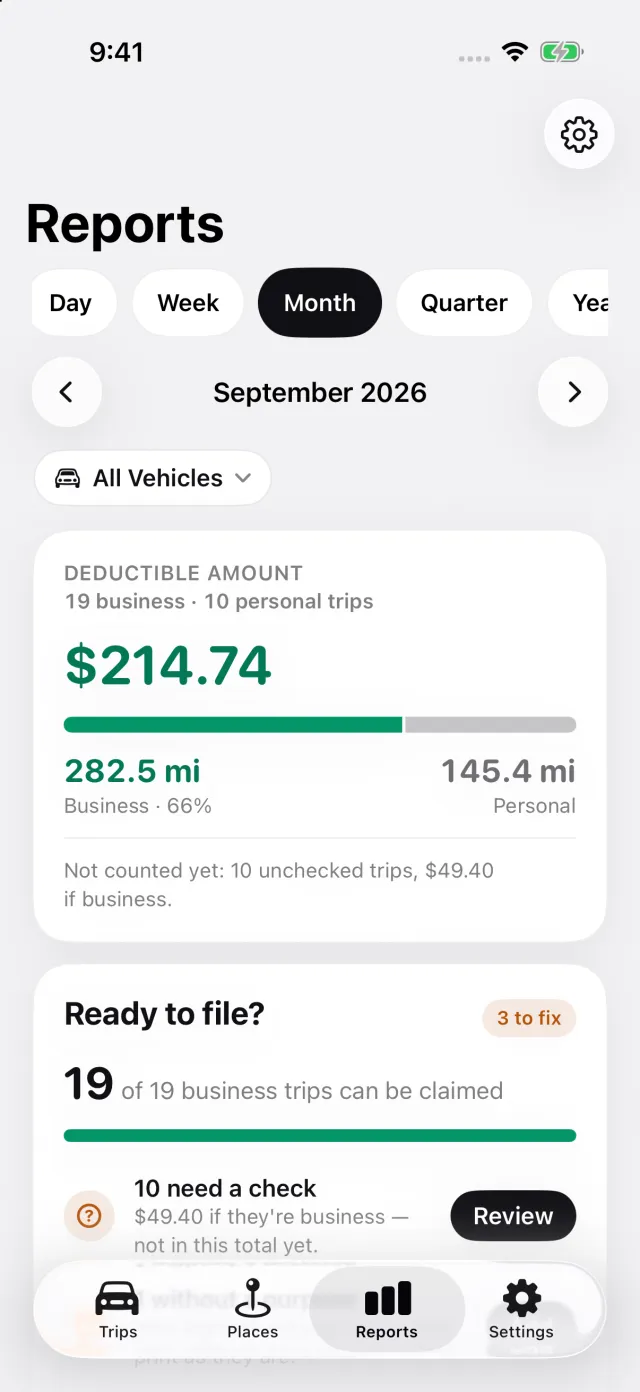
With location access set to Always, DriveHub records every drive in the background — and if it ever misses one, it tells you. DriveHub files most trips as Business or Personal by your places, past routes and working hours, and asks you about the rest. A trip not sorted yet waits under Need to check, and you add the purpose in your own words.
The Estonian report prints the date, the purpose and the odometer at the start and end of each trip. On a report for one car, the driver and the registration number appear once in the header, which is where § 4 puts them. Reports shows the month's business and personal kilometres and what the business kilometres come to at 0.50 € per km. DriveHub stops that amount at 550 € a month for each employer you name on your cars or trips, so it is the figure for the decision. A custom rate is not held to the cap.
Tracking is free; exporting the report as PDF, Excel or CSV is part of DriveHub Pro. Recorded on your device. With iCloud enabled, your trips also sync through Apple's iCloud. Maps and address features may send coordinates or search text to Apple. You choose whether to share or export trips.
Where DriveHub stops: it does not write the § 3 decision, file INF 14 or TSD, or decide whether you hold a board role. Those belong to the company. Whether a phone-kept log meets § 4 is answered in is a GPS or app sõidupäevik accepted in Estonia?.
DriveHub is on the App Store for iPhone. The Estonian rules are on the Estonia page. Setting up automatic tracking takes a few minutes, once.
Sources
- Tulumaksuseadus (TuMS) § 9 lg 2, § 12 lg 3, § 13 lg 3 p 2 and p 2³, § 48 lg 4 p 5 and lg 8 (RT I, 09.07.2026, 66, in force 01.10.2026).
- Vabariigi Valitsuse määrus nr 164 (14.07.2006), § 1 lg 1 and lg 3, §§ 3, 4 and 5 (RT I, 02.07.2025, 18).
- Maksu- ja Tolliamet, Isikliku sõiduauto kasutamise hüvitis — Kellele saab maksta maksuvaba hüvitist?
- Maksu- ja Tolliamet, Erisoodustused handbook, chapter 11656 — Maksuvaba hüvitise piirmäärad and Hüvitise deklareerimine, updated 08.01.2025.
- Maksukorralduse seadus § 58.
This page states what the income tax act, the regulation and the tax board's own guidance say, and cites them so you can check. It is not tax advice. It can't account for your circumstances. Where money is involved, ask your raamatupidaja — and bring the logbook.
Do it in DriveHub
Employment dates, different rates and trips for more than one job.
The full rule for Estonia, with the instruments it comes from: mileage log requirements in Estonia.