 DriveHub
Country guide · Estonia · 5 min
Car in your OÜ's name or your own car? In Estonia one tax counts kilowatts, the other kilometres
Ettevõtte auto või isiklik auto — a car in the company's name, or your own car paid per kilometre? In Estonia these are two different taxes, and they measure different things.

The short answer
- Your own car, used for work: the employer may pay a tax-free isikliku sõiduauto hüvitis of 0.50 € per kilometre, up to 550 € a month. It needs a logbook under määrus nr 164 § 4 and a written employer decision under § 3.
- Without the logbook, the whole payment is salary. Not a smaller tax-free amount — all of it.
- A car the employer provides: TuMS § 48 lg 8 values the private-use benefit from the car's power. In 2026 that is 1.96 € per kW a month for a new car and 1.47 € per kW for one over five years old.
- Distance does not move the company-car figure. The benefit comes from the car being available. Driving less does not lower it.
- A logbook is not the way out of the company-car benefit. A Transpordiamet register mark that the car is work-only is, and only the employer can make it.
So the question is not which car is cheaper in general. It is which quantity describes your driving: the kilometres you drive for work, or the kilowatts of a car that stands ready for you.
Your own car: paid by the kilometre, proved by the logbook
When you drive your own car for the company, the company can pay you back per kilometre. The figure for 2026 is 0.50 € per km, capped at 550 € a month (the current figures are kept on the Estonia page). At that rate the cap is reached at 1 100 business kilometres in a month: 1 100 × 0.50 € = 550 €. If you own the OÜ and sit on its board, it can pay you as a board member, never as the owner: see autokompensatsioon in your own OÜ.
The figure no longer sits in the regulation. Since the RT I, 02.07.2025, 14 amendment, määrus 164 § 5 cross-refers to TuMS § 13 lg 3 p 2 instead. What määrus 164 still holds is the record.
What the logbook must show
Määrus nr 164 § 4 asks for the driver's name and the car's registration number, and for each trip (iga sõidu korral) the odometer at the start and end, the date and the purpose. The exact wording and a ready-made form are in the Estonian sõidupäevik template.
The employer's written decision
§ 3 is a separate condition. The employer decides in writing, naming you, "hüvitise suurus" and "sõidu kuupäev või periood, mille jooksul tehtud sõitude kulusid hüvitatakse". It pays for trips already made. The MTA handbook: "ei saa maksuvaba hüvitist maksta tulevaste sõitude eest, vaid ainult juba tehtud sõitude eest". One decision may cover more than a calendar month.
If you are both the employer and the driver, as in many one-person OÜs, the decision still applies. Being paid for your own car in Estonia covers the decision and the repealed 64 € flat allowance in more detail.
What a gap costs
The MTA puts it in one sentence:
"Kui isikliku sõiduauto kasutamise hüvitist makstakse ilma arvestust pidamata, on väljamakse näol tegemist palgatuluga."
Paid without records, the payment is salary — all of it, declared on TSD lisa 1. A compensation paid with records is declared on INF 14 by 1 February of the following year. The logbook is kept for seven years from the 1 January after its last entry.
The company's car: valued by the kilowatt, not the kilometre
Put the car in the company's name and let yourself drive it privately, and a different tax applies. TuMS § 48 lg 8 charges an erisoodustus (fringe benefit) on the employer, computed from the car:
"uuel sõiduautol 1,96 eurot kW kohta kuus, üle 5 aasta vanusel sõiduautol 1,47 eurot kW kohta kuus"
That is the wording of § 48 lg 8 as the MTA's Erisoodustused handbook gives it (chapter Tööandja sõiduauto, last updated 08.01.2025).
A worked example
Take a car with a 100 kW engine.
| New car | Over 5 years old | |
|---|---|---|
| Rate | 1.96 € per kW a month | 1.47 € per kW a month |
| Benefit value per month | 100 × 1.96 € = 196 € | 100 × 1.47 € = 147 € |
| Over a year | 196 € × 12 = 2 352 € | 147 € × 12 = 1 764 € |
The value is the same whether the car did 50 private kilometres that month or 2 000. This is the figure the benefit is taxed on, not the tax itself.
Distance is irrelevant to it
The MTA handbook explains why: "ei ole oluline tööandja sõiduauto kasutamine erasõitudeks, vaid sõiduauto kasutamise võimaldamine". What is taxed is making the car available, not the use. Driving less does not reduce it, and driving more does not raise it.
A logbook is not the way out
A common assumption is that logging the private kilometres, or paying for them, avoids the benefit. The MTA says otherwise:
"Erasõite ei ole võimalik arvestuse alusel hüvitada ja seetõttu ei ole sõidupäeviku pidamine vajalik."
The way out it names is a Transpordiamet register mark that the car is used for work only:
"Kui Transpordiametit ei ole teavitatud/puudub vastav märge, siis tööandja võimaldab töötajatel kasutada firma sõiduautot erasõitudeks."
Without that mark, the car counts as available for private trips. The notification is the employer's act. No record the driver keeps can stand in for it.
Passenger cars only
The notification duty covers M1 passenger cars. "N1-kategooria sõidukite (kaubikute) kasutamisest teavitama ei pea" — vans need no notification. The per-kW valuation can still be applied to a van the employer lets be driven privately.
Side by side
| Your own car | The company's car | |
|---|---|---|
| What is measured | Business kilometres | Engine power (kW) |
| Source | määrus 164 §§ 3–4; TuMS § 13 lg 3 p 2 | TuMS § 48 lg 8 |
| 2026 figure | 0.50 €/km, up to 550 € a month, tax-free | 1.96 €/kW a month (new), 1.47 €/kW (over 5 years), taxable benefit |
| Effect of driving more | Pays more, up to the cap | None |
| Logbook | Required, every trip; without it, the payment is salary | Not the way out of the benefit |
| What the employer must do | A written § 3 decision for trips already made | Notify Transpordiamet if the car is work-only (M1) |
Which one fits your driving
The two regimes answer different questions, so the facts of your driving decide.
- You drive for work often, and the car is also your private car. The own-car route pays per kilometre, up to the cap. It rewards a complete logbook and punishes an incomplete one completely.
- The company provides the car and you also use it privately. The benefit is priced by the kilowatt every month. A smaller engine lowers it; fewer kilometres do not.
- The car is used for work only. The register mark is what shows that, not a driver's logbook.
What this page does not cover: VAT on a company car, how the OÜ deducts the car's running costs, and the tax rate applied to the benefit value. Those are questions for your raamatupidaja.
How DriveHub makes this easier
For your own car, the work is the logbook, and the risk is the trip that never got written down.
With location access set to Always, DriveHub records every drive in the background — and if it ever misses one, it tells you. DriveHub files most trips as Business or Personal by your places, past routes and working hours, and asks you about the rest. A trip not sorted yet waits under Need to check, and Missed drives lists drives your iPhone logged with no matching trip.
The Estonian report prints the date, the purpose in your own words and the odometer at the start and end of each trip, worked out from the readings you enter (a carried-forward figure is marked ≈). On a report for one car, the driver and the registration number appear once in the header, which is where § 4 puts them. Reports shows the month's business and personal kilometres and what the business kilometres come to at 0.50 € per km. DriveHub stops that amount at 550 € a month for each employer you name on your cars or trips. A custom rate is not held to the cap.
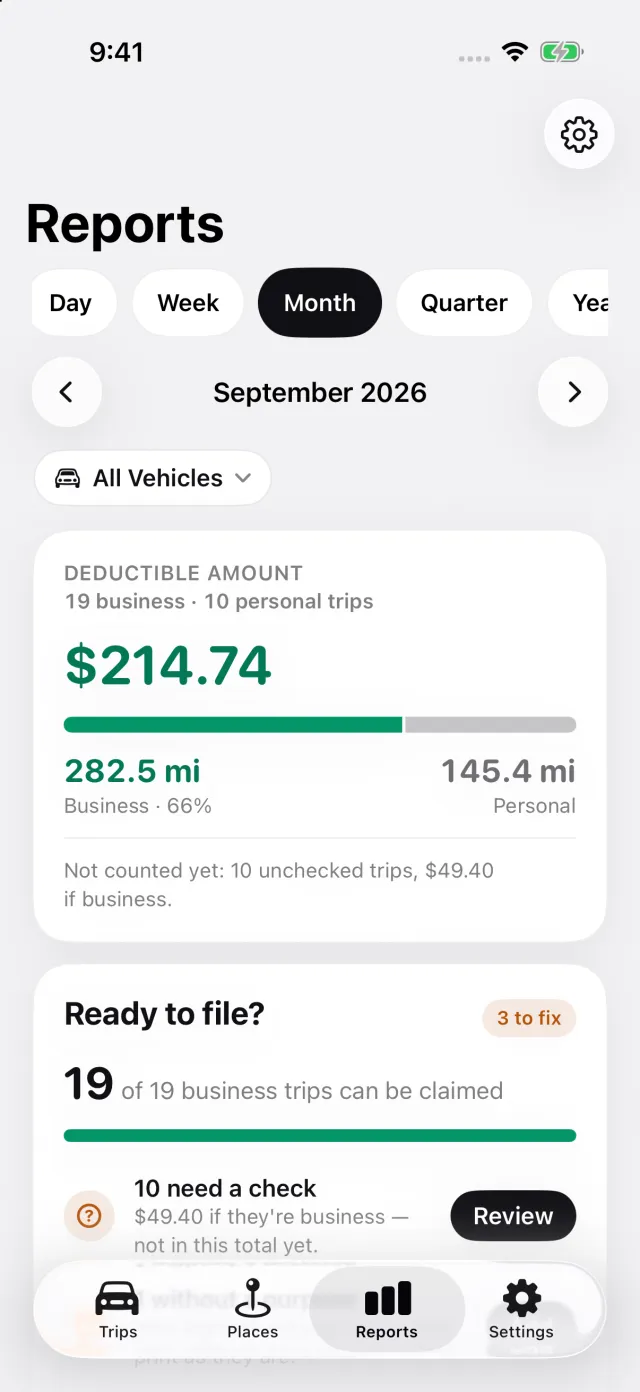
Tracking is free; exporting the report as PDF, Excel or CSV is part of DriveHub Pro. Recorded on your device. With iCloud enabled, your trips also sync through Apple's iCloud. Maps and address features may send coordinates or search text to Apple. You choose whether to share or export trips.
For a car the company provides, DriveHub calculates no amount: the kW benefit does not depend on distance. It names the tax that applies instead.
Where DriveHub stops: it does not write the employer's § 3 decision, notify Transpordiamet, or compute the erisoodustus. Those belong to the company. If you want to know whether a phone-kept log meets § 4, see is an app or GPS sõidupäevik accepted in Estonia.
DriveHub is on the App Store for iPhone. The Estonian rules are on the Estonia page. Setting up automatic tracking takes a few minutes, once.
Sources
- Vabariigi Valitsuse määrus nr 164 (14.07.2006), §§ 3, 4 and 5 (RT I, 02.07.2025, 18).
- Tulumaksuseadus (TuMS) § 13 lg 3 p 2 and § 48 lg 8.
- Maksu- ja Tolliamet, Erisoodustused handbook: chapter 11656, Isikliku sõiduauto kasutamise hüvitis, updated 08.01.2025, and chapter Tööandja sõiduauto.
- Maksukorralduse seadus § 58.
This page states what the regulation, the income tax act and the tax board's own handbook say, and cites them so you can check. It is not tax advice. It can't account for your circumstances. Where money is involved, ask your raamatupidaja — and bring the logbook.
Do it in DriveHub
Employment dates, different rates and trips for more than one job.
The full rule for Estonia, with the instruments it comes from: mileage log requirements in Estonia.