 DriveHub
Country guide · Estonia · 6 min
Is a GPS sõidupäevik or a sõidupäevik äpp accepted in Estonia? § 4 judges the record
You want a sõidupäevik äpp or a GPS tracker to keep your log instead of writing it by hand. The question is not whether the tool is accepted. It is whether the record it produces shows what määrus 164 § 4 lists, for every trip.

The short answer
A sõidupäevik is judged by what it shows, not by what it was kept with. The rule is Vabariigi Valitsuse määrus nr 164, § 4 Arvestuse pidamine. It lists what the record of car use has to show. It names no product, no device and no approval.
So the question for an app or a GPS log is whether its record shows all four points of § 4:
- The name of the person using the car — once, for the record.
- The car's registration number — once, for the record.
- The odometer reading at the start and at the end of each trip.
- The date and the purpose of each trip.
A GPS track on its own does not show the last two. It knows where the car went and how far. It does not know the odometer reading, and it cannot know why you drove.
What § 4 actually requires
Here is the text, from the current version (RT I, 02.07.2025, 18):
"Sõiduauto kasutamise üle peetavas arvestuses näidatakse: 1) sõiduautot kasutava isiku ees- ja perekonnanimi; 2) sõiduauto riikliku registreerimismärgi andmed; 3) sõiduauto läbisõidumõõdiku alg- ja lõppnäit iga … sõidu korral; 4) kuupäev ja sõidu eesmärk iga … sõidu korral."
The verb is näidatakse — "is shown". The text is about the content of the record.
Points 3 and 4 say iga sõidu korral: for each trip. Points 1 and 2 do not, so a header that states the driver and the plate once does what § 4 asks.
The full list, and the employer's side, is on the Estonian sõidupäevik page.
What a GPS log gives you, and what it does not
Take the four points one at a time.
Points 1 and 2, the driver and the plate. Any app or device can carry these. Check that the export prints both, for the car you were paid for.
Point 3, the odometer. § 4 asks for "läbisõidumõõdiku alg- ja lõppnäit": the reading on the car's odometer at the start and at the end. A route on a map is not that. Nor is a distance in kilometres. If a tool exports only the distance, the record is missing a point the regulation names.
Point 4, the date and the purpose. The date is easy for any tracker. The purpose is not. Sõidu eesmärk is a reason, and a tracker has no way to know it. You have to write it, for each business trip.
The test takes a minute. Open an exported month and look for the odometer at both ends of each trip, and a purpose on each one.
Why "accepted" is not something a product can be
The regulation sets content, not a procedure for products. In the part of § 4 quoted above there is no register of approved apps, no certificate and no test. A product described as "accepted" is describing itself. The Maksu- ja Tolliamet looks at your record.
And the stakes are high. The MTA:
"Kui isikliku sõiduauto kasutamise hüvitist makstakse ilma arvestust pidamata, on väljamakse näol tegemist palgatuluga."
Paid without records, the whole payment is salary. Nothing of it stays tax-free. Why that rule is absolute, and how the old 64 € allowance ended in 2014, is in being paid for your own car in Estonia.
There is a second rule for records that exist but fall short. Maksukorralduse seadus § 94 (1) allows the tax to be estimated "kui maksu määramiseks vajalikud kirjalikud tõendid on puudulikud, ebapiisavad, mitteusaldusväärsed, hävinud või kadunud". That covers incomplete, insufficient and unreliable records, and lost ones.
What no app or GPS log can do for you
The employer's written decision. § 3 of määrus 164 is a separate condition. The employer decides in writing, naming the recipient, "hüvitise suurus" and "sõidu kuupäev või periood, mille jooksul tehtud sõitude kulusid hüvitatakse". It pays for trips already driven. The MTA handbook: "ei saa maksuvaba hüvitist maksta tulevaste sõitude eest, vaid ainult juba tehtud sõitude eest". One decision may cover more than one calendar month.
Keeping it for seven years. Määrus 164 sets no retention period. Two other laws do. Raamatupidamise seadus § 12 lg 1 counts seven years from the end of the financial year. Maksukorralduse seadus § 58 counts seven years from 1 January after the last entry in a collection of documents, which a sõidupäevik is. For a log that runs across years the second clock ends later: it starts after the last entry, so the first pages are kept as long as the last. An app log has to be exportable, and the export kept, for that long.
The company car. None of this applies to a car your employer provides. That is taxed by the car's kilowatts under TuMS § 48 lg 8. The MTA says a logbook of private trips does not take you out of it: "Erasõite ei ole võimalik arvestuse alusel hüvitada ja seetõttu ei ole sõidupäeviku pidamine vajalik." See company car or your own car in Estonia.
Questions to ask of any app, device or spreadsheet
- Does each business trip carry the odometer reading at the start and at the end?
- Can you write a real purpose for each trip, not only "business"?
- Does the export show your name and the registration number?
- Does it tell you when it may have missed a drive?
- Can you export every month and keep the files for seven years?
Prefer to keep it by hand? The Estonian sõidupäevik template has the four points as columns, or download the blank log as PDF or CSV. The trade-offs between paper, spreadsheet, device and app are in how to keep a mileage log.
How DriveHub fits § 4
DriveHub is not approved or certified by the Maksu- ja Tolliamet; § 4 provides for no such approval, for any product. What it does is capture the trips and print the points § 4 names. With location access set to Always, DriveHub records every drive in the background — and if it ever misses one, it tells you. Business and private trips are recorded alike, and DriveHub files most as Business or Personal by your places, past routes and working hours, and asks you about the rest.
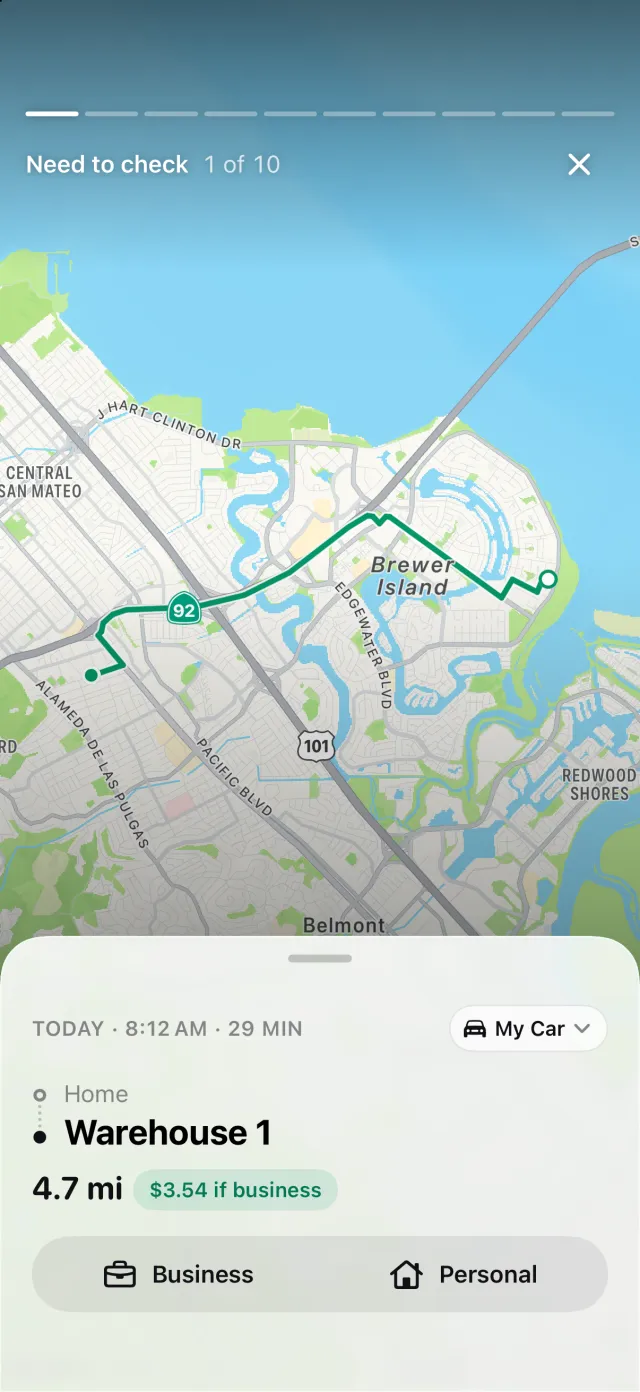
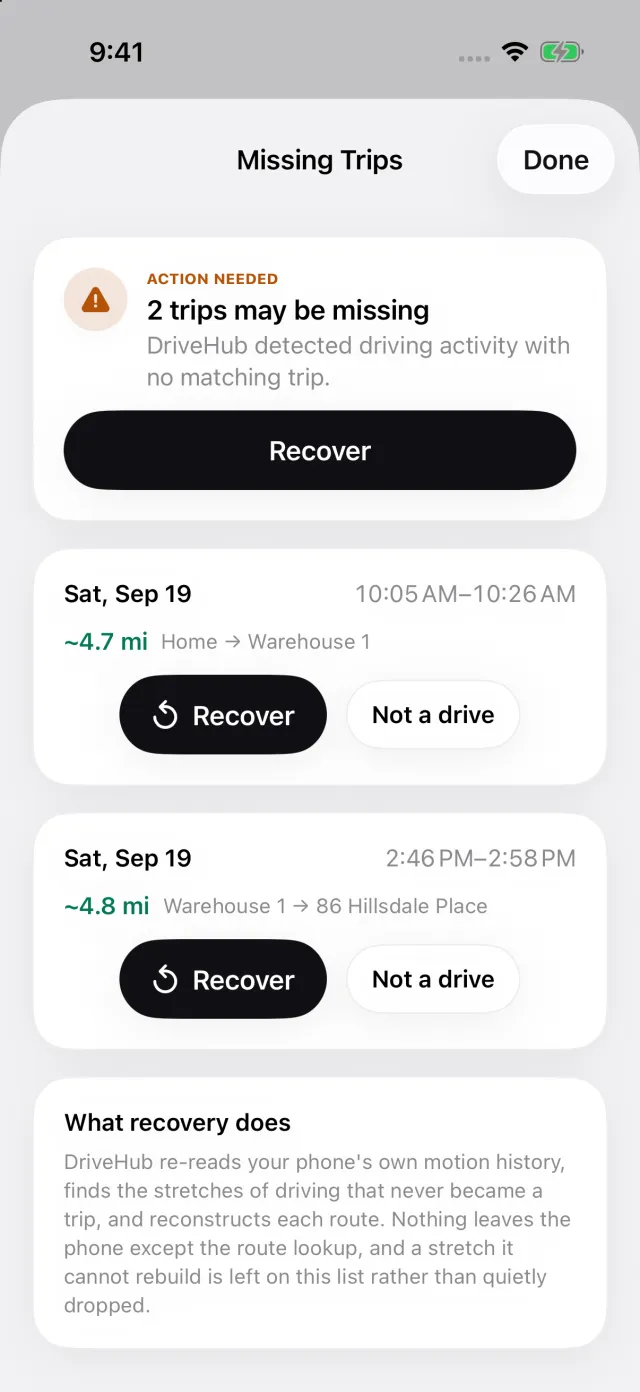
If your iPhone logged driving with no matching trip, a Missed drives story appears on the Trips tab and opens Missing Trips. Tap Recover to restore the trip, or add it yourself.
The report prints the date, the purpose in your own words and, for each business trip, the odometer at the start and end. The figures come from you: type the two readings on the trip, or enter a dashboard reading for the car now and then and DriveHub carries it forward trip by trip, marking those figures ≈. With no reading at all, the column stays empty. On a report for one car, the driver and the registration number appear once, in the header — where § 4 puts them. Reports export as PDF, Excel or CSV with DriveHub Pro. Recorded on your device. With iCloud enabled, your trips also sync through Apple's iCloud. Maps and address features may send coordinates or search text to Apple. You choose whether to share or export trips.
What stays yours. The purpose is a reason only you can write. Check a ≈ figure against the dashboard now and then, and correct it on the trip if they differ. The employer's written decision is the employer's document. And whether the record is enough is decided by the Maksu- ja Tolliamet, for your record, not for DriveHub.
- DriveHub on the App Store
- Estonian sõidupäevik requirements
- Set up automatic tracking, and know when a drive is missed
Sources
- Vabariigi Valitsuse määrus nr 164 (14.07.2006), §§ 3 and 4 (RT I, 02.07.2025, 18).
- Maksu- ja Tolliamet, handbook Erisoodustused, chapters Isikliku sõiduauto kasutamise hüvitis and Tööandja sõiduauto (emta.ee/node/168/handbook/11/pdf).
- Raamatupidamise seadus § 12 lg 1; maksukorralduse seadus §§ 58 and 94.
- Tulumaksuseadus § 48 lg 8.
- RT I, 26.08.2014, 8 (repeal of määrus 164 § 6).
This page states what määrus nr 164, the maksukorralduse seadus, the raamatupidamise seadus and the tax board's own handbook say, and names them so you can check. It is not tax advice. It can't account for your circumstances. Where money is involved, ask your raamatupidaja — and bring the logbook.
Do it in DriveHub
Add your document identity and review which fields appear in the PDF.
The full rule for Estonia, with the instruments it comes from: mileage log requirements in Estonia.