 DriveHub
Country guide · United States · 8 min
Your Uber or DoorDash mileage deduction is only as big as your log
You drive for Uber, Lyft or DoorDash in the US and want the mileage deduction. You are self-employed, so it is yours to claim — and yours to prove, trip by trip, with a mileage log you keep.

The short answer
If you drive for Uber, Lyft, DoorDash or Instacart, your car costs go on Schedule C, line 9. You choose the standard mileage rate or your actual car expenses. For 2026 the rate is 72.5 cents a mile to 30 June and 76 cents from 1 July. Business parking and tolls go on top.
Which miles? In Hagos v. Commissioner, an Uber driver's Tax Court case, the IRS allowed the miles Uber reported as driven for customers. Three kinds of driving are unsettled: waiting online without an order, the drive to your first pickup, and the drive home after your last drop-off.
What you must keep is a record. Your car is "listed property" (IRC § 280F(d)(4)), so the record rule of § 274(d) applies, and the Tax Court applied it to an Uber driver's vehicles. Each business trip needs its date, its business mileage and its business purpose, and the year needs your total miles. Publication 463: "You can't deduct amounts that you approximate or estimate."
The platform's mileage summary is not that record. No IRS publication, form instruction or gig page read for this page says anything about it.
You are self-employed, so the car goes on Schedule C
The IRS's Gig Economy Tax Center lists "Drive a car for booked rides or deliveries" as gig work. Its page Manage taxes for your gig work says: "Collect and keep your records and receipts during the year. Recordkeeping can help you track your income, deduct expenses and complete your tax return." It points to Publication 463 and Schedule C.
The Schedule C instructions for line 9: "You can deduct the actual expenses of operating your car or truck or take the standard mileage rate. This is true even if you used your vehicle for hire (such as a taxicab)."
Under the standard rate you multiply your business miles by the rate and "Add to this amount your parking fees and tolls". You "Do not deduct depreciation, rent or lease payments, or your actual operating expenses." Gas is inside the rate, so there are no fuel receipts to add.
For an owned car, the rate is open only if you choose it in the car's first business year. For a leased car it runs for the whole lease. The full comparison, with the cases where the rate is barred, is in a car for your business: standard rate or actual expenses.
What the 2026 rate gives
The rate changed mid-year. Notice 2026-10 § 3 set 72.5 cents, and Announcement 2026-11 raised it to 76 cents from 1 July. Suppose your log shows 6,000 business miles before 1 July and 7,000 after:
6,000 × $0.725 = $4,350 7,000 × $0.76 = $5,320 Total: $9,670, plus business parking and tolls.
The mileage figures are invented for the arithmetic. Which of your miles are business miles is the question the rest of this page is about.
Your car is § 274(d) property, so a record is required
IRC § 274(d) allows no deduction for "any listed property" unless you substantiate it "by adequate records or by sufficient evidence corroborating the taxpayer's own statement". Listed property includes "any passenger automobile" (§ 280F(d)(4)(A)).
The statute has an exception for property used "substantially all" in a business of carrying people or goods for hire. It covers only "any other property used as a means of transportation", not an ordinary passenger car (§ 280F(d)(4)(B)).
It did not help the Uber driver in Nurumbi v. Commissioner, T.C. Memo. 2021-79, whose SUVs and passenger trucks the court treated as that other property. The court: "Petitioner has not shown that 'substantially all of the use' of his vehicles" was in such a business. He "did not introduce evidence that he had a separate vehicle for personal use." So "he must satisfy the heightened substantiation requirements under section 274(d)."
A second provision, § 280F(d)(5)(B)(ii), takes a vehicle used "directly in the trade or business of transporting persons or property for compensation or hire" out of "passenger automobile". In the opinions found, the Tax Court has applied it to a private car service (Sami v. Commissioner, T.C. Memo. 2026-69), not to a rideshare driver's own car. No opinion or IRS text found holds that a personal car used for app work and for private driving escapes § 274(d). Treat yours as covered.
The standard rate does not relieve you of the log either. 26 CFR § 1.274-5(j)(2): "The taxpayer will not be relieved of the requirement to substantiate the amount of each business use (i.e., the business mileage), or the time and business purpose of each use."
What your log has to prove
In Publication 463's terms, per trip: the date, the destination, the business mileage and the business purpose. Per year, from Table 5-1: "the mileage for each business use, and the total miles for the year." The regulation, 26 CFR § 1.274-5T(b)(6), names the mileage of each use, the total for the year, the date and the business purpose.
The log does not have to be written the same day: "A contemporaneous log is not required", and a weekly one counts. The detail is in what the IRS means by adequate records.
Estimates don't count. Publication 463: "You can't deduct amounts that you approximate or estimate." The Tax Court: "The Court may not use the Cohan rule to estimate expenses covered by the strict substantiation requirements of section 274(d), which apply to most transportation expenses" (Ottuso v. Commissioner, T.C. Memo. 2024-91).
If your records are incomplete, Publication 463 accepts your own statement plus other supporting evidence. Its example is a driver: "the nature of your work, such as making deliveries, provides circumstantial evidence of the use of your car for business purposes. Invoices of deliveries establish when you used the car for business." The regulation is narrower than that sounds. Circumstantial evidence can prove the purpose. The miles and the dates need direct or documentary evidence.
What is at stake: the Hagos case
Hagos v. Commissioner, T.C. Memo. 2018-166, is an Uber driver's case. He claimed 79,873 miles. The IRS "allowed a deduction for car and truck expenses of $5,286, representing 9,439 miles, on the basis of the number of miles Uber reported as miles driven for customers."
The court went no further: "the record is simply devoid of any information to substantiate any amount above the $5,286 … reported by Uber". And: "We could make a guess as to certain additional mileage but that is not appropriate."
The allowed miles were fewer than one in eight of those claimed. 79,873 ÷ 8 = 9,984.1, and 9,439 is less than that.
A caution about reading this case. It is one finding of fact, not a rule that the platform's figure is the IRS's number. No IRS publication, form instruction or gig page read says anything about a platform's reported miles, in either direction. What the case does show is what happens when the platform's figure is the only record there is.
A missing log can also cost more than the deduction. IRC § 6662 adds a 20 % penalty on the underpayment for negligence. 26 CFR § 1.6662-3(b)(1) says negligence "includes any failure by the taxpayer to keep adequate books and records or to substantiate items properly." In Hagos itself the court did not sustain the penalty, for a procedural reason.
Miles between orders: what is not settled
Three kinds of driving come up in every shift, and no primary source found states the rule for any of them:
- miles driven while you are online and waiting for an order;
- the drive to your first pickup — and whether the working day starts there, at the first restaurant, or when you go online;
- the drive home after your last drop-off.
The IRS publications, the Schedule C instructions, the gig pages and the Tax Court's own opinion search were read for this. The rideshare and delivery cases found decide substantiation or income, not these miles. So this page does not call them deductible, and does not call them non-deductible.
The nearest IRS text is Publication 463's Example 3. It covers someone with no regular office and no home office: "the location of your first business contact inside the metropolitan area is considered your office." Home to that first contact, and last contact to home, are commuting; "you can deduct the costs of going from one client or customer to another." How that applies to app work is not stated anywhere read. The general commuting rules are in is commuting mileage deductible.
What you can do is keep the facts. A log that keeps all your driving, each trip with its date, miles, and where it started and ended, lets you and your tax preparer apply whichever answer is right. A log that holds only the trips you decided were business cannot be revisited.
How DriveHub makes this easier
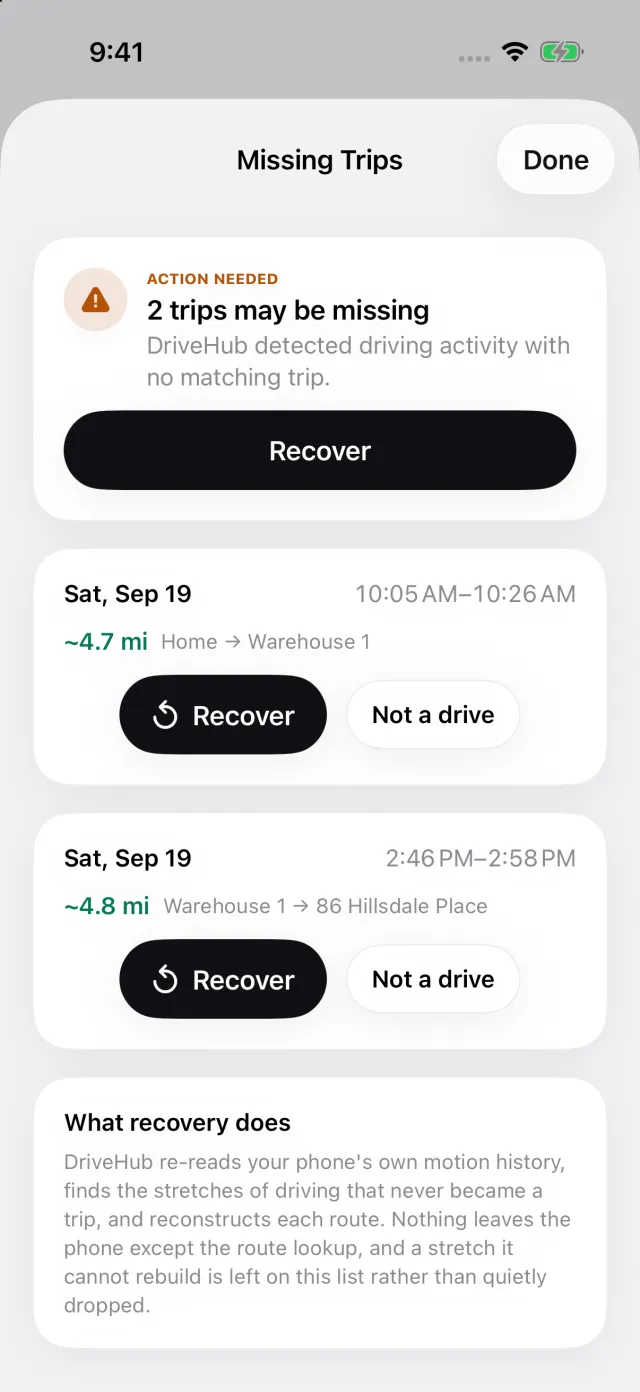
With location access set to Always, DriveHub records every drive in the background on your iPhone, the ones between orders included — and if it ever misses one, it tells you. You don't open anything before a shift.
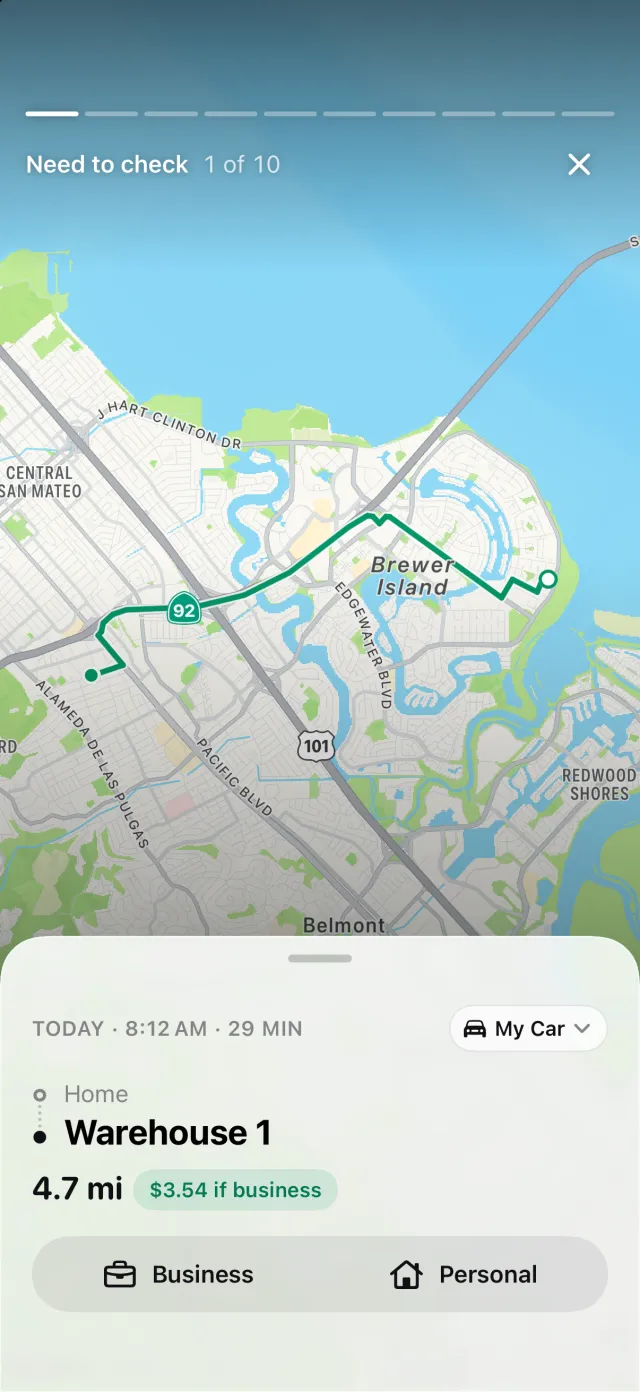
You classify each trip afterwards as Business or Personal. DriveHub has no rule of its own for gig miles. It files trips automatically only from what you give it: a rule on a place, your past drives on the same route, working hours, an optional work calendar. Anything still open waits under Need to check. Given what is unsettled above, which of your gig miles are business is your call and your tax preparer's.
If your iPhone logged driving with no matching trip, a Missed drives story appears on the Trips tab. It opens Missing Trips, below, and Recover rebuilds the route. A gap shows while you still remember the shift.
The report prints the date, destination, business purpose in your own words and the mileage for each trip. It also prints the year's opening and closing odometer readings as their own block. That is where the year's total comes from — the other half of what Publication 463 asks for. Each trip is priced at the rate in force on its own date, 72.5 or 76 cents.
Where it stops: DriveHub is not connected to any platform. It does not read your orders or the platform's mileage summary. Ways to keep a mileage log compares this with paper and spreadsheets.
- DriveHub on the App Store
- US mileage log rules
- Set up automatic tracking, and know when a drive is missed
This page states what Publication 463, the Schedule C instructions, the Internal Revenue Code, its regulations and the Tax Court say, and cites them so you can check. It is not tax advice. It can't account for your circumstances. Where money is involved, ask your tax preparer — and bring the log.
The full rule for United States, with the instruments it comes from: mileage log requirements in the United States.