 DriveHub
Country guide · United States · 9 min
Standard mileage rate vs actual expenses: the first year decides
You bought or lease a car and use it for your business. The IRS lets you count it two ways — the standard mileage rate or actual expenses — and never both for one year. Which ways stay open to you is settled in the car's first business year.

The short answer
The IRS gives you two methods for a car used in your business: the standard mileage rate or your actual car expenses. You use one of them for a year, not both. Gas is already inside the rate, so you cannot add fuel receipts to a mileage claim.
- For 2026 the rate is 72.5 cents a mile to 30 June and 76 cents from 1 July.
- A car you own: to use the rate at all, choose it in the first year the car is available for your business. After that you may switch either way.
- Choose actual expenses in that first year and the rate is closed for that car for good.
- A car you lease: if you want the rate, you use it for the entire lease period, renewals included.
- Parking and tolls for business are deducted on top of either method.
- Either method rests on the same two figures: your business miles and your total miles for the year.
If you qualify for both, Publication 463 suggests working it out both ways: "you may want to figure your deduction both ways to see which gives you a larger deduction."
Can I deduct gas and mileage?
Publication 463, chapter 4, Car Expenses: "You can generally use one of the two following methods to figure your deductible expenses. Standard mileage rate. Actual car expenses."
The rate replaces the running costs rather than sitting beside them: "If you use the standard mileage rate for a year, you can't deduct your actual car expenses for that year. You can't deduct depreciation, lease payments, maintenance and repairs, gasoline (including gasoline taxes), oil, insurance, or vehicle registration fees." Rev. Proc. 2019-46 § 4.02 says the same, and adds tires and license fees to what the rate covers.
So you can't claim both. The mile rate is the gas, the insurance and the wear, priced together.
The 2026 rate is two numbers
Notice 2026-10 § 3 set 72.5 cents a mile. Announcement 2026-11 of 13 July 2026 then raised it to 76 cents for driving "on or after July 1, 2026". The IRS standard mileage rates page lists both: "2026 (Jan. 1 – June 30) 72.5" and "2026 (July 1 – Dec. 31) 76".
A mile driven in March and a mile driven in September are priced differently. One rate applied to the whole year is wrong for half of it.
For a car you own, the first year decides
Publication 463, Choosing the standard mileage rate: "If you want to use the standard mileage rate for a car you own, you must choose to use it in the first year the car is available for use in your business. Then, in later years, you can choose to use either the standard mileage rate or actual expenses."
The year that counts is the car's first year available for your business. For a car you owned before using it for business, that can be a later year than the one you bought it in.
The choice is made "by the due date (including extensions) of your return", and "You can't revoke the choice." A sole proprietor claims either method on Schedule C, line 9: "You can deduct the actual expenses of operating your car or truck or take the standard mileage rate." The car's details then go in Schedule C, Part IV, or on Form 4562, Part V.
What that means in practice:
- Rate in year one: the door stays open both ways. You can move to actual expenses in a later year.
- Actual expenses in year one: the rate is closed for that car. If you depreciated it with MACRS, a section 179 deduction or bonus depreciation, it cannot come back.
Switching later has a cost. Rev. Proc. 2019-46 § 4.05(3): "By using the business standard mileage rate, the taxpayer has elected to exclude the automobile, if owned, from MACRS." Publication 463 then says you "must use straight line depreciation over the estimated remaining useful life of the car."
For a car you lease, it is the whole lease
"If you want to use the standard mileage rate for a car you lease, you must use it for the entire lease period." IRS Topic no. 510 adds "(including renewals)".
The reverse also holds. A leased car on which you "claimed actual car expenses after 1997" cannot use the rate at all.
When can't you use the standard mileage rate?
Publication 463 lists the cases. You can't use the standard mileage rate if you:
- "Use five or more cars at the same time (such as in fleet operations)";
- "Claimed a depreciation deduction for the car using any method other than straight line for the car's estimated useful life";
- used MACRS on it;
- "Claimed a section 179 deduction" on it;
- "Claimed the special depreciation allowance on the car";
- "Claimed actual car expenses after 1997 for a car you leased."
Five cars means at the same time. "You aren't using five or more cars for business at the same time if you alternate using (use at different times) the cars for business." Publication 463's own example: one salesperson alternating three cars and two vans may use the rate. A business running a car and four vans at once "must use actual expenses for all vehicles."
A car for hire, such as a taxi, may use the rate unless one of the bars above applies.
Parking, tolls and interest go on top
"In addition to using the standard mileage rate, you can deduct any business-related parking fees and tolls." Topic no. 510 says the same holds "whether you use the standard mileage rate or actual expenses."
Parking at your own place of work is not included: those fees "are nondeductible commuting expenses." Which drives count as commuting is its own question — see commuting miles in the US.
Two more items sit outside the rate. If you are self-employed, the business part of car-loan interest counts: "if you use your car 60% for business, you can deduct 60% of the interest on Schedule C (Form 1040)." State and local personal property tax on the car is also separate from the rate.
Actual expenses: the costs, times the business share
Publication 463 lists what actual expenses are: "Depreciation, Lease payments, Registration fees, Licenses, Insurance, Repairs, Gas, Garage rent, Tires, Oil, Tolls, Parking fees."
You claim only the business part. "If you use your car for both business and personal purposes, you must divide your expenses between business and personal use. You can divide your expense based on the miles driven for each purpose."
The IRS's own example: 20,000 miles in the year, 12,000 of them for business. "You can claim only 60% (12,000 ÷ 20,000) of the cost of operating your car as a business expense."
A worked comparison: standard mileage rate vs actual expenses
Take that same car in 2026 — 12,000 business miles of 20,000 — and suppose 6,000 of the business miles fell before 1 July and 6,000 after. For actual expenses, suppose gas, insurance, repairs, registration and depreciation together came to $12,000 for the year.
| Standard mileage rate | Actual expenses | |
|---|---|---|
| Jan.–June | 6,000 × $0.725 = $4,350 | |
| July–Dec. | 6,000 × $0.76 = $4,560 | |
| Year | $8,910 | $12,000 × 60% = $7,200 |
In this example the rate gives the larger figure. At these miles, actual expenses would come out ahead only if the car's costs for the year passed $14,850 ($8,910 ÷ 60%). The rate's figure moves with the business miles; the actual-expenses figure moves with what the car costs to run and depreciate.
Business parking and tolls count under either method. The cost figures here are invented for the arithmetic; the percentage rule is the IRS's.
The business share also gates depreciation
The same percentage decides how you may depreciate. "Generally, you must use your car more than 50% for qualified business use […] during the year to use MACRS. You must meet this more-than-50%-use test each year of the recovery period (6 years under MACRS)."
For section 179: "you must use your car more than 50% for business or work in the year you acquired it." At 50% or less in the year it was placed in service, the car is depreciated "using the straight line method over a 5-year recovery period". That holds even if business use rises later.
The depreciation already inside the rate
Choosing the rate does not skip depreciation; it fixes it. Rev. Proc. 2019-46 § 4.04: a set "per-mile amount … is treated as the depreciation claimed by the taxpayer." Notice 2026-10 § 4 puts it at "35 cents per mile for 2026" — and 33 cents for 2025, 30 for 2024, 28 for 2023, 26 for 2022.
It matters when you switch to actual expenses, or sell. Publication 463: "you must reduce your basis in the car (but not below zero) by a set rate per mile for all miles for which you used the standard mileage rate." In the example above, 12,000 business miles in 2026 × $0.35 = $4,200 off the car's basis for that year.
The July rise did not move that figure. Announcement 2026-11: "All other provisions of Notice 2026-10 remain in effect." So 35 cents applies to every 2026 business mile.
When you sell or trade in the car, the same reduction applies: "You must reduce your basis in your car (but not below zero) by the amount of this depreciation."
What you have to record, whichever method you choose
The mileage records are the same for both methods. Actual expenses also need a record of each cost: Table 5-1 asks for the "Cost of each separate expense."
Per trip: the date, the destination, the business mileage and the business purpose.
Per year, in Publication 463's Table 5-1: "the cost of the car and any improvements, the date you started using it for business, the mileage for each business use, and the total miles for the year."
The business share is business miles over total miles. A log of business trips alone gives only the top half of that fraction. Schedule C, Part IV, asks for both: of the year's total miles, how many were "a Business b Commuting (see instructions) c Other".
The record does not have to be written the same day: 26 CFR § 1.274-5T(c)(2)(ii)(A) accepts a weekly log. And "if you prepare a record on a computer, it is considered an adequate record." The detail, and how long to keep it, is in what the IRS means by adequate records. For the ways to keep one, see how to keep a mileage log.
If your company employs you and pays you back. A reimbursement for your own car follows different rules — see using your own car for work in the US. An employee who owns, directly or indirectly, more than 10% in value of the company's outstanding stock counts as related to the employer. Publication 463 says such an employee "must be able to prove your expenses to the IRS even if you have already adequately accounted to your employer and returned any excess reimbursement."
How DriveHub makes the mileage side easier
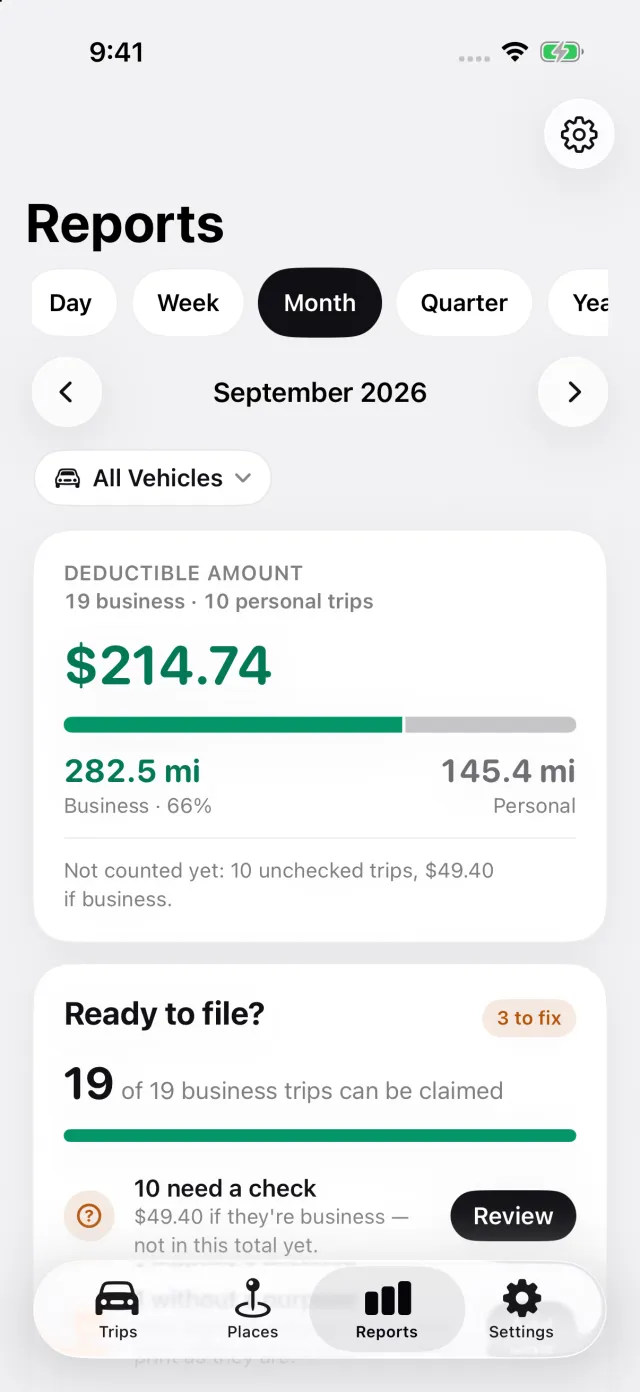
DriveHub records the mileage half of this. With location access set to Always, it records every drive in the background — and if it ever misses one, it tells you, business and personal alike. You mark each trip Business or Personal afterwards, and the Reports tab shows business miles and their share of the total.
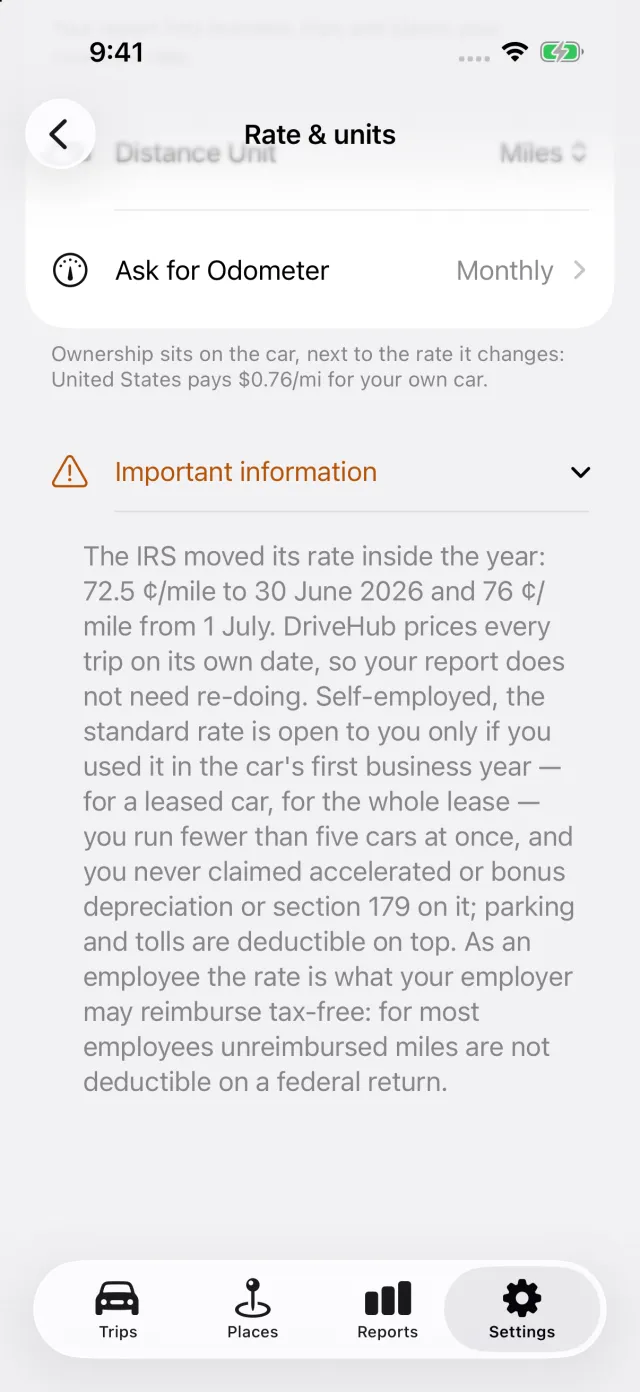
Under Settings → Rate & units, the US rate is built in. Every trip is priced at the rate in force on its own date: 72.5 cents before 1 July 2026, 76 cents from then. The same screen sets out when the standard rate is open to a self-employed driver: the first business year, the whole lease, fewer than five cars at once.
The exported report prints the date, destination, business purpose and mileage per trip, and the year's opening and closing odometer readings. If your iPhone logged driving with no matching trip, it appears as Missed drives on the Trips tab, so you can catch a gap before you file.
Where it stops: DriveHub records and classifies miles and prints the log. It does not calculate depreciation, section 179, or an actual-expenses deduction — those need your costs and your tax preparer.
- DriveHub on the App Store
- US mileage log rules
- Set up automatic tracking, and know when a drive is missed
This page states what Publication 463, Rev. Proc. 2019-46, Notice 2026-10, Announcement 2026-11, IRS Topic no. 510 and the Schedule C instructions say, and cites them so you can check. It is not tax advice. It can't account for your circumstances. Where money is involved, ask your tax preparer — and bring the log.
The full rule for United States, with the instruments it comes from: mileage log requirements in the United States.