 DriveHub
Country guide · United States · 7 min
The commute never counts. Where your working day starts decides
Commuting mileage is not deductible, and the IRS rule has no exceptions for distance, for calls made on the way or for tools in the trunk. What it does have is three situations in which the drive from home stops being a commute at all.

The short answer
Driving between your home and your regular place of work is a personal commuting expense, and it is never deductible. Publication 463, chapter 4: "You can't deduct commuting expenses no matter how far your home is from your regular place of work. You can't deduct commuting expenses even if you work during the commuting trip."
What changes the answer is not the drive but where it starts and ends. Revenue Ruling 99-7 sets out three exceptions:
- a temporary work location outside the metropolitan area where you live and normally work;
- a temporary work location at any distance, if you have a regular workplace away from home;
- any other work location, if your home is your principal place of business.
Driving from one workplace to another during the day is deductible too, up to the direct route.
If you have no regular workplace, no qualifying home office and your sites are all inside your metropolitan area, the first trip of the day and the last trip home are the commute. Only the trips between sites count.
If you are an employee, the exceptions rarely give you a deduction. Since 2018 most employees cannot deduct unreimbursed car expenses at all. What the exceptions decide for you is which miles your employer can reimburse tax-free — see using your own car for work in the US.
You drive to the same office every day: always commuting
This is the commute in its plain form, and nothing about it is deductible. Figure B in Publication 463 labels the trip between home and your regular or main job "Never deductible."
Working on the way does not help. Publication 463's example is business calls, or a business discussion with a passenger — they "don't change the trip from personal to business."
What is deductible is the driving you do from that office once you are there: to a client, to another site, back to the office.
You are sent to a temporary work location
Say you have one or more regular work locations away from home. Then a trip from home to a temporary location in the same trade or business is deductible, whatever the distance. Publication 463: "you can deduct the expenses of the daily round-trip transportation between your home and the temporary location, regardless of distance." Its example is a one-week training session at another office in the same city.
What makes a location temporary is a one-year expectation, not a matter of days or weeks. Publication 463 words it this way: "If your employment at a work location is realistically expected to last (and does in fact last) for 1 year or less, the employment is temporary unless there are facts and circumstances that would indicate otherwise."
The test looks forward, and it can change:
- Expected to last more than a year from the start: not temporary, "regardless of whether it actually lasts for more than 1 year."
- Expected to last a year or less, then extended: temporary until your expectation changes, and "It won't be treated as temporary after the date you determine it will last more than 1 year."
So a posting meant to last six months and then extended past a year does not lose the earlier months. The trips after the day you knew it would run past a year are commuting.
You have no regular place of work
Some people have no office to commute to — a contractor who goes from site to site, or a salesperson who works from the car. Here the metropolitan area where you live decides.
Publication 463: "If you have no regular place of work but ordinarily work in the metropolitan area where you live, you can deduct daily transportation costs between home and a temporary work site outside that metropolitan area." Within it, the trips from home are "nondeductible commuting expenses." A metropolitan area "includes the area within the city limits and the suburbs that are considered part of that metropolitan area."
Inside your metropolitan area, the first and last trips of the day are the commute. Publication 463's Example 3: "the location of your first business contact inside the metropolitan area is considered your office. Transportation expenses between your home and this first contact are nondeductible commuting expenses. Transportation expenses between your last business contact and your home are also nondeductible commuting expenses. While you can't deduct the costs of these trips, you can deduct the costs of going from one client or customer to another."
You work two jobs, or at two places in one day
Getting from one workplace to the other is deductible, whether or not it is the same employer. Publication 463: "If you work at two places in 1 day, whether or not for the same employer, you can deduct the expense of getting from one workplace to the other."
Two limits come with it:
- The direct route is the cap. "if for some personal reason you don't go directly from one location to the other, you can't deduct more than the amount it would have cost you to go directly from the first location to the second."
- A day off from your main job is a commute day. "Transportation expenses you have in going between home and a part-time job on a day off from your main job are commuting expenses. You can't deduct them."
If you are not sure which job is your main one, Figure B says to "Consider the time you spend at each, the activity you have at each, and the income you earn at each."
Your office is in your home
If your home office qualifies as your principal place of business, the drive from home is no longer a commute. Publication 463: "you can deduct your daily transportation costs between your home and another work location in the same trade or business." Revenue Ruling 99-7 adds that this holds "regardless of whether the other work location is regular or temporary and regardless of the distance."
Qualifying is the hard part, and it is set by IRC § 280A(c)(1). The space must be used "exclusively" and "on a regular basis" as your principal place of business. Publication 587 spells both out:
- Exclusive: "You do not meet the requirements of the exclusive use test if you use the area in question both for business and for personal purposes."
- Regular: "Incidental or occasional business use is not regular use."
A home office where you do the administration can count even if the paid work happens elsewhere. It qualifies if "You use it exclusively and regularly for administrative or management activities of your trade or business" and "You have no other fixed location where you conduct substantial administrative or management activities". Publication 587's examples include "Billing customers, clients, or patients" and "Keeping books and records."
If your home office does not qualify, Revenue Ruling 99-7 is blunt: the business activity there "is not sufficient to overcome the inherently personal nature of the residence", and the trips between it and your regular work locations are personal.
You are an employee and work from home
Two limits apply to employees. Section 280A(c)(1) says of the administrative-activities route: "In the case of an employee, the preceding sentence shall apply only if the exclusive use referred to in the preceding sentence is for the convenience of his employer."
The second limit is broader. Since 2018 an employee cannot deduct unreimbursed car expenses at all. The suspension of miscellaneous itemized deductions in IRC § 67(h) is now permanent, with narrow carve-outs such as reservists and eligible educators. For most employees the question is therefore what the employer may reimburse tax-free, and that is where the rules above still matter.
Does parking, a car ad or hauling tools make the commute deductible?
Publication 463 names several things people hope will change the answer. None of them does.
- Parking at work. "Fees you pay to park your car at your place of business are nondeductible commuting expenses. You can, however, deduct business-related parking fees when visiting a customer or client."
- An advertisement on the car. Displaying one "doesn't change the use of your car from personal use to business use."
- Hauling tools or instruments. It "doesn't make your car expenses deductible. However, you can deduct any additional costs you have for hauling tools or instruments (such as for renting a trailer you tow with your car)."
A payment from your employer does not change it either. Publication 463 calls the commute a personal expense, and says of personal expenses an employer reimburses: "your employer must report the reimbursement as wage income in box 1 of your Form W-2." It does not name the commute in that sentence. Read together, a per-mile payment for the commute is wages, not a tax-free reimbursement.
One day, three ways
Take an example day: from home to client A, 12 miles; from client A to client B, 8 miles; from client B back home, 15 miles. That is 35 miles in all, and both clients are inside your metropolitan area.
| Your situation | Home → A, 12 mi | A → B, 8 mi | B → home, 15 mi | Business miles |
|---|---|---|---|---|
| No regular office, no qualifying home office | Commute | Business | Commute | 8 |
| Regular office elsewhere; A and B are temporary sites in the same line of work | Business | Business | Business | 35 |
| Home office that is your principal place of business | Business | Business | Business | 35 |
| Employee, in any row above | As in that row | As in that row | As in that row | Same count; for most employees not deductible, only reimbursable tax-free |
In the first row, client A counts as your office for the day, so 35 − 12 − 15 = 8. Commuting or not, the same 35 miles give 8 business miles or 35, and the difference is decided by facts that no trip record shows on its own.
What your log has to show
A business mile has to be substantiated trip by trip: the date, the destination, the mileage and the business purpose. Where the commute rules are involved, the purpose is what carries the weight. "Client B, from client A" says why a trip is business; "Warehouse" does not say whether the warehouse is your regular workplace or a temporary one. What the IRS counts as adequate records covers the rest, including the year's total miles, commute included.
How DriveHub makes this easier
With location access set to Always, DriveHub records every drive in the background — and if it ever misses one, it tells you. The commute is included, and DriveHub asks you afterwards which were Business and which Personal. The commute stays in the log as personal miles, which is where the year's total comes from.
A drive from home to the warehouse at eight in the morning is the kind of trip only you can classify: Personal if the warehouse is your regular workplace, Business if it is a temporary site.
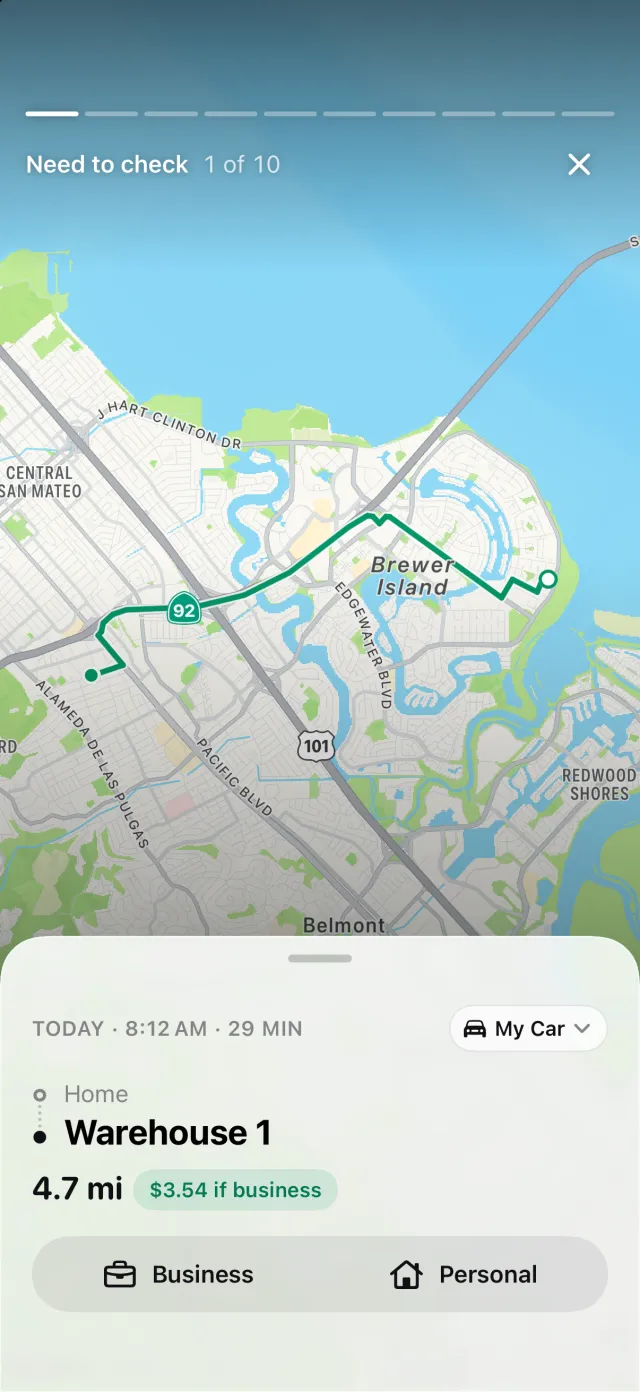
What DriveHub cannot do is decide which rule applies to you. Whether a site is temporary, whether you have a regular place of work, and whether your home office qualifies are facts about your work. DriveHub does not know them, so it does not classify a trip for you on that basis — you do.
If your iPhone logged driving with no matching trip, it appears under Missed drives on the Trips tab, so a day's middle trip does not quietly go missing. The report prints the date, the destination, your business purpose in your own words and the mileage for each trip. Ways to keep a mileage log compares this with paper and spreadsheets; if you drive a car your business owns, see a car for your business in the US.
This page states what Publication 463, Publication 587, Revenue Ruling 99-7 and the Internal Revenue Code say, and cites them so you can check. It is not tax advice. It can't account for your circumstances. Where money is involved, ask your tax preparer — and bring the log.
The full rule for United States, with the instruments it comes from: mileage log requirements in the United States.